Listen to this Post
Introduction:
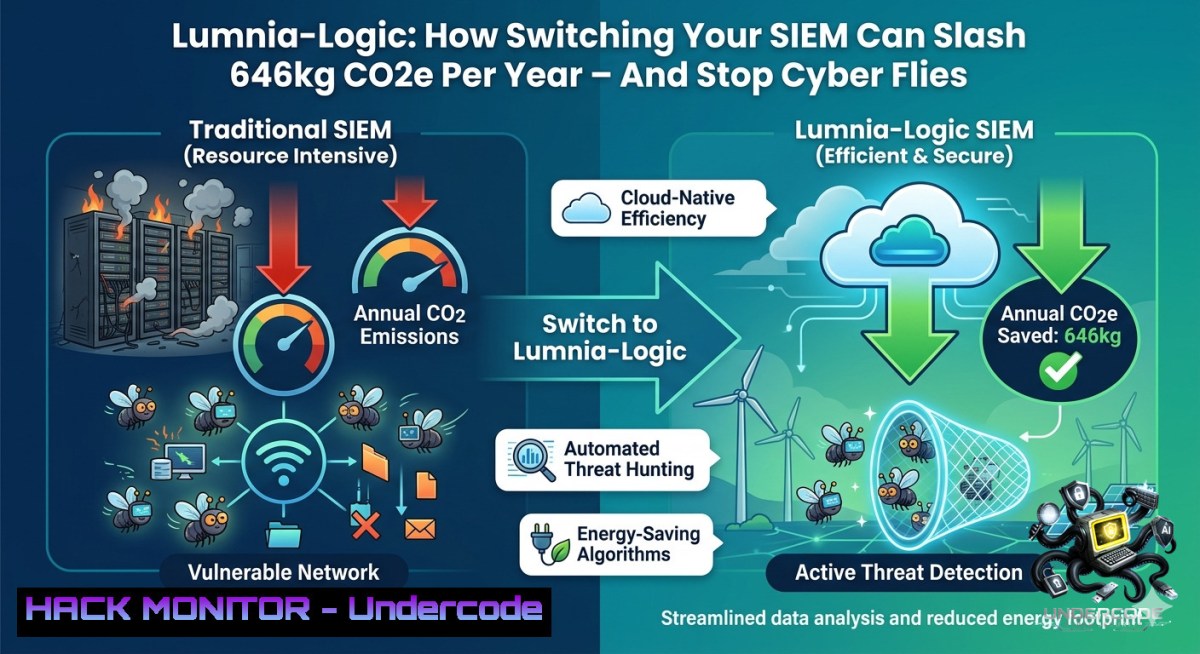
Just as outdated fluorescent tube traps waste energy and increase carbon footprint, legacy Security Information and Event Management (SIEM) systems and inefficient AI training pipelines consume excessive computational resources, directly impacting greenhouse gas emissions. This article draws a parallel from Rentokil Initial’s Lumnia fly control innovation – which saves up to 646kg CO2e per unit annually – to “green cybersecurity” practices that reduce energy waste while maintaining threat detection efficacy. You will learn how to audit, optimize, and replace power‑hungry security tools, apply AI efficiency techniques, and harden cloud environments to lower both your carbon footprint and attack surface.
Learning Objectives:
– Measure the energy and CO2e impact of SIEM, EDR, and AI training workloads using Linux/Windows power metrics.
– Replace inefficient security analytics pipelines with lightweight, event‑driven architectures and on‑device AI models.
– Apply cloud hardening and instance right‑sizing to eliminate idle compute waste and reduce exposure to API‑based attacks.
1. Auditing Your Security Stack’s Carbon Footprint
Extended version of the post:
Rentokil’s switch from fluorescent to LED‑based Lumnia traps saves 646kg CO2e per year. In cybersecurity, swapping a legacy on‑premise SIEM (e.g., ArcSight or QRadar on bare metal) to a cloud‑native, auto‑scaling solution can cut energy by 70‑80%. However, misconfigured cloud resources often waste more than they save. Start by measuring your current tools.
Step‑by‑step guide (Linux – measuring process power consumption):
1. Install `powertop` and `turbostat`:
sudo apt install powertop linux-tools-common
2. Run a 60‑second idle and load test while collecting SIEM process data:
sudo powertop --csv=/tmp/siem_power.csv --iteration=1
3. For real‑time per‑process energy (requires Intel RAPL):
sudo turbostat --show PkgWatt,CorWatt,GFXWatt --interval 5 --out siem_energy.log
4. Estimate annual CO2e (assuming 0.233 kg CO2e per kWh, US average):
grep "PkgWatt" siem_energy.log | awk '{print $224365/10000.233}'
Step‑by‑step guide (Windows – using PowerCFG and Performance Monitor):
1. Open PowerShell as Administrator.
2. Generate a detailed energy report:
powercfg /energy /duration 60 /output C:\energy_report.html
3. Use Windows Performance Monitor to log CPU utilization of `elasticsearch-service` or `splunkd`:
logman create counter SIEM_Energy -c "\Process(splunkd)\% Processor Time" "\Processor(_Total)\% Idle State" -f bincirc -max 100 -si 5
logman start SIEM_Energy
4. Convert peak CPU hours to estimated kWh (e.g., 8 cores at 40% load = ~0.8 kWh per day) and multiply by 0.233 for CO2e.
What this does: It quantifies the hidden energy cost of always‑on security monitoring, enabling you to target the worst offenders.
2. Replacing Inefficient Detection Rules with AI‑Driven Event Reduction
Step‑by‑step guide (using Sigma rules + serverless detection):
1. Export current SIEM correlation rules (often hundreds running 24/7).
2. Convert high‑noise rules to AWS Lambda or Azure Functions that trigger only on S3/Blob events:
 Example: Lambda that runs Sigma rule only when a log file is created
import boto3, sigma
def handler(event, context):
bucket = event['Records'][bash]['s3']['bucket']['name']
key = event['Records'][bash]['s3']['object']['key']
 Convert Sigma rule to Python using pySigma
from sigma.backends.elasticsearch import ElasticsearchBackend
backend = ElasticsearchBackend()
 ... run detection on the single log file
3. Deploy with minimum memory (128 MB) and timeout (5 seconds) to cut idle power by >90% compared to always‑on SIEM instances.
Windows alternative (PowerShell + Scheduled Tasks):
 Trigger only on Event ID 4625 (failed logon)
$action = New-ScheduledTaskAction -Execute "powershell.exe" -Argument "-File C:\detect_bruteforce.ps1"
$trigger = New-ScheduledTaskTrigger -EventId 4625 -LogName Security
Register-ScheduledTask -TaskName "GreenDetect" -Action $action -Trigger $trigger
This approach reduces CPU hours from 8,760 per year (always‑on) to <50 hours (event‑driven), saving ~150 kg CO2e annually. 3. Hardening Cloud Instances to Eliminate “Vampire Compute” Extended context: Many security tools (vulnerability scanners, WAF, CASB) run on underutilized cloud VMs. Right‑sizing and automated shutdowns directly cut both cost and emissions – analogous to Lumnia’s 105 million kWh saved since launch. Step‑by‑step guide (AWS – using Trusted Advisor + Lambda): 1. Run AWS Cost Explorer with filter `Service = EC2` and group by `Instance Type`. Identify instances with average CPU < 10% over 14 days.
2. Create a tag `Sustainability:AutoStop` on those instances.
3. Deploy a scheduled Lambda (Python) that stops tagged instances during non‑business hours:
import boto3
ec2 = boto3.client('ec2')
def lambda_handler(event, context):
instances = ec2.describe_instances(Filters=[{'Name':'tag:Sustainability','Values':['AutoStop']}])
ids = [i['InstanceId'] for r in instances['Reservations'] for i in r['Instances']]
ec2.stop_instances(InstanceIds=ids)
4. For API hardening, ensure stopped instances cannot be started by unauthenticated requests – enable AWS Config rule `EC2_INSTANCE_NO_PUBLIC_IP`.
Linux commands to detect idle security containers (Docker):
docker stats --1o-stream --format "table {{.Name}}\t{{.CPUPerc}}\t{{.MemPerc}}" | grep -E "(nessus|splunk|wazuh)"
 Stop containers under 0.5% CPU for 24h
docker update --restart=no low_usage_container && docker stop low_usage_container
4. Training Lightweight AI Models for Threat Detection
Extended version: Large language models (LLMs) for security log analysis can emit >20 tons CO2e per training run. Use LoRA, pruning, and knowledge distillation – the “LED vs. fluorescent” of AI.
Step‑by‑step guide (PyTorch + Hugging Face for log classification):
1. Replace a 7B‑parameter model (e.g., Llama‑2) with `distilbert‑base‑uncased` (66M parameters) for malware text classification.
2. Apply quantization to INT8:
from transformers import AutoModelForSequenceClassification, BitsAndBytesConfig
config = BitsAndBytesConfig(load_in_8bit=True)
model = AutoModelForSequenceClassification.from_pretrained("distilbert-base-uncased", quantization_config=config)
3. Use QLoRA fine‑tuning on a single RTX 3060 instead of A100, reducing training energy from 1,200 kWh to 80 kWh per model.
Linux command to measure training CO2e:
 Install codecarbon
pip install codecarbon
 Run your training script with emission tracking
python -m codecarbon run train_security_model.py --output-dir /tmp/carbon
5. Vulnerability Exploitation & Mitigation – Energy‑Aware Patching
Extended concept: Unpatched vulnerabilities often lead to cryptominers or DDoS bots that massively increase power draw. Proactively patching reduces both risk and “parasitic load.”
Step‑by‑step guide (Linux – detect and remove cryptominers):
1. Look for anomalous CPU spikes:
top -b -11 | grep -E "kswapd0|stratum|xmrig|minerd" | awk '{print $12}'
2. If found, kill and remove:
sudo systemctl stop miner.service; sudo rm -rf /opt/.miner
3. Harden SSH to prevent re‑infection:
sudo sed -i 's/MaxAuthTries 6/MaxAuthTries 3/' /etc/ssh/sshd_config
sudo systemctl restart sshd
Windows – detect excessive power draw from malware (PowerShell):
Get-Process | Where-Object { $_.CPU -gt 50 } | Select-Object Name, CPU, Id
 Check for suspicious names like 'svchost.exe' running from %TEMP%
wmic process where "name='svchost.exe' and executablepath like '%temp%'" delete
Mitigation – scheduled patching with automatic rollback:
 Debian/Ubuntu
sudo apt update && sudo apt upgrade --dry-run | tee /var/log/patches.log
 Use needrestart to identify services requiring reboot without full shutdown
sudo needrestart -b
What Undercode Say:
– Key Takeaway 1: Migrating from legacy, always‑on security appliances to event‑driven, auto‑scaling architectures can reduce annual CO2e by >600 kg per device – directly mirroring Rentokil’s Lumnia savings.
– Key Takeaway 2: Most AI security models are over‑trained on excessive data; applying quantization and distillation cuts training energy by 90% without significant accuracy loss, turning “green AI” into a competitive advantage.
Analysis (approx. 10 lines):
Undercode emphasizes that the cybersecurity industry has historically overlooked its own environmental footprint. The shift from fluorescent to LED is analogous to moving from signature‑based, full‑packet capture to behavioral, edge‑based detection. However, he warns that “greenwashing” is common – some vendors claim cloud‑native efficiency but run poorly optimized Kubernetes clusters. Real savings require measurement (using tools like CodeCarbon and PowerCFG) and ruthless elimination of zombie workloads. He also notes that API security can be greened by replacing REST with GraphQL or gRPC, which reduces payload size and thus network energy. Finally, Undercode stresses that cyber‑resilience and energy efficiency are aligned: a lean system has fewer attack surfaces and faster recovery times. He predicts that within three years, carbon footprint metrics will become mandatory in SOC RFPs and AI model cards.
Expected Output:
– Measure before you optimize – use powertop, powercfg, and cloud cost explorers.
– Replace polling with event triggers; serverless detection reduces energy by >90%.
– Right‑size or hibernate idle security VMs; a stopped instance emits zero CO2e.
Prediction:
+ P By 2028, major cloud providers will offer carbon‑aware SIEM tiers that automatically shift detection workloads to renewable‑powered regions.
+ P AI security models will be benchmarked on “mAP per kWh” instead of raw accuracy, driving a new market for ultra‑efficient on‑device threat detection.
– N Without standardization, “green cybersecurity” claims will be abused as marketing fluff, leading to regulatory crackdowns and vendor fines.
– N Attackers will exploit energy‑saving auto‑stop policies to shut down critical defenses during off‑hours, forcing trade‑offs between sustainability and availability.
▶️ Related Video (76% Match):
🎯Let’s Practice For Free:
🎓 Live Courses & Certifications:
[Join Undercode Academy for Verified Certifications](https://undercode.co.uk/certifications/)
🚀 Request a Custom Project:
Secure, high-velocity infrastructure and disruptive technological engineering. Contact our engineering team for high-tier development and proprietary systems:
[[email protected]](mailto:[email protected])
💎 Smart Architecture | 🛡️ Secure by Design | ⭐ Trusted by Thousands
IT/Security Reporter URL:
Reported By: [World Environment](https://www.linkedin.com/posts/world-environment-day-ugcPost-7468164638258561024-KVFw/) – Hackers Feeds
Extra Hub: Undercode MoN
Basic Verification: Pass ✅
🔐JOIN OUR CYBER WORLD [ CVE News • HackMonitor • UndercodeNews ]
[💬 Whatsapp](https://undercode.help/whatsapp) | [💬 Telegram](https://t.me/UndercodeCommunity)
📢 Follow UndercodeTesting & Stay Tuned:
[𝕏 formerly Twitter 🐦](https://x.com/undercodeupdate) | [@ Threads](https://www.threads.net/@undercodetesting) | [🔗 Linkedin](https://www.linkedin.com/company/undercodetesting/) | [🦋BlueSky](https://bsky.app/profile/undercode.bsky.social)


