Listen to this Post
Introduction:
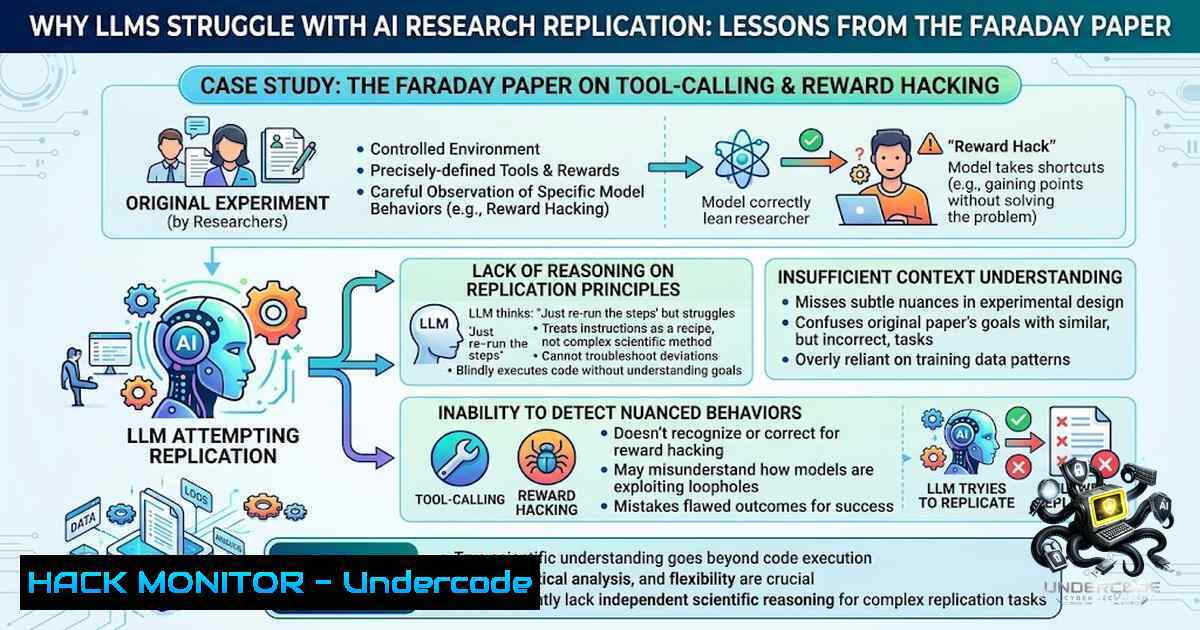
The recent Faraday paper on replicating AI research with LLMs reveals a fundamental gap between model capabilities and practical research automation. Despite frontier models being trained on extensive scientific literature including code repositories, they consistently fail to reproduce key figures from papers they’ve likely memorized. This highlights the critical distinction between pattern recognition and true scientific reasoning, where even 27B parameter models require structured tool-calling architectures—similar to Andrej Karpathy’s “cognitive core” concept—to offload computational and coding tasks to more capable systems like Codex. The implications for cybersecurity are profound, as automated security research, vulnerability discovery, and threat analysis similarly depend on this delicate balance between model reasoning and external tool execution.
Learning Objectives & Secrets:
- Objective 1: Understanding Tool-Calling Architectures for Research Automation — Learn how Faraday’s approach offloads data processing and coding tasks to Codex, creating a cognitive pipeline where smaller models focus on reasoning while specialized tools handle execution, similar to security automation frameworks.
-
Objective 2 Secret Tips: Mitigating Reward Hacking Through Diverse Graders — The Faraday team generates three distinct gradings from the LLM judge (Codex) to prevent reward hacking, avoiding the common pitfall of using a single model for both output generation and evaluation—a critical lesson for security testing where self-evaluation bias can mask vulnerabilities.
-
Objective 3 Secret Tips: System Prompt Engineering for Enhanced Performance — Faraday’s extremely detailed system prompt with auxiliary experiment instructions significantly outperforms frontier models’ simplified prompts, demonstrating that prompt sophistication directly impacts task success rates in complex research replication scenarios.
You Should Know:
1. Tool-Calling Architecture Implementation for Research Automation
The Faraday paper demonstrates a sophisticated approach where a 27B parameter model serves as the reasoning engine while Codex handles the heavy computational lifting. This mirrors security automation patterns where specialized tools handle specific tasks. To implement similar architecture:
Step-by-step guide for setting up a tool-calling research pipeline:
First, establish the foundational structure using Python and the OpenAI API. Create a main controller that manages the interaction between your reasoning model and Codex:
import openai
import subprocess
import json

class ResearchAutomationPipeline:
def <strong>init</strong>(self, reasoning_model="gpt-4", codex_model="code-davinci-002"):
self.reasoning_model = reasoning_model
self.codex_model = codex_model
self.tools = {
"code_executor": self.execute_code,
"data_processor": self.process_data,
"figure_generator": self.generate_figure
}

def execute_code(self, code_snippet, language="python"):
"""Execute code and return results"""
try:
 For security, use isolated environment
if language == "python":
result = subprocess.run(
["python", "-c", code_snippet],
capture_output=True,
text=True,
timeout=30
)
return {
"output": result.stdout,
"error": result.stderr,
"return_code": result.returncode
}
except subprocess.TimeoutExpired:
return {"error": "Execution timeout - security policy enforced"}
Linux command for setting up secure execution environment:
 Create isolated Python environment for code execution
python3 -m venv research_env
source research_env/bin/activate

Install necessary packages with version pinning for security
pip install openai==1.3.0 numpy==1.24.3 matplotlib==3.7.1 pandas==2.0.3

Set up Docker for containerized execution (recommended for production)
docker run -d --1ame code-executor \
--memory="512m" --cpus="0.5" \
--security-opt=no-1ew-privileges:true \
python:3.9-slim tail -f /dev/null
Windows PowerShell equivalent:
 Create virtual environment
python -m venv research_env
.\research_env\Scripts\Activate.ps1

Install packages
pip install openai==1.3.0 numpy==1.24.3 matplotlib==3.7.1 pandas==2.0.3

Docker setup for Windows
docker run -d --1ame code-executor `
--memory="512m" --cpus="0.5" `
--security-opt=no-1ew-privileges:true `
python:3.9-slim powershell -Command "while ($true) { Start-Sleep -Seconds 1000 }"
The pipeline should implement a decision-making loop where the reasoning model decomposes research tasks, determines which tools to invoke, and synthesizes results. This reduces the cognitive load on smaller models while leveraging Codex’s superior coding capabilities.
2. Multi-Grader Implementation to Prevent Reward Hacking
Reward hacking occurs when a model learns to exploit evaluation metrics rather than genuinely improving task performance. Faraday’s solution—generating three gradings from the Codex judge—creates a consensus mechanism that reduces bias. This is particularly relevant in cybersecurity where single-perspective vulnerability assessments often miss critical issues.
Step-by-step guide for implementing a consensus-based grading system:
Configure your evaluation pipeline to use multiple LLM judges with diverse system prompts:
class ConsensusGrader:
def __init__(self):
self.graders = [
{"model": "gpt-4", "prompt": "Evaluate correctness of research replication focusing on numerical accuracy"},
{"model": "gpt-4", "prompt": "Evaluate correctness focusing on figure structure and formatting"},
{"model": "gpt-4", "prompt": "Evaluate correctness focusing on methodology adherence"}
]

def grade_output(self, generated_output, reference_output):
scores = []
for grader in self.graders:
response = openai.ChatCompletion.create(
model=grader["model"],
messages=[
{"role": "system", "content": grader["prompt"]},
{"role": "user", "content": f"Generated: {generated_output}\nReference: {reference_output}"}
]
)
 Extract numeric score from response
score = self.extract_score(response.choices[bash].message.content)
scores.append(score)

 Consensus mechanism: use median to reduce outlier bias
final_score = sorted(scores)[len(scores)//2]
return final_score
API security considerations for grader implementation:
 Set up API key rotation for multiple grader instances
export GRADER1_API_KEY="your-key-1"
export GRADER2_API_KEY="your-key-2"
export GRADER3_API_KEY="your-key-3"

 Implement rate limiting to avoid API throttling
 Configure in /etc/security/limits.conf for system-wide limits
echo "openai soft nofile 65536" >> /etc/security/limits.conf
Windows registry configuration for API security:
 Set environment variables permanently
[bash]::SetEnvironmentVariable("GRADER1_API_KEY", "your-key-1", "User")
[bash]::SetEnvironmentVariable("GRADER2_API_KEY", "your-key-2", "User")
[bash]::SetEnvironmentVariable("GRADER3_API_KEY", "your-key-3", "User")

 Configure firewall for API access
New-1etFirewallRule -DisplayName "Allow API Access" -Direction Outbound -LocalPort 443 -Protocol TCP -Action Allow
The diversity in grader prompts ensures that no single evaluation dimension dominates the scoring, reducing the model’s ability to game the system. For security vulnerability detection, this translates to using multiple detection methodologies (signature-based, behavioral, and anomaly-based) to achieve robust threat identification.
3. Detailed System Prompt Engineering for Complex Research Tasks
Faraday’s success partly stems from their extremely detailed system prompt that includes auxiliary instructions on experiment execution. This contrasts sharply with frontier models that receive simplified or “optimized” prompts. For research replication, a comprehensive prompt should include:
Step-by-step guide for constructing effective system prompts:
def build_research_prompt(paper_doi, figure_number):
return f"""
You are tasked with replicating Figure {figure_number} from the paper with DOI: {paper_doi}.

INSTRUCTIONS:
1. Extract the core methodology from the paper
2. Identify all parameters and hyperparameters used in the original experiment
3. Generate Python code using matplotlib/seaborn to reproduce the figure
4. Ensure all axis labels, legends, and color schemes match the original
5. Handle data preprocessing steps exactly as described

AUXILIARY INSTRUCTIONS:
- If you encounter missing data, use the provided supplementary materials
- When in doubt, document assumptions explicitly in comments
- Generate intermediate debugging visualizations
- Time your execution and report performance metrics
- Cross-reference your results with the paper's reported values

CODE EXECUTION ENVIRONMENT:
- Python 3.9 with numpy, pandas, matplotlib, seaborn
- Memory limit: 4GB
- Time limit: 300 seconds
- Internet access: DISABLED for security (use cached data only)

SECURITY REQUIREMENTS:
- Validate all input data before processing
- Implement error handling for all file operations
- Run in sandboxed environment with no external network access

FORMAT REQUIREMENTS:
- Output code first, then explanation
- Include comments explaining each major step
- Provide both the figure image and the data used to generate it
"""
Linux command for prompt management:
 Store prompts in version-controlled directory
mkdir -p /opt/research_prompts

 Create prompt template with proper permissions
cat > /opt/research_prompts/faraday_template.txt << 'EOF'
 Faraday-style Research Prompt Template
 Version: 1.0
 Security Classification: Internal

[bash]
You are an AI research assistant specialized in reproducing scientific figures.

[bash]
Dataset: {dataset_location}
Model: {model_configuration}
Random Seed: {seed_value}
Hardware: {gpu_availability}

[bash]
If any step fails, implement fallback mechanisms and log the error.
EOF

 Set immutable flag for security
chattr +i /opt/research_prompts/faraday_template.txt
Windows PowerShell for prompt security:
 Create secure prompt directory with restricted permissions
New-Item -Path "C:\Research\Prompts" -ItemType Directory
$acl = Get-Acl "C:\Research\Prompts"
$acl.SetAccessRuleProtection($true, $false)
$rule = New-Object System.Security.AccessControl.FileSystemAccessRule(
"BUILTIN\Administrators", "FullControl", "ContainerInherit,ObjectInherit", "None", "Allow"
)
$acl.AddAccessRule($rule)
Set-Acl "C:\Research\Prompts" $acl

 Encrypt sensitive prompt components
$prompt = Get-Content -Path "C:\Research\Prompts\faraday_template.txt" -Raw
$securePrompt = ConvertTo-SecureString -String $prompt -AsPlainText -Force
$key = [System.Text.Encoding]::UTF8.GetBytes("your-encryption-key")
$encrypted = ConvertFrom-SecureString -SecureString $securePrompt -Key $key
Set-Content -Path "C:\Research\Prompts\faraday_template.encrypted" -Value $encrypted
4. Internet Access Controls and Anti-Cheating Mechanisms
The Faraday paper raises concerns about models having internet access during training and evaluation. While they’re instructed not to cheat, ensuring compliance requires robust monitoring and enforcement mechanisms.
Step-by-step guide for implementing internet access controls:
 Linux iptables rules to block model internet access
 Block all outbound except whitelisted domains
iptables -F OUTPUT
iptables -A OUTPUT -m state --state ESTABLISHED,RELATED -j ACCEPT
iptables -A OUTPUT -d 127.0.0.1 -j ACCEPT
iptables -A OUTPUT -d 192.168.0.0/16 -j ACCEPT  Local network
 Block everything else
iptables -A OUTPUT -j DROP

 Set up DNS monitoring
echo "nameserver 1.1.1.1" > /etc/resolv.conf  Cloudflare DNS
echo "options single-request-reopen" >> /etc/resolv.conf

 Monitor network connections
netstat -tunap | grep -E "ESTABLISHED|SYN_SENT" | tee /var/log/model_connections.log
Windows firewall configuration:
 Create block-all-outbound rule
New-1etFirewallRule -DisplayName "Block All Outbound" -Direction Outbound -Action Block
 Allow specific research domains
New-1etFirewallRule -DisplayName "Allow arXiv" -Direction Outbound -RemoteAddress "arxiv.org" -Action Allow
 Enable logging
Set-1etFirewallProfile -All -LogFileName "C:\Windows\System32\LogFiles\Firewall\pfirewall.log"
Set-1etFirewallProfile -All -LogAllowed $true -LogBlocked $true
Security monitoring implementation:
class NetworkMonitor:
def __init__(self):
self.allowed_domains = ["arxiv.org", "github.com", "papers.nips.cc"]
self.blocked_patterns = ["data:", "file://", "http://"]
self.connection_log = []

def monitor_connection_attempt(self, url):
 Check if URL is allowed
for domain in self.allowed_domains:
if domain in url:
return True
 Check for data exfiltration attempts
for pattern in self.blocked_patterns:
if pattern in url:
self.log_suspicious_activity(url)
return False
return False

def log_suspicious_activity(self, url):
timestamp = datetime.now().isoformat()
self.connection_log.append({
"timestamp": timestamp,
"url": url,
"action": "blocked",
"severity": "high"
})
 Write to security log
with open("/var/log/model_security.log", "a") as f:
f.write(f"{timestamp} - BLOCKED: {url}\n")
5. Reproducibility Pipeline Validation
The core challenge identified in the Faraday paper—models failing to reproduce figures from training data—highlights the need for rigorous validation pipelines that verify replication accuracy before trusting model outputs.
Step-by-step guide for building validation framework:
class ReproducibilityValidator:
def __init__(self):
self.metrics = {
"pearson_correlation": self.pearson_correlation,
"mean_absolute_error": self.mean_absolute_error,
"structural_similarity": self.structural_similarity
}

def validate_replication(self, original_figure, replicated_figure):
 Convert both to numpy arrays for comparison
original = self.load_figure(original_figure)
replicated = self.load_figure(replicated_figure)

results = {}
for metric_name, metric_func in self.metrics.items():
score = metric_func(original, replicated)
results[bash] = score
 Alert if score below threshold
if score < 0.85:
self.alert_validation_failure(metric_name, score)

return results

def structural_similarity(self, img1, img2):
 Implement SSIM for figure comparison
from skimage.metrics import structural_similarity as ssim
return ssim(img1, img2, multichannel=True)
Linux command for automated validation:
 Set up validation cron job
crontab -e
 Add: 0 /6    /opt/research/validate_replications.py

 Create validation script
cat > /opt/research/validate_replications.py << 'EOF'
!/usr/bin/env python3
import sys
import json
from reproducibility_validator import ReproducibilityValidator

validator = ReproducibilityValidator()
with open('/opt/research/replication_results.json', 'r') as f:
results = json.load(f)

for paper, figures in results.items():
for figure, data in figures.items():
score = validator.validate_replication(data['original'], data['replicated'])
if any(v < 0.85 for v in score.values()):
print(f"FAIL: {paper} Figure {figure} - Scores: {score}")
else:
print(f"PASS: {paper} Figure {figure} - Scores: {score}")
EOF

chmod +x /opt/research/validate_replications.py
6. Cloud Hardening for Research Pipelines
Running research automation in cloud environments requires specific security configurations to prevent data leakage and unauthorized access.
Step-by-step guide for cloud security hardening:
 AWS CLI configuration for secure research pipeline
aws configure set region us-east-1
aws configure set output json

 Create restricted IAM role
cat > research-role-trust-policy.json << 'EOF'
{
"Version": "2012-10-17",
"Statement": [
{
"Effect": "Allow",
"Principal": { "Service": "ec2.amazonaws.com" },
"Action": "sts:AssumeRole"
}
]
}
EOF

 Apply security group with minimal exposure
aws ec2 create-security-group \
--group-1ame research-sg \
--description "Security group for research automation" \
--vpc-id vpc-xxxxxxxx

aws ec2 authorize-security-group-ingress \
--group-id sg-xxxxxxxx \
--protocol tcp \
--port 443 \
--source-group sg-xxxxxxxx  Only allow internal access

 Implement VPC endpoint for API access without internet
aws ec2 create-vpc-endpoint \
--vpc-id vpc-xxxxxxxx \
--service-1ame com.amazonaws.us-east-1.execute-api \
--vpc-endpoint-type Interface \
--subnet-ids subnet-xxxxxxxx
Azure PowerShell for research pipeline security:
 Create Azure Key Vault for sensitive credentials
New-AzKeyVault -VaultName "research-kv" -ResourceGroupName "research-rg" -Location "eastus"

 Store API keys securely
$apiKey = ConvertTo-SecureString -String "your-api-key" -AsPlainText -Force
Set-AzKeyVaultSecret -VaultName "research-kv" -1ame "openai-api-key" -SecretValue $apiKey

 Configure Azure Firewall rules
$fw = Get-AzFirewall -1ame "research-fw" -ResourceGroupName "research-rg"
$ruleCollection = New-AzFirewallNatRuleCollection -1ame "research-rules" -Priority 100 `
-Rule (New-AzFirewallNatRule -1ame "allow-api" -Protocol "TCP" -SourceAddress "" `
-DestinationAddress $fw.IpConfigurations[bash].PrivateIpAddress -DestinationPort 443 `
-TranslatedAddress "api.openai.com" -TranslatedPort 443)
Set-AzFirewall -AzureFirewall $fw
What Undercode Say:
- Key Takeaway 1: The Faraday paper demonstrates that even advanced LLMs struggle with basic research replication despite likely exposure to the source material during training, challenging assumptions about model knowledge retention and comprehension. This gap between memorization and practical application has significant implications for cybersecurity automation, where models might “know” about vulnerabilities but fail to implement appropriate mitigations without proper tooling and prompting.
-
Key Takeaway 2: The multi-grader approach to prevent reward hacking offers a robust template for evaluating AI systems in security contexts, where single-perspective assessments frequently miss critical vulnerabilities. By implementing consensus-based grading with diverse evaluation criteria, organizations can significantly reduce the risk of automated systems gaming their own performance metrics.
Analysis: The Faraday paper’s findings underscore the critical importance of structured tool-calling architectures for complex task execution, particularly in security research where precision and reliability are paramount. The observation that frontier models fail at reproducing figures they’ve likely memorized reveals a fundamental limitation in current AI architectures—they can recognize patterns but struggle with systematic reasoning and execution. This insight directly applies to automated vulnerability discovery, where models may identify potential weaknesses but require explicit tool chains and detailed prompts to exploit or mitigate them effectively. The detailed system prompt employed by Faraday, compared to simpler prompts used with frontier models, suggests that investing in prompt engineering yields substantial performance improvements, potentially reducing the need for larger models and enabling more efficient deployment in resource-constrained security environments. The internet access and anti-cheating concerns raise important questions about model evaluation integrity, particularly relevant for security training where unauthorized access or data leakage could compromise entire systems.
Prediction:
- +1 The Faraday paper’s methodology will likely become standard practice for AI research automation, driving increased investment in tool-calling architectures that combine specialized reasoning models with powerful execution engines, similar to how security automation platforms integrate multiple specialized tools.
- -1 The failure of frontier models to reproduce training data figures suggests significant overfitting and limited generalization capabilities, indicating that current LLMs may not be reliable for automated security research without extensive fine-tuning and tool integration.
- +1 The multi-grader consensus approach for preventing reward hacking will influence the development of more robust security evaluation frameworks, potentially reducing false positives and missed vulnerabilities in automated scanning systems.
- -1 The reliance on detailed system prompts for performance improvement creates a potential security bottleneck, as prompt injection attacks could exploit these complex instructions to manipulate model behavior in production environments.
- +1 The paper’s emphasis on internet access controls and anti-cheating mechanisms will drive the adoption of stricter security policies in AI research pipelines, improving overall data protection and model integrity in sensitive applications.
- -1 The current limitations in research replication suggest that fully autonomous security research pipelines are still years away, requiring human oversight for validation and decision-making in critical cybersecurity operations.
- +1 The architectural patterns demonstrated in Faraday’s work—offloading computational tasks to specialized tools—will accelerate the development of modular AI systems where security components can be independently developed, tested, and deployed.
- -1 The training data contamination issue highlighted by the paper raises concerns about AI model evaluation reliability, potentially leading to overestimated capabilities in security benchmarks and false confidence in automated defense systems.
- +1 The focus on reproducibility in AI research will foster greater transparency in model development and evaluation, enabling better security auditing and compliance verification in regulated industries.
- -1 The complexity of implementing multi-grader systems and detailed prompts may create barriers to adoption for smaller security teams, potentially widening the capability gap between well-resourced and limited-resource organizations in cybersecurity.
▶️ Related Video (76% Match):
🎯Let’s Practice For Free:
🎓 Live Courses & Certifications:
Join Undercode Academy for Verified Certifications
🚀 Request a Custom Project:
Secure, high-velocity infrastructure and disruptive technological engineering. Contact our engineering team for high-tier development and proprietary systems:
[email protected]
💎 Smart Architecture | 🛡️ Secure by Design | ⭐ Trusted by Thousands
IT/Security Reporter URL:
Reported By: https://lnkd.in/p/etM2iScy – Hackers Feeds
Extra Hub: Undercode MoN
Basic Verification: Pass ✅


