Listen to this Post
Introduction
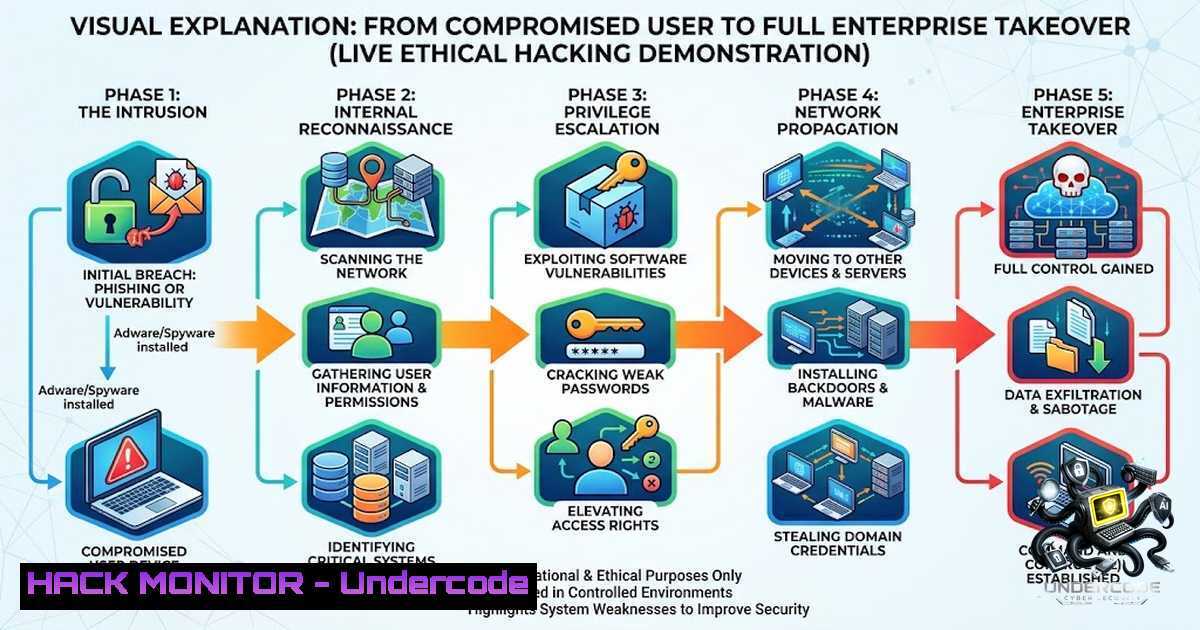
The construction industry is undergoing a rapid digital transformation, integrating AI-driven resource mapping, Building Information Modeling (BIM), and collaborative digital platforms into everyday workflows. Yet with this digitization comes an expanding attack surface—and the uncomfortable reality that a single compromised user account can serve as the entry point for a full-scale enterprise breach. At the Molio Konferencen on November 17, 2026, ethical hacker Emil “Dota” Bak—a member of Kalmarunionen, the world’s top-ranked competitive hacking team—will demonstrate live how an attacker moves laterally through systems from an initial foothold until the entire organization is compromised.
Learning Objectives
- Understand the attack chain: from initial user compromise to full enterprise takeover
- Learn practical reconnaissance and privilege escalation techniques used by ethical hackers
- Identify security gaps in digital construction workflows and implement defensive countermeasures
You Should Know
- Understanding the Attack Surface in Digitized Construction Environments
Modern construction firms rely on a complex ecosystem of digital tools: BIM software, cloud-based project management platforms, resource mapping systems, and collaborative documentation tools. Each of these represents a potential entry point for attackers. The live demonstration at Molio Konferencen will show how an ethical hacker approaches this environment. Kalmarunionen, the team behind the demonstration, has secured the 1 position on the global CTFtime.org ranking, making their insight particularly valuable for understanding real-world attack methodologies.
What This Means for Defenders: The demonstration underscores that cybersecurity is not just an IT concern—it is a business continuity imperative. A breach can halt construction projects, expose sensitive client data, and result in multimillion-kroner losses.
- The Attack Chain: From Initial Foothold to Full Compromise
Ethical hackers follow a structured methodology. Understanding this chain is the first step toward building effective defenses.
Step 1: Reconnaissance – The attacker gathers information about the target organization through open-source intelligence (OSINT), scanning for exposed services, employee social media profiles, and publicly available documentation.
Step 2: Initial Access – This often involves phishing, credential stuffing, or exploiting a vulnerable web application. In the construction context, this could be a BIM collaboration portal or a project management dashboard with weak authentication.
Step 3: Persistence – Once inside, the attacker establishes backdoors to maintain access even if the initial vector is discovered.
Step 4: Lateral Movement – Using tools like Mimikatz (for credential dumping) or PsExec (for remote execution), the attacker moves from the compromised user’s machine to other systems on the network.
Step 5: Privilege Escalation – The attacker exploits misconfigurations or unpatched vulnerabilities to gain administrative rights.
Step 6: Data Exfiltration or Ransomware Deployment – The final stage, where the attacker achieves their objective.
Linux Command Example – Network Reconnaissance:
 Discover live hosts on the local network
nmap -sn 192.168.1.0/24

Scan for open ports and services
nmap -sV -p- 192.168.1.100

Enumerate SMB shares (common in Windows environments)
enum4linux -a 192.168.1.100
Windows Command Example – Lateral Movement Detection:
 Check for suspicious scheduled tasks
schtasks /query /fo LIST /v

Review recent PowerShell history (often used by attackers)
Get-Content (Get-PSReadlineOption).HistorySavePath

List established network connections
netstat -ano | findstr ESTABLISHED
3. Privilege Escalation Techniques: What Attackers Look For
Privilege escalation is often the most critical phase of an attack. Ethical hackers look for:
- Unpatched vulnerabilities (e.g., PrintNightmare, ZeroLogon)
- Misconfigured services running with SYSTEM privileges
- Plaintext credentials in configuration files, scripts, or registry
- Weak permissions on critical folders or scheduled tasks
Linux Privilege Escalation Checklist:
 Check sudo permissions
sudo -l

Find files with SUID bit set
find / -perm -4000 -type f 2>/dev/null

Check for writable cron jobs
ls -la /etc/cron

Search for credentials in files
grep -r "password" /var/www/ 2>/dev/null
Windows Privilege Escalation Checklist:
 Check current user privileges
whoami /priv

List all local users
net user

Find unquoted service paths (a common escalation vector)
wmic service get name,displayname,pathname,startmode | findstr /i "auto" | findstr /i /v "C:\Windows\"

Check for AlwaysInstallElevated registry key
reg query HKCU\SOFTWARE\Policies\Microsoft\Windows\Installer /v AlwaysInstallElevated
reg query HKLM\SOFTWARE\Policies\Microsoft\Windows\Installer /v AlwaysInstallElevated
4. Defensive Measures: Hardening Against Live Attacks
The Molio Konferencen demonstration is not just about showing vulnerabilities—it is about teaching defenders how to respond. Key defensive strategies include:
Identity and Access Management (IAM):
- Implement multi-factor authentication (MFA) for all users
- Enforce the principle of least privilege
- Regularly audit user accounts and remove inactive ones
Network Segmentation:
- Isolate critical systems (e.g., BIM servers, project databases) from general user networks
- Use VLANs and firewall rules to limit lateral movement
Endpoint Detection and Response (EDR):
- Deploy EDR solutions that can detect and block suspicious behavior
- Enable PowerShell logging and script block logging
Incident Response Planning:
- Develop and regularly test an incident response plan
- Conduct tabletop exercises simulating ransomware or data breach scenarios
Cloud Hardening (for construction firms using cloud platforms):
 AWS: Enable CloudTrail for all regions
aws cloudtrail create-trail --1ame "global-trail" --s3-bucket-1ame "your-bucket" --is-multi-region-trail

Azure: Enable diagnostic settings for all subscriptions
az monitor diagnostic-settings create --1ame "security-logs" --resource "/subscriptions/{sub-id}" --logs "[{category: 'Audit', enabled: true}]"

GCP: Enable Audit Logs
gcloud services enable cloudaudit.googleapis.com
- AI and Automation in Cybersecurity: The Double-Edged Sword
While AI is transforming construction through resource mapping and circular economy initiatives, it also presents new security challenges. Attackers are increasingly using AI to automate phishing campaigns, bypass CAPTCHAs, and even generate malicious code.
AI-Supported Scripting and Programming (one of the conference topics) can be used defensively to:
– Automate vulnerability scanning
– Analyze logs for anomalous patterns
– Generate security reports and dashboards
However, the same tools can be weaponized. Organizations must ensure that AI systems themselves are secured—training data must be protected, models must be monitored for poisoning, and API endpoints must be properly authenticated.
Example: Using AI for Log Analysis (Python with OpenAI API):
import openai

def analyze_log(log_entry):
response = openai.ChatCompletion.create(
model="gpt-4",
messages=[
{"role": "system", "content": "You are a security analyst. Identify if this log entry indicates a potential attack."},
{"role": "user", "content": log_entry}
]
)
return response.choices[bash].message.content
6. API Security in Construction Tech Ecosystems
Modern construction workflows rely heavily on APIs—between BIM software, project management tools, and resource databases. Securing these APIs is critical.
Common API Vulnerabilities:
- Broken object-level authorization (BOLA)
- Excessive data exposure
- Lack of rate limiting (leading to brute force)
- Improper logging and monitoring
API Security Checklist:
 Test for rate limiting
for i in {1..100}; do curl -X GET "https://api.example.com/projects" -H "Authorization: Bearer $TOKEN"; done

Check for excessive data exposure
curl -X GET "https://api.example.com/users/1" -H "Authorization: Bearer $TOKEN"

Validate JWT tokens
jwt decode --secret $SECRET $TOKEN
Recommendation: Implement OAuth 2.0 with PKCE for authentication, use API gateways for centralized security policies, and regularly conduct penetration testing on all APIs.
What Undercode Say
- Key Takeaway 1: The construction industry is no longer immune to cyberattacks. The live demonstration at Molio Konferencen makes this tangible and urgent. Organizations must move beyond “it won’t happen to us” thinking and adopt proactive security measures.
-
Key Takeaway 2: Security is a shared responsibility across the entire value chain—from software vendors to project managers to end users. The conference brings together stakeholders from across the industry, reflecting the need for collective action on digital security.
Analysis: The Molio Konferencen represents a critical inflection point for the construction sector. As the industry embraces AI, BIM, and digital collaboration tools, the attack surface expands exponentially. The live hacking demonstration by Emil “Dota” Bak—a member of the world’s 1 CTF team—provides an unparalleled opportunity to see real attack techniques in action. This is not theoretical; it is a wake-up call. Organizations that fail to invest in cybersecurity training, vulnerability assessments, and incident response planning will find themselves increasingly vulnerable. Conversely, those that embrace this moment—learning from ethical hackers, implementing robust IAM, and hardening their cloud and API environments—will build resilience and trust. The integration of AI into both offensive and defensive security strategies will only accelerate; the winners will be those who understand and harness this duality.
Prediction
- +1 The construction industry will see a surge in demand for cybersecurity professionals with domain-specific knowledge of BIM, IoT sensors, and construction management software, creating new career pathways and upskilling opportunities.
-
+1 The live demonstration at Molio Konferencen will catalyze a wave of security awareness initiatives across Nordic construction firms, leading to better-prepared organizations and reduced incident response times.
-
-1 Small and medium-sized construction firms without dedicated IT security resources will remain disproportionately vulnerable, potentially becoming prime targets for ransomware gangs seeking easy payouts.
-
+1 AI-driven security tools will increasingly be adopted to automate threat detection and response, offsetting the skills shortage and enabling 24/7 monitoring at scale.
-
-1 The convergence of IT and OT (operational technology) in construction—smart tools, drones, robotic equipment—will introduce new, poorly understood attack vectors that ethical hackers will continue to expose.
For more information on the Molio Konferencen and to register, visit: https://molio.dk/kurser/konferencer/molio-konferencen/
▶️ Related Video (82% Match):
🎯Let’s Practice For Free:
🎓 Live Courses & Certifications:
Join Undercode Academy for Verified Certifications
🚀 Request a Custom Project:
Secure, high-velocity infrastructure and disruptive technological engineering. Contact our engineering team for high-tier development and proprietary systems:
[email protected]
💎 Smart Architecture | 🛡️ Secure by Design | ⭐ Trusted by Thousands
IT/Security Reporter URL:
Reported By: https://lnkd.in/p/eFapm9RC – Hackers Feeds
Extra Hub: Undercode MoN
Basic Verification: Pass ✅


