
Listen to this Post
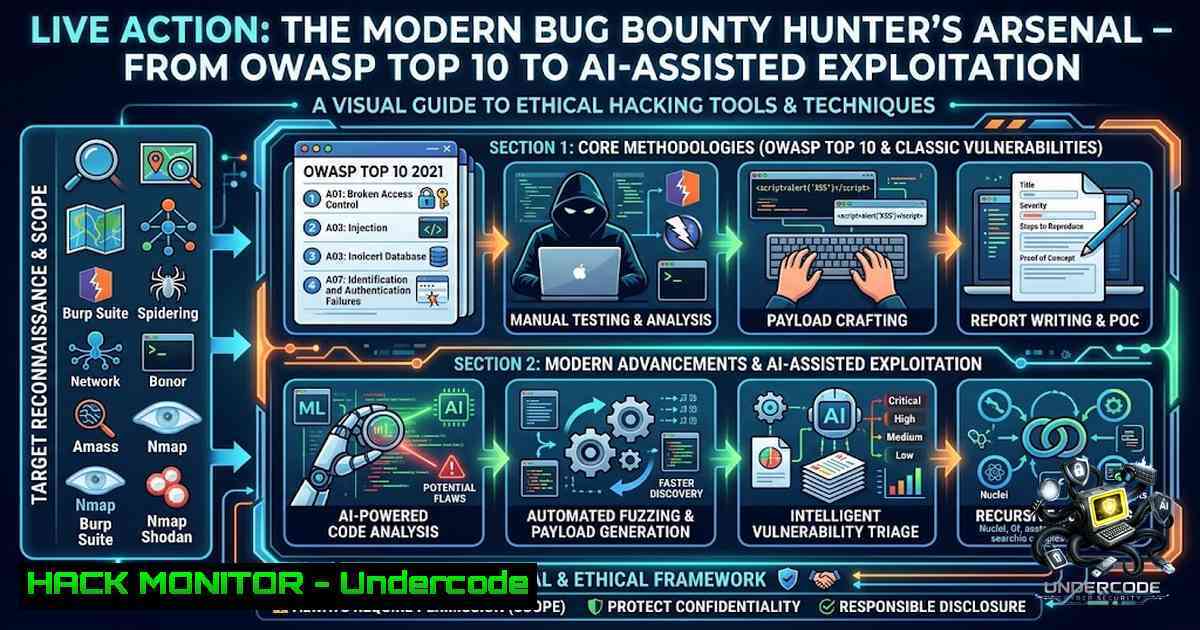
Introduction:
The landscape of web application security is shifting from reactive patching to proactive, continuous reconnaissance. Bug bounty programs and ethical hacking have evolved beyond simple port scanning into complex, multi-layered assessments that leverage both open-source intelligence and artificial intelligence. This article synthesizes insights from a recent technical seminar to provide a comprehensive, hands-on guide to the tools, techniques, and mindset required for modern vulnerability hunting, focusing on the critical intersection of OWASP Top 10 vulnerabilities, automated tooling, and AI-driven analysis.
Learning Objectives & Secrets:
- Objective 1: Master the OWASP Top 10 as a Discovery Framework. Understand that the OWASP Top 10 isn’t just a checklist but a methodology. For example, when testing for Identification and Authentication Failures, you should test for rate limiting bypasses and JWT algorithm confusion, not just basic credential brute-forcing.
- Objective 2 Secret Tips: Leverage Disclosed Reports for Contextual Learning. Instead of just reading HackerOne reports, replicate them. Use tools like Nuclei with a custom template based on a disclosed report to see how the exploit actually works in a lab environment. This bridges the gap between theory and execution.
- Objective 3 Secret Tips: Integrate AI for Anomaly Detection. AI isn’t for automated exploitation, but for filtering noise. Use AI to parse through large Burp Suite logs to identify unusual status codes (e.g., 402 for payment required, 429 for rate limiting) that might indicate hidden parameters or misconfigurations missed by traditional pattern matching.
You Should Know:
- Deep Dive: IDOR, XSS, and RCE – The Holy Trinity of Web Vulns
The seminar emphasized these three common vulnerability classes. Insecure Direct Object References (IDOR) occur when an application uses user-supplied input to access objects directly without authorization checks. For instance, changing the `user_id` parameter in a URL from `123` to `124` might expose another user’s profile. Cross-Site Scripting (XSS), including DOM-based and Blind XSS, involves injecting malicious scripts into web pages. DOM XSS occurs when client-side scripts process untrusted data unsafely. Remote Code Execution (RCE) allows an attacker to execute commands on the hosting server, often via input fields that pass data to `eval()` or unsanitized system calls.
Step‑by‑step guide for IDOR Testing:
- Intercept a request with Burp Suite that contains a unique identifier (e.g.,
GET /profile?userId=123). - Send the request to Repeater and change the `userId` to a different value (
124). - Analyze the response. If you receive another user’s data, the endpoint is vulnerable.
- For a more advanced test, use a `for` loop in a Bash script to iterate through a range of IDs:
for i in {1..100}; do curl -s "https://target.com/profile?userId=$i" | grep "email"; done. -
Automated Vulnerability Assessment with Nuclei, Nessus, OpenVAS, and Nikto
These tools form the backbone of vulnerability assessment. Nuclei is a fast, template-based scanner that uses community-driven templates to detect thousands of CVEs and misconfigurations. Nessus and OpenVAS are comprehensive vulnerability scanners that perform in-depth audits. Nikto is a web server scanner that checks for outdated server software and dangerous files.
Step‑by‑step guide for Using Nuclei:
1. Installation: `go install -v github.com/projectdiscovery/nuclei/v2/cmd/nuclei@latest`
2. Update Templates: `nuclei -update-templates`
- Basic Scan: `nuclei -u https://example.com -t vulnerabilities/` to run a basic vulnerability scan.
- Custom Filter: `nuclei -u https://example.com -tags cve,exposure -severity critical` to only run critical CVE and exposure checks.
- Integrate with Subfinder: Combine with subdomain discovery:
subfinder -d example.com -silent | nuclei -silent -t cves/.
3. Subdomain Enumeration and Endpoint Discovery
Subdomain discovery is crucial for expanding the attack surface. Tools like Katana, a crawling and URL discovery tool, and Amass are essential. The seminar highlighted that often, the most severe vulnerabilities are not on the main domain (www.example.com) but on obscure subdomains like `dev-api.example.com` or test-admin.example.com.
Step‑by‑step guide for Subdomain Discovery:
1. Passive Enumeration: Use `subfinder -d example.com -silent`.
- Active Enumeration: Use
amass enum -passive -d example.com -o subdomains.txt. - Resolving to IP: `cat subdomains.txt | httpx -silent -status-code -title` to check which subdomains are live.
- Endpoint Crawling: `katana -u https://example.com -depth 5 -silent` to crawl and find hidden endpoints. Combine with `grep` to find `.js` or `.php` files.
-
AI as a Security Partner – Anomaly Detection and Report Generation
AI tools can assist in understanding suspicious behavior. For instance, using natural language processing (NLP) to analyze web request parameters for potential command injection patterns. AI can also help generate clear, concise vulnerability reports by analyzing the request/response and suggesting a CVSS (Common Vulnerability Scoring System) score.
Step‑by‑step guide for AI-Assisted Log Analysis:
- Export Logs: Export a Burp Suite or WAF log to a `.txt` file.
- Use an LLM: Feed the log file to an API (like OpenAI) with a prompt such as: “Analyze this access log for unusual patterns, specifically looking for high-frequency requests from the same IP or weird user-agent strings.”
- Automate Filtering: `cat access.log | awk ‘{print $1}’ | sort | uniq -c | sort -1r | head -10` to find IPs with suspicious request counts.
-
Action: Create a script that automatically bans IPs exceeding a certain request threshold using
iptables. -
Mastering Vulnerability Report Writing and Proof of Concept (PoC)
A critical skill often overlooked is report writing. A good report has a clear title, a concise description, a reproducible PoC, impact analysis, and a remediation recommendation. The PoC should be a step-by-step guide with screenshots or a cURL command.
Step‑by‑step guide for a Basic PoC:
- Replicate the Request: Capture the vulnerable request in Burp Suite.
- Simplify: Convert the request to a cURL command for easy replication. `curl -v -X POST -d ‘param=test’ https://target.com`.
3. Craft the PoC: Place the curl command in a code block in your report.
4. Demonstrate Impact: Show a before-and-after response. Explain how an attacker could exploit this to, for example, steal cookies or execute commands.
5. Remediation: Suggest specific code fixes, like input validation or access control checks.6. Setting Up a Windows and Linux Lab Environment
A robust lab is essential. On Linux (Ubuntu), use `sudo apt install docker.io` to set up containerized vulnerable applications (e.g., OWASP Juice Shop). On Windows, use Windows Subsystem for Linux (WSL) to run Linux-based tools. Configure your host firewall to allow VM communication.
Linux Firewall Configuration:
`sudo ufw allow 8080/tcp` to allow traffic on port 8080 for your lab application.
Windows Firewall Rule (PowerShell):
`New-1etFirewallRule -DisplayName “Lab Web Port” -Direction Inbound -LocalPort 8080 -Protocol TCP -Action Allow`
7. Cloud-Hardening and API Security
Modern bug bounties often target cloud APIs. Security misconfigurations in AWS S3 buckets or Google Cloud Storage are common. Always check for public buckets by performing a DNS lookup on bucket names (e.g., nslookup bucket-1ame.s3.amazonaws.com). API security involves checking for broken object-level authorization (BOLA) and mass assignment.
Step‑by‑step guide for AWS Bucket Enumeration:
- Identify Potential Bucket: Look for S3 URLs in JavaScript files or source code.
- List Buckets (if public): `aws s3 ls s3://bucket-1ame –1o-sign-request`
3. Try to Upload a Test File:aws s3 cp test.txt s3://bucket-1ame/ --1o-sign-request. If this works, the bucket is writable.
What Undercode Say:
- Key Takeaway 1: The OWASP Top 10 is the Universal Language of Web Security. Mastery of this list provides a foundational understanding that allows you to communicate effectively with other security professionals and clients. It is the starting point for every web assessment.
- Key Takeaway 2: Automation Amplifies Skill, but Does Not Replace It. Tools like Nuclei and Nessus find low-hanging fruit, but a skilled tester uses them for reconnaissance, not exploitation. The human element—seeing the bigger picture and connecting disparate pieces of information—is what finds critical vulnerabilities.
- Key Takeaway 3: A Strong PoC is Your Most Valuable Asset. In the bug bounty ecosystem, a report is only as good as its PoC. If you can clearly demonstrate how an attacker can achieve impact, you drastically increase the chances of a bounty payout and a quick fix.
Prediction:
- +1: The integration of LLMs (Large Language Models) into security tooling will continue to accelerate, making vulnerability identification faster for junior testers and creating a new class of “AI-assisted red teamers.”
- +1: Bug bounty programs will become the primary testing ground for new AI models, using them to hunt for zero-day vulnerabilities in AI-generated code.
- -1: The widespread adoption of AI for coding will exponentially increase the number of novel vulnerabilities, as AI models often generate functionally correct but insecure code.
- -1: Attackers will increasingly use generative AI to write more sophisticated phishing lures and exploit code, making defense and detection significantly more difficult for blue teams.
- +1: The demand for roles that bridge traditional security operations with data science will rise by 40% over the next two years as organizations scramble to manage the influx of AI-generated security alerts.
▶️ Related Video (76% Match):
🎯Let’s Practice For Free:
🎓 Live Courses & Certifications:
Join Undercode Academy for Verified Certifications
🚀 Request a Custom Project:
Secure, high-velocity infrastructure and disruptive technological engineering. Contact our engineering team for high-tier development and proprietary systems:
[email protected]
💎 Smart Architecture | 🛡️ Secure by Design | ⭐ Trusted by Thousands
IT/Security Reporter URL:
Reported By: https://lnkd.in/p/e9XF2XJd – Hackers Feeds
Extra Hub: Undercode MoN
Basic Verification: Pass ✅


