
Listen to this Post
Introduction:
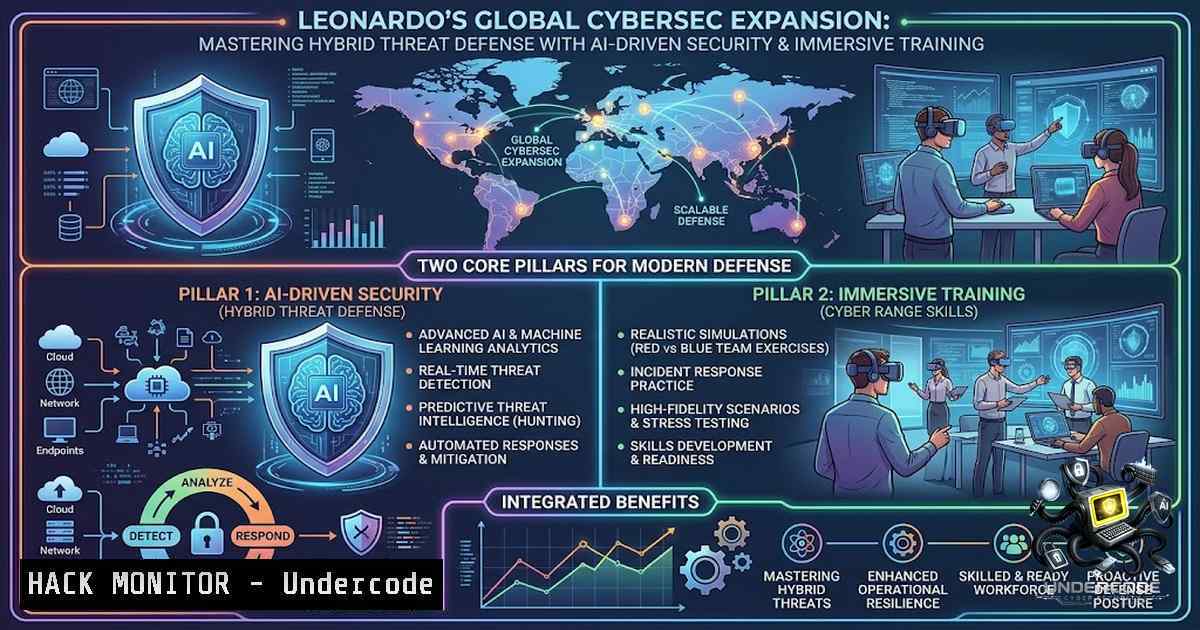
In an era where hybrid warfare blends conventional conflict with cyberattacks, information manipulation, and economic coercion, defending national infrastructure demands a paradigm shift. Leonardo, a global aerospace and security leader, has responded by inaugurating a new Regional Cyber Center in Kuala Lumpur, Malaysia, as part of its Global CyberSec Center (GCC) network. Concurrently, the company’s Cyber & Security Academy and AI training programs are equipping professionals with the skills needed to counter sophisticated ransomware, DDoS, and application-layer attacks through secure-by-design architectures and trustworthy AI. This article provides a technical deep-dive into the strategies, tools, and training methodologies essential for building cyber resilience in 2026 and beyond.
Learning Objectives & Secrets:
- Objective 1: Understand Hybrid Threat Vectors – Learn to identify and analyze the convergence of conventional and non-conventional warfare tactics, including ransomware, DDoS, and information warfare, which target public and private infrastructures.
- Objective 2 Secret Tip: Master Predictive Protection – Leverage big data, virtualization, and trustworthy AI to implement predictive data protection and continuous monitoring, moving beyond reactive defenses.
- Objective 3 Secret Tip: Operationalize Cyber Range Training – Utilize immersive platforms like Cyber Range and Cyber Game (Capture The Flag) to simulate real-world attacks, enabling hands-on experience in a safe, controlled environment.
You Should Know:
1. Architecting a Federated Cyber Defense Network
Leonardo’s GCC operates as a federated network with regional centers in Chieti, Brussels, Bristol, Riyadh, and now Kuala Lumpur. This model enables coordinated global response while preserving national data sovereignty. For organizations, this means adopting a distributed Security Operations Center (SOC) architecture.
Step‑by‑step guide to setting up a federated SOC:
- Step 1: Deploy regional SIEM (Security Information and Event Management) nodes that correlate logs locally.
- Step 2: Implement a centralized threat intelligence platform that aggregates IOCs (Indicators of Compromise) from all nodes.
- Step 3: Use VPN or dedicated MPLS links to ensure secure, low-latency communication between centers.
- Step 4: Establish a unified incident response playbook that respects local data privacy laws (e.g., GDPR, Malaysia’s PDPA).
- Step 5: Conduct regular cross-center tabletop exercises to test coordination.
Linux Command for Log Aggregation:
Using rsyslog to forward logs to a central server:
echo ". @@central-soc.example.com:514" >> /etc/rsyslog.conf
systemctl restart rsyslog
Windows Command (PowerShell) for Event Forwarding:
Enable Sysmon and configure Event Collector:
wevtutil set-log Microsoft-Windows-Sysmon/Operational /enabled:true
winrm quickconfig
 Configure Event Collector subscription via GUI or wevtutil
2. Hardening Against Application-Layer DDoS
Application-layer attacks (HTTP floods, Slowloris) bypass network defenses by mimicking legitimate traffic. Leonardo’s approach integrates AI-driven anomaly detection to differentiate bots from humans.
Step‑by‑step guide to mitigate application-layer DDoS:
- Step 1: Deploy a Web Application Firewall (WAF) with behavioral analysis.
- Step 2: Implement rate limiting per IP and session.
- Step 3: Use CAPTCHA challenges for suspicious sessions.
- Step 4: Analyze HTTP headers and TLS fingerprints using machine learning models.
- Step 5: Automate blacklisting of malicious IPs via threat intelligence feeds.
Linux Command (Nginx) for Rate Limiting:
http {
limit_req_zone $binary_remote_addr zone=mylimit:10m rate=10r/s;
server {
location / {
limit_req zone=mylimit burst=20 nodelay;
}
}
}
3. Building Trustworthy AI for Cybersecurity
Leonardo emphasizes “trustworthy AI” – systems that are explainable, robust, and free from bias. In security, AI models must resist adversarial attacks (e.g., evasion techniques).
Step‑by‑step guide to harden AI models:
- Step 1: Implement adversarial training by injecting perturbed samples into the training dataset.
- Step 2: Use ensemble methods to reduce variance and improve robustness.
- Step 3: Apply input sanitization (e.g., feature squeezing) to detect adversarial inputs.
- Step 4: Continuously monitor model drift and retrain with fresh data.
- Step 5: Use SHAP or LIME for explainability to audit model decisions.
Python Code Snippet for Adversarial Detection:
import numpy as np
from sklearn.ensemble import IsolationForest

Feature squeezing: reduce color bit depth
def squeeze_image(img, bits=4):
return np.round(img / (256 / (2bits)))  (256 / (2bits))

Detect anomalies in feature space
clf = IsolationForest(contamination=0.1)
preds = clf.fit_predict(feature_vectors)
4. Leveraging Cyber Range and Cyber Game Platforms
Leonardo’s Cyber Range and Cyber Game (Capture The Flag) platforms are core to its training methodology. These environments replicate complex, multi-domain attack scenarios.
Step‑by‑step guide to operationalize a Cyber Range:
- Step 1: Define learning objectives and attack scenarios (e.g., ransomware, supply chain compromise).
- Step 2: Provision virtual machines and network segments using infrastructure-as-code (Terraform, Ansible).
- Step 3: Inject realistic traffic and adversary behavior using tools like Metasploit, Cobalt Strike.
- Step 4: Integrate a SIEM for real-time monitoring and logging.
- Step 5: After each exercise, conduct a thorough debrief and gap analysis.
Linux Command to Deploy a CTF Challenge (Docker):
docker run -d -p 8080:80 -e FLAG="flag{cyber_range_rocks}" vulnerable_app
5. Securing the Software Supply Chain
With increasing attacks on open-source repositories and CI/CD pipelines, secure-by-design principles are paramount. Leonardo’s Cyber & Security Academy offers courses on secure coding and DevSecOps.
Step‑by‑step guide to supply chain security:
- Step 1: Implement Software Composition Analysis (SCA) to identify known vulnerabilities in dependencies.
- Step 2: Use cryptographic signing and checksums to verify artifact integrity.
- Step 3: Enforce least-privilege access in CI/CD pipelines.
- Step 4: Regularly scan container images for vulnerabilities (e.g., Trivy, Clair).
- Step 5: Maintain a Software Bill of Materials (SBOM) for all applications.
Linux Command to Scan a Container Image:
trivy image --severity HIGH,CRITICAL myapp:latest
6. Continuous Training and Certification
Leonardo’s Cyber Trainer platform supports the entire training lifecycle: from needs identification to formal learning, practical application, and skill certification. The platform offers social tools for continuous learning.
Step‑by‑step guide to implement a continuous training program:
- Step 1: Conduct a skills gap analysis using frameworks like the ENISA European Cybersecurity Skills Framework (ECSF).
- Step 2: Curate role-based learning paths (e.g., for SOC analysts, developers, executives).
- Step 3: Integrate hands-on labs and simulations.
- Step 4: Track progress and certifications via a Learning Management System (LMS).
- Step 5: Foster a culture of security awareness through phishing simulations and gamification.
What Undercode Say:
- Key Takeaway 1: Hybrid threat defense requires a federated, AI-driven approach that combines predictive analytics with immersive, hands-on training. Organizations must move beyond reactive measures and embrace continuous, scenario-based learning to build true cyber resilience.
- Key Takeaway 2: The convergence of AI and cybersecurity is not optional – it is imperative. However, AI systems must be trustworthy, explainable, and robust against adversarial manipulation. This demands a new breed of professionals who understand both security and machine learning.
Analysis:
Leonardo’s expansion and training initiatives highlight a critical shift in the cybersecurity industry: the recognition that technology alone is insufficient. The human element – skills, awareness, and continuous learning – is equally vital. By integrating AI-driven threat detection with immersive training platforms like Cyber Range and Cyber Trainer, Leonardo is addressing the dual challenge of evolving threats and the widening skills gap. The federated SOC model also reflects a pragmatic approach to data sovereignty and global coordination, which is increasingly relevant in a multipolar world. For professionals, this means that mastering hybrid threat defense requires not only technical proficiency but also the ability to think strategically about risk, compliance, and incident response. The emphasis on “trustworthy AI” further underscores the need for ethical and transparent AI practices in security operations.
Prediction:
- +1 The integration of AI-driven predictive protection and immersive training will become the industry standard, leading to more resilient global cyber defenses.
- +1 The demand for professionals with cross-functional skills in AI, cloud security, and incident response will surge, creating new career opportunities and specialized certifications.
- -1 The complexity of hybrid threats and the rapid evolution of AI-powered attacks will outpace the ability of many organizations to adapt, widening the gap between security leaders and laggards.
- -1 Without standardized frameworks for trustworthy AI, there is a risk of bias, false positives, and adversarial vulnerabilities undermining AI-based security solutions.
- +1 The proliferation of Cyber Range platforms and gamified training will democratize access to advanced cybersecurity education, enabling a new generation of defenders to emerge globally.
▶️ Related Video (80% Match):
🎯Let’s Practice For Free:
🎓 Live Courses & Certifications:
Join Undercode Academy for Verified Certifications
🚀 Request a Custom Project:
Secure, high-velocity infrastructure and disruptive technological engineering. Contact our engineering team for high-tier development and proprietary systems:
[email protected]
💎 Smart Architecture | 🛡️ Secure by Design | ⭐ Trusted by Thousands
IT/Security Reporter URL:
Reported By: https://lnkd.in/p/eYgiphjN – Hackers Feeds
Extra Hub: Undercode MoN
Basic Verification: Pass ✅


