Listen to this Post
Introduction
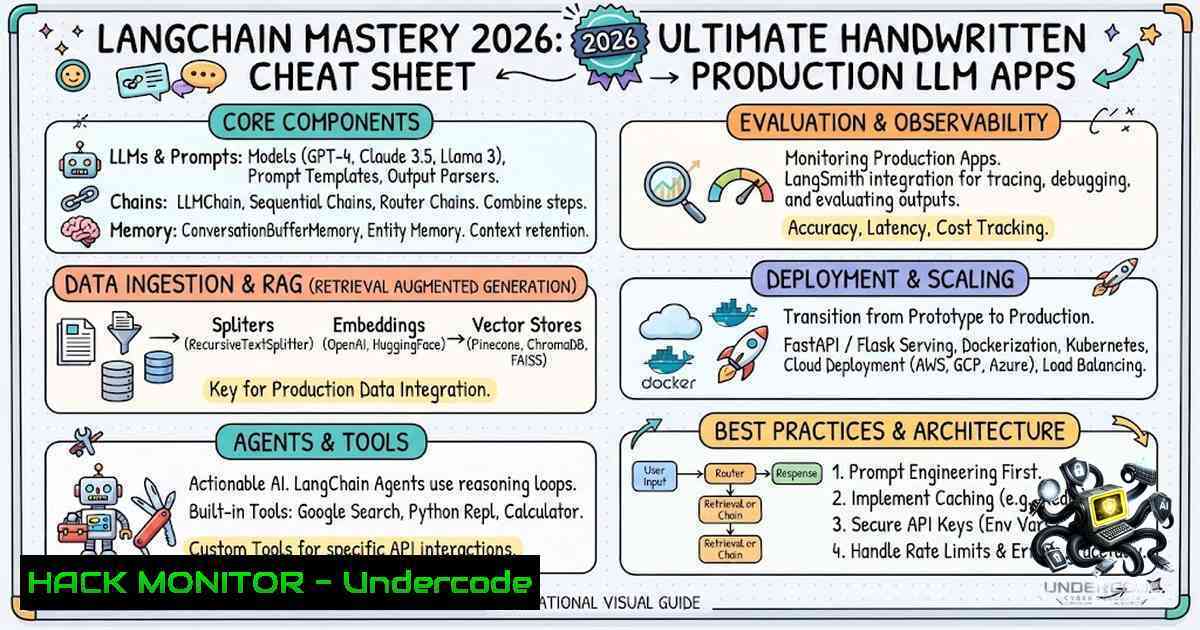
LangChain has emerged as the foundational framework for building applications powered by large language models (LLMs), fundamentally transforming how developers interact with artificial intelligence. This comprehensive guide distills the entire LangChain ecosystem—from core concepts to production best practices—into an actionable reference for AI engineers, GenAI developers, and technical professionals seeking to master LLM application development.
Learning Objectives
- Understand the complete LangChain ecosystem and how each component (LangChain, LangSmith, LangServe, LangGraph) serves distinct purposes in the development lifecycle
- Master the implementation of Retrieval-Augmented Generation (RAG) pipelines, including vector database integration and retrieval strategies
- Build and deploy sophisticated AI agents using ReAct, Zero-Shot, and Conversational agent architectures with proper tool integration
You Should Know
1. LangChain Ecosystem Architecture and Core Components
The LangChain ecosystem comprises four interconnected frameworks that collectively enable end-to-end LLM application development. LangChain serves as the primary orchestration layer, providing the building blocks for chaining LLM operations. LangSmith functions as the observability platform, offering debugging, testing, and monitoring capabilities throughout the development lifecycle. LangServe enables deployment of LangChain applications as REST APIs with minimal configuration, while LangGraph introduces stateful, cyclic workflows essential for complex agent behaviors and multi-agent systems.
At its foundation, LangChain operates on several core abstractions. Models represent the underlying LLM interfaces, supporting providers like OpenAI, Anthropic, and open-source alternatives. Prompts are templatized input structures that can be dynamically formatted with variables and few-shot examples. Chains combine multiple operations into sequential or conditional workflows, enabling complex reasoning patterns.
 Basic LangChain setup and model initialization
from langchain_openai import ChatOpenAI
from langchain_core.prompts import ChatPromptTemplate
from langchain_core.output_parsers import StrOutputParser

Initialize the model with temperature control
model = ChatOpenAI(model="gpt-4", temperature=0.7)

Create a prompt template with dynamic variables
prompt = ChatPromptTemplate.from_template(
"You are an expert AI assistant. Answer the following question: {question}"
)

Build a simple chain
chain = prompt | model | StrOutputParser()

Execute the chain
response = chain.invoke({"question": "What is the difference between RAG and fine-tuning?"})
print(response)
2. RAG Pipeline Implementation with Vector Databases
Retrieval-Augmented Generation (RAG) represents one of the most impactful applications of LangChain, enabling LLMs to access external knowledge bases and reduce hallucinations. The RAG pipeline begins with document ingestion, where source materials are loaded, chunked into manageable segments, and embedded into vector representations using models like OpenAI’s text-embedding-ada-002 or open-source alternatives like Sentence Transformers.
Vector databases serve as the retrieval backbone, with options including Chroma, Pinecone, Weaviate, and FAISS. Each offers different trade-offs between performance, scalability, and ease of use. Chroma provides excellent local development capabilities, while Pinecone offers managed cloud infrastructure for production deployments.
from langchain_community.document_loaders import TextLoader
from langchain_text_splitters import RecursiveCharacterTextSplitter
from langchain_openai import OpenAIEmbeddings
from langchain_community.vectorstores import Chroma
from langchain.chains import RetrievalQA

Load and process documents
loader = TextLoader("knowledge_base.txt")
documents = loader.load()

Split documents into chunks with overlap for context preservation
text_splitter = RecursiveCharacterTextSplitter(
chunk_size=1000,
chunk_overlap=200,
length_function=len
)
chunks = text_splitter.split_documents(documents)

Create embeddings and vector store
embeddings = OpenAIEmbeddings()
vectorstore = Chroma.from_documents(chunks, embeddings)

Configure the retriever with similarity search
retriever = vectorstore.as_retriever(
search_type="similarity",
search_kwargs={"k": 4}
)

Build a complete RAG chain
qa_chain = RetrievalQA.from_chain_type(
llm=model,
chain_type="stuff",
retriever=retriever
)

Query with document context
result = qa_chain.invoke({"query": "What are the key principles of LangChain?"})
3. Advanced Chain Types and Dynamic Prompt Engineering
LangChain provides multiple chain types designed for different use cases. The LLMChain forms the basic building block, wrapping a prompt template and LLM for simple inference. SequentialChain enables multi-step reasoning by passing outputs from one chain as inputs to another, creating sophisticated processing pipelines. RouterChain implements conditional routing logic, directing queries to specialized sub-chains based on input characteristics, which is particularly valuable for multi-domain applications.
MapReduceChain addresses large document processing by splitting documents into chunks, processing each individually, and aggregating results. ConversationChain maintains dialogue context through built-in memory management, making it ideal for chatbot applications. RetrievalQA combines retrieval and generation in a single chain, providing the foundation for RAG applications.
from langchain.chains import SequentialChain, LLMChain
from langchain_core.prompts import PromptTemplate

Define specialized prompts for different tasks
summarize_prompt = PromptTemplate(
input_variables=["document"],
template="Summarize this document concisely: {document}"
)

key_points_prompt = PromptTemplate(
input_variables=["summary"],
template="Extract the 3 most important bullet points from: {summary}"
)

Create individual chains
summarize_chain = LLMChain(llm=model, prompt=summarize_prompt)
key_points_chain = LLMChain(llm=model, prompt=key_points_prompt)

Build a sequential chain for document analysis
analysis_chain = SequentialChain(
chains=[summarize_chain, key_points_chain],
input_variables=["document"],
output_variables=["summary", "key_points"]
)

Execute the chain
result = analysis_chain({"document": "A detailed technical description of LangChain..."})
print(f"Summary: {result['summary']}")
print(f"Key Points: {result['key_points']}")
4. Memory Management Strategies for Conversational AI
Effective memory management is crucial for building coherent conversational AI applications. LangChain implements three primary memory types, each serving different interaction paradigms. ConversationBufferMemory maintains a complete history of the conversation, providing maximal context at the cost of increasing token usage. This approach works well for short conversations but becomes inefficient for extended interactions.
ConversationBufferWindowMemory addresses this limitation by maintaining only the most recent exchanges, typically the last 5-10 turns. This strategy balances context preservation with token efficiency, making it suitable for most production applications. ConversationSummaryMemory takes a different approach by generating and updating a summary of the conversation, preserving key information while dramatically reducing token consumption.
from langchain.memory import ConversationBufferMemory, ConversationBufferWindowMemory
from langchain.chains import ConversationChain

Buffer memory - keeps full conversation
buffer_memory = ConversationBufferMemory(return_messages=True)
buffer_chain = ConversationChain(llm=model, memory=buffer_memory)

Window memory - keeps last n exchanges
window_memory = ConversationBufferWindowMemory(k=5, return_messages=True)
window_chain = ConversationChain(llm=model, memory=window_memory)

Interactive conversation loop with memory
def chat_with_memory(chain, user_input):
response = chain.predict(input=user_input)
return response

Example conversation
print(chat_with_memory(buffer_chain, "What is LangChain?"))
print(chat_with_memory(buffer_chain, "How does it compare to LlamaIndex?"))
- AI Agents: Architecture, Execution Flow, and Tool Integration
AI agents represent the most sophisticated LangChain capability, enabling LLMs to reason about actions, select appropriate tools, and iteratively work toward goals. The ReAct (Reasoning + Acting) pattern is particularly influential, where agents alternate between generating thoughts and taking actions based on observations. This paradigm enables complex problem-solving that would be impossible with static chains.
LangChain supports multiple agent types optimized for different scenarios. Zero-Shot ReAct agents require no examples, making decisions based on tool descriptions alone. Conversational agents maintain context across interactions, suitable for dialogue-based applications. Self-Ask agents implement a specialized reasoning pattern that breaks problems into sub-questions, particularly effective for complex research tasks.
The agent execution flow follows a predictable pattern: Thought (analyzing the current state), Action (selecting and invoking a tool), Observation (processing the tool’s output), and Response (generating a final answer or next action). This cycle continues until the agent determines it has sufficient information.
from langchain.agents import AgentExecutor, create_react_agent, Tool
from langchain_community.tools import DuckDuckGoSearchRun, PythonREPLTool
from langchain_core.prompts import PromptTemplate

Define available tools
search_tool = DuckDuckGoSearchRun()
python_tool = PythonREPLTool()

tools = [
Tool(name="Search", func=search_tool.run, description="Search the web for information"),
Tool(name="Python REPL", func=python_tool.run, description="Execute Python code for calculations")
]

Create ReAct agent
agent = create_react_agent(
llm=model,
tools=tools,
prompt=PromptTemplate.from_template(
"You are a helpful AI assistant with access to tools.\n"
"Question: {input}\n"
"Thought: {agent_scratchpad}"
)
)

Create the executor with validation
agent_executor = AgentExecutor.from_agent_and_tools(
agent=agent,
tools=tools,
verbose=True,
handle_parsing_errors=True,
max_iterations=5
)

Execute a multi-step task
result = agent_executor.invoke({
"input": "What is the current population of New York City? Verify this by checking multiple sources."
})
print(result['output'])
6. LangGraph: Stateful Multi-Agent Workflows
LangGraph extends LangChain with graph-based workflow capabilities, enabling complex, stateful interactions that go beyond linear chains. Unlike standard chains that follow predetermined paths, LangGraph allows for cyclic execution patterns, conditional branching, and parallel processing, making it ideal for multi-agent collaboration and complex reasoning tasks.
The LangGraph architecture revolves around nodes (processing units) and edges (transitions between nodes). This graph structure supports advanced patterns like human-in-the-loop feedback, error recovery, and dynamic workflow adaptation. State management is central to LangGraph, with a persistent state object that accumulates information throughout the workflow execution.
Multi-agent systems built with LangGraph can implement sophisticated collaboration patterns, including specialized agents for different domains working together on complex problems. This enables applications like research assistants that combine web search, document analysis, and fact-checking in a coordinated workflow.
from langgraph.graph import StateGraph, END
from typing import TypedDict, List

Define the state structure
class AgentState(TypedDict):
query: str
context: str
research: str
final_answer: str
iterations: int

Define node functions
def research_node(state: AgentState) -> dict:
 Perform research based on query
return {"research": f"Research findings for {state['query']}", "iterations": state.get('iterations', 0) + 1}

def analyze_node(state: AgentState) -> dict:
 Analyze research results
return {"context": f"Analysis of {state['research']}"}

def decide_next_node(state: AgentState) -> str:
 Conditional routing logic
if state.get('iterations', 0) < 3:
return "research"
return "respond"

def respond_node(state: AgentState) -> dict:
 Generate final response
return {"final_answer": f"Based on research: {state['research']}\nAnalysis: {state['context']}"}

Build the workflow
workflow = StateGraph(AgentState)

Add nodes
workflow.add_node("research", research_node)
workflow.add_node("analyze", analyze_node)
workflow.add_node("respond", respond_node)

Define edges
workflow.set_entry_point("research")
workflow.add_edge("research", "analyze")
workflow.add_conditional_edges("analyze", decide_next_node, {
"research": "research",
"respond": "respond"
})
workflow.add_edge("respond", END)

Compile and run
app = workflow.compile()
result = app.invoke({"query": "What are the latest developments in AI safety?"})
print(result['final_answer'])
7. Production Best Practices and Deployment Strategies
Deploying LangChain applications to production requires careful consideration of performance, security, and reliability. LangServe provides a turnkey solution for serving LangChain applications as REST APIs, handling request validation, error handling, and response formatting automatically. For production deployment, implement proper authentication, rate limiting, and monitoring to ensure system stability.
API key management is critical for production applications. Store API keys and sensitive configuration in environment variables or secrets management services, never hardcoding them in source code. Implement comprehensive logging to track application performance, user interactions, and error patterns, enabling rapid debugging and optimization.
 Production-ready LangServe implementation
from langserve import add_routes
from fastapi import FastAPI, HTTPException
from fastapi.middleware.cors import CORSMiddleware
import os
from dotenv import load_dotenv

load_dotenv()

app = FastAPI(title="LangChain API", version="1.0.0")

Configure CORS for web applications
app.add_middleware(
CORSMiddleware,
allow_origins=os.getenv("ALLOWED_ORIGINS", "").split(","),
allow_credentials=True,
allow_methods=[""],
allow_headers=[""],
)

Error handling middleware
@app.exception_handler(Exception)
async def global_exception_handler(request, exc):
raise HTTPException(status_code=500, detail=str(exc))

Add LangChain routes with authentication
add_routes(
app,
chain,
path="/chain",
enabled_endpoints=["invoke", "batch", "stream"],
)

Run with uvicorn
if <strong>name</strong> == "<strong>main</strong>":
import uvicorn
uvicorn.run(app, host="0.0.0.0", port=8000)
What Undercode Say:
- Ecosystem Integration is Key: The power of LangChain lies not in individual components but in how seamlessly they integrate. Understanding LangChain, LangSmith, LangServe, and LangGraph as a unified ecosystem is essential for building production-grade applications. The observability provided by LangSmith alone justifies the investment in the complete stack.
-
RAG is the Killer Application: While agents capture headlines, RAG implementations deliver the most immediate business value by grounding LLM responses in organizational knowledge. Mastering retrieval strategies, chunking techniques, and vector database optimization yields significant performance improvements with relatively straightforward implementation.
-
Agent Complexity Requires Thoughtful Design: Agents introduce non-determinism and potential failure modes that demand careful architecture. Implementing proper tool descriptions, error handling, and iterative improvement cycles is essential. Start with simpler chains and progressively introduce agent complexity as requirements demand.
Prediction:
+1 The LangChain ecosystem is poised to become the standard framework for enterprise LLM applications, with increasing integration of multimodal capabilities and specialized tooling for domain-specific use cases like healthcare and finance.
+1 As LangGraph matures, multi-agent workflows will enable more sophisticated applications that combine specialized AI capabilities with human oversight, creating new categories of intelligent automation tools.
-1 The rapid evolution of LangChain’s API presents a significant challenge, with breaking changes between versions requiring substantial refactoring efforts and creating friction for production deployments.
+1 Open-source alternatives to proprietary LLMs will increasingly integrate with LangChain, reducing API costs and enabling privacy-preserving deployments for sensitive enterprise applications.
+N Competition from specialized frameworks like LlamaIndex and Haystack may fragment the ecosystem, requiring developers to maintain expertise across multiple platforms rather than mastering a single framework.
▶️ Related Video (82% Match):
🎯Let’s Practice For Free:
🎓 Live Courses & Certifications:
Join Undercode Academy for Verified Certifications
🚀 Request a Custom Project:
Secure, high-velocity infrastructure and disruptive technological engineering. Contact our engineering team for high-tier development and proprietary systems:
[email protected]
💎 Smart Architecture | 🛡️ Secure by Design | ⭐ Trusted by Thousands
IT/Security Reporter URL:
Reported By: Rahul Y – Hackers Feeds
Extra Hub: Undercode MoN
Basic Verification: Pass ✅


