Listen to this Post
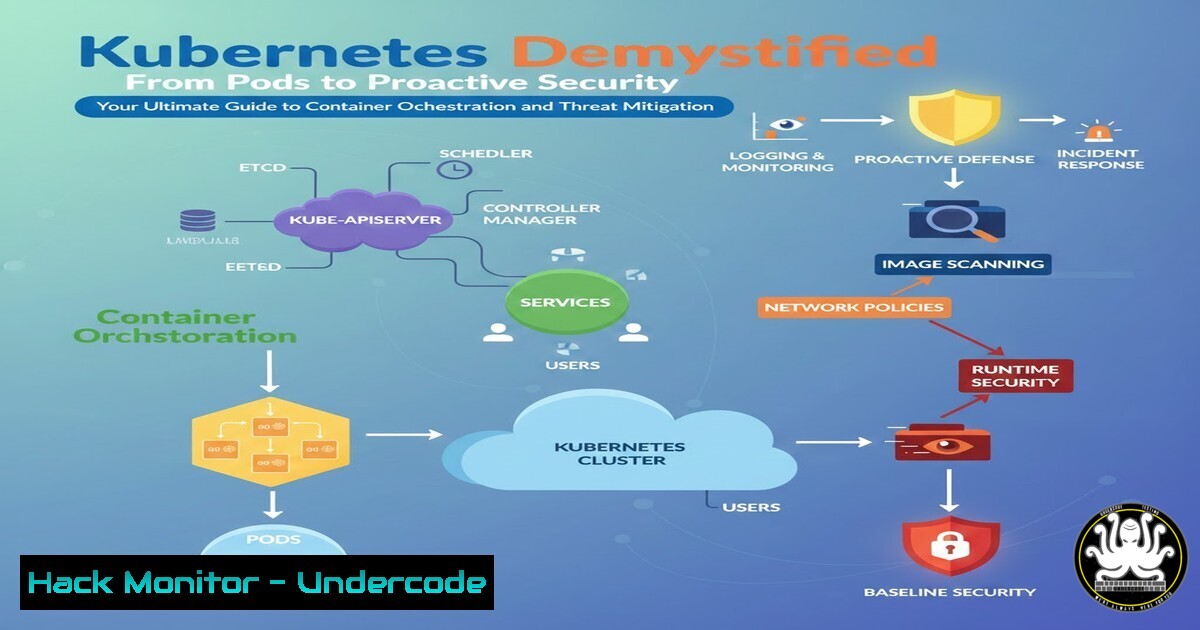
Introduction:
Kubernetes has become the de facto standard for container orchestration, powering everything from microservices to machine learning pipelines. However, its complexity often obscures critical security implications, turning misconfigured clusters into prime targets for attackers. This guide breaks down Kubernetes fundamentals through a security lens, transforming confusion into hardened, production-ready knowledge.
Learning Objectives:
- Decode the core components of a Kubernetes cluster and their security postures.
- Implement essential security controls using kubectl commands and manifest files.
- Harden your cluster against common misconfigurations and exploitation techniques.
You Should Know:
- Architecture Breakdown: Nodes, Pods, and the Attack Surface
Kubernetes architecture is a hierarchy where the compromise of one component can lead to cluster-wide breach. The control plane (master) manages the worker nodes, which host pods—the smallest deployable units containing one or more containers.
Step‑by‑step guide explaining what this does and how to use it.
Concept: The control plane’s API server is the primary entry point for all administrative commands. An unauthenticated or weakly authenticated API server is a critical vulnerability.
Command – Listing Nodes & Pods:
 Check node status and identify tainted or unscheduled nodes
kubectl get nodes -o wide
 List all pods in all namespaces with node placement info
kubectl get pods --all-namespaces -o wide
Security Action: Immediately review the output for unknown or `NotReady` nodes. Use `kubectl describe node
2. Securing Pods with Security Contexts and Policies
By default, pods run with excessive permissions, capable of accessing host resources. Security contexts and Pod Security Standards (PSS) enforce least-privilege principles at the pod or container level.
Step‑by‑step guide explaining what this does and how to use it.
Concept: A Security Context defines privilege and access control settings for a Pod or Container. This prevents container breakout attacks.
Tutorial – Apply a Basic Security Context:
Create a file named `secured-pod.yaml`:
apiVersion: v1
kind: Pod
metadata:
name: secured-app
spec:
securityContext:
runAsUser: 1000  Run as non-root user
runAsGroup: 3000
fsGroup: 3000
containers:
- name: sec-container
image: nginx:alpine
securityContext:
allowPrivilegeEscalation: false
capabilities:
drop: ["ALL"]  Drop all kernel capabilities
Deploy it: `kubectl apply -f secured-pod.yaml`
Verification: `kubectl exec secured-app — whoami` should return 1000, not root.
3. Network Policy: Your Kubernetes Firewall
Zero-trust networking within the cluster is not default. Without Network Policies, pods can communicate freely, allowing east-west movement for an attacker.
Step‑by‑step guide explaining what this does and how to use it.
Concept: Network Policies are YAML manifests that control traffic flow between pod groups (ingress and egress) based on labels.
Tutorial – Isolate a Namespace:
First, ensure your CNI (like Calico or Cilium) supports Network Policies. Create deny-all.yaml:
apiVersion: networking.k8s.io/v1
kind: NetworkPolicy
metadata:
name: deny-all
namespace: critical-apps
spec:
podSelector: {}  Selects all pods in the namespace
policyTypes:
- Ingress
- Egress
 No rules defined means all traffic is denied
Apply it: kubectl apply -f deny-all.yaml. Now, explicitly create policies to allow only necessary communication.
4. Secrets Management: Beyond Base64 Encoding
Kubernetes `Secrets` are only base64-encoded, not encrypted by default, posing a significant data leakage risk.
Step‑by‑step guide explaining what this does and how to use it.
Concept: Always enable encryption at rest for Secrets and consider external secret managers (AWS Secrets Manager, HashiCorp Vault).
Command & Configuration:
1. Check if encryption is enabled:
`kubectl describe apiserver | grep encryption`
2. Create a local secret (for testing only):
kubectl create secret generic app-creds \
--from-literal=username=admin \
--from-literal=password='S3cr3tP@ss!' \
--dry-run=client -o yaml
Notice the values are easily decoded with echo 'YWRtaW4=' | base64 --decode.
Mitigation: Configure an EncryptionConfiguration file for the API server using a strong key from a KMS.
- Auditing and Incident Response with Kubectl and Logs
Proactive monitoring and auditing are crucial for detecting anomalous activity, such as privilege escalation attempts or unauthorized pod creation.
Step‑by‑step guide explaining what this does and how to use it.
Concept: Enable the Kubernetes API audit log and aggregate container logs using a tool like Falco or the native audit-policy.
Commands for Forensics:
 Get events from all namespaces, sorted by time
kubectl get events --all-namespaces --sort-by='.lastTimestamp'
 Check for pods running with privileged security context (HIGH RISK)
kubectl get pods --all-namespaces -o json | jq '.items[] | select(.spec.containers[].securityContext.privileged==true) | .metadata.name'
 Inspect logs of a specific pod
kubectl logs <pod-name> --previous --tail=50
Action: Define and apply an `audit-policy.yaml` file to log all requests to the API server, especially create, patch, delete, and `exec` commands.
What Undercode Say:
- Key Takeaway 1: Kubernetes’ power is inversely proportional to its default security. A foundational understanding of its architecture is the first and most critical step in securing it. Misunderstood components lead to misconfigurations, which are the primary cause of breaches.
- Key Takeaway 2: Security is not a plugin but a configuration paradigm. It must be baked into the cluster via Security Contexts, Network Policies, encrypted Secrets, and rigorous auditing from the very first deployment. The commands and manifests provided are the essential building blocks for a defense-in-depth strategy.
The engagement on the original post highlights a widespread need for simplified Kubernetes education, particularly among cybersecurity and DevSecOps professionals. This convergence of roles is positive, as it indicates security is being integrated earlier into the cloud-native lifecycle. The real danger lies in operators who deploy Kubernetes without this security-first mindset, treating it as a simple hosting platform rather than a complex distributed system that requires careful governance. The comments from security-focused individuals underscore that securing Kubernetes is now a non-negotiable core skill in cloud engineering.
Prediction:
The future of Kubernetes security is shifting left towards automated policy-as-code and AI-driven anomaly detection. Tools like OPA Gatekeeper and Kyverno will become standard for enforcing security policies at deployment time. Furthermore, with the rise of AI workloads on Kubernetes, new attack surfaces targeting training data, model theft, and poisoned pipelines will emerge. Security postures will need to evolve from mitigating misconfigurations to defending against sophisticated, automated attacks that target the AI/ML lifecycle within clusters, making runtime security and zero-trust networking not just best practices, but absolute necessities.
🎯Let’s Practice For Free:
IT/Security Reporter URL:
Reported By: Temple Osaroejiji – Hackers Feeds
Extra Hub: Undercode MoN
Basic Verification: Pass ✅


