Listen to this Post
Introduction:
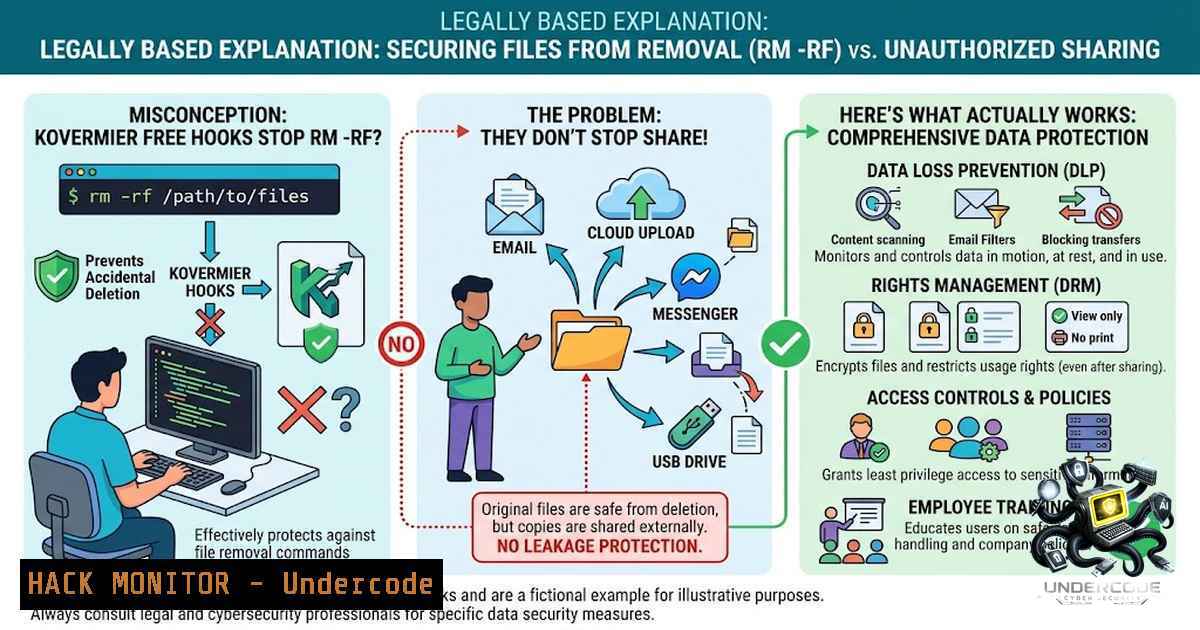
The `rm -rf` command remains one of the most powerful and dangerous tools in any system administrator’s arsenal – a single mistyped path can wipe out critical data in seconds. While various “hooks” and preventive measures have emerged to guard against accidental deletions, the reality is that no hook can stop data from being shared once it’s been exposed. This article explores the technical landscape of deletion prevention, hook-based security controls, and why access control remains the true frontier of data protection.
Learning Objectives:
- Understand the mechanics of `rm -rf` and its implications in Linux/Unix environments
- Learn how pre-command hooks and aliases can mitigate accidental deletions
- Explore Windows equivalents and cross-platform data protection strategies
- Master API security hooks and their role in preventing unauthorized data access
- Implement cloud hardening techniques to protect against both deletion and exfiltration
- Understanding the RM -RF Threat: More Than Just Deletion
The `rm -rf` command (remove recursively and forcefully) is a cornerstone of Linux system administration, yet it’s also one of the most frequently misused commands in production environments. When executed without proper safeguards, it can recursively delete directories and their contents without prompting for confirmation.
What many administrators fail to recognize is that the true danger isn’t just deletion – it’s the cascade of consequences that follow. When critical configuration files, database storage, or application binaries are removed, the resulting downtime can cost organizations millions. More insidiously, if sensitive data is deleted before proper backups are verified, recovery becomes impossible.
Step-by-Step Guide: Implementing RM -RF Safeguards
- Create aliases for safety: Add `alias rm=’rm -i’` to your `.bashrc` or `.zshrc` file to prompt for confirmation before each deletion.
-
Use the trash-cli utility: Install `trash-cli` (
sudo apt install trash-clion Debian/Ubuntu) and alias `rm` to `trash-put` for recoverable deletions. -
Implement the safe-rm package: Install `safe-rm` to protect specific directories from accidental deletion by configuring a protected paths list in
/etc/safe-rm.conf. -
Set up a pre-commit hook: For Git repositories, create a pre-commit hook that scans for dangerous commands:
!/bin/sh
 .git/hooks/pre-commit
if grep -r "rm -rf" --include=".sh" --include=".bash" .; then
echo "Error: rm -rf detected in commit. Aborting."
exit 1
fi
- Enable filesystem snapshots: Configure LVM snapshots or ZFS snapshots to enable rapid recovery from accidental deletions.
-
The Hook Ecosystem: From Git Hooks to Webhook Security
Hooks are automated scripts that trigger on specific events, and they’ve become ubiquitous across modern development stacks. Git hooks allow developers to enforce code quality and security policies before commits are finalized. Webhooks enable real-time integration between services, but they also introduce security vulnerabilities if not properly configured.
The concept of “free hooks” often refers to open-source hook libraries and pre-built automation scripts available through package managers like npm. The `kovermier` package, for instance, provides multi-LLM failover with circuit breakers, cost tracking, and intelligent retry mechanisms – demonstrating how hooks have evolved beyond simple event triggers into sophisticated orchestration tools.
Step-by-Step Guide: Securing Webhooks Against Data Exfiltration
- Validate incoming payloads: Always verify the signature of incoming webhook requests using HMAC-SHA256 with a secret key stored in environment variables.
-
Implement rate limiting: Use middleware to limit the number of webhook requests per IP address or API key to prevent abuse.
-
Sanitize output: Never echo webhook payload data back to clients without proper sanitization to prevent XSS and data leakage.
-
Use allowlists for source IPs: Restrict webhook endpoints to accept traffic only from known source IP ranges provided by the service provider.
-
Log all webhook activity: Maintain detailed audit logs of all webhook requests, including timestamps, source IPs, and payload sizes for forensic analysis.
3. Windows Equivalents: Protecting Against Mass Deletion
While `rm -rf` is a Unix/Linux command, Windows systems face similar risks through `del /f /s` and `rd /s /q` commands. The PowerShell `Remove-Item -Recurse -Force` cmdlet presents an equally dangerous capability. Cross-platform environments require consistent protection strategies.
Step-by-Step Guide: Windows Deletion Prevention
- Enable Windows File Protection: Use the `icacls` command to set read-only permissions on critical system directories:
icacls C:\Windows\System32 /grant Administrators:R /inheritance:r
- Configure PowerShell execution policies: Restrict script execution to signed scripts only:
Set-ExecutionPolicy RemoteSigned -Scope LocalMachine
- Implement audit policies: Enable object access auditing in Group Policy to track all deletion attempts.
-
Use Windows Defender’s Controlled Folder Access: Enable ransomware protection to block unauthorized applications from modifying protected folders.
-
Create scheduled system restore points: Automate system restore point creation using PowerShell scripts triggered by Task Scheduler.
-
API Security Hooks: The Frontline of Data Protection
Modern applications rely heavily on APIs, and hooks play a critical role in API security. Pre-request hooks can validate authentication tokens, enforce rate limits, and sanitize inputs before they reach backend services. Post-response hooks can encrypt sensitive data, log access patterns, and trigger alerts on anomalous behavior.
Step-by-Step Guide: Implementing API Security Hooks
- Implement JWT validation hooks: Create middleware that validates JWT tokens on every request, checking expiration, signature, and required claims.
// Express.js middleware example
const jwt = require('jsonwebtoken');
function authenticateToken(req, res, next) {
const authHeader = req.headers['authorization'];
const token = authHeader && authHeader.split(' ')[bash];
if (!token) return res.sendStatus(401);
jwt.verify(token, process.env.ACCESS_TOKEN_SECRET, (err, user) => {
if (err) return res.sendStatus(403);
req.user = user;
next();
});
}
- Add request validation hooks: Use libraries like Joi or Zod to validate request payloads against schemas before processing.
-
Implement CORS policies: Configure Cross-Origin Resource Sharing to restrict which domains can access your API.
-
Set up API gateway hooks: Use tools like Kong or Tyk to add authentication, rate limiting, and logging at the gateway level.
-
Enable response sanitization: Remove sensitive fields (passwords, API keys, PII) from API responses using post-response hooks.
5. Cloud Hardening: Beyond Traditional Deletion Prevention
Cloud environments introduce new dimensions to data protection. While `rm -rf` may not directly apply to S3 buckets or Azure Blob Storage, the equivalent risks exist through misconfigured lifecycle policies, accidental bucket deletions, and exposed access keys.
Step-by-Step Guide: Cloud Data Protection
- Enable versioning on storage buckets: S3 versioning and Azure Blob soft delete allow recovery of accidentally deleted objects.
-
Implement MFA delete: On AWS S3, enable MFA Delete to require multi-factor authentication for permanent object deletions.
-
Use infrastructure as code with validation: Tools like Terraform and CloudFormation can include pre-apply hooks that validate changes before deployment.
 Terraform pre-apply validation example
resource "aws_s3_bucket" "example" {
bucket = "my-secure-bucket"
versioning {
enabled = true
}
lifecycle {
prevent_destroy = true
}
}
- Configure bucket policies with strict conditions: Restrict delete permissions to specific IAM roles and require MFA.
-
Enable CloudTrail logging: Monitor all API calls to detect unauthorized delete operations or unusual access patterns.
6. Vulnerability Exploitation and Mitigation: The Share Problem
The title’s assertion that “hooks don’t stop share” points to a fundamental truth: while hooks can prevent deletion, they cannot prevent data from being shared or exfiltrated once accessed. Attackers increasingly focus on data theft rather than destruction, making access controls and monitoring more critical than deletion prevention.
Step-by-Step Guide: Preventing Data Exfiltration
- Implement data loss prevention (DLP): Use DLP tools to monitor and block sensitive data leaving your network.
-
Enforce least privilege access: Use tools like AWS IAM or Azure RBAC to grant minimum required permissions.
-
Monitor for unusual data access patterns: Set up alerts for large data transfers, unusual hours access, or access from new geographic locations.
-
Encrypt data at rest and in transit: Use AES-256 for storage and TLS 1.3 for transmission.
-
Conduct regular security audits: Perform penetration testing and access reviews to identify vulnerabilities before attackers do.
7. AI-Powered Security Hooks: The Next Frontier
Artificial intelligence is transforming how hooks are implemented and how security threats are detected. AI-powered hooks can analyze patterns in real-time, identify anomalous behavior, and automatically respond to threats without human intervention.
Step-by-Step Guide: Implementing AI Security Hooks
- Deploy anomaly detection models: Use machine learning models to establish baseline behavior and flag deviations.
-
Implement adaptive rate limiting: AI algorithms can adjust rate limits dynamically based on traffic patterns and threat intelligence.
-
Use predictive analytics for threat hunting: AI models can predict potential attack vectors based on historical data and current trends.
-
Automate incident response: Create AI-driven hooks that trigger automated containment actions when specific threat patterns are detected.
-
Integrate threat intelligence feeds: Use AI to correlate internal logs with external threat intelligence for enhanced detection.
What Undercode Say:
-
Key Takeaway 1: No single hook or preventive measure provides complete protection – defense-in-depth remains the gold standard. Combining deletion prevention with access controls, monitoring, and encryption creates a more resilient security posture.
-
Key Takeaway 2: The “share” problem highlights that data exfiltration is often more damaging than deletion. Organizations must prioritize preventing unauthorized access and detecting unusual data movement patterns over simply blocking delete commands.
-
Analysis: The evolution from simple command aliases to sophisticated AI-powered security hooks reflects the growing complexity of modern IT environments. While tools like `safe-rm` and Git pre-commit hooks address specific deletion risks, the broader challenge lies in protecting data across distributed systems, cloud environments, and API-driven architectures. The emphasis on “free hooks” in the original post suggests a democratization of security tools, making advanced protection accessible to smaller organizations. However, the reminder that “they don’t stop share” serves as a critical warning: security is not a one-size-fits-all solution, and organizations must continuously adapt their strategies to address emerging threats. The integration of AI and machine learning into security hooks represents the next logical step, enabling real-time threat detection and automated response at scale.
Prediction:
-
+1 The democratization of security hooks through open-source packages will continue to lower barriers to entry, enabling smaller teams to implement enterprise-grade protection without significant investment.
-
+1 AI-powered security hooks will become standard within 3-5 years, with machine learning models automatically adapting to new threat patterns and reducing the burden on security teams.
-
-1 The proliferation of API-based architectures will increase the attack surface, making webhook security a critical vulnerability that many organizations will fail to address adequately.
-
-1 As hooks become more sophisticated, attackers will develop techniques to bypass or disable them, leading to an ongoing arms race between security implementations and exploitation methods.
-
+1 Cloud providers will continue to enhance built-in security features, reducing the need for custom hooks and providing more robust, managed protection for storage and compute resources.
🎯Let’s Practice For Free:
🎓 Live Courses & Certifications:
Join Undercode Academy for Verified Certifications
🚀 Request a Custom Project:
Secure, high-velocity infrastructure and disruptive technological engineering. Contact our engineering team for high-tier development and proprietary systems:
[email protected]
💎 Smart Architecture | 🛡️ Secure by Design | ⭐ Trusted by Thousands
IT/Security Reporter URL:
Reported By: Kovermier Free – Hackers Feeds
Extra Hub: Undercode MoN
Basic Verification: Pass ✅


