Listen to this Post
Introduction
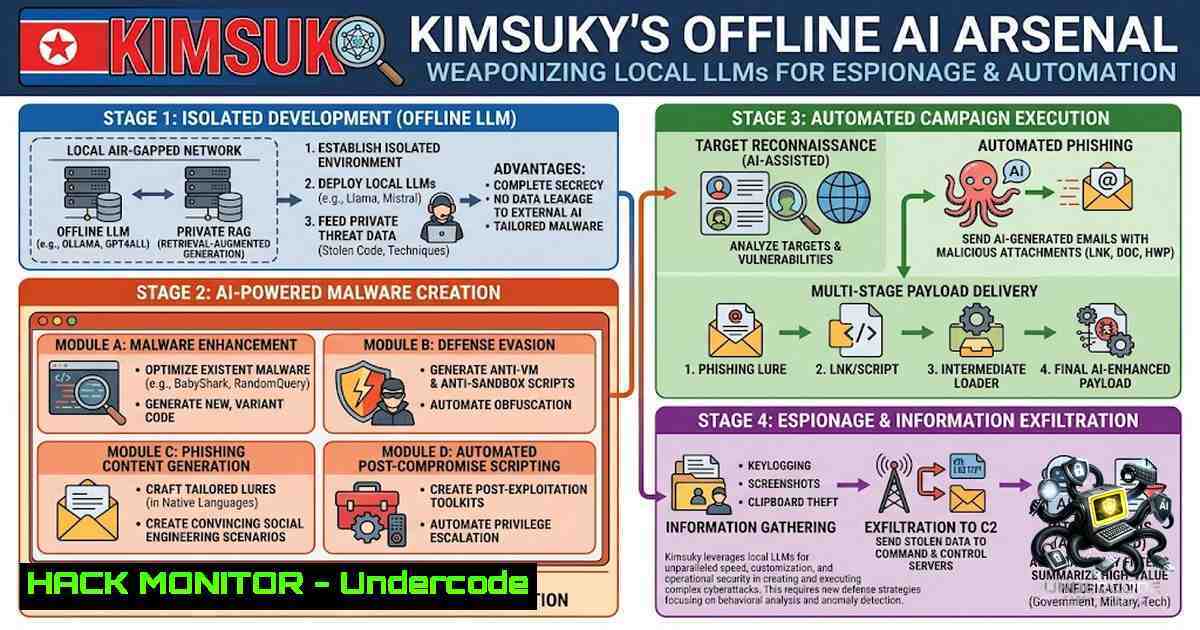
For years, state-sponsored cyber-espionage groups have leveraged generative AI to craft more convincing phishing lures. However, the North Korean-linked hacking collective known as Kimsuky has taken a significant leap forward by establishing a fully local infrastructure to run large language models (LLMs). According to a newly released report from South Korean cybersecurity firm Genians, this sanctioned state-sponsored unit is moving beyond simple prompt engineering. The group is now actively integrating tools like Ollama, GPT4All, and Msty into its attack workflow to automate malware development, analyze stolen data, and refine operational strategies without relying on external cloud-based services—drastically enhancing its operational security. The adoption of Retrieval-Augmented Generation (RAG) technology signals a technical shift toward more sophisticated cyber warfare, enabling Kimsuky to process sensitive documents internally and generate highly targeted, AI-generated decoys focused on finance and cryptocurrency.
Learning Objectives
- Understand how Kimsuky is operationalizing local LLMs and RAG technology to automate cyberattacks and enhance operational security.
- Identify the specific open-source tools (Ollama, GPT4All, Msty) and AI development frameworks being weaponized by state-sponsored actors.
- Learn to detect and mitigate the abuse of Git-based repositories as command-and-control (C2) infrastructure.
- Acquire practical command-line and configuration techniques to secure local AI deployments and harden enterprise environments against AI-driven threats.
- Develop threat-hunting strategies to correlate LNK execution, PowerShell activity, and GitHub traffic as indicators of compromise (IoCs).
You Should Know:
- The Local AI Stack: Ollama, GPT4All, and Msty
Genians’ investigation uncovered concrete evidence that Kimsuky is not merely experimenting with AI but actively building and operating local LLM environments. The core of this infrastructure relies on three primary tools:
- Ollama: A popular open-source framework for running LLMs locally. The group generated the cryptographic keys created on first launch, indicating active configuration rather than passive download. However, Ollama’s default configuration binds its HTTP API to `0.0.0.0:11434` with zero authentication, a critical vulnerability that allows unauthenticated attackers to perform model management operations, inject malicious models, and even leak sensitive inference data. This underscores the dual-use nature of such tools—while Kimsuky uses them offensively, their inherent insecurities can be exploited for defensive counter-operations.
- GPT4All: An ecosystem of open-source chatbots that runs locally. The researchers found a configured `localdocs_v3.db` database, which is the backbone of GPT4All’s LocalDocs RAG feature. This database serves as evidence that the actor attempted to connect an AI system to private documents in its possession, enabling the model to answer questions based on stolen intelligence without ever exfiltrating that data to the cloud.
- Msty: A local LLM client that further facilitates offline interactions with AI models, allowing operators to process documents without sending sensitive information to external AI services.
- Building AI into Malware: Development Frameworks and Cursor
Beyond ready-made applications, Kimsuky has been assembling a developer’s toolkit to weave AI capabilities directly into custom malware. On the same infrastructure, Genians identified several developer libraries and AI-assisted coding tools:
- LLaMaSharp: A .NET binding for LLaMA models, enabling the integration of LLM inference into C applications.
- Microsoft Semantic Kernel & Microsoft.Agents.AI: Frameworks for orchestrating AI agents and building AI functions into .NET software.
- Cursor: An AI-powered code editor that assists with rapid malware development, debugging, and code optimization.
- OpenAI Whisper: Speech-to-text files were discovered alongside guides on extracting text from audio, suggesting the group may be expanding its intelligence-gathering capabilities to include audio surveillance.
This combination of tools allows Kimsuky to automate complex attack chains, from writing malicious code to analyzing exfiltrated data, all within a closed-loop environment that minimizes exposure to external monitoring.
3. The RAG Advantage: Private Intelligence at Scale
The integration of Retrieval-Augmented Generation (RAG) technology is arguably the most significant technical shift in Kimsuky’s evolution. RAG allows an LLM to query a private collection of documents and generate responses grounded in that specific data. For an espionage group, this is transformative:
- Offline Data Processing: Stolen documents, including diplomatic cables, financial records, and cryptocurrency wallet data, can be indexed locally and queried using natural language. This eliminates the need to send sensitive material to third-party AI services like ChatGPT, which could be monitored or blocked.
- Enhanced Phishing: By combining RAG with AI-generated decoy documents, Kimsuky can produce highly personalized and contextually accurate phishing lures that reference real internal information, making them exceptionally difficult to detect.
- Automated Analysis: The group has been observed requesting analysis of datasets for wallet details, Gmail credentials, and site-registration history, with the instruction: “The more detailed the analysis, the better. Please do not do it haphazardly.”
- The Infection Chain: LNK Files, PowerShell, and GitHub C2
Kimsuky’s operational tactics remain consistent with its historical patterns, now supercharged by AI. The attack chain, dubbed “Operation GitPower” by Genians, typically unfolds as follows:
- Delivery: Spear-phishing emails containing ZIP archives with malicious LNK files are sent to targets in government, military, diplomatic, and financial sectors.
- Execution: When the LNK file is executed, it triggers obfuscated command-line arguments that invoke an embedded PowerShell loader.
- Reconnaissance: The PowerShell script collects extensive system information, including OS version, architecture, running processes, and boot history.
- C2 Communication: The compromised host connects to public GitHub repositories used as command-and-control infrastructure. These repositories host configuration files, additional PowerShell scripts, and encrypted AsyncRAT payloads disguised as image files.
Practical Mitigation and Detection Commands
To defend against this evolving threat landscape, security teams must adopt a multi-layered approach that combines endpoint detection, network monitoring, and secure AI configuration.
Linux Command: Detecting Ollama and RAG Activity
 Check for running Ollama processes and listening ports
ps aux | grep ollama
ss -tulpn | grep 11434

Search for GPT4All RAG databases
find / -1ame "localdocs_v3.db" 2>/dev/null

Monitor outbound connections to known Git-based C2 infrastructure
sudo tcpdump -i any -1 'host github.com and port 443'
Windows PowerShell: Identifying LNK Abuse and Obfuscated Scripts
 Search for recently created LNK files in user directories
Get-ChildItem -Path C:\Users\ -Recurse -Filter .lnk | Where-Object { $_.CreationTime -gt (Get-Date).AddDays(-30) }

Extract and analyze obfuscated PowerShell commands from LNK targets
Get-ChildItem -Path C:\Users\ -Recurse -Filter .lnk | ForEach-Object {
$shell = New-Object -ComObject WScript.Shell
$shortcut = $shell.CreateShortcut($_.FullName)
$shortcut.TargetPath + " " + $shortcut.Arguments
}

Detect Base64-encoded PowerShell execution
Get-WinEvent -LogName "Windows PowerShell" | Where-Object { $_.Message -match "Base64" }
Hardening Ollama Deployments
Given Ollama’s default lack of authentication, any organization running self-hosted LLMs must implement strict access controls:
 Bind Ollama to localhost only to prevent external access
export OLLAMA_HOST=127.0.0.1:11434
ollama serve

Alternatively, use a reverse proxy with authentication (e.g., NGINX + Basic Auth)
 /etc/nginx/sites-available/ollama
server {
listen 443 ssl;
server_name ollama.internal;
location / {
auth_basic "Restricted Access";
auth_basic_user_file /etc/nginx/.htpasswd;
proxy_pass http://127.0.0.1:11434;
}
}
What Undercode Say:
- Key Takeaway 1: Kimsuky’s move to local AI infrastructure represents a paradigm shift in cyber warfare. By operating offline, state-sponsored actors can now deploy sophisticated AI-driven attacks without the risk of detection or data leakage associated with cloud-based AI services.
- Key Takeaway 2: The combination of RAG technology with traditional spear-phishing tactics creates a new class of “hyper-personalized” attacks that leverage stolen intelligence to generate contextually accurate and highly convincing decoys. Defenders must shift their focus from analyzing the content of lures to monitoring post-execution behaviors, such as PowerShell activity and GitHub C2 traffic.
Analysis: The Genians report underscores a critical reality: the democratization of AI through open-source tools like Ollama and GPT4All is a double-edged sword. While these tools drive innovation, they also lower the barrier to entry for sophisticated cyber operations. Kimsuky, a group already sanctioned by the U.S. Treasury in 2023, is demonstrating how nation-states can rapidly operationalize emerging technologies. The use of RAG to process stolen documents locally is particularly concerning, as it enables intelligence agencies to sift through vast datasets with unprecedented speed and precision, automating what was once a labor-intensive manual process. For enterprise security teams, this means that traditional perimeter defenses are no longer sufficient. Behavior-based detection, EDR (Endpoint Detection and Response) correlation, and proactive threat hunting against LNK execution, PowerShell obfuscation, and anomalous GitHub traffic are now essential components of a robust security posture.
Prediction:
- -1 The proliferation of local AI stacks among state-sponsored groups will lead to a surge in AI-generated malware that is harder to signature-detect, increasing the workload for security operations centers and widening the skills gap in cybersecurity.
- -1 The use of RAG for automated document analysis will accelerate the speed of espionage, allowing attackers to extract actionable intelligence from stolen data within minutes rather than days, reducing the window for incident response.
- +1 The inherent vulnerabilities in tools like Ollama (e.g., CVE-2026-7482 “Bleeding Llama”) provide defenders with new opportunities for counter-intelligence, potentially allowing them to poison or monitor adversary AI models.
- +1 Increased awareness of AI-enabled threats will drive innovation in defensive AI, leading to the development of more sophisticated anomaly detection systems and automated threat-hunting platforms that can keep pace with adversarial AI.
- -1 As more threat actors adopt similar techniques, the barrier to entry for conducting state-level cyber espionage will lower, potentially leading to an increase in attacks from less sophisticated but financially motivated groups leveraging open-source AI tools.
▶️ Related Video (72% Match):
🎯Let’s Practice For Free:
🎓 Live Courses & Certifications:
Join Undercode Academy for Verified Certifications
🚀 Request a Custom Project:
Secure, high-velocity infrastructure and disruptive technological engineering. Contact our engineering team for high-tier development and proprietary systems:
[email protected]
💎 Smart Architecture | 🛡️ Secure by Design | ⭐ Trusted by Thousands
IT/Security Reporter URL:
Reported By: Alimoheyaldeen Kimsuky – Hackers Feeds
Extra Hub: Undercode MoN
Basic Verification: Pass ✅


