Listen to this Post
Introduction
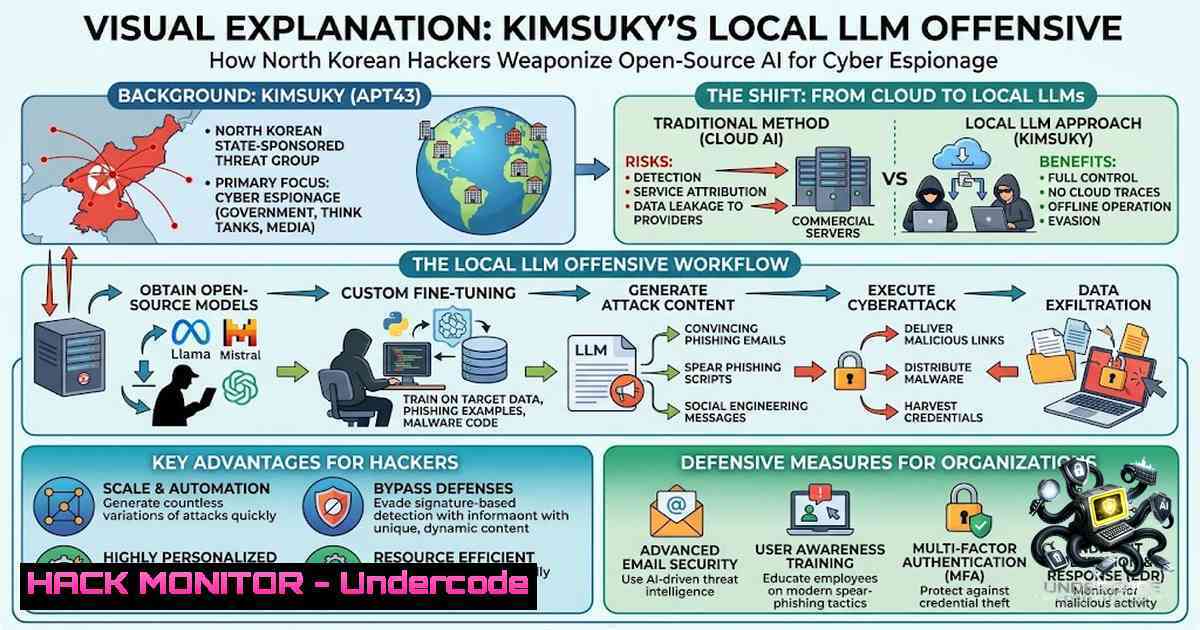
In a significant escalation of cyber warfare tactics, South Korean cybersecurity firm Genians has uncovered evidence that the North Korean state-backed hacking group Kimsuky is actively deploying local Large Language Model (LLM) environments using open-source tools including Ollama, GPT4All, and Msty. This development marks a critical shift from opportunistic AI experimentation to structured integration of artificial intelligence into the cyberattack lifecycle—enabling threat actors to process stolen documents, automate malware development, and generate hyper-realistic spear-phishing campaigns without ever sending sensitive data to external cloud services. The findings, part of an ongoing activity cluster labeled “Operation GitPower,” provide concrete evidence that Kimsuky is moving beyond using generative AI for phishing lures and is systematically building capacity to integrate existing AI models into malware development, data analysis, and attack automation.
Learning Objectives
- Understand how nation-state threat actors are operationalizing open-source AI tools for offensive cyber operations
- Identify the specific tools (Ollama, GPT4All, Msty, RAG) and techniques employed by Kimsuky in their AI-assisted attack framework
- Learn practical detection, monitoring, and mitigation strategies against locally-deployed LLM threats in enterprise environments
You Should Know
- The Kimsuky AI Arsenal: Tools, Techniques, and Infrastructure
Kimsuky—also tracked as APT43, Velvet Chollima, Emerald Sleet, and Thallium—operates under North Korea’s Reconnaissance General Bureau (RGB), the regime’s primary foreign intelligence service. Active since at least 2012, the group has a singular mission: intelligence collection at scale targeting governments, think tanks, academic institutions, military organizations, and diplomatic entities worldwide.
Genians’ investigation revealed that Kimsuky established multiple local LLM environments on infrastructure it controlled, utilizing:
- Ollama: A lightweight framework for running LLMs locally, enabling the group to deploy models without cloud dependencies
- GPT4All: An open-source ecosystem that runs models entirely on-device, ensuring complete data privacy
- Msty: A unified desktop application that manages local models across Ollama, MLX, and Llama.cpp with offline capabilities
- Retrieval-Augmented Generation (RAG): Document search technology used to analyze stolen materials locally
- Cursor: An AI-assisted coding tool for malware development acceleration
- Speech-to-text software and AI agent development frameworks
The group also collected libraries including LLaMaSharp and Microsoft.Extensions.AI, plus additional packages. Notably, Genians found no evidence that Kimsuky has trained its own AI models from scratch—they are leveraging existing open-source tools rather than building proprietary AI capabilities.
Step-by-Step: How Threat Actors Deploy Local LLMs
Understanding the deployment workflow helps security teams anticipate adversary behavior:
- Tool Acquisition: Download open-source LLM frameworks (Ollama, GPT4All, Msty) from official repositories or mirrored sources
- Model Selection: Pull specific models suited to operational needs—code-focused models for malware development, general-purpose models for document analysis
- Local Deployment: Install and configure the LLM environment on controlled infrastructure (servers, VPS instances, or compromised systems)
- RAG Integration: Set up document retrieval pipelines to index and query stolen intelligence data
- Operational Use: Deploy AI-generated content in phishing campaigns, automate code generation, or analyze exfiltrated documents
Linux/macOS Ollama Deployment Example:
 Install Ollama
curl -fsSL https://ollama.com/install.sh | sh

Start the Ollama service
ollama serve

Pull a model for use
ollama pull llama3.2
ollama pull codellama

Verify installation
ollama --version
curl http://localhost:11434/api/tags

Run a model interactively
ollama run llama3.2 "Generate a diplomatic meeting invitation"
Windows GPT4All Setup:
 Download the Windows installer from gpt4all.io
 Run the installer executable
 Launch GPT4All and opt out of data collection for maximum privacy
 Download models through the application interface
- The AI-Generated Spear-Phishing Pipeline: From Lures to Execution
Kimsuky has integrated AI-generated content into a sophisticated spear-phishing pipeline targeting military, diplomatic, and academic sectors. The attack chain typically follows this pattern:
Step 1: AI-Generated Decoy Document Creation
The group uses local LLMs to generate highly polished documents on a wide range of topics within short timeframes. These include finance and cryptocurrency-themed materials designed to resemble legitimate investment reports, research papers, meeting requests, embassy correspondence, and payment applications. The AI-generated documents “use natural language, a highly polished structure, and formats similar to actual business materials to increase user trust and induce the execution of malicious files”.
Step 2: Malicious Payload Delivery
Phishing emails contain ZIP archives with malicious LNK (Windows shortcut) files disguised as legitimate documents. When a recipient opens the archive and executes the LNK file, it runs an embedded PowerShell loader.
Step 3: Obfuscated Execution
The PowerShell script employs various obfuscation techniques including Base64 encoding, string splitting, and custom decoding routines to hide malicious behavior. The -EncodedCommand flag passes a Base64-encoded string that performs system information gathering.
Step 4: System Reconnaissance
The script collects extensive system information: operating system version and architecture, system configuration, PC type, installation and boot history, and a list of running processes.
Step 5: C2 Communication via GitHub
Kimsuky abuses Git-based repositories as command-and-control (C2) infrastructure for payload distribution and stolen data management. Public GitHub repositories operated by the threat actor contain configuration files, PowerShell scripts, and various payloads for subsequent attacks. This approach leverages legitimate services to evade detection—C2 traffic blends with normal Microsoft cloud communications.
Detection Commands for Security Teams:
Windows Event Log Monitoring (PowerShell Execution):
 Query Security Event Log for suspicious PowerShell executions
Get-WinEvent -FilterHashtable @{LogName='Security'; ID=4688} |
Where-Object {$_.Message -like "powershell"} |
Select-Object TimeCreated, Message

Check for encoded command indicators
Get-WinEvent -FilterHashtable @{LogName='Security'; ID=4688} |
Where-Object {$_.Message -like "-EncodedCommand"}
Sysmon DNS Query Detection for Local LLM Frameworks:
 Detect DNS queries to LLM framework domains (Sysmon Event ID 22)
Get-WinEvent -FilterHashtable @{LogName='Microsoft-Windows-Sysmon/Operational'; ID=22} |
Where-Object {($<em>.Message -like "ollama") -or
($</em>.Message -like "gpt4all") -or
($_.Message -like "msty")}
Linux Process Monitoring:
 Detect Ollama or GPT4All processes
ps aux | grep -E "ollama|gpt4all|msty"

Monitor for model file creation
find / -1ame ".gguf" -type f 2>/dev/null

Check for unusual network connections to GitHub
ss -tunap | grep github
3. The RAG Advantage: Processing Stolen Intelligence Offline
One of the most significant aspects of Kimsuky’s AI strategy is the implementation of Retrieval-Augmented Generation (RAG) for local document search and analysis. RAG enables the group to:
- Index and query large volumes of stolen documents without sending data to external services
- Analyze exfiltrated intelligence materials efficiently
- Generate context-aware responses and documents based on stolen information
The local approach “prevents conversation data from being transmitted to external AI services, reduces the risk of external exposure, making it a particularly attractive option for a state-sponsored threat actor”. This operational security advantage is critical for a group that cannot risk exposing sensitive intelligence to Western AI providers.
RAG Security Considerations for Defenders:
Organizations should be aware that RAG systems introduce new attack surfaces including:
– Knowledge base poisoning
– Indirect prompt injection
– Sensitive information leakage through retrieval
– Access control bypass
Monitoring for RAG Activity:
 Detect document processing patterns indicative of RAG usage
 Look for bulk reading of documents followed by LLM API calls
lsof | grep -E ".pdf|.docx|.xlsx" | grep ollama

Monitor for unusual document access patterns
auditctl -w /home/ -p r -k document_access
ausearch -k document_access -ts recent
- The Vulnerability Landscape: CVE-2026-7482 and Local LLM Risks
The Kimsuky revelations coincide with critical security vulnerabilities in the very tools they are exploiting. CVE-2026-7482, dubbed “Bleeding Llama,” is a critical unauthenticated heap out-of-bounds read vulnerability (CVSS 9.1) in Ollama’s GGUF model loader affecting versions prior to 0.17.1.
Technical Details:
- An attacker can craft a malicious GGUF model file with a declared tensor offset and size exceeding the file’s actual length
- The vulnerability allows unauthenticated remote attackers to leak the entire Ollama server process memory—including environment variables and API keys
- Approximately 300,000 internet-facing servers are at risk
- Public proof-of-concept exploits are available on GitHub
Mitigation Commands:
 Check current Ollama version
ollama --version

Upgrade to patched version (0.17.1 or later)
 Linux/macOS
curl -fsSL https://ollama.com/install.sh | sh

Verify upgrade
ollama --version

Restrict network access to Ollama service
 Bind only to localhost (default is safe)
 Avoid using OLLAMA_HOST=0.0.0.0 in production

Implement authentication proxy if remote access is required
 Use nginx with mTLS or OAuth2 Proxy
Network Isolation Best Practices:
 Block external access to Ollama port (11434)
 Using iptables
iptables -A INPUT -p tcp --dport 11434 -s 127.0.0.1 -j ACCEPT
iptables -A INPUT -p tcp --dport 11434 -j DROP

Using Windows Firewall
New-1etFirewallRule -DisplayName "Block Ollama External" -Direction Inbound -Protocol TCP -LocalPort 11434 -Action Block
- Detecting Shadow AI and Local LLM Deployments in Enterprise Environments
The Kimsuky case underscores a broader enterprise challenge: the proliferation of “shadow AI”—unauthorized local LLM deployments by employees or attackers. Organizations must implement detection strategies for unauthorized AI tools:
Detection Methods:
1. DNS Monitoring for LLM Framework Domains:
- Monitor for DNS queries to domains associated with Ollama, GPT4All, LM Studio, and Msty
- Deploy Sigma rules for detecting local LLM framework DNS queries
2. File Creation Monitoring:
- Detect creation of model files with .gguf extensions
- Monitor for downloads from model repositories (Hugging Face, Ollama registry)
3. Process Execution Analysis:
 Linux - Detect LLM processes
ps aux | grep -E "ollama|gpt4all|msty|llama|lm-studio"

Windows PowerShell - Detect LLM processes
Get-Process | Where-Object {$_.ProcessName -match "ollama|gpt4all|msty|llama"}
4. Network Connection Monitoring:
- Identify connections to Ollama API endpoints (port 11434)
- Monitor for GitHub API usage patterns consistent with C2 activity
5. Windows Event Log Correlation (Splunk Query Example):
index=windows EventCode=4688
(CommandLine="ollama" OR CommandLine="gpt4all" OR CommandLine="msty")
| stats count by User, Computer, CommandLine
| sort - count
- The Bigger Picture: AI-Assisted Cyber Threats as the New Normal
The Kimsuky case represents a watershed moment in cybersecurity. Genians’ findings “provide concrete evidence that the Kimsuky-affiliated threat actor is moving beyond one-off experimentation with AI and is continuously preparing to integrate the technology into actual attack capabilities”. This is not an isolated incident—it reflects a broader trend where “AI can enable the automation and large-scale production of social engineering attacks”.
Mark T. Hofmann, a criminal and intelligence analyst specializing in cybercrime, noted: “You no longer need hacking skills or a master’s degree in computer science. All you need is a computer and a motive”. He warned that “threat actors all around the world will use more and more generative AI and, much worse, AI agents to accelerate their cyberattacks”.
For cybersecurity teams, this means AI-assisted attacks must be integrated into threat models as a standard capability rather than an exotic edge case.
What Undercode Say
- AI Democratization Is a Double-Edged Sword: The same open-source tools that enable innovation and accessibility for legitimate users are equally available to nation-state adversaries. Kimsuky’s use of Ollama, GPT4All, and Msty demonstrates that sophisticated cyber capabilities no longer require massive infrastructure investments—they can be assembled from freely available components.
-
Offline Operations Represent a Strategic Advantage: By running AI models locally, Kimsuky avoids the operational security risks of cloud-based AI services. This approach prevents intelligence leakage, eliminates dependency on external providers, and enables operations in air-gapped environments. Expect other sophisticated threat actors to follow this playbook.
-
RAG Is the Force Multiplier: The integration of RAG with local LLMs transforms stolen documents from static intelligence into an actively queryable knowledge base. This dramatically accelerates the intelligence exploitation cycle and enables threat actors to extract value from stolen data at scale.
-
The Attack Surface Is Expanding Beyond Traditional Vectors: Local LLM deployments introduce new detection challenges—they may not generate network traffic, making them invisible to traditional network monitoring. Organizations need host-based detection capabilities to identify unauthorized AI tools.
-
Patch Management for AI Infrastructure Is Critical: The “Bleeding Llama” vulnerability (CVE-2026-7482) demonstrates that AI tools are subject to the same security flaws as traditional software. Organizations deploying local LLMs must treat them as part of their vulnerability management program.
-
GitHub as C2 Is a Growing Trend: Kimsuky’s abuse of GitHub repositories for command-and-control represents a sophisticated technique that leverages legitimate services to evade detection. Security teams must monitor for unusual GitHub API access patterns and unauthorized repository interactions.
-
The Line Between Cybercrime and State Espionage Is Blurring: Kimsuky’s use of cryptocurrency-themed decoy documents suggests the group is diversifying beyond traditional espionage targets, potentially to fund operations through financial theft—a pattern observed across North Korean hacking units.
Prediction
-
-1 Escalation of AI-Enabled Phishing Campaigns: As local LLM tools become more sophisticated and accessible, the volume and quality of AI-generated phishing lures will increase dramatically. Organizations will face an unprecedented wave of highly personalized, grammatically perfect social engineering attacks that are increasingly difficult to distinguish from legitimate communications.
-
-1 Proliferation of “AI-as-a-Service” for Cybercriminals: The success of Kimsuky’s local LLM approach will inspire the development of commercial AI-powered attack toolkits, lowering the barrier to entry for less sophisticated threat actors and democratizing AI-assisted cybercrime.
-
-1 RAG-Based Intelligence Exploitation as Standard Practice: The ability to query stolen documents using RAG will become a standard capability for espionage-focused threat actors. This will accelerate the intelligence cycle and increase the value derived from data breaches.
-
-1 Increased Regulatory Scrutiny of Open-Source AI Tools: The weaponization of open-source AI frameworks will likely trigger regulatory responses, potentially including export controls, usage restrictions, and mandatory security requirements for AI tool developers.
-
+1 Accelerated Development of AI Security Defenses: The Kimsuky revelations will drive investment in AI-specific security tools, including detection systems for unauthorized local LLM deployments, AI-generated content analysis, and adversarial AI defense capabilities. This will create new opportunities in the cybersecurity market.
-
+1 Enhanced Threat Intelligence Sharing: The cross-border nature of AI-assisted attacks will encourage greater international cooperation and threat intelligence sharing, particularly among allies facing North Korean cyber threats. This could lead to more robust collective defenses.
▶️ Related Video (78% Match):
https://www.youtube.com/watch?v=BNcvtQuIQgc
🎯Let’s Practice For Free:
🎓 Live Courses & Certifications:
Join Undercode Academy for Verified Certifications
🚀 Request a Custom Project:
Secure, high-velocity infrastructure and disruptive technological engineering. Contact our engineering team for high-tier development and proprietary systems:
[email protected]
💎 Smart Architecture | 🛡️ Secure by Design | ⭐ Trusted by Thousands
IT/Security Reporter URL:
Reported By: https://lnkd.in/p/eH6vYJY7 – Hackers Feeds
Extra Hub: Undercode MoN
Basic Verification: Pass ✅


