
Listen to this Post
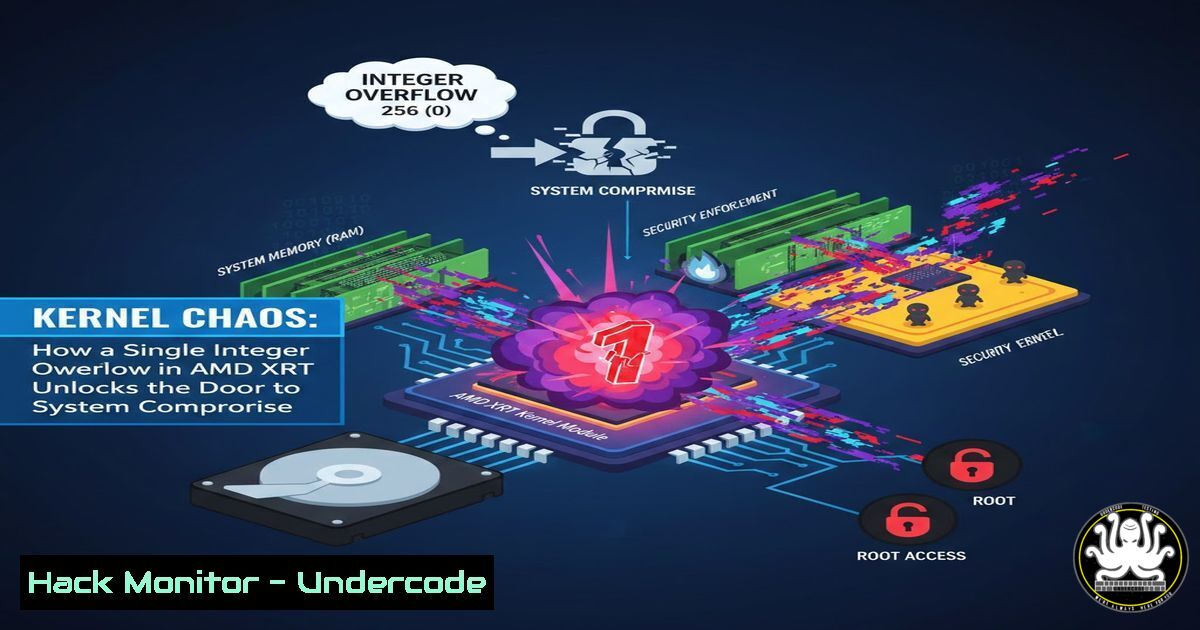
Introduction:
In the clandestine world of kernel-level security, a single misplaced integer can collapse the entire castle. A recent responsible disclosure by a security researcher to AMD highlights this stark reality, where an integer overflow vulnerability within the AMD Xilinx Runtime (XRT) kernel driver could have granted attackers a pathway to privilege escalation or system crashes. This incident underscores the perennial danger of arithmetic missteps in low-level code and serves as a masterclass in the critical intersection of hardware acceleration software and core system security.
Learning Objectives:
- Understand the mechanics and severe implications of integer overflow vulnerabilities in kernel-space drivers.
- Learn the methodology for interacting with and fuzzing kernel drivers from user-space to uncover such flaws.
- Acquire defensive coding and system hardening techniques to prevent and mitigate similar low-level exploits.
You Should Know:
- Deconstructing the Integer Overflow: From Theory to Kernel Panic
An integer overflow occurs when an arithmetic operation attempts to create a numeric value that falls outside the range that can be represented with a given number of bits. In a kernel driver, this often involves calculations for buffer sizes, offsets, or array indices using user-controlled input. If unchecked, this can lead to buffer underflows or overflows, corrupting critical kernel memory.
Step-by-step guide explaining what this does and how to use it.
Consider a driver function that allocates a buffer based on a user-provided `size` and count:
// Vulnerable Code Snippet
int driver_allocate(struct ioctl_data user_data) {
size_t total_size = user_data->size  user_data->count; // Integer Overflow here!
char kernel_buffer = kmalloc(total_size, GFP_KERNEL);
if (!kernel_buffer) return -ENOMEM;
// ... copy data from user ...
}
If `user_data->size = 4096` and `user_data->count = 1073741824` (2^30), the multiplication 4096 1073741824 = 4398046511104, which exceeds 32 bits. On a 32-bit system or with 32-bit size_t, this overflows and wraps around, resulting in a tiny `total_size` (e.g., 0). The subsequent `kmalloc` allocates a minuscule buffer, but the driver may then copy a huge amount of user data into it, leading to a catastrophic kernel heap overflow.
- The Bridge to Chaos: User-Space Interaction with Kernel Drivers
Kernel drivers are typically accessed from user-space via system calls (syscalls) or, more commonly for hardware, through `ioctl` (Input/Output Control) calls on a device file (e.g.,/dev/xrt). This interface is the attack surface.
Step-by-step guide explaining what this does and how to use it.
1. Identify the Device: First, find the device node associated with the driver.
$ ls -la /dev | grep xrt
crw- 1 root root 123, 0 Mar 20 /dev/xrt0
2. Craft an IOCTL Caller: Write a user-space program to interact with the driver. You need the correct IOCTL command codes (often found in driver headers).
include <sys/ioctl.h>
include <fcntl.h>

int main() {
int fd = open("/dev/xrt0", O_RDWR);
if (fd < 0) { perror("open"); return 1; }

struct my_ioctl_data data = {.size = 4096, .count = 1073741824};
int ret = ioctl(fd, VULNERABLE_IOCTL_CMD, &data); // Trigger the vulnerable path
close(fd);
return 0;
}
3. Fuzzing the Interface: Use a tool like `AFL++` in persistent mode or a custom fuzzer to generate thousands of malformed `ioctl` calls with varying `size` and `count` values to trigger the overflow condition.
3. Exploitation Primer: Turning Overflow into Privilege Escalation
While a simple overflow may cause a Denial-of-Service (DoS) via kernel panic, a skilled attacker aims for privilege escalation. The goal is to corrupt kernel memory structures to gain arbitrary code execution in kernel mode, effectively achieving root access.
Step-by-step guide explaining what this does and how to use it.
1. Heap Feng Shui (Grooming): Manipulate the kernel heap allocator (e.g., SLUB) to place controlled data adjacent to target objects (like `cred` structures holding UID/GID).
2. Direct Overflow & Overwrite: Use the integer overflow-induced buffer overflow to overwrite the function pointers or data in those adjacent objects.
// Conceptual goal: Overwrite a `cred` structure's UID field
struct cred target_cred = ...; // Located near our overflowed buffer
// Overflow writes 0 into `target_cred->uid` (root's uid)
3. Trigger Privilege Change: Force a context switch or operation that uses the corrupted object. If `current->cred->uid` is overwritten with 0, the process now runs as root.
4. Stability & Post-Exploitation: Use techniques like KASLR bypass and install a kernel rootkit or backdoor.
- Defensive Coding: Mitigating Integer Overflows at the Source
The primary fix is implemented in the driver source code using robust boundary checks.
Step-by-step guide explaining what this does and how to use it.
1. Use Saturation Arithmetic or Checked Functions: Employ helper functions that detect overflow before it happens.
include <linux/overflow.h>

size_t total_size;
if (check_mul_overflow(user_data->size, user_data->count, &total_size)) {
return -EINVAL; // Reject the request
}
char kernel_buffer = kmalloc(total_size, GFP_KERNEL);
2. Leverage Compiler Hardening: Enable compiler flags that insert runtime checks for common patterns.
CFLAGS += -ftrapv Trap signed integer overflows (GCC)
3. Code Review & Static Analysis: Integrate tools like Coverity, Clang Static Analyzer, or `Coccinelle` into the CI/CD pipeline to automatically catch unsafe arithmetic patterns.
5. System Hardening: Protecting the Running Kernel
Even with patched code, defense-in-depth is critical for unknown vulnerabilities.
Step-by-step guide explaining what this does and how to use it.
1. Enable Kernel Protections: Ensure these are active in your kernel configuration (/boot/config-).
$ grep -E "CONFIG_SLAB_FREELIST_HARDENED|CONFIG_STATIC_USERMODEHELPER|CONFIG_RANDOMIZE_KSTACKOFFSET" /boot/config-$(uname -r)
CONFIG_SLAB_FREELIST_HARDENED=y
CONFIG_STATIC_USERMODEHELPER=y
CONFIG_RANDOMIZE_KSTACKOFFSET=y
2. Restrict Device File Access: Use strict permissions and `sysctl` parameters to limit driver interaction.
$ sudo chmod 600 /dev/xrt0  Only root can read/write
$ echo 0 | sudo tee /proc/sys/kernel/unprivileged_bpf_disabled  Disable unprivileged BPF
3. Monitor & Detect: Use auditd or eBPF-based tools to monitor for anomalous `ioctl` calls.
$ sudo auditctl -a always,exit -S ioctl -F arch=b64 -F path=/dev/xrt0 -k xrt_driver_audit
What Undercode Say:
- The Perimeter is Within: The most critical attack surface is not always the network firewall; it’s the privileged, hardware-touching code running in your kernel. A single driver bug can nullify billions of dollars in perimeter security.
- Arithmetic is a Weapon: Modern exploit development requires deep mathematical understanding alongside memory corruption skills. What seems like a trivial math error can be weaponized into a full-system takeover.
This case is not an anomaly but a symptom. As hardware acceleration (GPUs, DPUs, FPGAs) becomes ubiquitous in data centers and cloud environments, the attack surface of kernel drivers expands exponentially. The AMD XRT flaw is a canonical example of the risks inherent in performance-critical, low-level code. We predict a surge in focused research towards AI accelerator drivers (like NVIDIA CUDA, AMD ROCm, and Intel oneAPI) and FPGA runtimes. The future of kernel exploitation—and defense—will be shaped by our ability to secure the complex dialogue between user-space applications and the privileged hardware abstractions they desperately rely on. Bug bounty programs for driver firmware and kernel modules will become as standard as those for web applications.
▶️ Related Video (76% Match):
🎯Let’s Practice For Free:
IT/Security Reporter URL:
Reported By: Tanish Saxena – Hackers Feeds
Extra Hub: Undercode MoN
Basic Verification: Pass ✅


