Listen to this Post
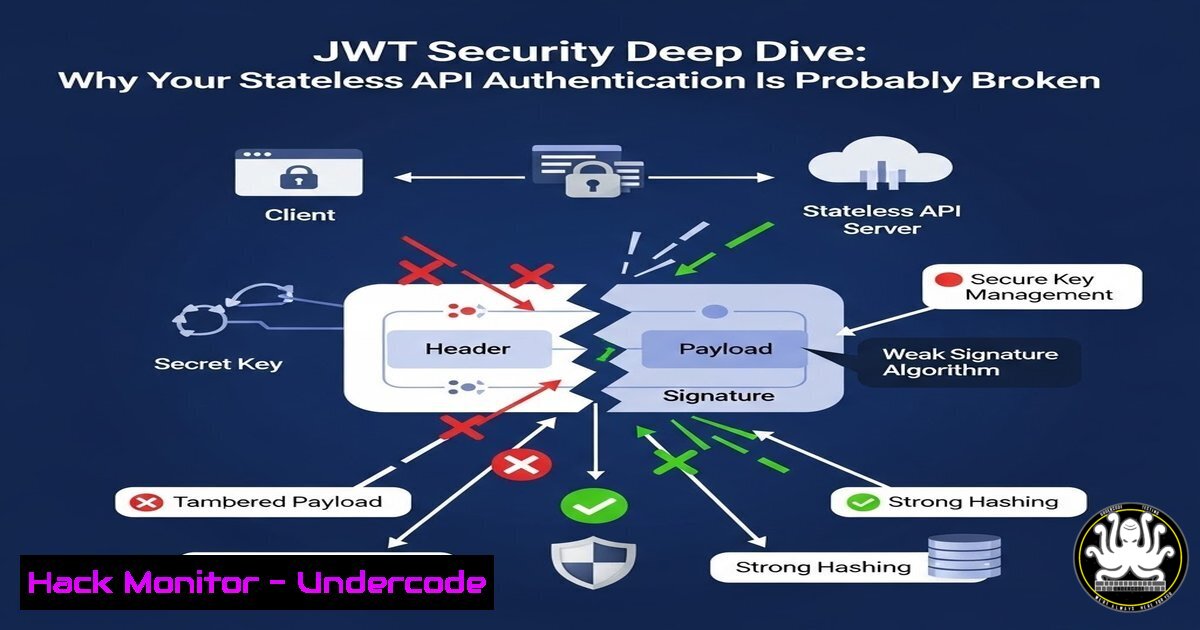
Introduction:
In the modern era of microservices and distributed systems, the concept of server-side sessions has become a bottleneck. To maintain scalability, modern APIs operate on a stateless principle—they do not store user session data between requests. JSON Web Tokens (JWT) have emerged as the standard solution to this problem, acting as self-contained access tokens that carry user identity and permissions. However, while frameworks provide the tools to generate and validate these tokens, they do not enforce security best practices. A misconfigured JWT implementation can lead to account takeover, privilege escalation, and data breaches. This article breaks down the mechanics of access tokens, the common pitfalls developers miss, and the exact commands and configurations needed to secure your API gateway.
Learning Objectives:
- Understand the stateless nature of JWTs and their role in API security.
- Learn to manually inspect and validate JWT signatures using CLI tools.
- Implement secure token storage and rotation strategies.
- Identify and mitigate common JWT vulnerabilities (algorithm confusion, missing expiration).
- Configure API gateways and middleware for robust token verification.
You Should Know:
- Anatomy of a JWT: Inspecting the Token Payload
Before securing an API, you must understand exactly what the token contains. A JWT is a base64url-encoded string consisting of three parts: Header, Payload, and Signature. Developers often forget that the payload is not encrypted; it is simply encoded. Anyone with the token can read its contents.
Step‑by‑step guide:
To inspect a JWT manually on Linux or macOS, you can use the command line.
- Capture a JWT: Assuming you have a token stored in an environment variable.
export JWT="eyJhbGciOiJIUzI1NiIsInR5cCI6IkpXVCJ9.eyJzdWIiOiIxMjM0NTY3ODkwIiwibmFtZSI6IkpvaG4gRG9lIiwiaWF0IjoxNTE2MjM5MDIyLCJyb2xlIjoidXNlciJ9.SflKxwRJSMeKKF2QT4fwpMeJf36POk6yJV_adQssw5c"
-
Split the Token: JWTs have three sections separated by dots.
Extract Header
echo $JWT | cut -d "." -f1 | base64 -d 2>/dev/null | jq .
Extract Payload
echo $JWT | cut -d "." -f2 | base64 -d 2>/dev/null | jq .
Note: You may need to add padding (
=). If `base64 -d` fails, usebase64 -d 2>/dev/null || echo "Padding issue". -
Analyze the Output: You will see the algorithm used (e.g., HS256) and the user claims. If you see a `role` or `admin` flag here, that data is publicly visible. Never store passwords or credit card numbers in a JWT payload.
-
The Critical Secret: Signing and Verification with OpenSSL
The security of a JWT relies entirely on the signature. If you are using a symmetric algorithm (HS256), the same secret used to sign the token must be used to verify it. If this secret is weak or leaked, attackers can forge tokens. For asymmetric algorithms (RS256), the private key signs, and a public key verifies.
Step‑by‑step guide: Creating a JWT with OpenSSL (without a library)
This demonstrates the raw cryptographic process, highlighting why the secret matters.
1. Create a Header and Payload:
HEADER='{"alg":"HS256","typ":"JWT"}'
PAYLOAD='{"sub":"1234567890","name":"Security Audit","iat":1516239022,"role":"user"}'
2. Base64URL Encode (Linux):
B64HEADER=$(echo -n $HEADER | base64 | tr '+/' '-<em>' | tr -d '=')
B64PAYLOAD=$(echo -n $PAYLOAD | base64 | tr '+/' '-</em>' | tr -d '=')
- Create the Signature: Use a secret key (
your-256-bit-secret) with HMAC-SHA256.SIGNATURE=$(echo -n "$B64HEADER.$B64PAYLOAD" | openssl dgst -sha256 -hmac "your-256-bit-secret" -binary | base64 | tr '+/' '-_' | tr -d '=')
4. Assemble the Token:
echo "$B64HEADER.$B64PAYLOAD.$SIGNATURE"
Security Takeaway: If the secret `your-256-bit-secret` is weak (e.g., “secret”), an attacker can brute-force it. On Linux, you can test secret strength using `hashcat` or john.
- Algorithm Confusion Attack: Forging Tokens with Public Keys
A severe vulnerability occurs when an application uses RS256 (asymmetric) but fails to restrict the algorithm type. An attacker can change the header from `RS256` to `HS256` and sign the token with the public key, which is often publicly available. The server, expecting an RSA signature, might mistakenly use the public key as the HMAC secret, validating the forged token.
Mitigation Steps:
- Verify the `alg` Header: Your middleware must explicitly reject tokens with a different algorithm than expected.
2. Node.js (jsonwebtoken) Example: Explicitly set algorithms.
jwt.verify(token, publicKey, { algorithms: ['RS256'] }, (err, decoded) => {
// Callback
});
3. Python (PyJWT) Example:
import jwt
 This will fail if the token's alg is not in the list
decoded = jwt.decode(token, public_key, algorithms=["RS256"])
4. Linux Command-Line Check: You can manually decode the header to see the algorithm.
echo $JWT | cut -d "." -f1 | base64 -d
If the output shows `”alg”:”none”` or a mismatch, the token is malicious.
4. Stateless vs. Stateful: Implementing Token Blacklists
Statelessness is a feature, but a bug when you need to log a user out immediately or change their permissions. Since JWTs are valid until they expire, a compromised token remains valid. You must implement a token blacklist or “deny list” to revoke tokens before expiration.
Implementation Strategy with Redis:
Use an in-memory store like Redis to blacklist tokens.
- On Logout: Add the token’s `jti` (JWT ID) to Redis with a TTL matching the token’s remaining lifespan.
Redis CLI command
SET blacklist:<jti> "revoked" EX <seconds_until_expiry>
2. On Request Interception (Pseudocode):
 Python/Flask example
token = get_token_from_header(request)
jti = decode_token(token).get('jti')
if redis_client.exists(f"blacklist:{jti}"):
abort(401, description="Token revoked")
3. Curl Test for Revoked Token:
curl -X GET https://api.example.com/protected \
-H "Authorization: Bearer $REVOKED_TOKEN"
 Expected Response: 401 Unauthorized
5. Short-Lived Tokens and Refresh Token Rotation
The primary defense against long-term token theft is ensuring access tokens are short-lived (e.g., 15 minutes). Combine this with refresh tokens to maintain user sessions.
Security Flow:
- Access Token: Short lifespan (15m). Sent with every request.
- Refresh Token: Long lifespan (7 days). Sent only to a specific `/refresh` endpoint. Must be stored securely (HTTP-only, Secure, SameSite=Strict cookies on the frontend).
Configuring Nginx to Forward Auth Headers (API Gateway Level):
When using an API gateway, you might need to pass the token to upstream services.
location /api/ {
 Pass the Authorization header exactly as received
proxy_set_header Authorization $http_authorization;
proxy_pass http://backend_servers;
}
- Hardening Storage: Where to Keep JWTs on the Client
A common mistake is storing JWTs in localStorage. This makes them accessible to any JavaScript running on the same origin, leading to XSS token theft.
Secure Storage Recommendation:
- Browser: Store the token in an HTTP-only Cookie. This prevents JavaScript access. Ensure the cookie has
Secure, `SameSite=Lax` (or Strict), and `Path=/` attributes. - Mobile: Use the platform’s secure storage (Keychain on iOS, Keystore on Android).
Setting the Cookie (Backend Example – Express):
res.cookie('token', jwtToken, {
httpOnly: true,
secure: true, // Send only over HTTPS
sameSite: 'Strict', // Protect against CSRF
maxAge: 900000 // 15 minutes
});
7. Auditing Dependencies: Keeping Libraries Updated
Vulnerabilities are often found in the JWT libraries themselves, not just the implementation. In 2022, a critical flaw in `jsonwebtoken` allowed remote code execution under certain conditions.
Command to Audit Node.js Dependencies:
 In your project directory
npm audit

If a JWT library vulnerability is found
npm update jsonwebtoken --depth 5
npm audit fix
Command to Check Java (Maven) for JWT Libraries:
mvn dependency:tree | grep -i "jwt|jjwt"
What Undercode Say:
- Key Takeaway 1: Frameworks abstract complexity, not liability. Understanding the raw cryptographic exchange (header, payload, signature) is essential for identifying misconfigurations like weak secrets or algorithm confusion.
- Key Takeaway 2: Statelessness does not mean “no security state.” You must implement hybrid approaches—short-lived tokens for stateless efficiency and a blacklist (like Redis) for immediate revocation.
The post correctly emphasizes that JWTs are foundational. However, the community often overlooks the operational reality: token inspection, rotation, and secure client-side storage are as critical as the signing process itself. Developers should shift from “it works” to “it is unforgeable.” This requires rigorous input validation, strict algorithm whitelisting, and the assumption that the token could be stolen—hence the need for very short expiration times and refresh token rotation. In a cloud-native world, securing the API gateway with these principles is the difference between a scalable architecture and a public data leak.
Prediction:
As quantum computing advances, the cryptographic primitives used in JWTs (RSA, ECDSA) will become obsolete. We will see a migration toward Post-Quantum Cryptography (PQC) for signing tokens. Furthermore, with the rise of zero-trust architectures, JWTs will be supplemented with “continuous verification,” where a valid token alone is insufficient—behavioral analytics and device posture checks will become mandatory before granting access to sensitive resources. The era of the “forever valid” JWT is ending; dynamic authorization will be the new standard.
▶️ Related Video (84% Match):
🎯Let’s Practice For Free:
IT/Security Reporter URL:
Reported By: Hephzibaholuwasina Kinda – Hackers Feeds
Extra Hub: Undercode MoN
Basic Verification: Pass ✅


