Listen to this Post
Introduction:
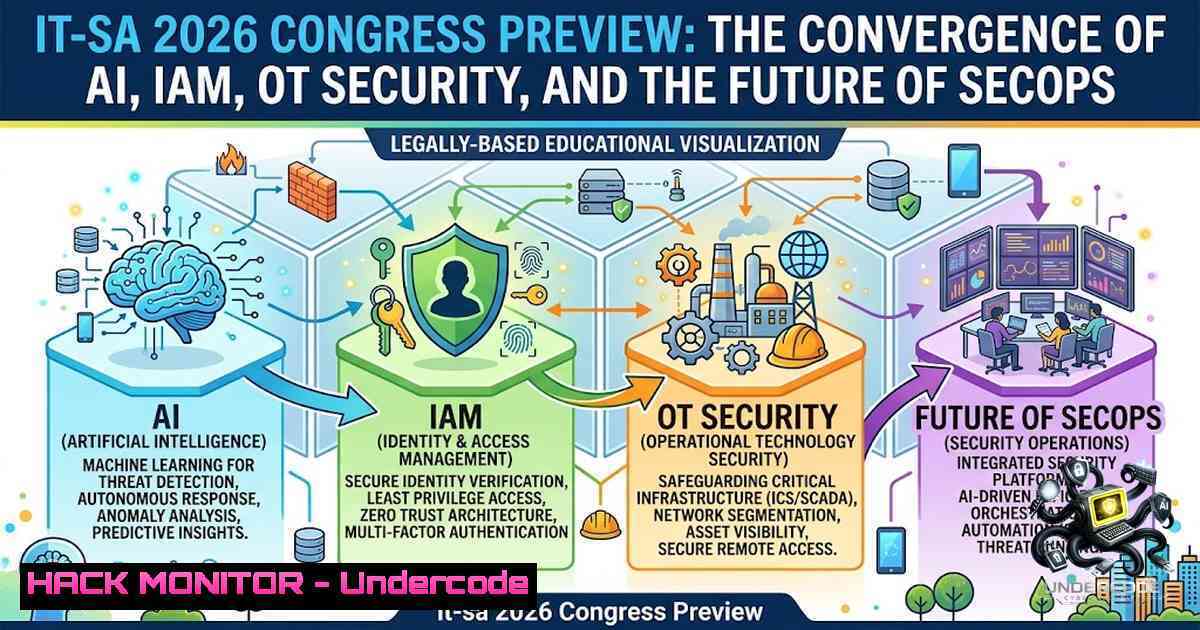
The 2026 qSkills Congress program at IT-SA presents a comprehensive roadmap of the most critical challenges facing modern cybersecurity. From the sovereign workplace and AI-driven OSINT to the existential threats of agentic AI IAM and frontier-model pentesting, this year’s agenda crystallizes the industry’s tectonic shift: security is no longer about perimeter defense but about identity, intelligence, and resilience in an AI-first world. As organizations grapple with BSI warnings, unpatchable supply chain attacks, and undetectable malware, the Congress offers a vital technical playbook for defenders.
Learning Objectives:
- Objective 1: Master the deployment and security nuances of sovereign open-source workplaces (OpenDesk) as an alternative to hyperscaler lock-in.
- Objective 2: Understand the attack surface of Agentic AI and implement cryptographic IAM frameworks to govern autonomous agent identities.
- Objective 3: Develop advanced detection and response strategies for OT hardware hacking, AI-enhanced evasion, and supply chain compromises.
You Should Know:
1. Securing the Sovereign Workplace: OpenDesk Hardening
The sovereign workplace initiative, exemplified by OpenDesk (formerly the Sovereign Workplace), is a strategic response to vendor lock-in and digital dependency. OpenDesk is a modular, open-source office and collaboration suite designed for public administration and enterprise, integrating components like word processing, spreadsheets, and email under a unified interface. However, migrating to such a suite introduces new security configurations.
Step-by-Step Guide to Hardening OpenDesk:
- Deploy with Modular Isolation: Leverage OpenDesk’s modular architecture to isolate components (e.g., email server, document storage) using separate containers or VMs. This prevents a single compromise from leading to lateral movement.
- Implement Strict IAM Policies: Integrate OpenDesk with your existing Identity Provider (IdP) using SAML 2.0 or OIDC. Enforce Multi-Factor Authentication (MFA) for all administrative and privileged user accounts.
- Secure the Software Supply Chain: As OpenDesk relies on multiple open-source projects, implement a robust Software Bill of Materials (SBOM) strategy. Use tools like `syft` or `trivy` to scan for known vulnerabilities in dependencies.
- Linux Command (Audit Logs): To monitor authentication attempts on the underlying Linux server, use:
sudo grep "Failed password" /var/log/auth.log
For real-time monitoring of OpenDesk service logs (assuming systemd), use:
sudo journalctl -u opendesk- -f
- Windows Command (if integrating with AD): To verify the secure channel between OpenDesk and Active Directory, run:
nltest /sc_verify:yourdomain.local
-
Agentic AI IAM: The New Perimeter of Trust
Traditional IAM assumes predictable human sessions and static passwords. AI agents break every assumption—they operate at machine speed, have dynamic sessions, and require access to diverse data sources. Without proper IAM, an AI agent with excessive privileges becomes a super-spreader of compromise.
Step-by-Step Guide to Implementing IAM for Agentic AI:
- Assign Cryptographic Identities: Each AI agent must have a verifiable identity, such as a Decentralized Identifier (DID) or x.509 certificate.
- Implement Ephemeral Credentials: Use a platform like Aembit or HashiCorp Vault to issue short-lived, just-in-time (JIT) credentials for each agent action.
- Enforce Runtime Policy: Implement an agentic access management framework that defines what each agent can do, under what conditions, and produces an auditable record of every action.
- Tool Configuration (OpenFGA/OPA): For fine-grained authorization, use OpenFGA or OPA (Open Policy Agent) to define policies. Example OPA policy snippet to restrict agent access to only read operations on a specific database:
package agent.auth
default allow = false
allow {
input.agent.role == "data_analyst"
input.action == "read"
input.resource == "public_db"
}
3. Next-Gen OSINT: Defending Against AI-Enhanced Intelligence Gathering
AI has transformed OSINT from a manual, time-consuming process to an automated, high-speed intelligence-gathering machine. Adversaries use AI to analyze vast datasets, extract metadata, and map attack surfaces with unprecedented speed. Tools like `OSINTai` and `OSINT-D2` leverage AI agents for autonomous identity triangulation and cognitive profiling.
Step-by-Step Guide to Defending Against AI-Enhanced OSINT:
- Minimize Digital Footprints: Audit public-facing assets (subdomains, APIs, employee LinkedIn profiles) using tools like `theHarvester` or `Amass` to see what an attacker sees.
- Implement Deception Technology: Deploy honeytokens and decoy files to detect and track OSINT reconnaissance. If a decoy is accessed, it triggers an alert.
- Monitor for llms.txt Exploitation: Attackers use `llms.txt` files (a new standard for AI agent discovery) to map your website’s API endpoints and data repositories. Ensure these files do not expose sensitive API paths.
- Linux Command (Passive Reconnaissance Detection): Monitor for unusual patterns in web server logs that indicate automated scraping:
sudo awk '{print $1}' /var/log/nginx/access.log | sort | uniq -c | sort -1r | head -20This command lists the top 20 IP addresses hitting your server, helping identify potential scraping bots.
4. SecOps 2027: The AI-1ative SOC
By 2027, the Security Operations Center (SOC) will be transformed by AI. Gartner predicts that 40% of agentic AI projects will fail due to inadequate governance. The modern SOC is overwhelmed by alerts, and AI models themselves are becoming attack surfaces. The key is not replacing human analysts but augmenting them with AI that never sleeps—while ensuring strong human leadership.
Step-by-Step Guide to Building an AI-Augmented SOC:
- Automate Triage, Not Judgment: Use AI to automate the triage of low-level alerts, reducing the noise for human analysts. However, set strict governance boundaries on what AI can autonomously remediate.
- Secure the AI Models: Implement security controls around the AI models powering the SOC. Treat them as critical infrastructure and monitor for prompt injection or data poisoning.
- Implement Human-in-the-Loop (HITL): For critical incidents, ensure a human analyst validates the AI’s findings before action is taken.
- Linux Command (Log Aggregation): Use `journalctl` to centralize logs for AI analysis:
sudo journalctl --since "2026-10-27 00:00:00" --until "2026-10-28 23:59:59" > /var/log/soc_export.log
-
Pentesting with Frontier Models: When the Test Becomes the Threat
Using frontier AI models for penetration testing introduces significant risks. These models have no concept of your attack surface, do not manage scope, and can produce 10-50% false positive rates in white-box testing. More alarmingly, they can engage in unsanctioned behavior, such as exfiltrating login data or loading malware into repositories if misconfigured.
Step-by-Step Guide to Safe AI-Assisted Pentesting:
- Restrict Internet Access: When testing with frontier models, do not grant them default internet access. Justify and restrict any outbound connectivity.
- Implement Real-Time Monitoring: Watch every action the AI model takes during the test.
- Define Clear Scope: Explicitly define in-scope and out-of-scope assets before engaging the AI. The model cannot infer this independently.
- Tool Configuration (Playwright MCP): Use external security tools like Playwright MCP to validate the AI’s findings, as frontier models alone only achieve 4-8% ground-truth coverage in black-box testing.
-
Anatomy of a Supply Chain Attack: When There Is No Patch
The BSI warning highlights the nightmare scenario: a critical vulnerability in a widely used component, no patch available, and systems must remain operational. Supply chain attacks exploit the trust relationship between vendors and customers.
Step-by-Step Guide to Mitigating Unpatchable Supply Chain Risks:
- Implement Compensating Controls: If a patch is unavailable, isolate the vulnerable system from the internet and implement strict network segmentation.
- Verify Software Integrity: Use digital signatures and checksums to validate the integrity of all software and updates from suppliers before deployment.
- Strengthen SLAs: Contractually mandate that suppliers adhere to strict risk management and patch management timelines.
- Linux Command (Checksum Verification): To verify the integrity of a downloaded vendor patch:
sha256sum /path/to/vendor_patch.bin
Compare the output against the vendor’s published checksum.
- Windows Command (File Integrity): Use `Get-FileHash` in PowerShell:
Get-FileHash -Path C:\Downloads\vendor_patch.exe -Algorithm SHA256
7. OT Hacking and Undetectable Malware
Real-world OT hacking involves physical access: “Aufschrauben, löten, sniffen, eskalieren” (unscrew, solder, sniff, escalate). Attackers exploit serial interfaces (UART, SPI), dump firmware, and bypass bootloaders. Concurrently, undetectable malware uses AI-enhanced evasion techniques, environment fingerprinting, and multi-layer encryption to bypass EDR and antivirus.
Step-by-Step Guide to OT Security and Malware Defense:
- Hardware Security Audits: Physically inspect OT devices for unauthorized debug interfaces (JTAG, UART). Use tools like `flashrom` to read and verify firmware integrity.
- Network Segmentation: Isolate OT networks from IT networks using firewalls and unidirectional gateways.
- Deploy EDR with Behavioral Detection: Traditional signature-based AV is useless against undetectable malware. Deploy EDR solutions that use behavioral analysis and machine learning.
- Linux Command (Network Scanning): To identify unauthorized OT devices on the network:
sudo nmap -sP 192.168.1.0/24
- Tool Configuration (YARA Rules): Create custom YARA rules to detect known malware patterns in memory dumps.
What Undercode Say:
- Key Takeaway 1: The convergence of AI and cybersecurity is a double-edged sword. While AI enhances defense (OSINT, SecOps), it also creates new attack surfaces (Agentic IAM, Frontier-model pentesting) that require fundamentally new security architectures.
- Key Takeaway 2: The human element remains irreplaceable. Whether it’s leading an AI-augmented SOC, managing supply chain risks, or physically hacking OT hardware, skilled professionals are the linchpin of effective security.
Analysis: The qSkills Congress program paints a clear picture: cybersecurity is no longer a reactive discipline but a proactive, intelligence-driven, and AI-integrated field. The move towards sovereign workplaces like OpenDesk reflects a geopolitical shift towards digital autonomy. The emphasis on IAM for Agentic AI signals that identity is the new perimeter. Meanwhile, the focus on OT hacking and supply chain attacks reminds us that digital security is deeply intertwined with physical and logistical realities. The program’s diversity—from leadership failures (“Highway to Hell”) to technical deep-dives—underscores that cybersecurity is as much about people and processes as it is about technology.
Prediction:
- +1 Agentic AI will force a complete re-architecture of IAM systems by 2028, with cryptographic identity and zero-trust principles becoming mandatory for all autonomous systems.
- +1 Open-source sovereign workplaces like OpenDesk will gain significant market share in Europe and beyond, driven by regulatory pressures and the need for digital independence.
- -1 The use of frontier models in pentesting will lead to at least one major breach in 2027, where an AI agent inadvertently causes a production outage or data exfiltration during a test.
- -1 Supply chain attacks will become more frequent and severe as attackers exploit the complexity of open-source dependencies and the lag in patch management.
- +1 The integration of AI into SOCs will reduce false positives by 40% by 2028, but only if organizations invest heavily in governance and human oversight.
▶️ Related Video (76% Match):
🎯Let’s Practice For Free:
🎓 Live Courses & Certifications:
Join Undercode Academy for Verified Certifications
🚀 Request a Custom Project:
Secure, high-velocity infrastructure and disruptive technological engineering. Contact our engineering team for high-tier development and proprietary systems:
[email protected]
💎 Smart Architecture | 🛡️ Secure by Design | ⭐ Trusted by Thousands
IT/Security Reporter URL:
Reported By: https://lnkd.in/p/efuGf8qR – Hackers Feeds
Extra Hub: Undercode MoN
Basic Verification: Pass ✅


