Listen to this Post
Introduction:
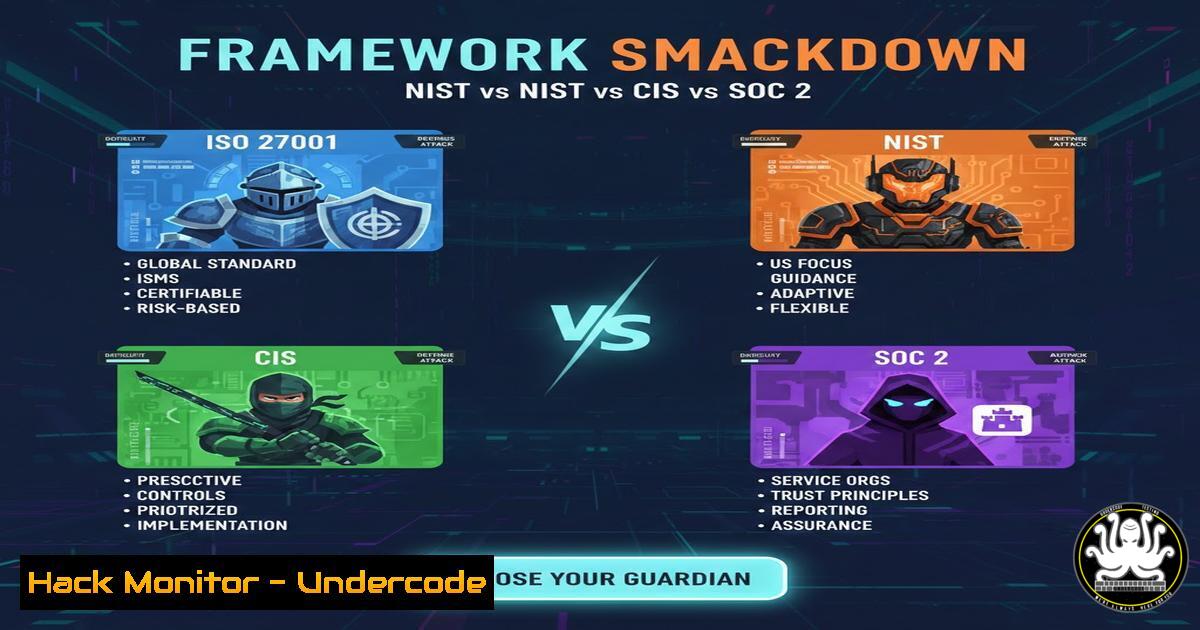
In today’s complex threat landscape, selecting and implementing the right security framework is not just a compliance exercise—it’s a strategic imperative for survival. Organizations are bombarded with options like ISO 27001, NIST CSF, CIS Controls, and SOC 2, each promising a path to resilience. Understanding their unique architectures, from ISO’s certifiable management system to NIST’s strategic governance and CIS’s technical pragmatism, is the first critical step in building a defensible, layered security posture that satisfies both auditors and threat actors.
Learning Objectives:
- Decipher the core purpose, scope, and primary audience for ISO 27001, NIST CSF, CIS Controls, and SOC 2.
- Gain practical, technical steps to implement key controls from each framework using common IT commands and tools.
- Develop a strategy to intelligently integrate multiple frameworks for comprehensive coverage without redundant effort.
You Should Know:
1. ISO 27001: The Certifiable Management System Blueprint
ISO 27001 is an international standard for an Information Security Management System (ISMS), providing a framework for managing people, processes, and technology. Its 93 controls in Annex A are designed to be systematically managed and audited for formal certification.
Step‑by‑step guide explaining what this does and how to use it.
Step 1: Scope Definition & Risk Assessment
Define the scope of your ISMS (e.g., “All customer-facing web applications and associated AWS infrastructure”). Conduct a risk assessment. A foundational step is asset inventory and basic vulnerability identification.
– Linux Command (Asset Discovery): `nmap -sV -O 192.168.1.0/24 > network_inventory.txt` This scans the local subnet for open ports and operating systems.
– Action: Catalog the output and classify assets (e.g., Web Server, Database).
Step 2: Implement Annex A Controls – Access Control (A.9.2.1)
A core ISO control is user access management. This involves implementing formal user provisioning and de-provisioning procedures.
– Windows Command (User Management):
 Create a new user (Part of provisioning procedure)
New-LocalUser -Name "jdoe" -Description "Developer Account" -NoPassword
 Add user to a group
Add-LocalGroupMember -Group "Remote Desktop Users" -Member "jdoe"
 Disable a user account (Part of de-provisioning)
Disable-LocalUser -Name "jdoe"
Step 3: Internal Audit & Management Review
Use logging to verify controls. Check successful and failed login attempts.
– Linux Command (Audit Logs): `sudo grep “Failed password” /var/log/auth.log` Review this regularly as part of your ISMS monitoring.
- NIST CSF 2.0: The Strategic Risk Governance Engine
The NIST Cybersecurity Framework (CSF) 2.0 is a risk-based framework organized around five core Functions: Identify, Protect, Detect, Respond, Recover. It helps align security activities with business objectives and assess maturity.
Step‑by‑step guide explaining what this does and how to use it.
Step 1: Identify – Asset & Vulnerability Management
Map your critical assets and their vulnerabilities. This feeds the “Identify” function.
– Tool Configuration (Vulnerability Scanner – Nessus/OpenVAS): Run a credentialed scan against a critical server.
– Command to prepare for scan (Linux): Ensure SSH key access or provide credentials in the scanner to perform a deep scan. The scanner will produce a report categorizing CVEs by severity (Critical, High, Medium), directly informing your risk register.
Step 2: Protect – Implement Access Control & Hardening
Align with the “Protect” function. Apply the principle of least privilege and system hardening.
– Linux Hardening (SSH): Edit `/etc/ssh/sshd_config`
PermitRootLogin no
PasswordAuthentication no
MaxAuthTries 3
Reload SSH: sudo systemctl reload sshd. This directly implements CSF’s “Identity Management and Access Control” (PR.AA) category.
- CIS Controls v8.1: The Technical Team’s Quick-Win Playbook
The CIS Critical Security Controls are a prioritized set of 18 actionable security practices. They are designed for efficient implementation, starting with foundational controls.
Step‑by‑step guide explaining what this does and how to use it.
Step 1: Implement Inventory and Control of Enterprise Assets (CIS Control 1)
You cannot protect what you don’t know. Use active discovery tools.
– Script Example (Bash Ping Sweep):
!/bin/bash
for i in {1..254}; do
ping -c 1 -W 1 192.168.1.$i | grep "64 bytes" | cut -d " " -f 4 | tr -d ":" &
done > live_hosts.txt
Run this script to build a dynamic list of active IPs.
Step 2: Secure Configuration for Hardware and Software (CIS Control 4)
Apply CIS Benchmarks, which are free, consensus-based hardening guides.
– Windows (PowerShell – Check for Local Admins): `Get-LocalGroupMember -Group “Administrators”` Review this list against policy. Remove unnecessary accounts.
– Linux (Apply Benchmark – Audit): Use tools like `lynis` or `CIS-CAT` to audit your system against the CIS Benchmark for Ubuntu/RHEL. Remediate findings like ensuring `umask` is set to 027.
4. SOC 2: The Service Organization’s Trust Attestation
SOC 2 is an audit report based on the Trust Services Criteria (Security, Availability, Processing Integrity, Confidentiality, Privacy). It provides assurance to clients about your control environment.
Step‑by‑step guide explaining what this does and how to use it.
Step 1: Implement Logging and Monitoring for Security Criterion
A universal SOC 2 requirement is monitoring for unauthorized access.
– Cloud (AWS CloudTrail & GuardDuty): Enable CloudTrail across all regions to log API activity. Enable GuardDuty for intelligent threat detection. This provides audit-ready evidence.
– On-Prem (SIEM – Elastic Stack): Ingest system logs into Elasticsearch. Create a detection rule for brute force attacks in Kibana Alerting.
Step 2: Change Management for Processing Integrity
Demonstrate controlled deployment of code to systems.
- Tool Configuration (Git & CI/CD): Enforce that all code changes are committed to a Git repository. Configure a CI/CD pipeline (e.g., Jenkins, GitLab CI) where deployments require a peer-reviewed merge request. The Git log provides an immutable audit trail.
5. Integration Strategy: Building Your Layered Defense
The true power lies in mapping controls across frameworks to avoid duplication and ensure gaps are filled.
Step‑by‑step guide explaining what this does and how to use it.
Step 1: Create a Control Mapping Matrix
Use a spreadsheet or GRC tool. Map one control to many frameworks.
– Example Row:
– Control Activity: “Multi-factor authentication (MFA) for administrative access.”
– ISO 27001: A.9.4.2 (Secure log-on procedures).
– NIST CSF: PR.AA-5 (MFA is implemented).
– CIS Controls: 6.3 (MFA for administrative access).
– SOC 2: CC6.1 (Logical access security).
Step 2: Prioritize Implementation Using CIS & NIST
Start with CIS Control 1 (Inventory). This also satisfies NIST CSF (Identify:ID.AM) and provides data for ISO 27001 risk assessment. Next, apply CIS Benchmarks (Control 4), which fulfills parts of NIST Protect and ISO A.8 (Asset Management). This integrated approach delivers measurable, high-impact security improvements rapidly.
What Undercode Say:
- Synergy Over Singularity: No single framework is “the best.” The most resilient organizations treat frameworks as a toolkit, using ISO for the certified management system structure, NIST for strategic risk governance, CIS for prioritized technical action, and SOC 2 for client-facing assurance. Their重叠 is a feature, not a bug—it highlights universally accepted critical controls.
- Automation is the Force Multiplier: Manual compliance is unsustainable. The future lies in Codified Compliance—expressing framework controls as infrastructure-as-code (IaC) templates, security-as-code policies in tools like HashiCorp Sentinel or Open Policy Agent, and continuous monitoring scripts. This transforms static audits into dynamic, evidence-based assurance.
Prediction:
The convergence of these frameworks will accelerate, driven by AI and automation. We will see the rise of “Continuous Compliance Engines”—AI-powered GRC platforms that ingest real-time telemetry from cloud environments, endpoints, and code repos, automatically mapping it to controls across ISO, NIST, CIS, and SOC 2. This will generate near-real-time audit evidence and predictive gap analysis. Furthermore, the pressure from software supply chain attacks will force frameworks to deeply integrate software bill of materials (SBOM) and attestation requirements, making tools like CIS’s Software Supply Chain Security controls (v8) and NIST’s SSDF foundational. The future belongs to organizations that can execute this integrated, automated approach, turning compliance from a cost center into a dynamic security advantage.
▶️ Related Video (76% Match):
🎯Let’s Practice For Free:
IT/Security Reporter URL:
Reported By: Vamsi Krishna – Hackers Feeds
Extra Hub: Undercode MoN
Basic Verification: Pass ✅


