Listen to this Post
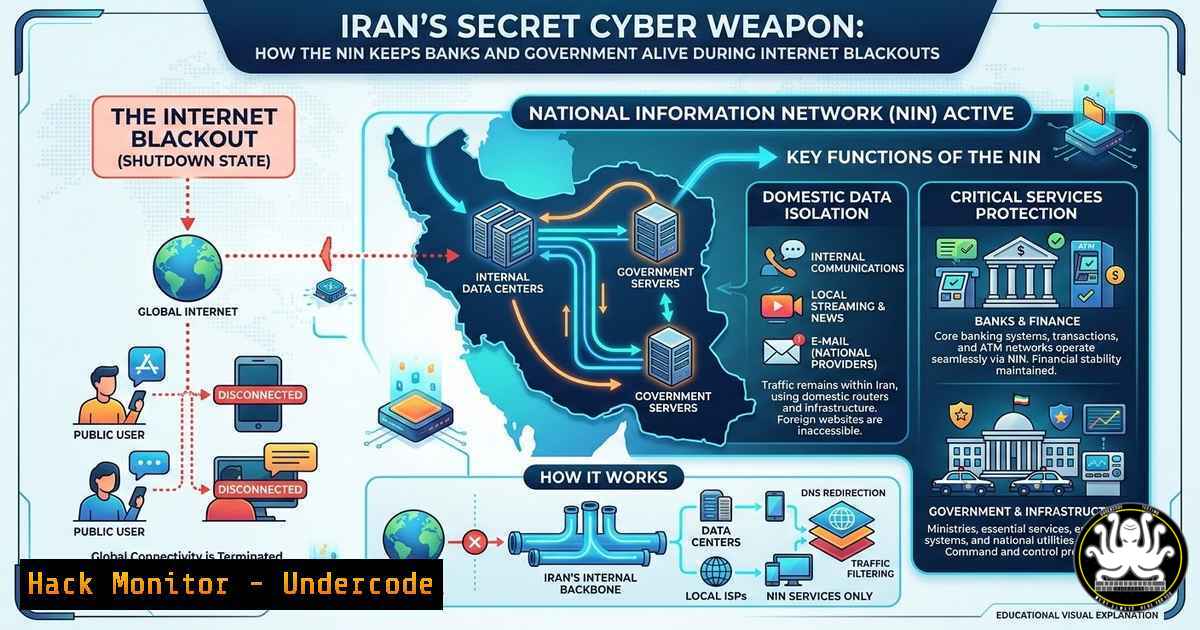
Introduction:
In an era where nation-states increasingly face the threat of undersea cable cuts, economic sanctions, or cyber warfare targeting external connectivity, the concept of “Digital Sovereignty” has shifted from a political ideal to a critical infrastructure necessity. Iran’s development of the National Information Network (NIN) serves as a primary case study in resilience engineering. By decoupling essential national services from the global internet, Iran has effectively built a “kill switch” that protects its banking, health, and government sectors from external shocks, ensuring business continuity even when the wider web becomes inaccessible.
Learning Objectives:
- Understand the architecture of National Information Networks (NIN) and the strategic role of Internet Exchange Points (IXPs) in state-level resilience.
- Learn how to implement data localization strategies and simulate isolated network environments using Linux tools.
- Analyze the security implications of routing national traffic internally and the configuration of DNS root server mirrors.
You Should Know:
- The Backbone of Isolation: Deploying a Local Internet Exchange Point (IXP)
At the heart of Iran’s strategy is the enhancement of local IXPs. In a standard scenario, a user in Amman requesting data from a server in Amman might have their traffic routed through London or Frankfurt if peering agreements are weak. This creates unnecessary latency and vulnerability.
To simulate a localized IXP environment in a lab, you can use Linux to force local routing. The goal is to ensure that traffic destined for local IP ranges never leaves the national gateway.
Step‑by‑step guide: Configuring Policy-Based Routing for Local Traffic
To mimic an IXP forcing local traffic to stay local, you must manipulate routing tables on a Linux gateway (similar to how an ISP router would behave within the NIN).
- Identify Local Subnets: Assume your “national” subnets are `10.0.0.0/8` (internal government) and `172.16.0.0/12` (banking).
2. Create a Custom Routing Table:
echo "100 local_routes" >> /etc/iproute2/rt_tables
3. Add Rules to the Table: Instead of sending traffic to the default gateway (the international pipe), route it to the local IXP switch.
 Add routes for local subnets to the local_routes table
ip route add 10.0.0.0/8 dev eth1 src [bash] table local_routes
ip route add 172.16.0.0/12 dev eth1 src [bash] table local_routes

Set the default gateway for this table (the IXP fabric)
ip route add default via 192.168.1.1 table local_routes
4. Create Routing Rules: Force traffic from local sources to use the local table.
ip rule add from 10.0.0.0/8 table local_routes
ip rule add from 172.16.0.0/12 table local_routes
5. Verify Isolation: Use `traceroute` to a local server. If configured correctly, the hops should remain within the `10.0.0.0/8` or `172.16.0.0/12` ranges, never hitting the external interface.
- Data Localization: Mirroring the Root and Forcing DNS Redirection
Moving servers and content locally is only half the battle; the other half is resolving the names locally. To prevent DNS leaks to the outside world during a disconnection, Iran operates mirrors of the DNS root zone.
Step‑by‑step guide: Implementing DNS Redirection with Response Policy Zones (RPZ)
On a local recursive resolver (like BIND9), you can force all queries for national domains to local servers, ensuring that even if a user types a `.com` address, the critical national subdomains (like banking.gov) never leave the country.
1. Install BIND9 on Ubuntu:
sudo apt update && sudo apt install bind9
2. Configure RPZ for Local Redirection: Edit `/etc/bind/named.conf.options` to add a Response Policy Zone.
options {
directory "/var/cache/bind";
recursion yes;
allow-query { any; };

response-policy {
zone "local.redirect";
};
};
3. Define the Redirect Zone: Create `/etc/bind/named.conf.local`:
zone "local.redirect" {
type master;
file "/etc/bind/db.redirect";
};
4. Populate the Redirect File: Create `/etc/bind/db.redirect`.
$TTL 60
@ IN SOA local.redirect. admin.local.redirect. (
2025030801 ; Serial
3600 ; Refresh
1800 ; Retry
604800 ; Expire
86400 ) ; Minimum

IN NS localhost.

; Force all queries for .bank.gov to the local server IP
bank.gov IN A 10.0.0.50
.bank.gov IN A 10.0.0.50
5. Restart and Force Clients: On client machines (Windows/Linux), set the DNS server to the IP of this BIND server. Now, even if the international link is down, `bank.gov` resolves to the local backup server.
3. Simulating “Internet Kill Switch” with Iptables
To test the resilience of applications (like banking apps or healthcare portals) during a disconnection, security teams must simulate a total blackout. This is done at the firewall level on the perimeter router.
Step‑by‑step guide: Blackhole Routing on Linux Gateway
This command simulates the cutting of international cables by dropping all traffic that is not destined for the local “national” ranges.
1. Allow Established Connections (Optional):
iptables -A INPUT -m state --state ESTABLISHED,RELATED -j ACCEPT
2. Allow Local Loopback and LAN:
iptables -A INPUT -i lo -j ACCEPT
iptables -A INPUT -s 10.0.0.0/8 -j ACCEPT  Allow internal traffic
iptables -A INPUT -s 172.16.0.0/12 -j ACCEPT
3. Drop Everything Else (The “Cable Cut”):
iptables -P INPUT DROP
iptables -P OUTPUT DROP
iptables -P FORWARD DROP
Note: In a production simulation, you would apply these rules on the interface facing the international gateway (e.g., eth0), not the internal interface.
 More precise: Drop traffic exiting to the internet
iptables -A OUTPUT -o eth0 -j DROP
iptables -A INPUT -i eth0 -j DROP
4. Testing: Attempt to ping `8.8.8.8` (should fail) versus pinging the local banking server (should succeed).
- Cloud Hardening for Sovereignty (AWS Outposts / Azure Stack)
While Iran uses physical data centers, enterprises can replicate this “local survivability” using hybrid cloud models like AWS Outposts or Azure Stack. This ensures that even if the region’s connection to the cloud provider’s main hub goes down, the on-premises stack keeps running.
Step‑by‑step guide: Configuring Failover for Cloud Dependencies
If your application relies on a cloud database (e.g., AWS RDS) but you need local survivability, you must configure a read-replica locally.
- Deploy a Local Stack: Set up an on-premises server running a local database (e.g., PostgreSQL).
- Setup Streaming Replication: Configure the cloud database to stream Write-Ahead Logs (WAL) to the local server.
On the cloud master (postgresql.conf):
wal_level = replica
max_wal_senders = 3
On the local standby:
pg_basebackup -h [bash] -D /var/lib/postgresql/12/main -U replication_user -P -v -R
3. Application Configuration: Modify the application connection string to use a local failover DNS. If the health check fails on the cloud IP, the app automatically points to the local standby IP.
5. Windows Hardening: Disabling WAN Auto-Disconnect
In a Windows environment (critical for hospital or bank workstations), if the internet is purposefully cut via the NIN, you must ensure the OS doesn’t try to disconnect “idle” network adapters or aggressively hunt for new gateways.
Step‑by‑step guide: Hardening Network Adapter Persistence
1. Open PowerShell as Administrator:
 Disable Power Management on the NIC to prevent Windows from turning it off
Get-NetAdapter | Disable-NetAdapterPowerManagement

Set the interface metric to prefer the local gateway over the internet gateway
 This ensures traffic stays on the "National" network even if the internet link is up
Get-NetAdapter -Name "Ethernet" | Set-NetIPInterface -InterfaceMetric 5

Disable NetBIOS over TCP/IP to prevent unnecessary name resolution leaks
Set-DnsClientGlobalSetting -SuffixSearchList $null
What Undercode Say:
- Resilience over Reach: Iran’s NIN proves that true cybersecurity isn’t just about preventing data theft; it’s about ensuring availability under extreme duress. For nations like Jordan, the strategic takeaway is clear: digital sovereignty requires physical infrastructure that can survive the disconnection of undersea cables.
- The Risk of the “Walled Garden”: While the NIN model protects against external threats, it centralizes control. If the NIN itself is compromised, the entire nation’s data is contained in one “walled garden” accessible to the state. This trades the risk of foreign surveillance for the certainty of domestic oversight.
- Implementation Reality: The success of this model relies on meticulous DNS and route planning. As demonstrated in the technical sections, misconfigured routing tables could cause a “blackout” even when the cables are intact, or worse, cause a “leak” that exposes internal traffic to external adversaries when the connection is restored.
Prediction:
The next evolution of this concept, which we call “Sovereign Cloud Mesh,” will see mid-tier nations (like Jordan, Egypt, or Saudi Arabia) forming regional IXP federations. Instead of full isolation, they will create a “walled garden of allies,” where banking data stays within the consortium of nations but is backed up across their borders. This creates a buffer zone against global outages while maintaining economic interoperability. Expect to see massive investments in “subsea cable diversity” and “automated failover to friendly neighbors” as the new standard for national cyber defense.
🎯Let’s Practice For Free:
IT/Security Reporter URL:
Reported By: Tawfiq Abu – Hackers Feeds
Extra Hub: Undercode MoN
Basic Verification: Pass ✅


