Listen to this Post
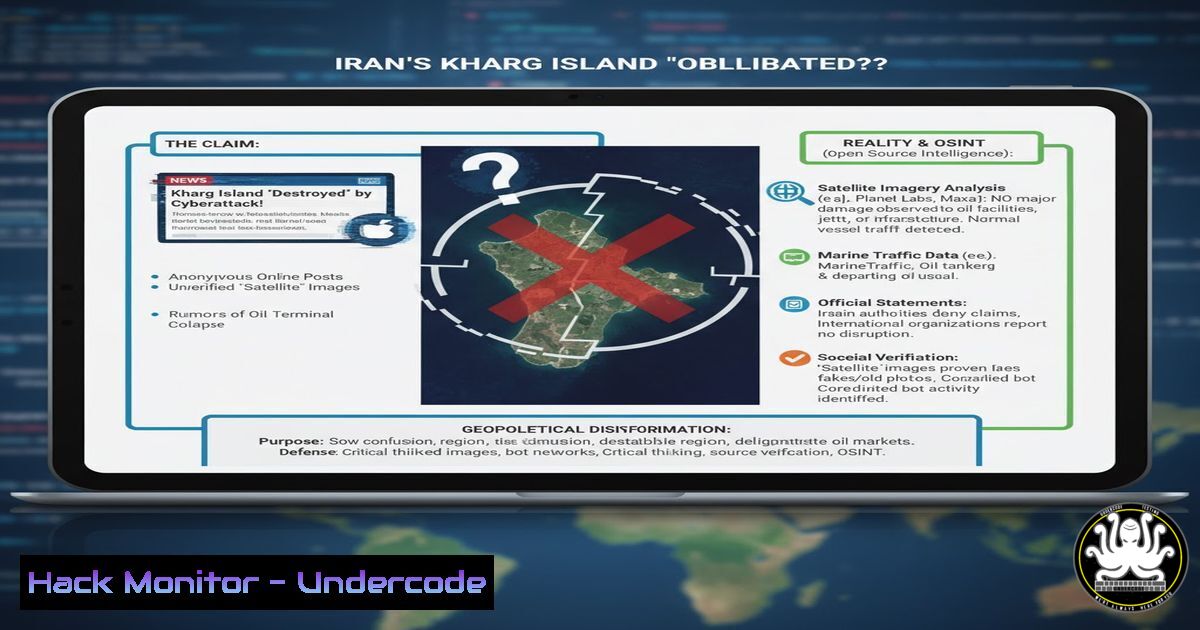
Introduction:
In the modern information battlefield, geopolitical tensions are fought as fiercely with bytes as they are with bombs. Following a provocative claim regarding a massive US strike on Iran’s Kharg Island, a wave of social media commentary erupted, mixing political rhetoric with speculation. This article analyzes the situation through a cybersecurity and Open Source Intelligence (OSINT) lens, moving beyond the political narrative to focus on the technical methods used to verify such claims, the vulnerabilities of critical infrastructure, and how IT professionals can apply forensic techniques to separate fact from fiction in real-time global events.
Learning Objectives:
- Understand how to apply OSINT techniques to verify geopolitical events and disinformation campaigns.
- Identify critical infrastructure vulnerabilities (SCADA/ICS) associated with energy facilities like Kharg Island.
- Learn command-line tools and API configurations for network intelligence gathering and digital footprint analysis.
You Should Know:
- Verifying the Claim: OSINT Techniques for Geostrategic Events
The claim of a major military installation being “totally obliterated” requires immediate technical verification. As an IT and security professional, you must rely on data, not rhetoric.
Step‑by‑step guide to verifying physical damage claims using OSINT:
- Satellite Imagery Analysis: Use services like Sentinel Hub (ESA) or Planet Labs. For a past event, check the “Sentinel-2” imagery archive. Look for recent cloud-free images of Kharg Island (coordinates: 29.2333° N, 50.3167° E).
- Linux Command: Use `gdalinfo` to analyze geospatial data if you download the imagery.
Install GDAL
sudo apt-get install gdal-bin
Get metadata from a satellite image file
gdalinfo sentinel_image_iran.jp2
-
Social Media Geolocation: Scrape X (Twitter) or Telegram for images or videos claiming to show the strike. Use tools like `exiftool` (Linux/Windows) to check metadata.
Linux/macOS - Extract metadata from an image
exiftool suspicious_war_image.jpg
Look for GPS Position, DateTimeOriginal, and Software fields to check for editing.
-
Flight Radar Analysis: A strike of this magnitude would cause a complete shutdown of civilian air traffic over the region. Check historical flight data on services like Flightradar24 or ADS-B Exchange.
- CLI Tool: Use `dump1090` if you have an ADS-B receiver to track live aircraft, or rely on public replay features of these websites to see if commercial traffic was rerouted around Kharg Island during the alleged time of the attack.
- Critical Infrastructure: The SCADA Risk of Kharg Island
Kharg Island is Iran’s main oil export terminal, making it a prime example of Critical National Infrastructure (CNI). If an attack were to occur, the cyber-physical systems would be the primary target. Security professionals must understand the attack surface of Industrial Control Systems (ICS).
Step‑by‑step guide to understanding ICS/SCADA vulnerabilities:
- Shodan Reconnaissance: Use Shodan to search for exposed industrial control systems. While Kharg Island’s military systems are likely air-gapped, the commercial port infrastructure may have exposed interfaces.
- Search Query: `port:502` (Modbus), `port:102` (Siemens S7), or search for specific PLC brands.
-
Shodan CLI: Install the Shodan CLI to automate searches.
Install Shodan CLI
pip install shodan
Initialize with your API key
shodan init YOUR_API_KEY
Search for specific industrial control systems in Iran
shodan search --limit 10 --fields ip_str,port,org "country:IR port:502"
-
Network Hardening for ICS: If managing such infrastructure, you would implement strict network segmentation.
- Cisco ASA Configuration snippet for segmentation:
access-list ICS_ACL extended deny ip any 10.0.0.0 0.255.255.255
access-list ICS_ACL extended permit tcp any host PUBLIC_IP eq 443
! Apply to interface
access-group ICS_ACL in interface outside
- Analyzing the Digital Battlefield: DNS & BGP Manipulation
During a conflict, cyber operations often target the domain names and routing of state-run media and military networks. If the US were to “obliterate” a target, cyber command would likely precede kinetic strikes to blind the enemy’s communications.
Step‑by‑step guide to network intelligence gathering:
- DNS Monitoring: Check for changes in DNS records of key Iranian government domains (e.g., president.ir, leader.ir).
-
Linux Command: Use `dig` to query authoritative name servers and see if the IP addresses have changed (a sign of DDoS mitigation or infrastructure takeover).
Query the authoritative name servers for a domain
dig NS leader.ir
Perform a trace to see the path
dig +trace leader.ir
Check for unusual TTL (Time To Live) values - very low TTLs might indicate attack mode.
dig ANY leader.ir
-
BGP Routing Analysis: Massive attacks or infrastructure takedowns can cause route leaks or changes in Border Gateway Protocol (BGP) announcements.
- Tools: Use `bgplay` from sites like RIPEstat or the CLI tool `bgpq4` to see how prefixes are announced.
Install bgpq4 on Linux
sudo apt-get install bgpq4
Generate routing configuration for an Iranian ASN (e.g., AS12880 is Iran Telecommunication)
bgpq4 -A -b AS12880
4. API Security and Information Warfare
The comments in the post reference global alliances (China, Russia). Modern information warfare often involves scraping and analyzing data from open sources via APIs to gauge international sentiment or coordinate botnet activity.
Step‑by‑step guide to securing APIs against data scraping:
- Rate Limiting Implementation: To prevent adversaries from scraping your data (like social media sentiment), implement strict rate limiting.
- Nginx Configuration for Rate Limiting:
Define a limit of 10 requests per minute per IP limit_req_zone $binary_remote_addr zone=mylimit:10m rate=10r/m;</li> </ul> server { location /api/ { limit_req zone=mylimit burst=20 nodelay; proxy_pass http://api_backend; } }- Analyzing Traffic: If you suspect a DDoS attack following a geopolitical event, use `tcpdump` to capture traffic.
Capture traffic on port 80 (HTTP) and save to a file for analysis
sudo tcpdump -i eth0 -s 65535 -w attack_traffic.pcap port 80
Use CapAnalysis or Wireshark to review the pcap for botnet patterns.
5. Vulnerability Exploitation: Lessons from Stuxnet
The discussion of Iran’s nuclear capabilities immediately brings to mind Stuxnet, the cyber-weapon that targeted Iranian centrifuges. Any modern conflict involving Iran would likely see a resurgence of such tailored malware.
Step‑by‑step guide to mitigation of similar threats:
- USB Disablement (Windows): Most air-gap breaches occur via USB (Stuxnet’s primary vector). Enforce Group Policy to disable USB writes.
- PowerShell Command (Windows):
Disable USB Write Access via Registry
Set-ItemProperty -Path "HKLM:\SYSTEM\CurrentControlSet\Control\StorageDevicePolicies" -Name "WriteProtect" -Value 1
Restart the Storage Service
Restart-Service -Name ShellHWDetection -Force
-
Process Enumeration for Malicious Code: Look for unusual processes that mimic legitimate system files (a common rootkit technique).
- Linux Command: Check for hidden processes.
Compare process list from different sources
ps aux > ps_list.txt
ls /proc | grep -E '^[0-9]+' | sort -n > proc_list.txt
diff ps_list.txt proc_list.txt
What Undercode Say:
- Key Takeaway 1: The greatest vulnerability in a geopolitical crisis is often the information vacuum. OSINT skills are no longer optional for IT professionals; they are critical for assessing real-world risks to organizational infrastructure.
- Key Takeaway 2: Critical infrastructure protection requires a multi-domain approach. Securing a facility like Kharg Island isn’t just about firewalls; it’s about understanding the interplay between physical security, satellite visibility, SCADA network segmentation, and supply chain integrity.
The political commentary from the original post serves as a perfect case study in cognitive hacking. While politicians debate, cybersecurity professionals must remain grounded in technical reality. We must analyze packet captures, not political promises. The failure to verify information technically leads to a vulnerability far more dangerous than any zero-day: the inability to perceive the truth.
Prediction:
Future conflicts will see an exponential rise in “hack-back” operations targeting the energy sector. We will likely witness a shift from purely disruptive malware (like Stuxnet) to ransomware deployed against state-owned oil facilities as a means of political coercion, forcing nations to pay ransoms not just in Bitcoin, but in geopolitical concessions. The lines between nation-state cyber warfare and financially motivated cybercrime will continue to blur, requiring defenders to prepare for adversaries with unlimited resources and unlimited motivation.
▶️ Related Video (82% Match):
🎯Let’s Practice For Free:
IT/Security Reporter URL:
Reported By: Hanslak He – Hackers Feeds
Extra Hub: Undercode MoN
Basic Verification: Pass ✅🔐JOIN OUR CYBER WORLD [ CVE News • HackMonitor • UndercodeNews ]
📢 Follow UndercodeTesting & Stay Tuned:
- Analyzing Traffic: If you suspect a DDoS attack following a geopolitical event, use `tcpdump` to capture traffic.


