
Listen to this Post
Introduction:
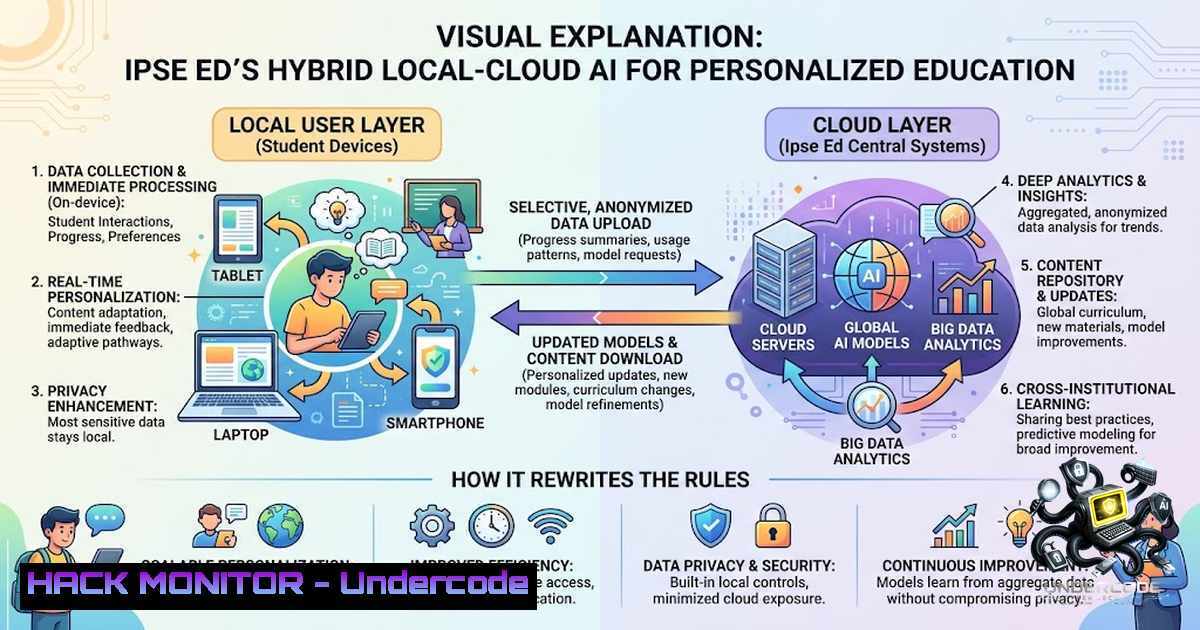
The education technology landscape is saturated with AI tools that promise personalization but deliver little more than generic chatbots and fragmented platforms. Platform fatigue has become a genuine barrier to adoption, with teachers and students juggling dozens of tools that fail to understand the context of their work. Ipse Ed is challenging this paradigm with a hybrid local-cloud AI architecture that creates a personalized semantic layer unique to each teacher and student, enabling AI assistants that truly understand how users work, study, and what matters most to them.
Learning Objectives:
- Understand the architectural components of hybrid local-cloud AI systems and how they enable personalized learning at scale
- Master the implementation of Retrieval-Augmented Generation (RAG) for educational content delivery with privacy preservation
- Learn to deploy and secure AI agents using API gateways, rate limiting, and zero-trust authentication patterns
- Explore federated learning and edge computing techniques for real-time, privacy-preserving student analytics
- Gain practical skills in configuring local LLM deployments (Ollama) and cloud-based AI orchestration for educational environments
- Understanding the Layered Intelligence Architecture: The Semantic Layer Explained
At the core of Ipse Ed’s approach is what the team calls a “layered intelligence architecture” that creates a personalized semantic layer for each user. This isn’t just marketing jargon — it represents a fundamental shift in how AI systems organize and retrieve information.
The semantic layer functions as an intelligent middleware that sits between raw data (student files, textbooks, assignments) and the AI models that process them. Rather than treating all documents as flat text, the semantic layer builds a knowledge graph that understands relationships: how a student’s quiz results connect to specific textbook chapters, how a teacher’s lesson plan aligns with district standards, and how individual student interactions build upon previous learning patterns.
Technical Implementation:
To understand this conceptually, consider how a RAG (Retrieval-Augmented Generation) system operates in this layered architecture. The semantic layer performs vector embedding of educational content, creating a searchable index that the AI can query contextually. Here’s a practical implementation using Python and ChromaDB:
import chromadb
from sentence_transformers import SentenceTransformer
from typing import List, Dict

Initialize embedding model and vector database
model = SentenceTransformer('all-MiniLM-L6-v2')
client = chromadb.PersistentClient(path="./education_semantic_db")
collection = client.get_or_create_collection(
name="student_knowledge_graph",
metadata={"hnsw:space": "cosine"}
)

Embed educational content with metadata
def index_educational_content(documents: List[bash], teacher_id: str):
for doc in documents:
embedding = model.encode(doc['content']).tolist()
collection.add(
embeddings=[bash],
documents=[doc['content']],
metadatas=[{
'teacher_id': teacher_id,
'subject': doc['subject'],
'grade_level': doc['grade_level'],
'standard_alignment': doc.get('standard', '')
}],
ids=[doc['id']]
)
This semantic layer enables the AI to retrieve only the most relevant content for each query, grounded in the specific curriculum and teaching style of the instructor.
- Hybrid Local-Cloud Deployment: Balancing Privacy, Performance, and Cost
Ipse Ed’s hybrid model addresses a critical tension in educational AI: the need for powerful cloud-based processing versus the privacy requirements of student data. Sensitive information stays on institutional infrastructure, while computationally intensive tasks are offloaded to the cloud for scalability.
Local Deployment with Ollama:
For institutions prioritizing data sovereignty, local LLM deployment is increasingly viable. Ollama provides an OpenAI-compatible API that can serve models like Llama 3 or Gemma locally, ensuring no student data ever leaves the institutional network.
 Install Ollama on Linux/macOS
curl -fsSL https://ollama.ai/install.sh | sh

Pull and run an educational-optimized model
ollama pull llama3.2:3b
ollama run llama3.2:3b

Run with custom context window and temperature for educational responses
ollama run llama3.2:3b --1um-ctx 8192 --temperature 0.3
Dockerized Deployment for Educational Institutions:
FROM ollama/ollama:latest
COPY ./models /root/.ollama/models
EXPOSE 11434
CMD ["ollama", "serve"]
Cloud Orchestration with Kubernetes:
For hybrid setups, Kubernetes can orchestrate both local edge nodes and cloud instances:
apiVersion: apps/v1
kind: Deployment
metadata:
name: ai-orchestrator
spec:
replicas: 3
selector:
matchLabels:
app: ai-orchestrator
template:
metadata:
labels:
app: ai-orchestrator
spec:
containers:
- name: orchestrator
image: ai-orchestrator:latest
env:
- name: LOCAL_LLM_ENDPOINT
value: "http://ollama-service:11434"
- name: CLOUD_LLM_ENDPOINT
valueFrom:
secretKeyRef:
name: cloud-credentials
key: endpoint
resources:
limits:
memory: "4Gi"
cpu: "2000m"
This hybrid approach delivers the best of both worlds: low-latency local inference for routine queries and cloud-scale processing for complex analytical tasks.
- API Security and Gateway Implementation for Educational AI
With AI agents becoming integral to educational workflows, securing API endpoints is paramount. Ipse Ed’s architecture must protect against unauthorized access, data exfiltration, and prompt injection attacks.
Implementing API Gateway Security:
A robust API gateway should enforce authentication, rate limiting, and request validation:
from fastapi import FastAPI, Depends, HTTPException, Request
from fastapi.security import HTTPBearer, HTTPAuthorizationCredentials
import jwt
import redis
import time

app = FastAPI()
security = HTTPBearer()
redis_client = redis.Redis(host='localhost', port=6379, db=0)

Rate limiting configuration
RATE_LIMIT = 100  requests per minute
RATE_WINDOW = 60  seconds

def verify_token(credentials: HTTPAuthorizationCredentials = Depends(security)):
try:
payload = jwt.decode(
credentials.credentials,
SECRET_KEY,
algorithms=['HS256']
)
 Verify user role and permissions
if payload.get('role') not in ['teacher', 'student', 'admin']:
raise HTTPException(status_code=403, detail="Invalid role")
return payload
except jwt.InvalidTokenError:
raise HTTPException(status_code=401, detail="Invalid token")

def rate_limit(request: Request):
client_ip = request.client.host
key = f"rate_limit:{client_ip}"
current = redis_client.get(key)

if current and int(current) >= RATE_LIMIT:
raise HTTPException(status_code=429, detail="Rate limit exceeded")

pipe = redis_client.pipeline()
pipe.incr(key)
pipe.expire(key, RATE_WINDOW)
pipe.execute()

@app.post("/api/ai/query")
async def ai_query(
request: Request,
payload: dict,
token: dict = Depends(verify_token)
):
 Rate limiting check
await rate_limit(request)

Input validation to prevent prompt injection
sanitized_input = sanitize_prompt(payload.get('query', ''))

Route to appropriate AI service based on request complexity
if len(sanitized_input) < 500:
response = await local_llm_query(sanitized_input, token)
else:
response = await cloud_llm_query(sanitized_input, token)

return {"response": response, "user": token.get('sub')}
Zero-Trust Security Model:
Implementing OAuth 2.0 with JWT and fine-grained RBAC ensures that even authenticated users only access appropriate resources.
4. RAG Implementation for Personalized Educational Content
Ipse Ed’s differentiation lies in its subject-specific, teacher-trained AI agents that use RAG to ground responses in actual curriculum materials. This prevents the generic, unfocused responses that plague general-purpose chatbots.
Building a Hierarchical RAG System:
from langchain.text_splitter import RecursiveCharacterTextSplitter
from langchain.embeddings import HuggingFaceEmbeddings
from langchain.vectorstores import FAISS
from langchain.llms import Ollama
from langchain.chains import RetrievalQA

class EducationalRAGSystem:
def <strong>init</strong>(self, teacher_id: str, subject: str):
self.teacher_id = teacher_id
self.subject = subject
self.embeddings = HuggingFaceEmbeddings(
model_name="sentence-transformers/all-MiniLM-L6-v2"
)
self.llm = Ollama(model="llama3.2:3b", temperature=0.3)

def ingest_documents(self, documents: List[bash], metadata: Dict):
"""Ingest educational documents with hierarchical metadata"""
text_splitter = RecursiveCharacterTextSplitter(
chunk_size=1000,
chunk_overlap=200,
separators=["\n\n", "\n", ".", " "]
)

all_chunks = []
all_metadatas = []

for doc in documents:
chunks = text_splitter.split_text(doc)
for chunk in chunks:
all_chunks.append(chunk)
all_metadatas.append({
metadata,
"teacher_id": self.teacher_id,
"subject": self.subject
})

self.vectorstore = FAISS.from_texts(
all_chunks,
self.embeddings,
metadatas=all_metadatas
)

def query(self, question: str, grade_level: int = None):
"""Query with grade-level awareness"""
 Filter by grade level if provided
filter_dict = {"teacher_id": self.teacher_id}
if grade_level:
filter_dict["grade_level"] = grade_level

retriever = self.vectorstore.as_retriever(
search_kwargs={"filter": filter_dict, "k": 5}
)

qa_chain = RetrievalQA.from_chain_type(
llm=self.llm,
chain_type="stuff",
retriever=retriever
)

return qa_chain.run(question)
Hierarchical RAG for District-Level Standards:
Ipse Ed extends this to district-wide implementations where administrators upload state and national standards that become the foundation for all AI-generated content. The hierarchical RAG system ensures content is automatically tagged and tracked against these standards.
5. Data Privacy and Compliance: FERPA and Beyond
Educational AI platforms must navigate complex regulatory landscapes including FERPA, COPPA, and state-specific privacy laws. Ipse Ed’s hybrid architecture addresses this by keeping sensitive data local while leveraging cloud capabilities for non-sensitive processing.
Privacy-Preserving Techniques:
import hashlib
from cryptography.fernet import Fernet
import numpy as np

class PrivacyPreservingPipeline:
def <strong>init</strong>(self, encryption_key: bytes):
self.cipher = Fernet(encryption_key)

def anonymize_student_data(self, student_record: dict) -> dict:
"""Anonymize PII before any cloud processing"""
anonymized = student_record.copy()

Hash student identifiers
for field in ['student_id', 'name', 'email']:
if field in anonymized:
anonymized[bash] = hashlib.sha256(
anonymized[bash].encode()
).hexdigest()[:16]

Encrypt sensitive educational data
if 'grades' in anonymized:
anonymized['grades'] = self.cipher.encrypt(
str(anonymized['grades']).encode()
)

return anonymized

def apply_differential_privacy(self, data: np.ndarray, epsilon: float = 1.0) -> np.ndarray:
"""Add Laplace noise for differential privacy"""
sensitivity = 1.0
scale = sensitivity / epsilon
noise = np.random.laplace(0, scale, data.shape)
return data + noise
Federated Learning for Multi-Institutional Collaboration:
Federated learning enables institutions to collaborate on model training without sharing raw student data:
import flwr as fl
import tensorflow as tf

Local model training on institution data
def train_local_model(client_data):
model = tf.keras.Sequential([
tf.keras.layers.Dense(128, activation='relu'),
tf.keras.layers.Dropout(0.2),
tf.keras.layers.Dense(64, activation='relu'),
tf.keras.layers.Dense(1, activation='sigmoid')
])
model.compile(optimizer='adam', loss='binary_crossentropy')

Train on local data only - never leaves the institution
model.fit(client_data['X'], client_data['y'], epochs=10, batch_size=32)
return model.get_weights()

Federated aggregation
class EducationalFLClient(fl.client.NumPyClient):
def <strong>init</strong>(self, data):
self.data = data
self.model = create_model()

def get_parameters(self):
return self.model.get_weights()

def fit(self, parameters, config):
self.model.set_weights(parameters)
self.model.fit(self.data['X'], self.data['y'], epochs=5, batch_size=32)
return self.model.get_weights(), len(self.data['X']), {}
- Real-Time Feedback with Edge AI and Low-Latency Processing
The hybrid architecture enables real-time feedback through edge computing, where AI models run locally on devices or nearby edge servers.
Edge AI Configuration:
 Deploy lightweight model for edge inference using TensorFlow Lite
tflite_convert --saved_model_dir=./model \
--output_file=./edge_model.tflite \
--input_shapes=1,128,128,3 \
--input_arrays=input \
--output_arrays=output

Run inference on edge device
import tflite_runtime.interpreter as tflite
interpreter = tflite.Interpreter(model_path="edge_model.tflite")
interpreter.allocate_tensors()
input_details = interpreter.get_input_details()
output_details = interpreter.get_output_details()

Real-time prediction
def predict_learning_outcome(student_data):
interpreter.set_tensor(input_details[bash]['index'], student_data)
interpreter.invoke()
return interpreter.get_tensor(output_details[bash]['index'])
7. The Closed-Loop System: Continuous Improvement Through Analytics
Ipse Ed implements what the team calls a “Closed-Loop System” where student assessment data continuously improves the AI agents. Each assessment is analyzed to identify weak topics, knowledge gaps, and areas of strength.
Analytics Pipeline Implementation:
-- PostgreSQL analytics for educational insights
CREATE TABLE student_analytics (
id SERIAL PRIMARY KEY,
student_id VARCHAR(50),
assessment_id VARCHAR(50),
topic VARCHAR(100),
score DECIMAL(5,2),
time_spent INTEGER,
created_at TIMESTAMP DEFAULT CURRENT_TIMESTAMP
);

-- Identify knowledge gaps across a class
SELECT
topic,
AVG(score) as avg_score,
COUNT() as student_count,
STDDEV(score) as score_variance
FROM student_analytics
WHERE created_at > NOW() - INTERVAL '30 days'
GROUP BY topic
HAVING AVG(score) < 0.7
ORDER BY avg_score ASC;
 Python analytics for continuous improvement
import pandas as pd
from sklearn.cluster import KMeans

def identify_learning_patterns(student_data: pd.DataFrame):
"""Identify student learning patterns for personalized recommendations"""
features = ['avg_score', 'time_spent', 'attempt_count', 'topic_difficulty']
X = student_data[bash].values

kmeans = KMeans(n_clusters=4, random_state=42)
student_data['learning_cluster'] = kmeans.fit_predict(X)

Generate personalized recommendations based on cluster
recommendations = {}
for cluster in student_data['learning_cluster'].unique():
cluster_data = student_data[student_data['learning_cluster'] == cluster]
recommendations[bash] = {
'avg_performance': cluster_data['avg_score'].mean(),
'recommended_pace': 'accelerated' if cluster_data['avg_score'].mean() > 0.8 else 'standard',
'focus_areas': cluster_data.groupby('topic')['avg_score'].mean().nsmallest(3).index.tolist()
}

return recommendations
What Undercode Say:
- Key Takeaway 1: The hybrid local-cloud architecture represents a paradigm shift from generic AI tools to truly personalized educational assistants. By keeping sensitive data local while leveraging cloud capabilities, platforms like Ipse Ed solve the privacy-performance tradeoff that has plagued educational technology. The semantic layer approach ensures AI understands context, not just content.
-
Key Takeaway 2: The integration of RAG with hierarchical district standards creates a governance framework that maintains educational quality while enabling personalization. The closed-loop analytics system ensures continuous improvement based on real student outcomes, making the AI “smarter” with each interaction. This is education technology that actually learns from its users.
Analysis: The education technology market has been flooded with AI tools that address isolated problems — lesson planning here, tutoring there, grading somewhere else. Ipse Ed’s approach consolidates these functions into an intelligent assistant that understands the complete educational context. The technical architecture — hybrid local-cloud deployment, layered semantic intelligence, and RAG-based content retrieval — is not just innovative but necessary for true personalization. The privacy-first approach addresses the single biggest barrier to AI adoption in K-12 education: FERPA compliance and student data protection. As edge computing capabilities improve and local LLMs become more powerful, hybrid architectures will likely become the standard for educational AI, not the exception.
Prediction:
- +1 Institutions will increasingly adopt hybrid local-cloud AI architectures as the cost of cloud inference rises and privacy regulations tighten. Local LLM deployment will become a competitive advantage for educational technology vendors.
-
+1 The semantic layer approach will become a standard pattern for AI personalization across industries, not just education. Understanding user context through knowledge graphs will be the next frontier beyond simple RAG.
-
-1 The digital divide may widen as institutions with greater IT resources adopt sophisticated hybrid architectures while under-resourced schools remain dependent on generic cloud AI tools.
-
+1 Federated learning will enable unprecedented collaboration between educational institutions, creating more robust AI models while preserving student privacy.
-
-1 Security vulnerabilities in AI agent architectures (prompt injection, data leakage through API endpoints) will require continuous vigilance and may lead to high-profile incidents that slow adoption.
▶️ Related Video (76% Match):
https://www.youtube.com/watch?v=3taiH-mBOYs
🎯Let’s Practice For Free:
🎓 Live Courses & Certifications:
Join Undercode Academy for Verified Certifications
🚀 Request a Custom Project:
Secure, high-velocity infrastructure and disruptive technological engineering. Contact our engineering team for high-tier development and proprietary systems:
[email protected]
💎 Smart Architecture | 🛡️ Secure by Design | ⭐ Trusted by Thousands
IT/Security Reporter URL:
Reported By: Vubt Ipseeducation – Hackers Feeds
Extra Hub: Undercode MoN
Basic Verification: Pass ✅


