Listen to this Post
Introduction:
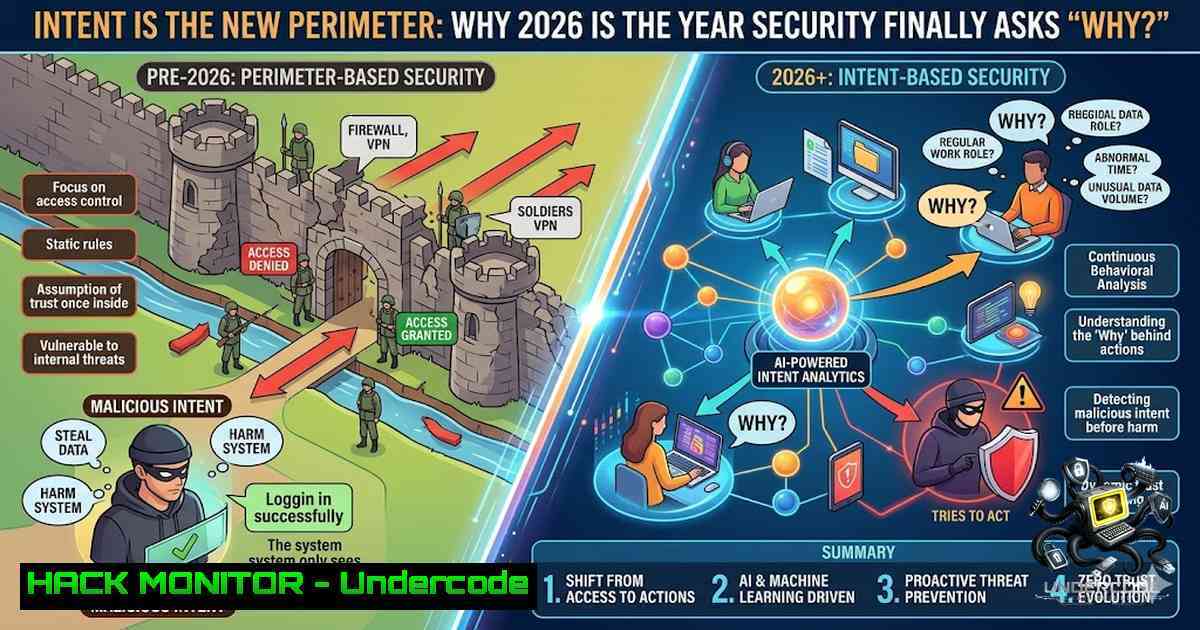
The concept of “intent” in cybersecurity has long been a theoretical luxury—something we might consider once we had the computational power and contextual awareness to do so. Today, that theory is rapidly becoming a practical necessity. The convergence of exponentially faster Large Language Models (LLMs), massive context windows, and sophisticated agentic frameworks has created the perfect storm, transforming intent from a vague aspiration into the central pillar of modern defense. As AI agents gain the autonomy to act on our behalf, the security industry can no longer afford to ask only “what” happened; we are now compelled to answer the far more difficult question: “was that action intentional?”
Learning Objectives:
- Understand the “Burning Platform”: Comprehend why AI agents, with their real system access, are the critical catalyst forcing the security industry to prioritize intent-based detection and response over traditional permission-based models.
- Identify the Technical Enablers: Learn how advancements in AI speed, cost, context windows, and tool-calling capabilities are providing the necessary infrastructure to operationalize intent in security.
- Implement a Framework for Intent: Gain practical knowledge on how to begin integrating intent analysis into your existing security stack, including specific commands, configurations, and monitoring strategies for Linux, Windows, and cloud environments.
- The Evolution of “Intent”: From Philosophy to Technical Reality
For years, “intent” was considered an academic or philosophical problem in cybersecurity. You could track a user’s keystrokes, log their API calls, and monitor their data exfiltration, but discerning if that action was malicious or a simple mistake was a manual, time-consuming process. The technical ingredients were simply not there. Models were slow and expensive, context windows couldn’t hold a full conversation history, and integrations were brittle.
Today, that has changed. The current wave of AI has given us components that are not just new, but significantly more powerful:
– Faster, Cheaper Reasoning: Models can process complex scenarios in milliseconds, making real-time intent analysis economically viable.
– Expanded Context Windows: We can now feed an agent’s entire multi-month interaction history into a model, providing the necessary background to determine if an action is anomalous.
– Robust Tool Calling: Agents can interact with a wider array of systems, leaving richer digital footprints that we can analyze for intent.
Step-by-Step Guide: Building an Intent-Aware Audit Trail
To leverage these capabilities, you need to capture the right data. Here’s how to start building a baseline for intent analysis in Linux:
- Enable Comprehensive Auditing: Use `auditd` to track all system calls made by process IDs (PIDs) associated with AI agents.
sudo auditctl -a always,exit -S execve -S open -S write -k agent_actions
- Log API Calls with Headers: Ensure your API gateways log not just the payload, but also the user-agent and any unique session IDs tied to the agentic request.
nginx log format for intent analysis
log_format agent_trail '$remote_addr - $remote_user [$time_local] "$request" $status $body_bytes_sent "$http_referer" "$http_user_agent" "$http_x_session_id"';
- Centralize Context: Forward these enriched logs to a SIEM or a data lake that can store the massive context windows required for future analysis.
-
The Burning Platform: AI Agents and Their Consequences
The “burning platform” that Cole Grolmus refers to is the rapid deployment of autonomous AI agents. Unlike traditional scripts or APIs, agents operate with real, dynamic access to real systems. They can read emails, modify databases, and execute code. When an agent exfiltrates data or triggers a destructive command, the question “was that intentional?” has enormous stakes for incident response, legal liability, and remediation.
Scenario: An agent tasked with optimizing storage costs deletes a critical file. Was it following a flawed instruction (intent = user), did it misinterpret the goal (intent = error), or was it compromised (intent = adversary)?
Step-by-Step Guide: Securing Agent Workflows in Azure
To mitigate the risks of agents, we must constrain their capabilities based on contextual intent.
- Implement Conditional Access Policies: Use Azure Conditional Access to restrict agent access based on risk signals (e.g., location, device health, and behavior).
PowerShell snippet to query risk detection
Get-AzureADRiskDetection -Filter "RiskType eq 'unfamiliarFeatures'"
- Mandate Just-In-Time (JIT) Access: Ensure agents request elevated permissions only for the duration of a specific task.
– Use Azure PIM (Privileged Identity Management) to activate roles only for the agent’s run time.
3. Deploy Agent Identity: Use Managed Identities for Azure Resources, ensuring agents have a specific, auditable identity rather than relying on static credentials.
- Operationalizing Intent at the Infrastructure Level (Linux & Windows)
Determining intent requires correlating user commands with application-level goals. This often means analyzing sequence patterns.
Step-by-Step Guide: Windows PowerShell Logging for Intent
- Enable Script Block Logging: This captures the actual code being executed, not just the command.
Set-ItemProperty -Path "HKLM:\SOFTWARE\Wow6432Node\Policies\Microsoft\Windows\PowerShell\ScriptBlockLogging" -1ame "EnableScriptBlockLogging" -Value 1
- Monitor for Suspicious Sequences: Use Sysmon (System Monitor) to track process creation events. Look for command-line arguments that indicate data staging or exfiltration.
Sysmon.exe -accepteula -i
- Correlate with User Input: Use Windows Event ID 4688 (Process Creation) and cross-reference it with the agent’s task queue to check if the action was in the expected workflow.
-
Securing the API Surface: The Gateway for Intent
APIs are the primary interface for AI agents. Securing them is critical for proper intent analysis.
Step-by-Step Guide: API Hardening with Threat Modeling
- Implement Rate Limiting: For APIs used by agents, implement granular rate limiting based on the agent’s specific functions.
Linux: Using iptables to limit connections
iptables -A INPUT -p tcp --dport 443 -m connlimit --connlimit-above 100 -j REJECT
- Validate Payload Schema: Use OpenAPI validation to ensure the agent is sending expected data structures.
Example Swagger snippet to ensure agent actions are valid
parameters:</li>
</ol>

<p>- name: action
in: query
schema:
type: string
enum: [read, write, delete]
required: true
3. Tokenize Permissions: Implement OAuth 2.0 scopes that restrict an agent’s API access to only the resources necessary for its current goal.
5. The Role of “Harnesses” and Configuration Management
Harnesses are the frameworks that wrap around models to guide their output, format their tool calls, and enforce safety rails. Configuring these properly is how we translate corporate policy into machine-understandable “intent.”
Step-by-Step Guide: Configuring a Harness for Security
- Define Permissible Actions: Create a JSON/XML schema that defines the exact functions and parameters an agent is allowed to call.
- Sandboxing: Run the agent’s execution environment in a Docker container to limit the blast radius of a malicious action.
Run agent in a container with read-only root
docker run --read-only -v /tmp/input:/input:ro my_agent_image
- Integrate a “Human-in-the-Loop” (HITL): For high-risk actions (e.g.,
DELETE,DROP,MODIFY), require the harness to pause execution and await explicit approval from a human.
6. Monitoring for Anomalous Intent (The “Dirty Laundry”)
Not all threats come from external actors. Insider threats, whether malicious or negligent, are a significant concern. Intent analysis helps distinguish between an employee trying to moonlight with a side hustle and an employee trying to steal corporate IP.
Step-by-Step Guide: Detecting Suspicious Data Access
- User and Entity Behavior Analytics (UEBA): Implement tools that detect anomalies. For example, using `grep` and `awk` on Linux logs to detect unusual file access patterns.
Find users who accessed /etc/passwd outside of business hours grep " /etc/passwd" /var/log/secure | awk '{if ($3 >= 20 || $3 <= 6) print $0}' - Monitor Public Data Repositories: Ensure your code isn’t being pushed to public repositories.
Linux: Scan for git pushes to SSH
tail -f /var/log/auth.log | grep -E "git|ssh"
- Cloud Monitoring: Use CloudTrail in AWS to detect unusual resource creation.
What Undercode Say:
- Key Takeaway 1: Technology is the catalyst, but the problem is the problem. The AI advancements are not the story; they are the tools. The real story is the urgent need to secure autonomous agents, which act as a “burning platform” forcing us to mature our security posture.
- Key Takeaway 2: Permission vs. Intent is the new battle. We have long operated on a “permission” model. Intent analysis shifts us to a “context” model, where actions are evaluated based on their alignment with a given task. This is a paradigm shift that requires new logging, new analytics, and new team skills.
Analysis: The article accurately predicts a seismic shift in cybersecurity. The traditional perimeter is dissolving, replaced by identity and now, contextually derived “intent.” The focus on AI agents as the “burning platform” is spot-on, as the velocity and complexity of agent actions make human oversight impossible. The real challenge for SOC teams is the “signal-to-1oise” ratio—how to implement these controls without creating alert fatigue. The solution lies in leveraging the very AI we seek to secure, using machine learning to establish baselines of “normal intent” and flag deviations. This requires a deep integration of Data Science and Incident Response, a skill set that is currently scarce. The industry must move from detecting threats to predicting them based on behavioral intent.
Prediction:
- +1 The necessity to secure agents will accelerate the development of specialized “Agent SIEMs” and “Intent Firewalls,” creating a new multi-billion dollar market segment and forcing innovation in cloud security.
- +1 NIST and ISO will release dedicated frameworks for “AI Agent Governance” within the next 18 months, standardizing intent-based controls and providing legal clarity for liability.
- -1 Many organizations will suffer significant data breaches not from sophisticated attackers, but from benign agents acting on ambiguous or poisoned instructions, leading to a crisis of trust in AI automation.
- -1 The “intent” shift will increase operational complexity, leading to a surge in demand for highly specialized architects, exacerbating the existing cybersecurity talent shortage.
- +1 Agents will eventually be used defensively to probe networks for weak “intent” controls, actively hunting for misconfigurations before attackers can exploit them.
🎯Let’s Practice For Free:
🎓 Live Courses & Certifications:
Join Undercode Academy for Verified Certifications
🚀 Request a Custom Project:
Secure, high-velocity infrastructure and disruptive technological engineering. Contact our engineering team for high-tier development and proprietary systems:
[email protected]
💎 Smart Architecture | 🛡️ Secure by Design | ⭐ Trusted by ThousandsIT/Security Reporter URL:
Reported By: Colegrolmus Why – Hackers Feeds
Extra Hub: Undercode MoN
Basic Verification: Pass ✅🔐JOIN OUR CYBER WORLD [ CVE News • HackMonitor • UndercodeNews ]
📢 Follow UndercodeTesting & Stay Tuned:


