
Listen to this Post
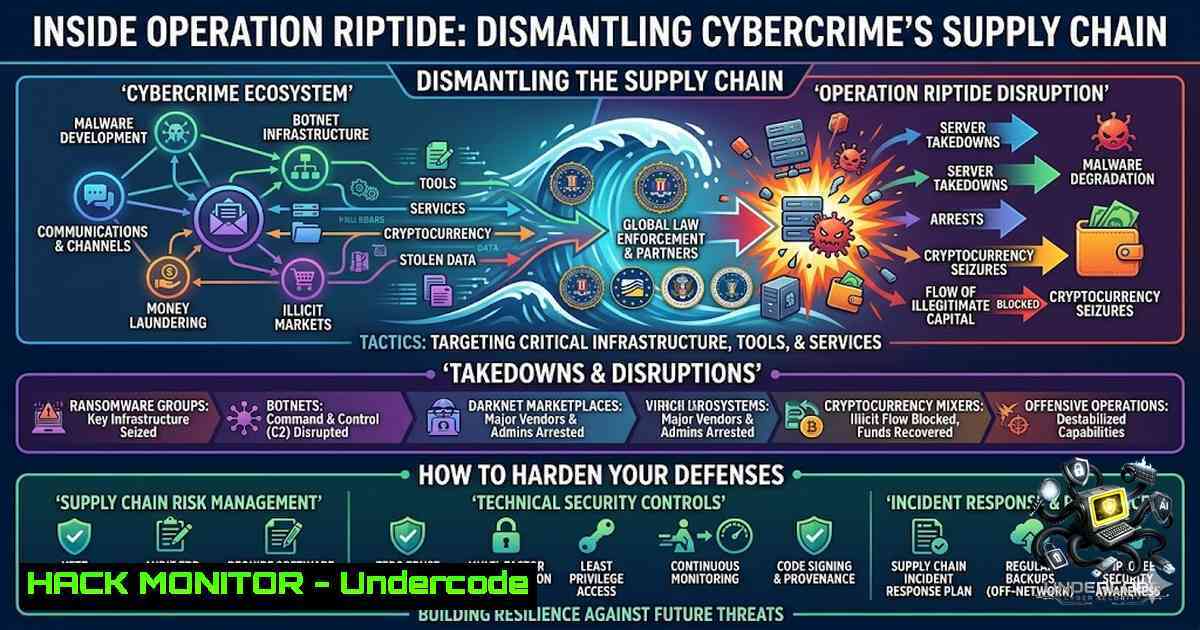
Introduction:
In a sweeping coordinated campaign dubbed “Operation Riptide,” the FBI’s Cyber Division has launched an aggressive, multi-pronged offensive against the infrastructure and financial networks enabling global cybercrime. This operation, spanning the last two weeks of June, marks a significant shift in law enforcement strategy, moving from reactive investigation to proactive disruption of the criminal supply chain, targeting everything from phishing-as-a-service platforms to the malware families and bulletproof VPNs that facilitate ransomware attacks. For cybersecurity professionals, understanding the technical mechanics of these takedowns and the tactics of the threat actors involved is crucial for fortifying defenses against the very tools and services being dismantled.
Learning Objectives:
- Understand the operational mechanics and security gaps exploited by the Phishing-as-a-Service (PhaaS) platform “Outsider.”
- Analyze the ransomware attack chain associated with the Conti actor, focusing on lateral movement and encryption tactics.
- Evaluate the risk posed by “First VPN” and similar services in obfuscating malicious traffic and bypassing geo-restrictions.
- Learn to identify and mitigate SocGholish malware infections and other drive-by download techniques.
- Develop practical, step-by-step defensive strategies, including log analysis, network hardening, and API security to counter these threats.
You Should Know:
- Anatomy of a Phishing-as-a-Service (PhaaS) Takedown: The “Outsider” Platform
The FBI Cleveland takedown of “Outsider,” a Chinese Phishing-as-a-Service platform, represents a critical blow to the cybercrime ecosystem. PhaaS platforms lower the barrier to entry for attackers, providing ready-made phishing kits, hosting, and templates that can be deployed with minimal technical skill. “Outsider” likely utilized techniques such as adversary-in-the-middle (AiTM) proxies to bypass multi-factor authentication (MFA). These proxies act as a relay between the victim and the legitimate service, capturing session cookies and credentials in real-time.
Step-by-step guide to detecting and mitigating PhaaS/AiTM attacks:
- Monitor for Anomalous Login Patterns: In your SIEM or log management tool, query for impossible travel events or logins from unusual geolocations. For Microsoft 365, use the `Get-AzureADAuditSignInLogs` PowerShell cmdlet to filter for `RiskLevel`
Highor `Medium` events.Example PowerShell command to fetch risky sign-ins Get-AzureADAuditSignInLogs -Filter "RiskLevel eq 'High'"
- Implement Conditional Access Policies: Enforce strict access controls. Require compliant devices or trusted IP ranges. In Azure AD, create a policy to block logins from countries not in your operational region.
- Analyze User-Agent Strings: Attackers often use automated tools or specific proxies. Search your web server logs (
/var/log/nginx/access.logon Linux) for unusual or non-standard User-Agent strings.Linux command to show top 10 User-Agents awk -F'"' '{print $6}' /var/log/nginx/access.log | sort | uniq -c | sort -1r | head -10 - Resetting Compromised Sessions: If a session token is captured, enforce a token revocation. In Azure/Entra ID, you can use the `Revoke-AzureADUserAllRefreshToken` cmdlet to force all tokens to expire.
- Hardening: Enforce number matching in Microsoft Authenticator for MFA, which is resistant to AiTM proxy attacks.
-
The Conti Ransomware Attack Chain: From Initial Access to Encryption
The guilty plea by a Conti actor, facilitated by FBI Nashville, San Diego, and El Paso, highlights the devastating impact of ransomware. Conti, a notorious Russian-speaking group, operated a Ransomware-as-a-Service (RaaS) model. Their attacks typically involved a multi-stage process: gaining initial access via phishing or exploiting vulnerabilities, conducting internal reconnaissance, stealing data, and then deploying the encryption payload.
Step-by-step guide to understanding and defending against the Conti attack chain:
- Initial Access via Exploits: Conti commonly exploited unpatched vulnerabilities. Prioritize patching known exploits like the PrintNightmare (CVE-2021-34527) and vulnerabilities in VPN appliances. On Windows, use `wmic qfe list` to list installed patches.
- Lateral Movement: Conti used tools like Cobalt Strike and RDP to move laterally. Monitor Windows Event logs for IDs 4624 (successful logins) and 4625 (failed logins) to identify brute-force attempts. Use Sysmon to track process creation and network connections.
- Defense Evasion: The actor often disabled security tools. Audit your group policies to restrict who can disable services.
PowerShell to list all running processes and filter for security tools Get-Process | Where-Object {$_.ProcessName -match "defender|crowdstrike|splunk"} - Data Exfiltration: Conti used Rclone to exfiltrate data to cloud storage. Implement network egress filtering to block unknown cloud storage IPs or protocols. Configure your firewall (e.g., Linux iptables) to log outbound connections on unusual ports.
Linux iptables example to log and drop outbound traffic to a known malicious subnet
sudo iptables -A OUTPUT -d 10.0.0.0/24 -j LOG --log-prefix "BLOCKED_EXFIL"
sudo iptables -A OUTPUT -d 10.0.0.0/24 -j DROP
- File Encryption: Monitor for high file I/O and the presence of `.conti` file extensions. Deploy Endpoint Detection and Response (EDR) rules to alert on mass file encryption events.
3. Bolstering VPN Security and Trust
The FBI Boston announcement of the international takedown of “First VPN” service underscores the danger of “bulletproof” VPNs. These services knowingly harbor criminal traffic, allowing threat actors to mask their origin. While legitimate VPNs are vital for privacy, attackers use them to blend in with legitimate encrypted traffic.
Step-by-step guide to analyzing and mitigating risks from malicious VPN traffic:
- Threat Intelligence Integration: Feed threat intelligence feeds (e.g., Cisco Talos, AlienVault OTX) that include known malicious VPN IP addresses into your firewall or intrusion prevention system (IPS). On Linux, you can use `ipset` to create a blacklist of malicious IPs.
Create an ipset list and add a malicious IP
sudo ipset create blocklist hash:ip
sudo ipset add blocklist 192.168.1.100
sudo iptables -I INPUT -m set --match-set blocklist src -j DROP
- SSL/TLS Inspection: While complex, deploying SSL/TLS decryption at the perimeter allows you to inspect the payload of traffic flowing to and from suspicious IP ranges.
- Log Correlation: Correlate VPN login logs with access logs. On a Cisco ASA or Palo Alto firewall, pull logs for VPN user logins and cross-reference them with successful application logins to identify possible credential misuse.
4. Disrupting SocGholish Malware and Drive-By Downloads
SocGholish, also known as “FakeUpdates,” is a JavaScript-based malware delivered via compromised websites. When users visit a legitimate but hacked site, they are redirected to a malicious page prompting them to update their browser. This “update” is actually the SocGholish payload, which establishes persistence.
Step-by-step guide to identifying and removing SocGholish:
- Network Monitoring: Analyze DNS logs for requests to domains using domain generation algorithms (DGA). SocGholish often queries random-looking domains.
- Check Startup Files: On Windows, check the `Startup` folder and the `Run` registry keys (
HKEY_CURRENT_USER\Software\Microsoft\Windows\CurrentVersion\Run) for suspicious executables. - Analyze Scheduled Tasks: Use the command `schtasks /query /fo LIST /v` to list all scheduled tasks and look for tasks named like a browser update.
- Browser Forensics: Delete browser cache and check for malicious extensions in Chrome or Firefox that may have been installed without user consent.
- Linux Hardening for Web Servers: To prevent serving SocGholish, harden your web server. Disable directory indexing and restrict file uploads.
Apache Linux example - disable directory indexing
<Directory /var/www/html>
Options -Indexes
</Directory>
5. Financial Network Disruption and OSINT
Operation Riptide’s focus on financial networks involves tracking cryptocurrency transactions used for ransom payments. Law enforcement uses blockchain analysis tools to identify wallets and exchange addresses.
Step-by-step guide for OSINT and basic blockchain analysis:
- Trace Ransomware Payments: Use public block explorers like Etherscan or Blockchain.com to trace the flow of funds from a known ransom wallet.
- Identify Exchange Addresses: Look for patterns (e.g., large volumes of outgoing transactions) that might indicate a crypto exchange.
- Threat Hunting: Import known malicious wallet addresses into your security appliances to alert if any internal system attempts to connect to a crypto-mining pool or payment gateway.
What Undercode Say:
- Key Takeaway 1: Operation Riptide exemplifies a “supply chain” approach to cybersecurity defense, recognizing that by dismantling the service providers (PhaaS, Bulletproof VPNs), you are not just punishing attackers but also removing the tools that empower less sophisticated criminals.
- Key Takeaway 2: The collaborative nature of this operation, involving domestic and international partners, highlights the necessity of information sharing and global cooperation in combating cybercrime, as the threats are inherently borderless.
Analysis: This operation signals a maturity in cybercrime enforcement, moving beyond individual arrests to disrupting the underlying business models. For defenders, the message is clear: we must adopt a similar “ecosystem” view. It’s not enough to patch a single CVE; we must understand how the attacker operates, the infrastructure they use, and the tactics they employ. Integrating threat intelligence feeds (IP blacklists, known malware hashes) into automated response workflows (SOAR) is no longer optional but a baseline requirement. The takedown of “First VPN” serves as a stark warning to service providers who turn a blind eye to criminal activity, but also serves as a reminder for organizations to vet their own third-party cloud and VPN providers rigorously. Ultimately, the resilience of our networks will be measured by how effectively we can implement zero-trust architectures to contain breaches and deny attackers the lateral movement they rely on.
Prediction:
- +1 This coordinated action will likely force cybercriminals to splinter into smaller, less efficient groups, increasing their operational security mistakes and making them more susceptible to detection and arrest.
- -1 The immediate removal of large platforms like “Outsider” will create a temporary void that will be filled by smaller, more agile start-ups, potentially leading to an influx of less stable but more aggressive malware variants that are harder to predict.
- +1 The success of Operation Riptide will spur further legislation and international treaties specifically targeting the “infrastructure providers” of the cybercrime world, increasing the legal liability for web hosting and VPN services.
- -1 As “bulletproof” VPNs are taken down, attackers will pivot to using large, legitimate cloud providers for command and control, making threat hunting more difficult as traffic becomes indistinguishable from normal business operations.
▶️ Related Video (76% Match):
🎯Let’s Practice For Free:
🎓 Live Courses & Certifications:
Join Undercode Academy for Verified Certifications
🚀 Request a Custom Project:
Secure, high-velocity infrastructure and disruptive technological engineering. Contact our engineering team for high-tier development and proprietary systems:
[email protected]
💎 Smart Architecture | 🛡️ Secure by Design | ⭐ Trusted by Thousands
IT/Security Reporter URL:
Reported By: On June – Hackers Feeds
Extra Hub: Undercode MoN
Basic Verification: Pass ✅


