Listen to this Post
Introduction:
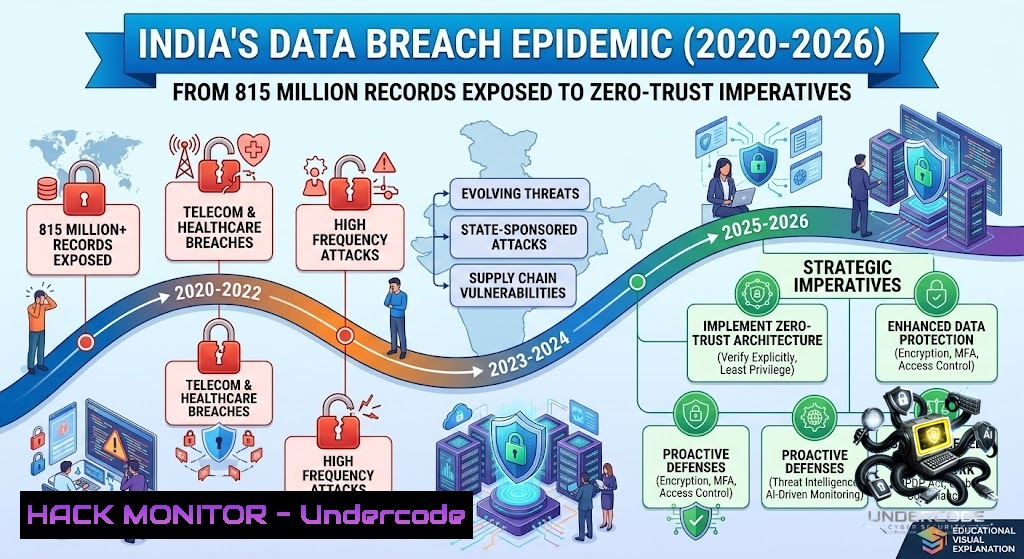
Over the past six years, India has witnessed a staggering cascade of cyber incidents—from the 815 million ICMR records leak to ransomware crippling AIIMS—that have redefined the nation’s threat landscape. These breaches, spanning healthcare, banking, telecom, and e-commerce, reveal a persistent failure in access controls, API security, and detection capabilities. For cybersecurity leaders, the question is no longer if a breach will occur, but how quickly their teams can detect, contain, and recover.
Learning Objectives:
- Understand the common attack patterns—compromised credentials, insecure APIs, and third-party gaps—that enabled India’s largest data breaches.
- Implement Zero Trust Architecture, Privileged Access Management (PAM), and Continuous Security Monitoring (SIEM/XDR) to mitigate similar risks.
- Apply hands-on Linux/Windows commands and configuration scripts for rapid threat detection, incident response, and forensic analysis.
You Should Know:
- Compromised Credentials and Weak Access Controls – The Root Cause of Most Breaches
The Unacademy (22M records), BigBasket (20M records), and boAt (7.5M records) breaches all originated from stolen or weak credentials. Attackers leverage credential stuffing, phishing, and brute-force attacks to gain initial access. Once inside, weak access controls—such as over-privileged service accounts and lack of Just-In-Time (JIT) access—allow lateral movement to sensitive databases.
Step‑by‑step guide: Enforcing MFA and PAM to Block Credential-Based Attacks
- Step 1: Audit all privileged accounts. Identify domain admins, service accounts, and local administrators using PowerShell on Windows or
awk/grepon Linux. - Windows (PowerShell): `Get-ADUser -Filter {AdminCount -eq 1} | Select-Object Name, SamAccountName`
– Linux: `sudo grep -E ‘sudo|admin’ /etc/group | cut -d: -f4` - Step 2: Enforce Multi-Factor Authentication (MFA) for all users. Use conditional access policies in Azure AD/Okta to block legacy authentication protocols.
- Azure AD PowerShell: `Set-AzureADPolicy -Definition @(‘{“EnableMFA”:true}’) -DisplayName “MFA Policy”`
- Step 3: Implement Privileged Access Management (PAM). Deploy a PAM solution (e.g., CyberArk, BeyondTrust) to rotate credentials automatically and require JIT access for critical systems.
- Linux (cron job for password rotation): `0 0 /usr/bin/passwd -e $SERVICE_ACCOUNT`
- Step 4: Monitor for anomalous logins. Configure SIEM alerts for impossible travel, multiple failed logins, or logins from Tor exit nodes.
- Splunk query: `index=main sourcetype=WinEventLog:Security EventCode=4625 | stats count by src_ip, user | where count > 5`
- Insecure APIs and Databases – The Silent Data Exfiltration Vectors
The ICMR breach (815M records) and CoWIN exposure highlight how misconfigured APIs and publicly exposed databases can leak terabytes of sensitive data. Attackers scan for unauthenticated API endpoints, SQL injection vulnerabilities, and misconfigured cloud storage buckets.
Step‑by‑step guide: Securing APIs and Databases Against Exfiltration
- Step 1: Discover and inventory all APIs. Use tools like SwaggerHub or Postman to document every endpoint. Identify shadow APIs using network traffic analysis.
- Linux (nmap to scan for open API ports): `nmap -p 80,443,8080,8443 –open -oG api_servers.txt
` - Step 2: Implement API gateway with authentication. Deploy an API gateway (e.g., Kong, AWS API Gateway) that enforces OAuth2/JWT tokens and rate limiting.
- Kong configuration: `curl -i -X POST http://localhost:8001/services/ –data name=secure-api –data url=http://backend:8080`
– Step 3: Harden database access. Ensure databases are not exposed to the public internet. Use network ACLs and VPCs to restrict access.
– MySQL: `GRANT SELECT ON mydb. TO ‘app_user’@’192.168.1.%’ IDENTIFIED BY ‘strong_password’;` -
Step 4: Encrypt sensitive data at rest and in transit. Enable Transparent Data Encryption (TDE) for databases and enforce TLS 1.3 for all API traffic.
- MongoDB encryption: `use admin; db.runCommand({setParameter: 1, enableEncryption: true})`
- Step 5: Regular vulnerability scanning. Use OWASP ZAP or Burp Suite to scan APIs for OWASP Top 10 vulnerabilities.
-
OWASP ZAP (headless): `zap-cli quick-scan –self-contained –start-options ‘-host 127.0.0.1 -port 8080’ http://target-api.com`
3. Third-Party Security Gaps – The Supply Chain Weak Link
The Air India breach (4.5M records) occurred through its Passenger Service System provider SITA, demonstrating that third-party vendors are often the weakest link. Similarly, the Bank of Baroda leak (700+ GB) originated from a compromised employee email account, highlighting insider and third-party risks.
Step‑by‑step guide: Managing Third-Party and Insider Threats
– Step 1: Conduct third-party risk assessments. Evaluate vendors against NIST CSF or ISO 27001 standards. Require SOC 2 reports and penetration testing results.
– Step 2: Implement UEBA for insider threat detection. Deploy User and Entity Behavior Analytics (UEBA) to detect anomalies like bulk data downloads or unusual login times.
– Example UEBA rule (Exabeam): `if (user.download_volume > 3x baseline AND user.department != ‘IT’) then trigger_alert` -
Step 3: Restrict third-party access using PAM. Provide vendors with time-limited, least-privilege access. Monitor all sessions.
- Linux (auditd for session monitoring): `auditctl -w /var/log/secure -p wa -k session_monitor`
- Step 4: Enforce Data Loss Prevention (DLP). Use DLP tools to block unauthorized data transfers via email, USB, or cloud storage.
- Windows (PowerShell to block USB): `Set-ItemProperty -Path “HKLM:\SYSTEM\CurrentControlSet\Services\USBSTOR” -1ame “Start” -Value 4`
- Delayed Detection and Response – The Window of Opportunity for Attackers
The AIIMS ransomware attack encrypted 1.3 TB of data and disrupted hospital services for days because detection was delayed. Similarly, the BSNL breach went undetected until CERT-In reported it. Rapid detection and response are critical to minimize impact.
Step‑by‑step guide: Building a Continuous Security Monitoring (SIEM/XDR) Program
- Step 1: Deploy SIEM and XDR. Integrate endpoint, network, and cloud logs into a central SIEM (e.g., Splunk, Sentinel) with XDR capabilities for automated threat hunting.
- Windows Event Forwarding: `wevtutil set-log Microsoft-Windows-Sysmon/Operational /enabled:true /retention:false /maxsize:1048576`
- Step 2: Create correlation rules for common attack patterns. Alert on ransomware indicators (e.g., mass file encryption, unusual file extensions).
- Splunk query for ransomware: `index=endpoint EventCode=4663 (file_name=.encrypted OR file_name=.locked) | stats count by host, user`
- Step 3: Implement automated containment. Use SOAR playbooks to automatically isolate compromised endpoints and revoke access tokens upon alert.
- Python script for Azure AD isolation: `revoke-azureaduserallrefreshtoken -objectid $userid`
- Step 4: Conduct regular tabletop exercises. Simulate breach scenarios (e.g., ransomware, data exfiltration) to test response times and communication protocols.
- Insufficient Data Protection Controls – The Encryption and Classification Gap
Many breaches—including Star Health (31M records) and Tata Electronics (630+ GB)—exposed sensitive data that was neither encrypted nor classified. Without data classification, organizations cannot prioritize protection for their most critical assets.
Step‑by‑step guide: Implementing Data Classification and Encryption
- Step 1: Classify data by sensitivity. Use tools like Microsoft Purview or Varonis to automatically tag data as Public, Internal, Confidential, or Restricted.
-
Step 2: Apply encryption based on classification. Encrypt Confidential and Restricted data at rest using AES-256 and in transit using TLS 1.3.
- Linux (LUKS full-disk encryption): `cryptsetup luksFormat /dev/sda1 && cryptsetup open /dev/sda1 encrypted`
- Step 3: Implement key management. Use a Hardware Security Module (HSM) or cloud KMS (e.g., AWS KMS) to manage encryption keys securely.
- AWS KMS CLI: `aws kms encrypt –key-id alias/my-key –plaintext fileb://plaintext.txt –output text –query CiphertextBlob > encrypted.txt`
- Step 4: Monitor data access patterns. Alert on unusual access to classified data (e.g., large queries, access by non-owners).
- Zero Trust Architecture – The New Security Paradigm
The common thread across all these breaches is the failure of the traditional perimeter-based security model. Zero Trust—”never trust, always verify”—would have prevented or mitigated many of these incidents by requiring continuous authentication and authorization for every access request.
Step‑by‑step guide: Deploying Zero Trust Architecture
- Step 1: Implement micro-segmentation. Use network segmentation to limit lateral movement. For example, isolate database servers from application servers.
- Linux (iptables for micro-segmentation): `iptables -A FORWARD -s 10.0.1.0/24 -d 10.0.2.0/24 -j DROP`
- Step 2: Enforce least-privilege access. Use role-based access control (RBAC) and attribute-based access control (ABAC) to grant minimum necessary permissions.
- AWS IAM policy: `{ “Effect”: “Deny”, “Action”: “s3:”, “Resource”: “arn:aws:s3:::sensitive-bucket/”, “Condition”: { “StringNotEquals”: {“aws:username”: “data_analyst”} } }`
- Step 3: Continuously verify trust. Use device health checks, user behavior analytics, and real-time risk scores to re-evaluate trust for every session.
What Undercode Say:
- Key Takeaway 1: Compromised credentials and weak access controls remain the primary entry vectors—MFA and PAM are non-1egotiable.
- Key Takeaway 2: Third-party risk and insider threats are just as dangerous as external attacks; continuous monitoring and UEBA are essential.
Analysis: The Indian data breach landscape from 2020 to 2026 is a stark reminder that cybersecurity is not a one-time investment but a continuous process. The breaches at ICMR, AIIMS, and Bank of Baroda demonstrate that even government and critical infrastructure are vulnerable. The shift from “if” to “when” requires organizations to adopt a proactive, intelligence-driven security posture. Zero Trust, combined with robust SIEM/XDR and regular vulnerability assessments, can significantly reduce dwell time and breach impact. However, the human element—training, awareness, and a culture of security—remains the most critical factor. As attackers evolve, so must our defenses, with a focus on resilience and rapid recovery.
Prediction:
- +1 The adoption of Zero Trust Architecture will accelerate across Indian enterprises, driven by regulatory mandates like the DPDP Act and increased board-level scrutiny.
- -1 The frequency and scale of data breaches will continue to rise, particularly in healthcare and telecom, as attackers target critical infrastructure with ransomware and supply chain attacks.
- +1 AI-driven threat detection and automated response (SOAR) will become standard, reducing mean time to detect (MTTD) and respond (MTTR) from days to minutes.
- -1 Insider threats, both malicious and negligent, will grow as remote work and third-party integrations expand the attack surface.
- +1 Cyber insurance premiums will incentivize stronger security controls, pushing organizations to adopt MFA, PAM, and encryption as baseline requirements.
- -1 The skills gap in cybersecurity will worsen, leaving many organizations understaffed and unable to keep pace with evolving threats.
- +1 Public-private partnerships and information sharing (e.g., ISACs) will improve threat intelligence and collective defense.
- -1 Nation-state actors will increasingly target Indian digital infrastructure for espionage and disruption, raising the stakes for national security.
- +1 The focus will shift from breach prevention to cyber resilience—ensuring business continuity even during an active attack.
- -1 Without a fundamental change in security culture and investment, India will remain a prime target for cybercriminals, with devastating consequences for citizens and the economy.
▶️ Related Video (82% Match):
🎯Let’s Practice For Free:
🎓 Live Courses & Certifications:
Join Undercode Academy for Verified Certifications
🚀 Request a Custom Project:
Secure, high-velocity infrastructure and disruptive technological engineering. Contact our engineering team for high-tier development and proprietary systems:
[email protected]
💎 Smart Architecture | 🛡️ Secure by Design | ⭐ Trusted by Thousands
IT/Security Reporter URL:
Reported By: Manashmisra Cybersecurity – Hackers Feeds
Extra Hub: Undercode MoN
Basic Verification: Pass ✅


