Listen to this Post
Introduction:
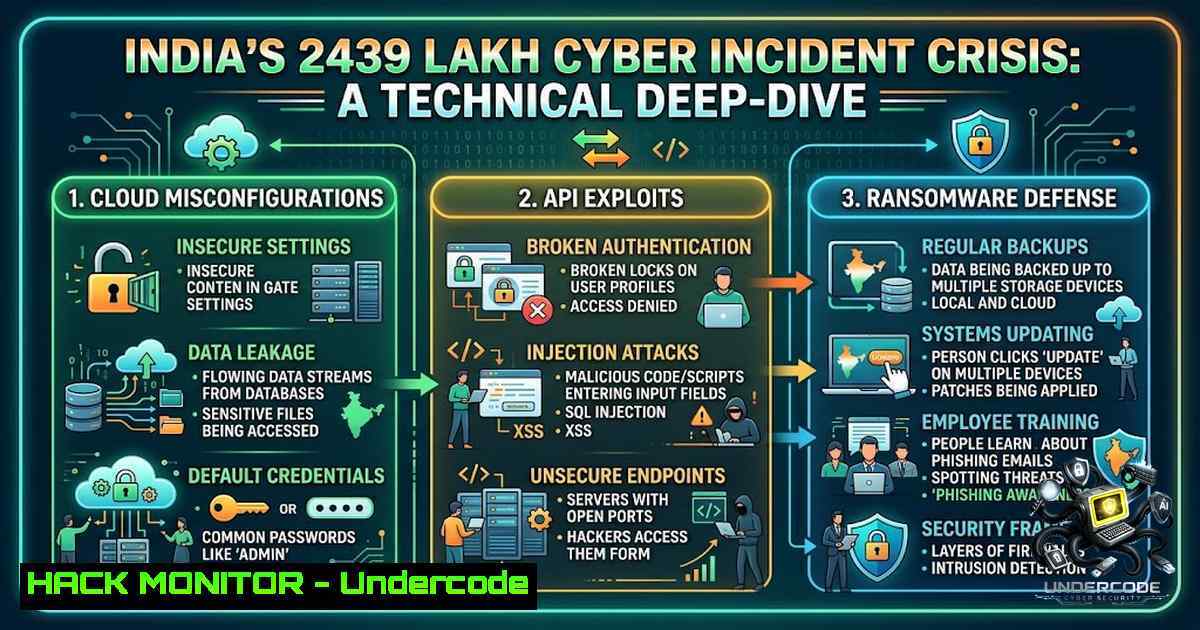
India’s digital economy is expanding at an unprecedented pace, but this rapid connectivity is widening the attack surface for cybercriminals at an alarming rate. Cybersecurity incidents detected across government and financial institutions surged from 11.46 lakh in 2023 to 24.39 lakh in 2025, with attackers increasingly leveraging AI to automate reconnaissance and accelerate exploitation. As identity flaws now play a material role in 90% of investigations and attackers can move from initial access to data exfiltration in just 72 minutes—four times faster than the previous year—organizations must move beyond reactive defense to pre-emptive, technically rigorous security postures.
Learning Objectives:
- Master essential Linux and Windows system hardening commands to close common attack vectors exploited in India’s current threat landscape.
- Implement critical cloud security configurations to prevent misconfigurations that have exposed sensitive data, including biometric records of law enforcement personnel.
- Develop proficiency in API security testing and OWASP Top 10 mitigation strategies to defend against broken object-level authorization (BOLA) and broken authentication flaws.
- Deploy ransomware detection and containment protocols using EDR, Sysmon, and active response techniques.
You Should Know:
- Linux System Reconnaissance and Hardening – Closing the Identity and Perimeter Gaps
With identity weaknesses now accounting for 90% of investigated incidents, system-level hardening is non-1egotiable. Begin any security assessment by understanding the system’s current state:
 Display kernel version and system architecture
uname -a

List all running processes to identify suspicious activity
ps aux

Show all listening ports and associated services
ss -tuln

Harden sensitive file permissions
chmod 600 /path/to/sensitive/file

Enable and configure Uncomplicated Firewall (UFW)
sudo ufw enable
sudo ufw default deny incoming
sudo ufw default allow outgoing
sudo ufw allow ssh
Step-by-step guide: The `uname -a` command reveals kernel version and architecture, helping identify known vulnerabilities. `ps aux` lists every running process—scan for unfamiliar names that may indicate infostealer malware or backdoors. `ss -tuln` exposes all listening ports; any unauthorized open port is a potential entry point. Harden the system by using `chmod` to remove unnecessary read permissions from sensitive files like `/etc/shadow` and /etc/sudoers. Enable UFW with default deny incoming policies to enforce basic network traffic rules. Additionally, disable unnecessary services that expand the attack surface:
sudo systemctl disable telnet
sudo systemctl disable rsh
sudo systemctl disable rlogin
Configure SSH to prevent root login and enforce key-based authentication:
sudo sed -i 's/PermitRootLogin yes/PermitRootLogin no/' /etc/ssh/sshd_config
sudo sed -i 's/PasswordAuthentication yes/PasswordAuthentication no/' /etc/ssh/sshd_config
sudo systemctl restart ssh
2. Windows Server Security Auditing and Configuration
Windows environments remain prime targets, with over 44,000 Windows devices in India compromised by Lumma Stealer alone between March and May 2025. Start with comprehensive system auditing:
 Get comprehensive OS build, hotfixes, and hardware info
systeminfo

Enumerate all listening ports
Get-1etTCPConnection -State Listen

Audit installed optional features
Get-WindowsOptionalFeature -Online | Where-Object {$_.State -eq "Enabled"}

Ensure Windows Defender real-time protection is active
Set-MpPreference -DisableRealtimeMonitoring $false
Step-by-step guide: `systeminfo` provides a complete overview of the OS version, installed hotfixes, and hardware details—critical for identifying missing patches. Use `Get-1etTCPConnection -State Listen` to enumerate listening ports, similar to `ss` on Linux. Audit enabled features with `Get-WindowsOptionalFeature` and disable unnecessary services like Telnet, RemoteRegistry, and Messenger. Finally, ensure Windows Defender real-time protection is enabled; disabling it is a common tactic used by ransomware operators.
Configure account policies to enforce strong password requirements:
net accounts /maxpwage:90 /minpwage:1 /minpwlen:12 /uniquepw:5
Enable audit policies for logon/logoff and account management events:
auditpol /set /category:"Logon/Logoff" /success:enable /failure:enable
auditpol /set /category:"Account Management" /success:enable /failure:enable
- Cloud Security Hardening – Preventing Misconfigurations That Expose Sensitive Data
Cloud misconfigurations were identified as a major India-specific vulnerability, including a breach that exposed 500GB of personal and biometric data due to an unsecured cloud storage bucket. With less than 9% of sensitive cloud data encrypted, immediate action is required.
AWS S3 Bucket Hardening:
 Retrieve current bucket policy for inspection
aws s3api get-bucket-policy --bucket my-bucket --query Policy --output text

Apply restrictive policy (create new-policy.json first)
aws s3api put-bucket-policy --bucket my-bucket --policy file://new-policy.json
Step-by-step guide: Misconfigured cloud storage is a top attack vector. Use the AWS CLI to audit S3 bucket policies. The `get-bucket-policy` command retrieves the current policy for inspection. Create a JSON policy file that denies all actions unless from a specific IP range or VPC, then apply it using `put-bucket-policy` to prevent public read/write access.
Example restrictive S3 bucket policy (new-policy.json):
{
"Version": "2012-10-17",
"Statement": [
{
"Effect": "Deny",
"Principal": "",
"Action": "s3:",
"Resource": "arn:aws:s3:::my-bucket/",
"Condition": {
"NotIpAddress": {
"aws:SourceIp": "192.168.1.0/24"
}
}
}
]
}
For Azure environments, enable Azure Security Center’s just-in-time VM access and regularly audit Key Vault access policies. Implement CIS benchmarks for cloud platforms—CIS-aligned controls across hardening, logging, SIEM, encryption, and backup validation provide a structured defense framework.
- Vulnerability Scanning with Nmap and Nikto – Proactive Threat Discovery
Proactive scanning is key to defense, especially as attackers now use AI to accelerate vulnerability identification and exploitation. Nmap remains the industry standard for network discovery:
 Comprehensive scan with service version, default scripts, and OS detection
nmap -sV -sC -O <target-ip>

Ping sweep to identify live hosts
nmap -sn 192.168.1.0/24

Web application vulnerability scanning with Nikto
nikto -h http://<target-url>
Step-by-step guide: The `-sV` flag probes open ports to determine service and version information—critical for identifying outdated, vulnerable services. `-sC` runs default Nmap scripts for additional reconnaissance, and `-O` enables OS detection. For web applications, Nikto performs comprehensive tests for dangerous files, outdated servers, and common misconfigurations. In controlled lab environments, tools like Metasploit can be used to confirm vulnerabilities, but never run these commands against systems you do not own or explicitly have permission to test.
Kali Linux penetration testing workflow:
- Information gathering – identify target IPs, hostnames, and services.
- Target identification – use ping sweeps and port scanning.
- Vulnerability analysis – discover service versions and misconfigurations.
4. Exploitation – use Metasploit to confirm vulnerabilities.
5. Post-exploitation and cleanup – document findings.
- API Security Testing and Mitigation – Defending Against BOLA and Broken Authentication
APIs expose business logic and data endpoints directly, making them a high-value attack surface. The OWASP API Security Top 10 (2023 Edition) reflects the maturity of threats against modern interfaces. Broken Object Level Authorization (BOLA)—the 1 API risk—occurs when an API accepts an object ID from the client without verifying the requesting user has permission to access it.
Testing for BOLA with curl:
 Authenticate as User A and capture a request
curl -H "Authorization: Bearer <token-a>" https://api.example.com/api/v1/orders/1001

Replay with User B's token but User A's order ID
curl -H "Authorization: Bearer <token-b>" https://api.example.com/api/v1/orders/1001
Step-by-step guide: If the second request returns User A’s data, the endpoint is broken. Test every ID-bearing path, including nested resources like /api/orgs/{orgId}/users/{userId}, where the outer ID might be checked but the inner one isn’t.
Mitigation strategies:
- Use UUIDs or non-predictable identifiers instead of sequential numbers.
- Implement ownership checks on every request in the backend.
- Use DTOs (Data Transfer Objects) and apply strict field allow-lists to prevent excessive data exposure.
- Implement OAuth2/OIDC with short-lived tokens and refresh token rotation.
Testing Broken Authentication:
 Test if login works with invalid password
curl -X POST https://api.example.com/api/v2/user/login \
-d "[email protected]&password=anything"
If login succeeds with an incorrect password, the authentication mechanism is broken. Mitigation requires proper password validation with bcrypt hashing, multi-factor authentication, and rate limiting on all credential-based endpoints.
6. Ransomware Detection, Containment, and Recovery
Ransomware attacks remained elevated in 2025, affecting an estimated 7 to 10% of organizations nationwide, with attackers increasingly prioritizing data exfiltration and extortion. The average data breach cost in India reached a record ₹25.5 crore in 2026.
Windows Ransomware Detection (Sysmon + PowerShell):
 Monitor for shadow copy deletion (pre-ransomware activity)
Get-WinEvent -LogName "Microsoft-Windows-Sysmon/Operational" |
Where-Object { $_.Message -match "vssadmin.delete.shadows" }

Detect encoded PowerShell commands
Get-WinEvent -LogName "Microsoft-Windows-PowerShell/Operational" |
Where-Object { $_.Message -match "EncodedCommand" }

Monitor for mass file encryption patterns
Get-WinEvent -LogName "Security" |
Where-Object { $<em>.Id -eq 4663 -and $</em>.Message -match "WriteData" }
Linux Ransomware Detection (auditd + FIM):
 Monitor for suspicious file modifications
sudo ausearch -m FILE_WRITE -ts recent | grep -E ".(doc|pdf|xls|txt)$"

Check for unauthorized process execution
sudo ausearch -m EXECVE -ts recent | grep -E "(wget|curl|chmod|encrypt)"

Monitor for shadow copy deletion attempts
sudo ausearch -m SYSCALL -ts recent | grep vssadmin
Containment and recovery steps:
- Immediate isolation – disconnect affected hosts from the network.
2. Disable compromised accounts – prevent lateral movement.
- Identify the ransomware variant – check ransom note extensions and filenames.
- Restore from offline backups – verify backup integrity before restoration.
- Post-incident hardening – patch vulnerabilities, enforce MFA, and tighten PowerShell and WMI execution controls.
Enable real-time anti-malware and anti-ransomware safeguards on all endpoints, and protect Volume Shadow Copy (VSS) snapshots from deletion. Implement active response rules to automatically kill processes exhibiting ransomware-like behavior.
What Undercode Say:
- Identity is the new perimeter. With identity weaknesses playing a material role in 90% of investigations, organizations must prioritize privileged access management, enforce least privilege, and implement multi-factor authentication across all critical systems.
- AI is a double-edged sword. Attackers are using AI to automate reconnaissance and accelerate exploitation, narrowing the gap between vulnerability discovery and exploitation. Defenders must deploy AI-powered threat detection and predictive intelligence to keep pace.
Analysis: The data from India’s Parliament and CERT-In reveals a cybersecurity crisis that demands immediate technical action. The 24.39 lakh incidents detected in 2025 represent not just a statistical increase but a fundamental shift in attacker capability—AI-assisted phishing, automated vulnerability chaining, and 72-minute breach-to-exfiltration timelines. The financial sector alone faced 4,70,445 malicious scanning and probing incidents in 2025, indicating systematic reconnaissance rather than opportunistic attacks. Cloud misconfigurations and unencrypted sensitive data remain inexcusable vulnerabilities that can be addressed with the hardening commands and policies outlined above. The rise of supply-chain ransomware, now accounting for close to 90% of incidents affecting financial institutions, underscores the need for third-party risk management and zero-trust architectures. Organizations that fail to implement these technical controls will continue to be exploited at accelerating speed.
Prediction:
- -1 The 72-minute breach-to-exfiltration window will continue to shrink as AI-powered attack tools become more sophisticated, potentially dropping to under 30 minutes by 2027, overwhelming traditional SOC response capabilities.
- -1 Supply-chain ransomware targeting Indian financial institutions will intensify, with attackers pivoting from direct compromise to exploiting trusted third-party relationships and SaaS integrations.
- +1 CERT-In’s 2025 Cyber Security Audit Policy Guidelines, requiring 6-hour incident reporting and 180-day log retention, will drive accelerated adoption of SIEM and SOAR platforms across Indian enterprises, improving detection and response capabilities.
- -1 The encryption gap—less than 9% of sensitive cloud data currently encrypted—will be exploited in high-profile breaches, exposing biometric and personally identifiable information of millions of Indian citizens.
- +1 Increased adoption of CIS benchmarks and cloud security posture management (CSPM) tools will gradually reduce cloud misconfigurations, though the lag between cloud adoption and security implementation will continue to create windows of exposure.
▶️ Related Video (74% Match):
🎯Let’s Practice For Free:
🎓 Live Courses & Certifications:
Join Undercode Academy for Verified Certifications
🚀 Request a Custom Project:
Secure, high-velocity infrastructure and disruptive technological engineering. Contact our engineering team for high-tier development and proprietary systems:
[email protected]
💎 Smart Architecture | 🛡️ Secure by Design | ⭐ Trusted by Thousands
IT/Security Reporter URL:
Reported By: Gregorydevans Cybersecurity – Hackers Feeds
Extra Hub: Undercode MoN
Basic Verification: Pass ✅


