Listen to this Post
Introduction:
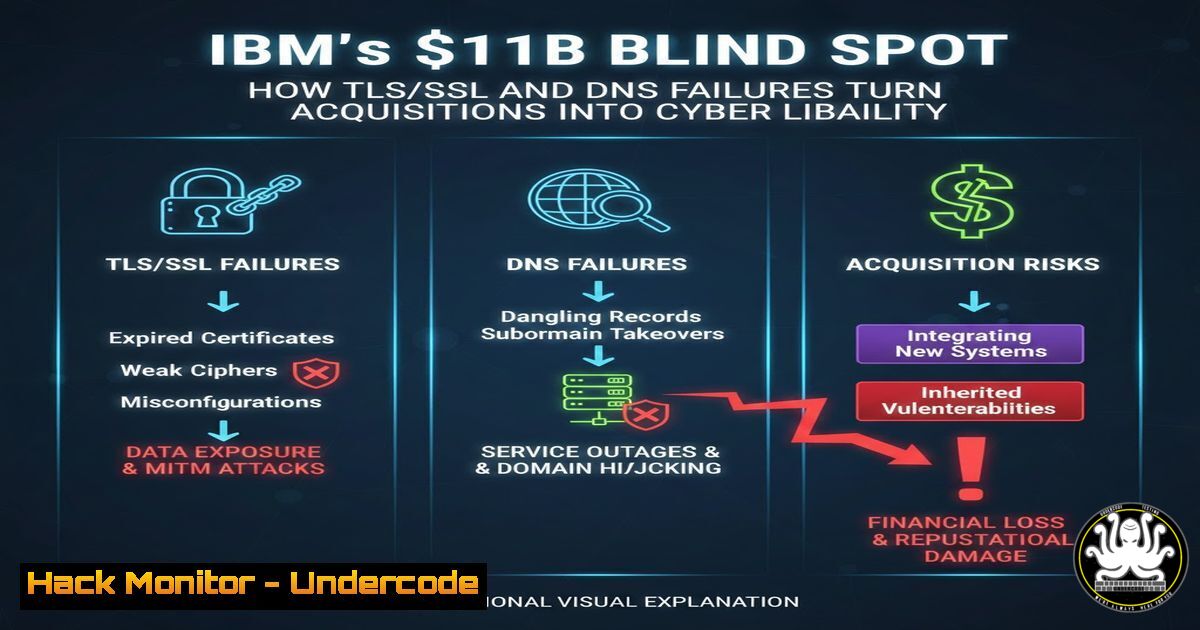
The recent announcement of IBM’s multi-billion dollar acquisition of Confluent has sparked debate, not about the potential for innovation, but about fundamental security hygiene. Critics point out that the acquiring tech giant, “Big Blue” itself, exhibits widespread basic security failures in TLS/SSL and DNS configurations across its internet-facing assets. This scenario highlights a critical, often-overlooked cyber risk in mergers and acquisitions (M&A): the exponential blending of pre-existing vulnerability landscapes, where poor security posture isn’t audited but inherited, guaranteeing expanded attack surfaces.
Learning Objectives:
- Understand the critical real-world risks posed by TLS/SSL misconfigurations and DNS vulnerabilities.
- Learn to audit and identify common TLS/SSL and DNS security weaknesses using command-line tools.
- Implement immediate hardening steps to mitigate these basic yet high-impact security failings.
You Should Know:
1. The Silent Killers: TLS/SSL Misconfigurations
A secure TLS/SSL implementation is the bedrock of trusted internet communication. Common failings, as alluded to in the critique, include using deprecated protocols (SSLv2, SSLv3, TLS 1.0), supporting weak cipher suites, and presenting invalid or expired certificates. These flaws enable eavesdropping, man-in-the-middle (MitM) attacks, and credential theft.
Step‑by‑step guide explaining what this does and how to use it.
First, audit your external footprint. Use tools like `nmap` and `testssl.sh` to probe for weaknesses.
 Using nmap to check for weak protocols and ciphers
nmap --script ssl-enum-ciphers -p 443 target.ibm.com

Using the open-source testssl.sh for a deep dive
./testssl.sh --color 0 target.ibm.com
On Windows, PowerShell can retrieve certificate details:
 PowerShell: Check certificate details for a remote service
$tcpSocket = New-Object Net.Sockets.TcpClient('target.ibm.com', 443)
$tlsStream = New-Object Net.Security.SslStream($tcpSocket.GetStream())
$tlsStream.AuthenticateAsClient('target.ibm.com')
$cert = $tlsStream.RemoteCertificate
[System.Security.Cryptography.X509Certificates.X509Certificate2]$cert2 = $cert
$cert2 | Format-List Subject, NotBefore, NotAfter, Thumbprint, SerialNumber
Remediation: Disable old protocols on web servers. For an Apache server, your SSL configuration should explicitly disable weak protocols:
SSLProtocol all -SSLv2 -SSLv3 -TLSv1 -TLSv1.1
SSLCipherSuite HIGH:!aNULL:!MD5:!RC4
2. DNS: The Forgotten Attack Surface
DNS is often the “blind spot” in security postures. Vulnerabilities include misconfigured DNSSEC (or its absence), open DNS resolvers, vulnerable zone transfers (AXFR), and dangling DNS records left after deprovisioning services. These can lead to DNS poisoning, subdomain takeover, traffic interception, and large-scale DDoS amplification attacks.
Step‑by‑step guide explaining what this does and how to use it.
Audit your DNS infrastructure for common misconfigurations.
 Check for open DNS resolvers (Query from an external network)
dig +short @<target_dns_server> test.openresolver.com TXT

Test for zone transfer vulnerability (Should be refused)
dig axfr @<dns_server> domain.com

Check for DNSSEC validation
dig +dnssec domain.com SOA
Remediation: Ensure DNS servers are not open resolvers (configure ACLs), disable zone transfers to untrusted hosts, and implement DNSSEC. For cloud DNS (e.g., AWS Route 53), ensure records are periodically audited and “aliases” are used where possible to avoid dangling CNAMEs.
3. Automated Asset Discovery & Inventory Bloat
A major M&A risk is not knowing the full scope of acquired internet-facing assets. This leads to “shadow IT” and unpatched systems falling through the cracks. Automated discovery is key.
Step‑by‑step guide explaining what this does and how to use it.
Use passive and active reconnaissance tools to build an asset inventory.
 Using Amass for passive enumeration and subdomain discovery
amass enum -passive -d acquired-company.com -o assets_passive.txt

Using Aquatone to scan and screenshot discovered hosts
cat discovered_hosts.txt | aquatone -ports xlarge
Remediation: Integrate continuous asset discovery into security orchestration. Tools like Rapid7’s Project Sonar or commercial Asset Attack Surface Management (ASM) platforms should be used pre- and post-acquisition to map the blended landscape.
4. Pre-Acquisition Cyber Due Diligence: The Technical Checklist
Due diligence must move beyond financials to include a rigorous technical security audit. This involves credentialed and non-credentialed scanning of the target’s infrastructure.
Step‑by‑step guide explaining what this does and how to use it.
Conduct a pre-acquisition technical assessment (with legal agreement).
 Run a comprehensive Nessus or OpenVAS scan against the target's provided IP ranges
 Use Nikto for quick web server vulnerability assessment
nikto -h https://acquired-app.com
Remediation: Make a standardized technical due diligence checklist mandatory for all M&A activities. This must include external penetration testing, code audit for key applications, and a review of all past security incidents and open vulnerabilities.
5. Post-Merger Hardening: Patching the Holes
After identifying TLS/SSL and DNS weaknesses across the merged entity, a systematic hardening program must be launched.
Step‑by‑step guide explaining what this does and how to use it.
Prioritize and remediate findings. Use configuration management for consistency.
 Example Ansible task to enforce strong TLS on NGINX across hundreds of servers
- name: Harden NGINX SSL configuration
lineinfile:
path: /etc/nginx/nginx.conf
regexp: '^\sssl_protocols'
line: ' ssl_protocols TLSv1.2 TLSv1.3;'
notify: reload nginx
Remediation: Implement a centralized certificate management system (e.g., HashiCorp Vault, Venafi) to prevent expired certificates. Enforce security baselines using Group Policy Objects (GPO) for Windows or CIS benchmarks for Linux across all integrated systems.
6. Continuous Monitoring for the New Attack Surface
The merged attack surface is dynamic. Continuous monitoring for new vulnerabilities and configuration drift is non-negotiable.
Step‑by‑step guide explaining what this does and how to use it.
Implement Security Information and Event Management (SIEM) and vulnerability scanning.
 Integrate Nmap scans with SIEM via scheduled jobs and syslog
nmap -sV -O --script vuln target-subnet -oX scan_results.xml
 Import XML into a SIEM like Splunk or Elastic for correlation
Remediation: Deploy a Cloud Security Posture Management (CSPM) tool if assets are in the cloud. Schedule weekly external vulnerability scans and subscribe to threat intelligence feeds related to both companies’ technology stacks.
What Undercode Say:
- M&A is a Prime Attack Vector: The integration phase post-acquisition is a period of extreme vulnerability. Attackers actively target companies during M&A, knowing security oversight is common and systems are in flux. Failing to conduct technical due diligence is a corporate governance failure.
- Basics Matter Most: The most devastating breaches often exploit elementary flaws—expired certificates, misconfigured DNS, unpatched public-facing servers. A “back-to-basics” security posture is not trivial; it is the most effective control against the majority of automated and opportunistic attacks. A company unable to manage its own TLS/DNS hygiene lacks the foundational discipline to secure a multi-billion dollar acquisition.
Prediction:
The public criticism of foundational security gaps in major tech acquisitions will catalyze a shift in M&A practices. Within the next 2-3 years, we predict the rise of mandated independent “cyber diligence” reports, akin to financial audits, for deals above a certain threshold. Shareholder lawsuits following breaches traced to negligent pre-acquisition security assessments will become a key driver. Furthermore, regulatory bodies in finance and healthcare will start requiring proof of attack surface consolidation and hardening as part of merger approvals. Companies that fail to integrate security into their M&A DNA will face not only technical risk but existential legal and reputational consequences, turning what should be strategic growth into catastrophic liability.
🎯Let’s Practice For Free:
IT/Security Reporter URL:
Reported By: Andy Jenkinson – Hackers Feeds
Extra Hub: Undercode MoN
Basic Verification: Pass ✅


