Listen to this Post
Introduction:
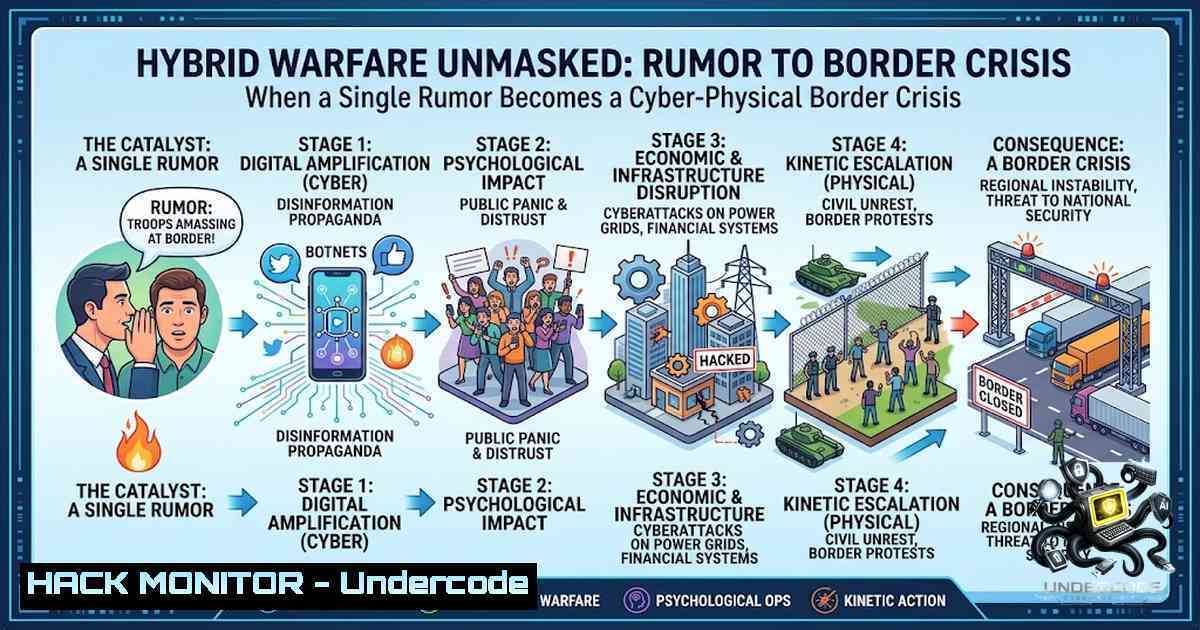
The July 2026 Ceuta incident demonstrates how hybrid threats can weaponize judicial rulings through social media, transforming procedural legal nuances into physical mass movements that overwhelm national borders. This convergence of disinformation, human trafficking networks, and geopolitical manipulation represents a new class of security challenge where the battlefield exists simultaneously in legal text, encrypted messaging apps, and maritime approaches.
Learning Objectives:
- Analyze the anatomy of hybrid threat campaigns that weaponize legal ambiguity for mass mobilization
- Identify digital indicators and OSINT methodologies for early detection of manipulated narratives
- Implement technical countermeasures across social media monitoring, cryptographic verification, and cross-platform threat intelligence
You Should Know:
1. The Disinformation-to-Physical-Impact Pipeline
The Ceuta case reveals a five-stage hybrid attack chain that any nation-state or non-state actor can replicate. On July 8, 2026, Spain’s Tribunal Supremo ruled that “hot returns” (devoluciones en caliente) could not be automatically applied to migrants intercepted at sea attempting to reach Ceuta or Melilla by swimming—they required formal repatriation procedures. Within weeks, criminal networks had transformed this procedural safeguard into a false promise: “Enter today, get regularized tomorrow”.
What this does: The manipulation exploits the gap between legal reality and simplified messaging. The ruling granted no automatic right to stay, yet traffickers leveraged Spain’s recently concluded extraordinary regularization process (over one million applications, deadline June 30) as credibility fuel.
Step-by-step guide to identifying this pipeline:
- Monitor judicial announcements for any procedural change that could be misrepresented—use Google Alerts with keywords: “Tribunal Supremo,” “respingimento,” “procedura di rimpatrio”
- Track social media velocity—Ceuta saw 1,500+ sea arrivals in days with 200+ daily entries; establish baseline migration flow metrics and flag anomalies exceeding 200% of weekly average
- Analyze narrative evolution—map how “procedural protection” becomes “entry guarantee” using sentiment analysis tools (Python with TextBlob or VADER)
- Identify amplification nodes—traffickers used TikTok, encrypted messaging, and temporary profiles; run OSINT queries for repeated phrases like “entra oggi e regolarizzato domani”
- Deploy automated fact-checking—cross-reference viral claims against official sources using API integrations (Spain’s Interior Ministry, Europol databases)
Linux/Windows Commands for Social Media Monitoring:
 Linux: Monitor Twitter/X for specific keywords using twint (archived)
twint -s "Ceuta regularización" --since 2026-07-01 --limit 1000 -o ceuta_tweets.csv

Linux: Extract geolocated TikTok metadata (using yt-dlp for public videos)
yt-dlp --write-info-json --skip-download "https://www.tiktok.com/@haragaa_ceuta1"

Windows PowerShell: Track URL shortening services used in smuggling networks
Invoke-WebRequest -Uri "https://api.linkpreview.net/?key=YOUR_API_KEY&q=https://bit.ly/xxx" | Select-Object -ExpandProperty Content

Cross-platform: OSINT aggregation with Sherlock (find all profiles across platforms)
sherlock haragaa_ceuta1
- Hybrid Threat Infrastructure: The Digital Ecosystem Enabling Physical Crises
Europol confirms that smuggling organizations now operate as digital-first enterprises: social networks, mobile applications, and digital financial services for promotion, logistics, and geopolitical reaction. The Ceuta crisis exposed three distinct but overlapping infrastructures:
Communication Layer: TikTok, WhatsApp, Telegram channels, gaming platforms, and decentralized communities serve as propaganda ecosystems for radicalization, recruitment, and operational planning. Extremist groups can enter a crisis post-initiation, using imagery and effects regardless of causation.
Financial Layer: Cryptocurrency payments (Monero, USDT on Tron), prepaid cards, and hawala networks enable untraceable transaction flows.
Logistical Layer: Real-time GPS tracking, maritime route mapping, and automated SMS alerts coordinate movements.
Step-by-step guide to mapping hybrid infrastructure:
- Map encrypted app presence—use TelegramOSINT to identify channels mentioning “Ceuta,” “nado,” “entrada irregular”
- Analyze financial fingerprints—blockchain explorers (Etherscan, Tronscan) for wallet addresses shared in smuggling channels
- Correlate with physical events—overlay digital chatter timestamps with maritime arrival data using Python’s Pandas
- Identify state-actor indicators—look for coordinated messaging campaigns, botnet amplification, and geopolitical framing (e.g., videos suggesting Moroccan facilitation)
Technical Countermeasures:
 Python: Cross-platform threat correlation
import pandas as pd
import requests

Fetch social media volume data
social_data = pd.read_csv('social_volume.csv')
maritime_data = pd.read_csv('maritime_arrivals.csv')

Merge timestamps
merged = pd.merge_asof(social_data.sort_values('timestamp'),
maritime_data.sort_values('timestamp'),
on='timestamp', direction='nearest')

Detect leading indicators (social spike precedes arrivals by 24-48 hours)
merged['lead_indicator'] = merged['social_volume'].shift(-48) > merged['social_volume'].mean()  2
print(merged[merged['lead_indicator'] == True])
 Windows: Monitor cryptocurrency flow related to smuggling keywords
 Use Chainalysis Reactor or open-source alternative:
python -c "import requests; print(requests.get('https://api.blockcypher.com/v1/btc/main/addrs/XXX').json())"
- National Preparedness: Italy’s Cyber and Physical Defense Architecture
Italy possesses established capabilities in border control, maritime rescue, counterterrorism, intelligence, and European coordination. The National Cybersecurity Strategy explicitly addresses online disinformation within hybrid threat frameworks, mandating monitoring, analysis, and coordinated crisis response. However, possessing specific capabilities does not guarantee integrated deployment.
Critical gaps identified:
- Siloed operations between social media monitoring, intelligence, diplomatic channels, maritime control, public order, identification procedures, reception, institutional communication, and counterterrorism
- No unified crisis cell capable of answering “why are thousands moving in the same direction and what information changed their behavior?”
- Delayed institutional communication allowing traffickers and hostile actors to fill the vacuum
Step-by-step guide to hardening hybrid response:
- Establish a 24/7 Hybrid Crisis Cell—integrate representatives from ACN (Agenzia per la Cybersicurezza Nazionale), intelligence services, Coast Guard, and Ministry of Interior
- Deploy OSINT early warning systems—use tools like Maltego, Shodan, and SpiderFoot to monitor narrative emergence before physical manifestation
- Implement rapid response communication protocols—pre-approved messaging templates in multiple languages (Arabic, French, English, Italian) for immediate deployment
- Conduct tabletop exercises—simulate Ceuta-style scenarios with real-time social media feeds and physical response coordination
- Establish platform liaison—direct relationships with TikTok, Telegram, Meta for rapid content takedown and intelligence sharing
Linux Commands for Crisis Cell Setup:
 Linux: Set up automated OSINT pipeline with TheHarvester
theHarvester -d redhotcyber.com -l 500 -b google,bing,linkedin

Linux: Real-time social media sentiment monitoring with tweepy
python -c "
import tweepy
auth = tweepy.OAuthHandler('API_KEY', 'API_SECRET')
api = tweepy.API(auth)
for tweet in api.search_tweets(q='Ceuta OR migrazione OR respingimento', lang='it', count=100):
print(tweet.text, tweet.created_at)
"

Windows PowerShell: Automated website change detection for official sources
$url = "https://www.interior.gob.es/opencms/en/detail-pages/article/Comunicado-sobre-la-situacion-en-la-ciudad-autonoma-de-Ceuta/"
$hash = (Get-FileHash -InputStream (Invoke-WebRequest -Uri $url).Content).Hash
 Compare with previous hash; alert on change
4. Geopolitical Dimensions: Ceuta as a Laboratory
Ceuta is Spanish (thus European) territory on the African coast, embedded in a zone of intersecting diplomatic interests, migration control, economic relations, and territorial claims. Every local crisis immediately resonates internationally. The EU Council conclusions of March 2026 explicitly qualify migration instrumentalization, information manipulation, cyber activities, and sabotage as components of possible hybrid campaigns.
Key geopolitical indicators:
- Previous crisis (2021) saw migration used as political leverage against an EU member state
- Unconfirmed reports suggest state-level orchestration of the July 2026 crisis
- Morocco’s cooperation with Spain—thwarting thousands of crossing attempts while reportedly facilitating others—demonstrates dual-use border dynamics
Step-by-step guide to geopolitical threat analysis:
- Map stakeholder interests—Spain, Morocco, EU, migrant origin countries, trafficking networks
- Identify pressure points—legal ambiguity, economic dependency, territorial disputes
- Monitor diplomatic signals—official statements, troop movements, policy shifts
- Correlate with digital campaigns—look for coordinated messaging from state-affiliated media
OSINT Tools for Geopolitical Monitoring:
 Linux: Monitor state-affiliated media with RSS feeds
curl -s https://www.lamoncloa.gob.es/serviciosdeprensa/notasprensa/Paginas/2026/020726-balance-regularizacion-extraordinaria.aspx | grep -i "regularizaci"

Cross-platform: Track domain registrations for fake news sites
whois disinformazione-ceuta.com

Windows: Use PowerBI or Tableau for geopolitical data visualization
 Import CSV data from multiple sources and create heat maps
5. The Extremist Vector: When Chaos Becomes Opportunity
Extremist groups benefit from hybrid crises through three mechanisms:
1. Temporary blinding—crisis diverts monitoring and identification capacities
- Anti-institution propaganda—narratives of EU failure, border collapse, state weakness
- Social polarization—simultaneously fueling jihadist, xenophobic, and accelerationist narratives
The risk lies not in collective migrant identity but in exploiting chaotic incidents where individuals and groups act autonomously while authorities focus on frontline urgency.
Step-by-step guide to countering extremist exploitation:
- Monitor extremists’ digital ecosystems—Telegram channels, Rocket.Chat instances, dark web forums
- Track narrative hijacking—identify when crisis-related keywords appear in extremist content
3. Deploy counter-1arratives—pre-approved, culturally attuned messaging
- Coordinate with Europol’s Internet Referral Unit—for rapid takedown of terrorist content
Technical Implementation:
 Python: Detect extremist narrative injection
import re
extremist_keywords = ['jihad', 'xenophobe', 'accelerate', 'chaos', 'collapse']
crisis_keywords = ['Ceuta', 'migrant', 'border', 'irregular']

def detect_injection(text):
if any(kw in text.lower() for kw in crisis_keywords) and any(kw in text.lower() for kw in extremist_keywords):
return True
return False

Apply to scraped content
 Linux: Monitor dark web forums (requires Tor)
torsocks curl http://dreadytofatroptsdj6io7l3xptbet6onoyno2yv7jicoxknyazubrad.onion/ | grep -i "ceuta"

Windows: Use PowerBI to create extremist threat dashboards
 Import data from multiple sources and visualize correlations
What Undercode Say:
- The Ceuta crisis proves that hybrid threats don’t require sophisticated cyberattacks—a single, credible, mistranslated message can destabilize a sovereign border. The vulnerability lies in the gap between legal nuance and public perception, which traffickers and hostile actors exploit with industrial efficiency.
-
Italy’s preparedness is theoretical, not operational. While the National Cybersecurity Strategy acknowledges hybrid threats, the Ceuta scenario demands real-time integration across siloed agencies—a capability that doesn’t currently exist. The question isn’t “do we have the tools?” but “can we use them together before the boats arrive?”
Analysis: The Ceuta incident represents a paradigm shift in border security. The frontline is no longer maritime—it exists within Telegram channels, WhatsApp groups, and viral videos. Disinformation becomes hybrid threat when it alters behavior, mobilizes masses, challenges administrative states, and influences political actions. When amplified to influence state choices, it becomes interference; when extremist ecosystems leverage chaos, polarization, and loss of trust for propaganda, recruitment, or violent action, it merges with terrorism. The EU’s Justice and Home Affairs Council meeting of August 4, 2026, prioritized strengthening pre-border intelligence, social network surveillance, communication timeliness, and combating external manipulation actors—yet implementation remains uneven across member states.
Prediction:
- -1 Hybrid threat campaigns will increase in frequency and sophistication, targeting legal ambiguities in immigration, asylum, and border procedures across all EU member states within 12-18 months. The Ceuta playbook will be replicated in Greece, Italy, and Bulgaria.
-
-1 State and non-state actors will invest heavily in AI-generated disinformation specifically designed to exploit procedural vulnerabilities—automated narrative generation, deepfake testimonials, and bot-swarm amplification will outpace traditional fact-checking capabilities.
-
+1 Italy’s proactive diplomatic engagement—co-leading the 22-1ation EU letter on illegal entry deterrence—positions it as a hybrid threat thought leader, potentially accelerating the development of unified EU response frameworks and shared intelligence platforms.
▶️ Related Video (84% Match):
https://www.youtube.com/watch?v=4ACnLtroFUQ
🎯Let’s Practice For Free:
🎓 Live Courses & Certifications:
Join Undercode Academy for Verified Certifications
🚀 Request a Custom Project:
Secure, high-velocity infrastructure and disruptive technological engineering. Contact our engineering team for high-tier development and proprietary systems:
[email protected]
💎 Smart Architecture | 🛡️ Secure by Design | ⭐ Trusted by Thousands
IT/Security Reporter URL:
Reported By: Redhotcyber Cybersecurity – Hackers Feeds
Extra Hub: Undercode MoN
Basic Verification: Pass ✅


