Listen to this Post
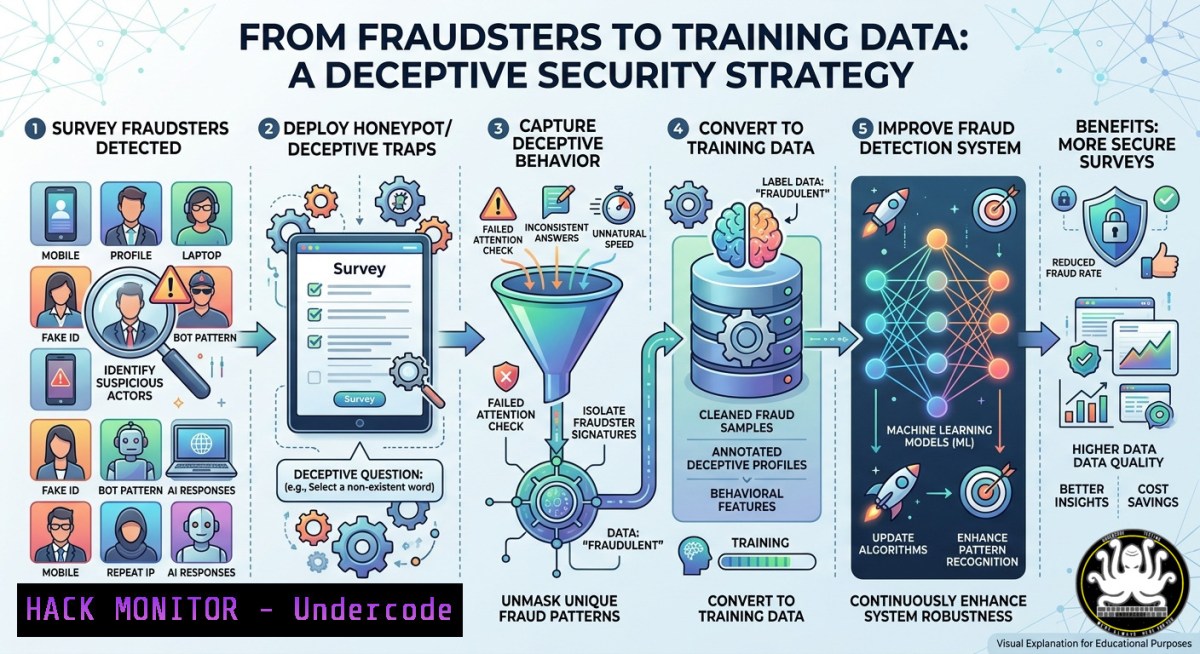
Introduction:
Online surveys are under constant attack from bots, click farms, and low‑effort fraudsters who exploit attention checks and screeners to steal incentives. Traditional fraud detection terminates respondents immediately upon failure—but that only teaches fraudsters which questions to avoid, creating an adaptive adversary. By flipping the model and letting fraudsters complete the survey while covertly analyzing their patterns, organizations can waste adversarial time, collect training data, and stay ahead of the fraud economy.
Learning Objectives:
- Understand the adversarial dynamics of survey fraud and why instant termination backfires.
- Implement deceptive countermeasures (honeypots, variable delays, randomized checks) to detect and profile bots without alerting them.
- Use behavioral analytics and machine learning to distinguish human from automated responses.
- Apply log analysis, API hardening, and scripting techniques to mitigate click‑farm economics.
You Should Know:
1. Deception‑Driven Fraud Detection – Step‑by‑Step Honeypot Implementation
Instead of blocking a suspicious respondent, let them finish while logging every action. This creates a honeypot that feeds your detection models.
Step‑by‑step guide:
- Step 1: Insert invisible trap questions (e.g., “Select ‘Strongly Disagree’ for this row”) that only bots or speeders will trigger, but do not terminate.
- Step 2: Record timestamps per page, answer patterns, and mouse movements (if using JavaScript).
- Step 3: After completion, flag the response internally without rejecting it immediately. Use a scoring algorithm (e.g., time < 20% of median, identical open‑ended answers).
- Step 4: Periodically reconcile flagged responses with your sample provider, as GroupSolver achieved 100% panel reconciliation.
Linux command to monitor real‑time survey traffic:
sudo tcpdump -i eth0 -s 0 -A 'port 443' | grep -E "POST /survey|User-Agent"
Python snippet to simulate a delayed termination honeypot:
import time, random
def evaluate_response(user_data):
score = 0
if user_data['completion_time'] < 30: score += 1  too fast
if user_data['attention_check'] == False: score += 2
if score >= 2:
 Log for training, but let them finish
with open('fraud_log.csv', 'a') as f:
f.write(f"{user_data['id']},{user_data['answers']}\n")
return "Thank you for completing the survey."  no rejection
return "Valid response"
- Behavioral Analysis with Machine Learning – Clustering Bot Patterns
Use unsupervised learning to group fraudulent responses without needing labelled data. Bots often produce uniform answer vectors or extreme speed patterns.
Step‑by‑step guide:
- Step 1: Collect response data (answer choices, time per page, device fingerprints) from completed surveys.
- Step 2: Normalize features – answer vectors (one‑hot encoding), total seconds, mouse movement entropy.
- Step 3: Apply Isolation Forest or DBSCAN in Python to identify outliers.
- Step 4: Manually review the smallest cluster – it often contains bots and click farms.
Python code using scikit‑learn:
from sklearn.ensemble import IsolationForest
import pandas as pd

df = pd.read_csv('survey_responses.csv')
features = ['time_seconds', 'answer_entropy', 'page_changes']
X = df[bash]
model = IsolationForest(contamination=0.05, random_state=42)
df['anomaly'] = model.fit_predict(X)  -1 = fraud candidate
fraud_candidates = df[df['anomaly'] == -1]
fraud_candidates.to_csv('suspicious_responses.csv')
Windows PowerShell one‑liner to extract rapid completions from a log:
Get-Content survey_log.txt | Where-Object {($_ -match "completed") -and (($_ -split ",")[bash] -as [bash]) -lt 30} > fast_responses.txt
- Linux Log Analysis for Click Farm IPs and User‑Agent Spoofing
Fraudsters rotate IPs and user agents, but patterns emerge in server logs – e.g., bursts from the same subnet or outdated browser strings.
Commands to analyze Apache/Nginx logs:
 Count requests per IP in the last hour
sudo awk '{print $1}' /var/log/nginx/access.log | sort | uniq -c | sort -nr | head -20

Find suspicious user agents (headless browsers, Python requests)
sudo grep -E "python-requests|HeadlessChrome|PhantomJS" /var/log/nginx/access.log

Block IPs with >100 survey starts in 10 minutes using fail2ban custom filter
sudo fail2ban-client set survey-fraud banip 192.168.1.100
Fail2ban filter definition (`/etc/fail2ban/filter.d/survey-fraud.conf`):
[bash]
failregex = ^<HOST> . "POST /survey/start." 200 .$
ignoreregex =
Then configure a jail with `maxretry = 50` and findtime = 600.
4. Windows PowerShell for Real‑Time Behavioral Monitoring
Deploy a script that watches survey completion times and automatically flags outliers for manual review.
PowerShell script to monitor folder for new submissions:
$watcher = New-Object System.IO.FileSystemWatcher
$watcher.Path = "C:\SurveyData\submissions"
$watcher.Filter = ".json"
$watcher.EnableRaisingEvents = $true
$action = {
$file = $Event.SourceEventArgs.FullPath
$data = Get-Content $file | ConvertFrom-Json
if ($data.completion_time_sec -lt 20 -or $data.answers -match "A,A,A,A") {
Add-Content "C:\logs\fraud_alerts.txt" "$(Get-Date) - $($data.respondent_id)"
}
}
Register-ObjectEvent $watcher "Created" -Action $action
5. API Security Hardening Against Automated Survey Submissions
Protect survey endpoints from bot‑friendly REST calls. Combine rate limiting, token expiration, and cryptographic proof‑of‑work for high‑incentive surveys.
Step‑by‑step guide:
- Step 1: Issue a unique, single‑use token per survey start (store in Redis with TTL).
- Step 2: Implement sliding window rate limiting per IP and per panelist ID.
- Step 3: Add a hidden field `_timestamp` and validate that submission time > start time + expected minimum.
- Step 4: For high‑value surveys, use Proof‑of‑Work (e.g., hashcash) before delivering questions.
Python Flask example with rate limiting:
from flask import request, jsonify
from flask_limiter import Limiter
from flask_limiter.util import get_remote_address

limiter = Limiter(app, key_func=get_remote_address, default_limits=["200 per day", "50 per hour"])

@survey_blueprint.route('/submit', methods=['POST'])
@limiter.limit("10 per minute")
def submit():
token = request.form.get('token')
if not redis_client.exists(token):
return jsonify({"error": "Invalid or expired token"}), 403
 process survey...
redis_client.delete(token)
Windows command to test API rate limiting (using curl in PowerShell):
for ($i=1; $i -le 20; $i++) { curl -X POST https://yoursurvey.com/submit -d "answers=AAAA" }
- Adversarial Training Data Collection – Building a Fraudster Dataset
Every bot that finishes your survey gives you labelled training data (you know it’s fraudulent, but it doesn’t know you know). Use this to retrain models weekly.
Step‑by‑step guide:
- Step 1: Create a separate database table `fraud_behavior_log` that stores raw request payloads, IP, user agent, and timestamps for all respondents flagged but not terminated.
- Step 2: After panel reconciliation (e.g., weekly), mark confirmed frauds with a label.
- Step 3: Extract features (inter‑question time variance, answer string lengths, click patterns) and train a supervised classifier (Random Forest or XGBoost).
- Step 4: Deploy the updated model to score new responses in real time – but still do not terminate.
SQL schema snippet:
CREATE TABLE fraud_training_data (
id INT PRIMARY KEY,
respondent_ip INET,
total_time_seconds INT,
answer_variance FLOAT,
is_confirmed_fraud BOOLEAN,
raw_headers TEXT
);
Linux cron job to retrain weekly:
0 2 1 cd /opt/survey_ml && python3 train_fraud_model.py --output models/fraud_v2.pkl
- Mitigating Click Farm Economics – Time Traps and Randomized Question Order
Click farms optimize for speed. Introduce unpredictable delays and dynamic question ordering to ruin their ROI.
Step‑by‑step guide:
- Step 1: Add JavaScript‑based random delays between pages (between 2–8 seconds, vary per session).
- Step 2: Shuffle answer choices for multiple‑choice questions. Bots that rely on fixed positions (e.g., always “C”) will fail.
- Step 3: Insert “ghost” pages that appear only to users who complete a page in under 3 seconds – these pages contain additional trap questions.
- Step 4: Log every unique combination of question order; replay attacks using pre‑recorded answer sets will mismatch.
JavaScript snippet for randomized delay:
function randomDelay() {
const delay = Math.floor(Math.random()  6000) + 2000; // 2-8 seconds
return new Promise(resolve => setTimeout(resolve, delay));
}
async function nextPage() {
await randomDelay();
window.location.href = nextUrl;
}
Linux command to simulate variable delays in a test script (using curl with sleep):
for i in {1..100}; do curl -X POST https://yoursurvey.com/page2 -d "ans=1"; sleep $((RANDOM % 5 + 2)); done
What Undercode Say:
- Deception beats direct defense – Letting fraudsters finish turns their advantage into your training pipeline, similar to how honeypots in cybersecurity capture zero‑day exploits without alerting attackers.
- Economics matter – By wasting fraudster time (tokens, compute, labor) while collecting clean labels, you degrade their profit margin faster than any blocklist ever could.
Analysis: This approach mirrors advanced persistent threat (APT) detection – instead of edge‑blocking, you observe, profile, and adapt. The 25,000 terminations with 100% reconciliation in 12 months proves that adversarial machine learning works outside classic cybersecurity. Most survey platforms still use static checks (CAPTCHA, speed bumps) that fraudsters easily reverse‑engineer. GroupSolver’s method is a practical application of “defeating the adversary with their own economics,” which can be ported to login fraud, form spam, and even DDoS mitigation. The missing piece for many is the willingness to accept short‑term data contamination for long‑term model superiority. Implementing the Linux/PowerShell commands above gives any survey operator the tooling to start this shift tomorrow.
Prediction:
Within two years, major survey platforms will adopt adversarial reinforcement learning where surveys dynamically mutate based on real‑time fraud signals, much like next‑gen web application firewalls. Click farms will counter by using LLMs to generate human‑like responses with variable timing, leading to an AI arms race. The winners will be those who, like GroupSolver, pivot from prevention to observation – turning every fraudulent submission into a training epoch for their detection models. This same logic will permeate online forms, e‑commerce checkout fraud, and even CAPTCHA alternatives, making “deceptive data collection” a standard cybersecurity control.
▶️ Related Video (80% Match):
🎯Let’s Practice For Free:
IT/Security Reporter URL:
Reported By: Rasto Ivanic – Hackers Feeds
Extra Hub: Undercode MoN
Basic Verification: Pass ✅


