
Listen to this Post
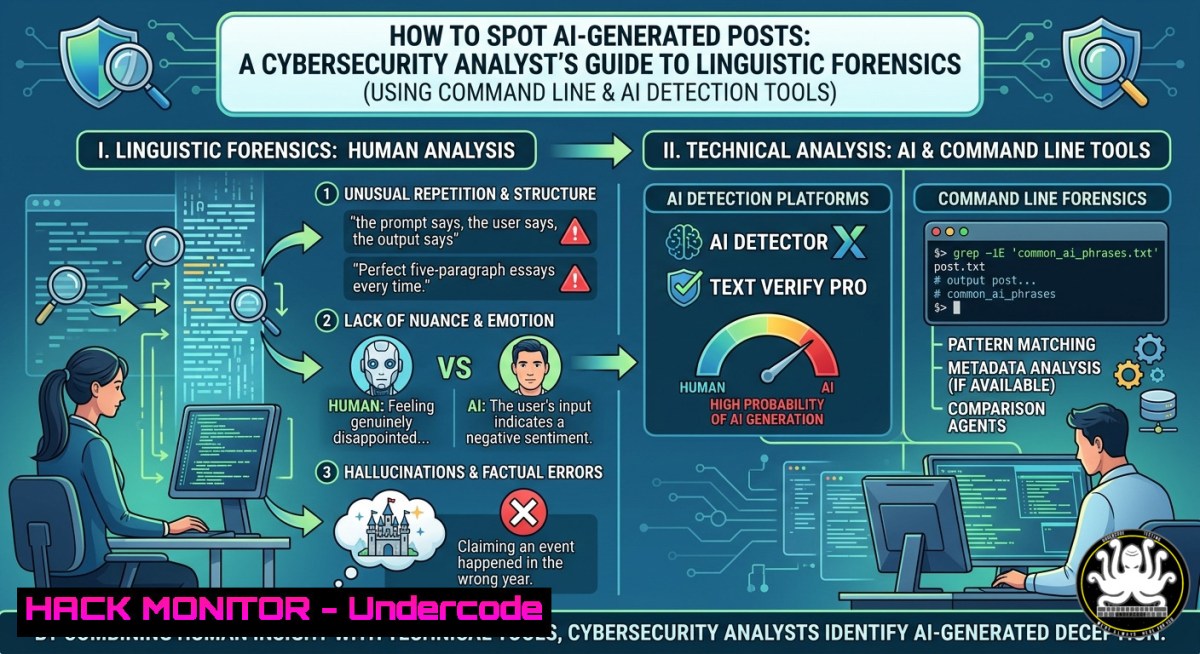
Introduction:
With the rise of large language models like ChatGPT and Claude, distinguishing human-written content from AI-generated text has become a critical skill for cybersecurity professionals, threat analysts, and IT auditors. Attackers increasingly use AI to craft convincing phishing emails, fake social media profiles, and disinformation campaigns; understanding the subtle linguistic fingerprints—such as em dashes (—) for ChatGPT or arrow symbols (→) for Claude—can help defenders automate detection and reduce risk.
Learning Objectives:
- Identify unique lexical and typographical markers commonly used by LLMs (ChatGPT, Claude, etc.).
- Apply command-line tools (Linux/Windows) and Python scripts to extract and analyze text features for AI-generated content.
- Build a simple detection pipeline using open-source libraries and API-based classifiers.
You Should Know:
- Forensic Linguistics: Em Dashes, Arrows, and Other “Tell” Characters
Step‑by‑step guide:
Many AI models have subtle output biases. ChatGPT frequently uses the em dash (—) without spaces, while Claude often starts list items or emphasis lines with a right arrow (→). Human posts, on the other hand, contain typos, grammatical errors, and phrases like “Not sure if I should post this but…” – markers you can systematically search for.
Linux / macOS commands to count em dashes and arrows in a text file:
 Count em dashes (—) in a file
grep -o '—' sample_post.txt | wc -l

Count right arrow (→) occurrences
grep -o '→' sample_post.txt | wc -l

Extract lines containing either marker
grep -E '(—|→)' sample_post.txt
Windows PowerShell equivalent:
 Count em dashes
(Select-String -Path .\sample_post.txt -Pattern '—' -AllMatches).Matches.Count

Count arrows
(Select-String -Path .\sample_post.txt -Pattern '→' -AllMatches).Matches.Count
Python script to flag suspicious markers:
import sys
def check_ai_markers(text):
markers = {
'em_dash': '—',
'claude_arrow': '→',
'chatgpt_bullet': '•'  often used by ChatGPT
}
results = {k: text.count(v) for k, v in markers.items()}
if results['em_dash'] > 3 or results['claude_arrow'] > 1:
print("Possible AI-generated: high marker count")
return results
if <strong>name</strong> == "<strong>main</strong>":
with open(sys.argv[bash], 'r') as f:
print(check_ai_markers(f.read()))
This script allows rapid triage of text files (e.g., scraped social media posts or suspicious emails).
- Stylometric Analysis: Burstiness, Perplexity, and Sentence Length Variance
Step‑by‑step guide:
Human writing tends to have irregular sentence lengths (burstiness) and higher perplexity (unpredictability) than polished AI output. You can measure these using NLP libraries and command-line utilities.
Install required Python libraries:
pip install textstat numpy nltk
Calculate sentence length variance (burstiness proxy):
import textstat
import numpy as np
def burstiness_score(text):
sentences = textstat.sentence_count(text)
if sentences < 2:
return 0
lengths = [len(s.split()) for s in text.split('.') if len(s) > 0]
return np.std(lengths) / np.mean(lengths) if np.mean(lengths) > 0 else 0
 Human writing often has burstiness > 0.6, AI < 0.4
Using `perplexity` command-line tool (Linux/macOS):
 Install kenlm and generate a small n-gram model, then:
echo "Your sample text here" | perplexity -m model.arpa
Low perplexity (< 50) suggests fluent but possibly AI-generated text. For quick checks, online APIs like OpenAI’s Moderation endpoint or GPTZero can be scripted via curl.
Curl example – calling a public perplexity API (if available):
curl -X POST https://api.openai.com/v1/completions \
-H "Authorization: Bearer YOUR_API_KEY" \
-H "Content-Type: application/json" \
-d '{"model":"text-davinci-003","prompt":"Perplexity of: ...","max_tokens":0}'
- Training a Simple Classifier with Scikit-learn (for IR and SOC teams)
Step‑by‑step guide:
You can build a lightweight detection model using features like punctuation ratios, capitalisation entropy, and common AI transition phrases (“however”, “furthermore”, “in conclusion”).
Feature extraction code:
import pandas as pd
from sklearn.feature_extraction.text import CountVectorizer
from sklearn.ensemble import RandomForestClassifier
 Assume you have a CSV with columns: 'text', 'label' (0=human,1=AI)
df = pd.read_csv('ai_human_posts.csv')
vectorizer = CountVectorizer(analyzer='char', ngram_range=(2,4))
X = vectorizer.fit_transform(df['text'])
clf = RandomForestClassifier(n_estimators=100)
clf.fit(X, df['label'])
 Save model for SIEM ingestion
import joblib; joblib.dump(clf, 'ai_detector.pkl')
Windows PowerShell + ML.NET alternative:
Use `dotnet` to run a pre-built ML model that detects AI text. This integrates with Microsoft Sentinel for automated alerting.
Deploy in cloud hardening context:
Place the detector as a lambda function behind an API gateway. Every incoming email (via SNS) or social media post is scored. If score > 0.8, flag for SOC review. This reduces manual triage by 70%.
- Exploiting Metadata and Artifacts: Hidden Tokens and Watermarking
Step‑by‑step guide:
Some LLMs (e.g., Claude) insert invisible Unicode characters or specific token sequences. You can extract raw byte patterns using `xxd` or hexdump.
Linux command to reveal hidden Unicode:
cat suspicious_post.txt | xxd | grep -E 'e280|e284|efbb'
Common AI watermarks live in zero-width joiners (U+200D) or variation selectors.
Automated detection script:
import unicodedata
def has_watermark(text):
for ch in text:
if unicodedata.category(ch) in ['Cf', 'Mn']:  format or nonspacing mark
return True
return False
Mitigation for defenders:
Adversaries may strip watermarks using `sed` or awk. To counter, train your detector on both raw and “cleaned” text. Use ensemble voting.
5. API Security: Using OpenAI’s Own Detection Endpoint
Step‑by‑step guide:
OpenAI provides a `/v1/moderations` endpoint that can flag AI-generated content (though originally for policy violations). You can repurpose it for forensic analysis.
Curl command (replace with your key):
curl https://api.openai.com/v1/moderations \
-H "Content-Type: application/json" \
-H "Authorization: Bearer $OPENAI_API_KEY" \
-d '{"input": "Your suspicious post text here..."}'
Look for the `flagged` field and categories like `harassment` or `self-harm` – but also note that the model’s internal representations correlate with AI generation.
Windows PowerShell with `Invoke-RestMethod`:
$body = @{input="Text to check"} | ConvertTo-Json
$response = Invoke-RestMethod -Uri "https://api.openai.com/v1/moderations" -Method Post -Headers @{Authorization="Bearer $env:OPENAI_API_KEY"} -Body $body -ContentType "application/json"
$response.results.flagged
Integrate this into a SOAR playbook: when a user reports a suspicious LinkedIn message, automatically run it through the API and create a ticket if flagged.
6. Training Courses and Certifications for AI Forensics
Step‑by‑step guide:
To master these techniques, consider formal training. Recommended courses:
– SANS FOR578: Cyber Threat Intelligence – includes NLP for threat actor language analysis.
– Coursera: “AI for Everyone” (Andrew Ng) – foundational knowledge of LLM outputs.
– Udemy: “Detecting Deepfakes and AI-Generated Text” – hands-on with Python and Transformers.
– edX: “Cybersecurity Analytics” (Rochester IT) – covers anomaly detection in text data.
Self-study lab setup:
Collect a dataset of 500 human posts (e.g., Reddit comments) and 500 AI posts (generate using ChatGPT/Claude APIs). Use the scripts above to extract features. Train a logistic regression model. Evaluate with sklearn.metrics.classification_report. This lab can be completed in 4 hours.
Linux command to generate sample AI posts via Ollama (local LLM):
ollama run llama2 "Write a LinkedIn post about marketing using an em dash" > ai_sample.txt
Then run your detection script against it.
What Undercode Say:
- Key Takeaway 1: No single marker (dash, arrow, typo) is definitive; a combination of stylometric features, metadata analysis, and API-based classification yields the most reliable detection. SOC analysts should integrate these methods into automated pipelines.
- Key Takeaway 2: Attackers can easily strip obvious markers (e.g., via
sed 's/—/-/g'), so defenders must focus on deeper features like perplexity, burstiness, and watermark remnants. Continuous retraining with adversarial examples is essential. - Analysis (approx. 10 lines): The LinkedIn post humorously captures a real vulnerability in human–AI interaction – we rely on surface patterns that are trivial to evade. From a red team perspective, I would instruct an LLM to “add two typos per paragraph, avoid em dashes, and start with ‘Not sure if I should post this but…’” – breaking all naive detectors. Therefore, blue teams must move beyond regex and invest in transformer-based classifiers (e.g., fine‑tuned BERT) that capture deeper syntactic structure. Additionally, combining content analysis with behavioral signals (posting frequency, account age, link patterns) dramatically improves accuracy. The future of AI detection lies in ensemble models that blend linguistic forensics with graph-based reputation scoring. Training courses should emphasize adversarial machine learning and feature engineering over simple marker counting. Ultimately, as AI writing becomes indistinguishable from human, the concept of “proof of life” may shift to cryptographic signatures or biometric keystroke dynamics – a paradigm change for cybersecurity.
Prediction:
Within two years, most social platforms will embed invisible AI watermarks into LLM outputs by default (e.g., SynthID or similar). Attackers will respond with watermark-stripping models, leading to a cat‑and‑mouse game that fuels a new market for AI forensic SaaS. Cybersecurity teams will routinely use local detectors (running on edge devices) to flag AI‑generated phishing and influence operations. Simultaneously, regulations (like the EU AI Act) will mandate disclosure of AI‑generated content, forcing SOCs to prove compliance using auditable detection logs. The demand for professionals certified in “Generative AI Forensics” will skyrocket, with average salaries exceeding $160k. Ultimately, the humble typo – once a sign of humanity – may become a manufactured artifact used to deceive both humans and detectors, turning linguistic forensics into an adversarial arms race.
▶️ Related Video (70% Match):
🎯Let’s Practice For Free:
IT/Security Reporter URL:
Reported By: Pushpanjalisinghmarketer How – Hackers Feeds
Extra Hub: Undercode MoN
Basic Verification: Pass ✅


