Listen to this Post
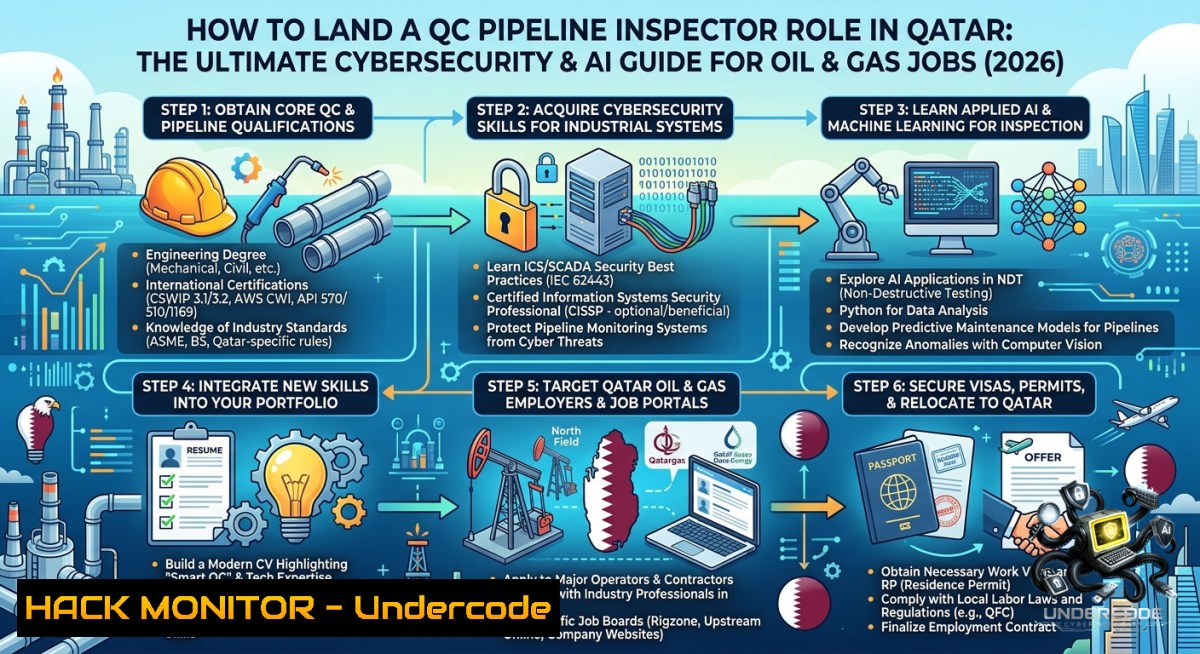
Introduction:
The oil and gas industry in Qatar is a high-stakes environment where physical safety and digital security are inextricably linked. As companies like Madre Integrated Engineering urgently seek QC Pipeline Inspectors with RLIC Gatepasses, they are simultaneously battling a surge of cyber threats targeting industrial control systems (ICS) and operational technology (OT). This guide bridges the gap between traditional pipeline inspection and modern cybersecurity, IT, and AI competencies that are rapidly becoming essential for career advancement in the energy sector.
Learning Objectives:
– Master the technical requirements for obtaining and managing an RLIC Gatepass in Qatar’s Ras Laffan Industrial City.
– Identify and mitigate common OT/ICS vulnerabilities in pipeline infrastructure using industry standards like API 1164 and NIST SP 800-82.
– Implement AI-driven pipeline inspection techniques and cloud hardening strategies to protect critical energy assets.
You Should Know:
1. Decoding the RLIC Gatepass: Your Digital Key to Qatar’s Energy Sector
The Ras Laffan Industrial City (RLIC) Gatepass is more than a physical credential; it’s a critical component of Qatar’s industrial security framework. This pass is mandatory for all personnel entering RLIC, and its management involves strict cybersecurity protocols to prevent unauthorized access. The application process requires rigorous verification of documents, including a valid passport, QID, and certificates, and any lapse can lead to significant delays or rejections. For cybersecurity professionals, understanding the RLIC gate pass portal and its procedures is essential for auditing access controls and ensuring compliance with Qatari regulations.
Step‑by‑step guide explaining what this does and how to use it:
– Step 1: Gather Required Documents. Compile your CV, certificates, passport, QID, and a recent photo. Ensure all documents are in digital format (PDF) for online submission.
– Step 2: Access the RLIC Gate Pass Portal. Navigate to the official RLIC application portal (if available) or coordinate with your company’s gate pass coordinator. Use a secure VPN connection to protect your data during transmission.
– Step 3: Submit Application. Fill in the online form with accurate personal and employment details. Double-check all fields to avoid errors that could trigger security flags.
– Step 4: Track Application Status. Use the portal’s tracking feature to monitor progress. If rejected, review the feedback and correct any issues promptly.
– Step 5: Receive and Activate Pass. Once approved, download your digital RLIC Gatepass. Follow the instructions to activate it upon your first entry to the industrial city.
– Step 6: Maintain Pass Validity. Set reminders for renewal dates. Keep your personal information updated in the system to avoid deactivation.
2. Unmasking ICS Vulnerabilities: Protecting Pipelines from Cyber Threats
Industrial control systems (ICS) and supervisory control and data acquisition (SCADA) systems are the brains behind pipeline operations, but they are increasingly vulnerable to cyberattacks. In 2025, CISA added a critical cross-site scripting (XSS) vulnerability (CVE-2021-26829) in OpenPLC ScadaBR to its Known Exploited Vulnerabilities catalog, confirming active exploitation in the wild. Similarly, the Canadian Centre for Cyber Security reported incidents where hacktivists manipulated internet-accessible ICS devices, such as automated tank gauges at an oil and gas company, triggering false alarms and unsafe conditions. These examples underscore the urgent need for robust security measures, including network segmentation, multi-factor authentication, and regular vulnerability assessments.
Step‑by‑step guide explaining what this does and how to use it:
– Step 1: Conduct an Inventory of Internet-Facing ICS Devices. Use tools like Shodan to identify all internet-accessible ICS components, including PLCs, RTUs, and HMIs. Document each device’s IP address, open ports, and firmware version.
– Step 2: Apply Patches and Mitigations. Immediately patch known vulnerabilities like CVE-2021-26829. If patches are unavailable, consider discontinuing the use of vulnerable components as advised by CISA.
– Step 3: Implement Network Segmentation. Deploy firewalls with strict access control lists (ACLs) to isolate OT networks from IT networks and the internet. Use VLANs to separate different OT zones (e.g., control vs. monitoring).
– Step 4: Enforce Strong Authentication. Require multi-factor authentication (MFA) for all remote access to ICS systems. Replace default credentials with strong, unique passwords.
– Step 5: Establish Continuous Monitoring. Set up intrusion detection systems (IDS) to monitor OT network traffic for anomalous patterns, such as unauthorized Modbus commands or unexpected data transfers.
– Step 6: Develop an Incident Response Plan. Create a documented procedure for responding to ICS cyber incidents, including roles, responsibilities, and communication protocols. Conduct regular tabletop exercises to test the plan.
3. API Security in Oil & Gas: Plugging the Leaks Before They Happen
Application Programming Interfaces (APIs) are the glue connecting modern pipeline monitoring systems, cloud platforms, and third-party services. However, they also introduce significant security risks. A 2025 report revealed that 1,536 new secrets (API keys and credentials) were leaked by oil and natural energy companies in public GitHub repositories in 2024 alone. Moreover, common API vulnerabilities like Insecure Direct Object Reference (IDOR) and broken access control are rampant, with one energy sector assessment finding an average of 6.59 vulnerabilities per project—higher than the overall average of 4.99. To secure these critical interfaces, organizations must implement rigorous API security testing, secret management, and access control measures.
Step‑by‑step guide explaining what this does and how to use it:
– Step 1: Discover All APIs. Use automated API discovery tools to identify all internal and external APIs, including those used for SCADA data access, asset management, and vendor portals.
– Step 2: Scan for Secrets in Code Repositories. Utilize tools like GitGuardian to scan public and private GitHub repositories for exposed API keys, passwords, and other credentials. Remediate any findings immediately by rotating the compromised secrets.
– Step 3: Implement API Gateways. Deploy API gateways to centralize authentication, authorization, rate limiting, and logging. Enforce the use of strong authentication mechanisms like OAuth 2.0 or API keys with short lifespans.
– Step 4: Conduct Regular API Penetration Testing. Engage third-party security firms to perform penetration testing on all APIs, focusing on common vulnerabilities like IDOR, SQL injection, and broken authentication.
– Step 5: Monitor API Traffic. Set up API-specific monitoring tools to detect anomalous behavior, such as a sudden spike in requests from a single IP address or attempts to access unauthorized data.
– Step 6: Establish a Secrets Management Policy. Adopt a secrets management solution (e.g., HashiCorp Vault, AWS Secrets Manager) to securely store, rotate, and audit access to all API keys and credentials. Enforce a policy that secrets are never hardcoded in source code.
4. AI-Powered Pipeline Inspection: The Future of Leak Detection
Artificial intelligence and machine learning are revolutionizing pipeline inspection by enabling faster, more accurate leak detection. A 2025 study demonstrated a lightweight vision transformer model that achieved 98.6% accuracy in classifying pipeline leaks across different fluid types and pressure conditions. Another system uses a combination of acoustic emission sensors and deep learning to detect micro-leaks in large-scale pipelines. These AI-driven approaches not only reduce false alarms but also allow for continuous monitoring, preventing environmental hazards and operational disruptions. However, the integration of AI into OT environments also introduces new attack surfaces, such as model poisoning or adversarial examples, which must be secured.
Step‑by‑step guide explaining what this does and how to use it:
– Step 1: Deploy Acoustic Emission Sensors. Install acoustic emission (AE) sensors along pipeline sections to capture transient signals generated by leaks. Ensure sensors are calibrated for the specific fluid (e.g., gas, oil, water) and environmental conditions.
– Step 2: Collect and Process Data. Use edge computing devices to pre-process raw AE data, applying filters like Savitzky-Golay to enhance leak-specific features while reducing noise.
– Step 3: Train a Machine Learning Model. Use historical leak and normal operational data to train a deep learning model, such as a convolutional neural network (CNN) or vision transformer, to classify leak events. Ensure the training dataset is representative of all possible operating scenarios.
– Step 4: Integrate Model into SCADA. Deploy the trained model within the SCADA environment, where it can receive real-time AE data and generate alerts upon leak detection. Use a secure API for communication between the AI model and the SCADA system.
– Step 5: Implement Adversarial Defenses. Protect the AI model from adversarial attacks by implementing input validation, model hardening techniques, and regular retraining with new data to maintain robustness.
– Step 6: Establish a Feedback Loop. Allow human operators to review AI-generated alerts and provide feedback (e.g., false positive, confirmed leak) to continuously improve the model’s accuracy over time.
5. Cloud Hardening for Energy Infrastructure: Securing the Digital Backbone
As oil and gas companies increasingly migrate to the cloud for data storage, analytics, and remote monitoring, the need for robust cloud security becomes paramount. A cloud hardening masterclass emphasizes that misconfigurations and unauthorized access are leading causes of cloud incidents, and the shared responsibility model means organizations must secure their own workloads and data. For example, the Capital One breach, where an attacker exploited a server-side request forgery (SSRF) vulnerability to steal 100 million credit card applications, serves as a cautionary tale for the energy sector. To prevent similar breaches, organizations must enforce network segmentation, harden identity and access management (IAM), and implement strong metadata service controls.
Step‑by‑step guide explaining what this does and how to use it:
– Step 1: Enforce Network Segmentation. Use VPC endpoints (AWS PrivateLink) or Azure Private Link to keep traffic between services and cloud APIs off the public internet. Ensure databases and internal applications reside in private subnets with no internet gateway route.
– Step 2: Harden IAM Policies. Implement the principle of least privilege for all IAM roles and users. Regularly review and remove unused permissions. Use service control policies (SCPs) to enforce security guardrails across the organization.
– Step 3: Disable IMDSv1. Immediately enforce IMDSv2 on all EC2 instances, which requires a session token for metadata access, mitigating SSRF attacks. Use SCPs to prevent launching instances that do not require IMDSv2.
– Step 4: Encrypt Data at Rest and in Transit. Enable encryption for all cloud storage (e.g., S3 buckets, Azure Blob) and databases. Use TLS 1.3 for all data in transit. Manage encryption keys using a hardware security module (HSM) or cloud-based key management service (KMS).
– Step 5: Implement Continuous Compliance Monitoring. Use tools like AWS Config or Azure Policy to continuously monitor cloud configurations against industry standards (e.g., CIS benchmarks, NIST SP 800-53). Set up automated remediation for common misconfigurations.
– Step 6: Establish a Cloud Incident Response Plan. Develop a playbook for responding to cloud-specific incidents, such as compromised IAM credentials or data exfiltration. Include procedures for isolating affected resources and preserving forensic evidence.
6. OT Security Training & Certifications: Building a Skilled Workforce
The demand for professionals with OT security skills is skyrocketing, with roles like ICS Security Architect commanding salaries of $195,000 in the energy sector. Certifications such as the Global Industrial Cyber Security Professional (GICSP) validate specialized knowledge in securing ICS and OT environments, covering SCADA systems, PLCs, industrial protocols, and safety systems. Training programs also focus on hands-on skills like securing smart grids, protecting water management SCADA systems, and responding to ransomware in industrial control systems. For those entering the field, a combination of formal education, practical labs, and industry-recognized certifications is the key to career advancement.
Step‑by‑step guide explaining what this does and how to use it:
– Step 1: Assess Current Skills. Identify gaps in your knowledge of OT/ICS security, networking, and industrial protocols (e.g., Modbus, DNP3, IEC 61850).
– Step 2: Enroll in Foundational Training. Start with online courses that cover the basics of OT security, such as the “OSINT for ICS/OT” course or “Google Dorking & Shodan for Ethical Hackers”.
– Step 3: Pursue Hands-On Labs. Participate in virtual labs that simulate real-world OT environments, such as penetration testing gas pipeline HMI systems or analyzing PLC malware.
– Step 4: Obtain a Professional Certification. Prepare for and pass the GIAC GICSP exam. Use study materials, practice tests, and official training courses to ensure success.
– Step 5: Gain Practical Experience. Seek opportunities to work on OT security projects within your organization, such as conducting vulnerability assessments or assisting with incident response.
– Step 6: Stay Current. Join professional communities (e.g., ONE-ISAC) and attend industry conferences (e.g., API Cybersecurity Conference) to stay updated on emerging threats and best practices.
7. OSINT for ICS: Reconnaissance and Defense with Shodan
Open-source intelligence (OSINT) techniques, particularly using Shodan, are powerful tools for both attackers and defenders of critical infrastructure. Shodan is a search engine that indexes internet-connected devices, including exposed ICS components like HMIs, PLCs, and SCADA systems. Adversaries use Shodan to discover vulnerable devices, while defenders can use it to identify their own exposed assets and take corrective action. For example, researchers have used Shodan to find internet-facing HMI screens, which could reveal sensitive information about system operations and provide a gateway for attacks. To defend against OSINT-based reconnaissance, organizations must minimize their attack surface and continuously monitor for unauthorized exposure.
Step‑by‑step guide explaining what this does and how to use it:
– Step 1: Set Up a Shodan Account. Create a free account on Shodan.io and obtain an API key. For more advanced searches, consider a paid subscription.
– Step 2: Perform Basic Searches. Use simple search queries like “port:502” to find Modbus devices or “default password” to identify systems using default credentials.
– Step 3: Use Advanced Search Filters. Combine filters to narrow down results. For example, “country:QA port:502” will show Modbus devices in Qatar. Use “org:Madre” to find assets associated with a specific organization.
– Step 4: Analyze Search Results. Review the found devices, noting their IP addresses, open ports, and any exposed banners. Identify devices that should not be publicly accessible, such as PLCs or HMIs.
– Step 5: Take Remedial Action. For any critical asset found via Shodan, immediately remove direct internet access by moving it behind a VPN or firewall. Change default passwords and apply security patches.
– Step 6: Set Up Continuous Monitoring. Use Shodan’s alerting feature to receive notifications when new assets matching your search criteria appear. This allows you to quickly detect and respond to unauthorized exposures.
What Undercode Say:
– The convergence of physical pipeline inspection and OT cybersecurity is creating new, high-value career paths. Professionals with both QC inspection experience and GICSP certification are uniquely positioned to lead in this evolving landscape.
– The 2025 API 1164 standard, which covers all control systems, is a game-changer. It provides a flexible risk assessment model that can be adapted to specific pipeline operations, helping organizations harden their assets against ransomware and advanced persistent threats (APTs).
Prediction:
– +1 By 2027, AI-driven pipeline inspection systems will become mandatory for new oil and gas projects in Qatar, driving demand for professionals skilled in both OT security and machine learning.
– -1 The rise of AI-powered offensive security tools, such as those using Moondream to analyze exposed ICS HMIs, will lead to a surge in targeted attacks on critical infrastructure, forcing regulators to tighten cybersecurity mandates.
– +1 The integration of API security practices into the API 1164 standard will significantly reduce the number of leaked secrets and broken access control incidents in the energy sector, but only if organizations invest in continuous monitoring and employee training.
– -1 Despite advances in AI detection, the average cost of a pipeline cyber incident is expected to rise by 15% annually through 2028, as attackers increasingly target cloud-connected OT systems and exploit zero-day vulnerabilities.
Expected Output:
This article emphasizes that the future of QC pipeline inspection in Qatar is inextricably linked to cybersecurity, IT, and AI. By mastering RLIC gatepass protocols, ICS vulnerability management, API security, AI-driven leak detection, cloud hardening, OT training, and OSINT techniques, professionals can not only secure their current roles but also position themselves for leadership in the digital transformation of the energy sector. The time to upskill is now, as the demand for these competencies is growing faster than the supply of qualified talent.
▶️ Related Video (62% Match):
🎯Let’s Practice For Free:
🎓 Live Courses & Certifications:
[Join Undercode Academy for Verified Certifications](https://undercode.co.uk/certifications/)
🚀 Request a Custom Project:
Secure, high-velocity infrastructure and disruptive technological engineering. Contact our engineering team for high-tier development and proprietary systems:
[[email protected]](mailto:[email protected])
💎 Smart Architecture | 🛡️ Secure by Design | ⭐ Trusted by Thousands
IT/Security Reporter URL:
Reported By: [Walk In](https://www.linkedin.com/posts/walk-in-interview-qc-pipeline-inspector-share-7467302168207835137-RBQI/) – Hackers Feeds
Extra Hub: Undercode MoN
Basic Verification: Pass ✅
🔐JOIN OUR CYBER WORLD [ CVE News • HackMonitor • UndercodeNews ]
[💬 Whatsapp](https://undercode.help/whatsapp) | [💬 Telegram](https://t.me/UndercodeCommunity)
📢 Follow UndercodeTesting & Stay Tuned:
[𝕏 formerly Twitter 🐦](https://x.com/undercodeupdate) | [@ Threads](https://www.threads.net/@undercodetesting) | [🔗 Linkedin](https://www.linkedin.com/company/undercodetesting/) | [🦋BlueSky](https://bsky.app/profile/undercode.bsky.social)


