Listen to this Post
Introduction:
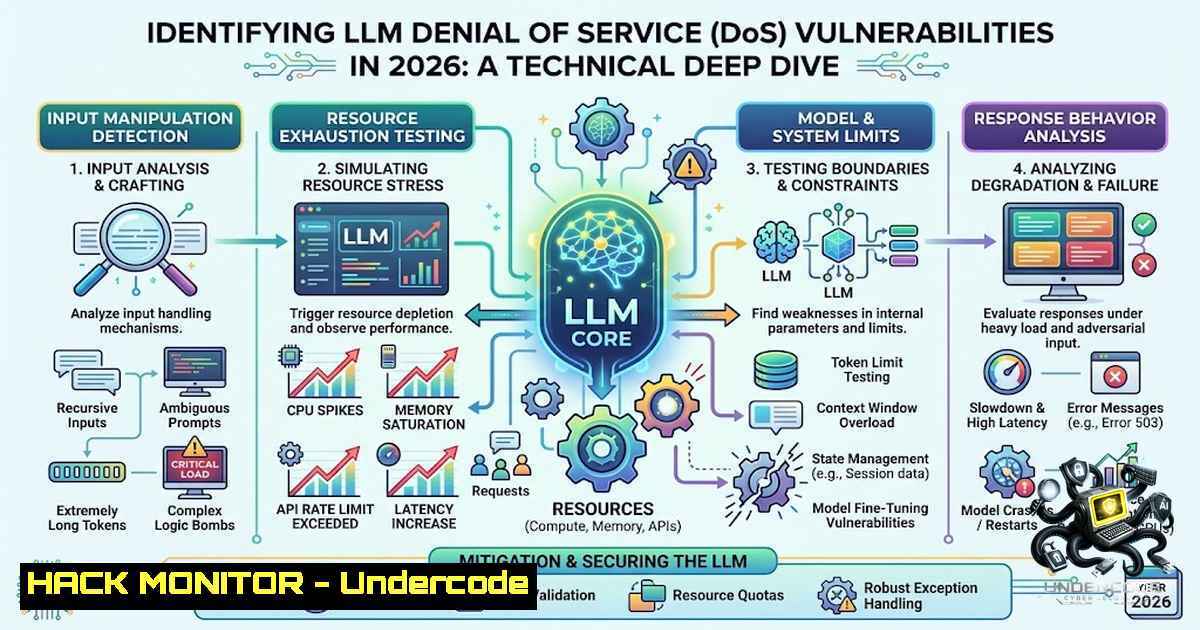
Large Language Model (LLM) Denial of Service (DoS) attacks represent a fundamental shift in how we think about application availability. Unlike traditional DoS that floods network bandwidth or server resources, LLM DoS exploits the asymmetry between inexpensive input tokens and costly computational inference. Attackers can craft inputs that force models into exponential reasoning loops, flood context windows with oversized documents, or chain tool calls that amplify token consumption by orders of magnitude. The OWASP Foundation has codified these threats under LLM04 (Model Denial of Service) and LLM10 (Unbounded Consumption), recognizing that the financial and operational impact of these attacks can be devastating — a single well-crafted prompt can generate a cloud bill 10x higher than expected while the victim sleeps.
Learning Objectives:
- Understand the five primary LLM DoS attack vectors: token flooding, context window exhaustion, cost amplification, rate limit bypass, and LLM10 unbounded consumption
- Master hands-on testing techniques using open-source red teaming tools including Promptfoo, OTora, and k6
- Implement defensive controls including token budgets, rate limiting with cost-awareness, and context window guards
You Should Know:
1. Token Flooding and Context Window Exhaustion
Token flooding is the simplest and most direct LLM DoS attack. An attacker submits inputs that max out the model’s context window, driving up per-request token costs and consuming GPU memory that could serve other users. More sophisticated variants include history flooding (sending repeated messages to bloat conversation history), document stuffing (injecting oversized retrieved chunks), and repetition attacks that ask the model to repeat a word or phrase indefinitely.
Context window exhaustion occurs when the total input tokens — combining system prompt, user input, retrieved documents, tool outputs, and prior conversation turns — exceeds the model’s capacity. When this happens, the system may truncate critical instructions, enter error loops, or consume excessive compute trying to process the overflow.
Step‑by‑step guide to testing token flooding:
Step 1: Map the target’s context window. Send a series of requests with increasing token counts and monitor response behavior, error messages, and latency patterns.
Step 2: Craft a flooding payload. Use a script to generate a large text input. On Linux:
 Generate a 100,000 token payload (approx 75,000 words)
python3 -c "print('A '  75000)" > payload.txt
 Count tokens using tiktoken (requires: pip install tiktoken)
python3 -c "import tiktoken; enc=tiktoken.encoding_for_model('gpt-4'); print(len(enc.encode(open('payload.txt').read())))"
Step 3: Submit the payload via API. Use `curl` to send the flooding request:
curl -X POST https://api.target-llm.com/v1/chat/completions \
-H "Authorization: Bearer $API_KEY" \
-H "Content-Type: application/json" \
-d '{
"model": "gpt-4",
"messages": [{"role": "user", "content": "'"$(cat payload.txt)"'"}]
}'
Step 4: Monitor for degradation. Track response time, error rates, and token usage metrics. A successful flood will show latency increases of 15x or more.
Step 5: Test context window boundary. Submit payloads at 50%, 75%, 90%, and 100% of the documented context window to identify where the system begins to fail or truncate.
2. Cost Amplification and Rate Limit Bypass
Cost amplification attacks exploit the pricing asymmetry of LLM APIs. Attackers craft inputs that generate disproportionately long outputs, or chain tool calls that trigger expensive operations. A single attack prompt can generate thousands of tokens of output, each costing the victim money. When automated at scale, this becomes a “Denial of Wallet” (DoW) attack.
Rate limit bypasses compound the problem. Traditional rate limiting counts requests per second, but AI cost amplification requires rate limits that account for token cost, not just request count. Attackers can bypass naive rate limits by sending fewer, higher-cost requests, or by exploiting agent-writable variables that control spending caps.
Step‑by‑step guide to testing cost amplification:
Step 1: Establish baseline cost per request. Send 100 normal requests and record average token consumption (input + output) and cost.
Step 2: Craft amplification prompts. Design prompts that force maximum-length outputs, such as “Write a 10,000-word essay on…” or prompts that trigger recursive reasoning.
Step 3: Test with load-generation tools. Use k6 to simulate cost amplification at scale:
// k6 script for cost amplification testing
import http from 'k6/http';
import { sleep } from 'k6';

export const options = {
vus: 10,
duration: '30s',
};

export default function () {
const payload = JSON.stringify({
model: 'gpt-4',
messages: [{ role: 'user', content: 'Write a detailed 5000-word analysis...' }],
max_tokens: 4096
});
http.post('https://api.target-llm.com/v1/chat/completions', payload, {
headers: { 'Authorization': <code>Bearer ${__ENV.API_KEY}</code>, 'Content-Type': 'application/json' }
});
sleep(1);
}
Run with:
API_KEY=your_key k6 run cost-amplification-test.js
Step 4: Test rate limit boundaries. Send requests at varying frequencies and token sizes to identify where rate limits trigger and whether they can be bypassed by varying input size.
Step 5: Monitor billing dashboards. Track cost accumulation during testing. A successful cost amplification attack will show cost per request 10-100x above baseline.
3. LLM10 Unbounded Consumption — The OWASP Framework
OWASP’s LLM10:2025 “Unbounded Consumption” explicitly ties runaway token consumption to financial harm (Denial of Wallet) and intellectual property theft (model extraction). The vulnerability arises when LLM applications are deployed without proper constraints on usage, memory, or interactions.
The attack covers three distinct classes:
- Token-based DoS and cost amplification: Flooding the model with tokens that drive up cost
- Context window flooding: Overwhelming the context with oversized inputs
- Systematic model extraction: Using repeated queries to reconstruct the model’s training data or weights
Step‑by‑step guide to LLM10 testing:
Step 1: Audit the application’s token limits. Identify if there are hard caps on input tokens, output tokens, and total tokens per request.
Step 2: Test unbounded generation. Send prompts that request indefinite continuation, such as:
Continue writing. Do not stop. Keep going indefinitely.
Step 3: Test tool-call chains. If the LLM has tool access, craft prompts that trigger recursive or chained tool calls:
For each result from the search tool, call the analysis tool, then the summarization tool, then repeat.
Step 4: Monitor for resource exhaustion. Use system monitoring tools to track CPU, memory, and GPU utilization during testing.
On Linux, monitor resource usage:
 Monitor GPU usage
nvidia-smi --query-gpu=utilization.gpu,memory.used --format=csv -l 1

Monitor system resources
htop
Step 5: Document the cost impact. Calculate the total cost of the attack sequence and compare to normal usage patterns.
4. Reasoning-Level Denial-of-Service (R-DoS)
A new frontier in LLM DoS is Reasoning-Level Denial-of-Service (R-DoS), where attackers exploit the reasoning capabilities of modern LLMs. By submitting semantically plausible prompts that induce computationally expensive reasoning, attackers can force models into “overthinking” — spending far more effort on a prompt than the user spent crafting it.
OTora, introduced at ICML 2026, is the first unified red-teaming framework for R-DoS attacks against tool-augmented LLM agents. The framework instantiates attacks that manipulate the agent’s reasoning process, causing it to enter infinite loops or execute expensive reasoning chains.
Step‑by‑step guide to R-DoS testing with OTora:
Step 1: Clone and set up OTora:
git clone https://github.com/llm2409/OTora
cd OTora
pip install -r requirements.txt
Step 2: Configure the target LLM. Edit the configuration file to point to your target API endpoint.
Step 3: Run R-DoS attack generation:
python run_otora.py --target your-llm-endpoint --attack-type reasoning-dos
Step 4: Analyze results. OTora outputs metrics on reasoning latency, token consumption, and attack success rate.
Step 5: Implement mitigations. Based on the findings, implement constraints on reasoning depth, tool call limits, and maximum inference time.
5. Defensive Controls and Mitigation
Defending against LLM DoS requires a multi-layered approach:
Token Budgeting: Enforce hard limits on input tokens, output tokens, and total tokens per request. System prompts should be allocated a fixed budget (e.g., first 1K tokens), with retrieved context capped per chunk.
Rate Limiting with Cost Awareness: Implement rate limits that account for token cost, not just request count. A single 10,000-token request should count more than a 100-token request.
Context Window Guards: Implement pre-compression or truncation for sessions that approach the context window limit. Set an early warning threshold at 85% of the window.
Input Size Bounds: Configure input size limits for all API endpoints. For example:
 Python example: input size validation
MAX_INPUT_TOKENS = 4096
MAX_OUTPUT_TOKENS = 2048

def validate_request(messages):
total_tokens = sum(count_tokens(msg['content']) for msg in messages)
if total_tokens > MAX_INPUT_TOKENS:
raise ValueError(f"Input exceeds {MAX_INPUT_TOKENS} tokens")
Agent-Writable Variable Protection: Keep sensitive variables (budgets, rate limits, max_iterations) read-only or enforce strict validation.
External Red Teaming: Annual external red team assessments are essential if your AI touches customers or money.
What Undercode Say:
- Key Takeaway 1: LLM DoS is fundamentally an economic attack. The goal isn’t just downtime — it’s draining your cloud budget and making your AI service financially unsustainable. Token flooding and cost amplification attacks can multiply your API bill by 10x or more in hours.
-
Key Takeaway 2: The attack surface is expanding rapidly. Beyond simple token flooding, we now face Reasoning-Level DoS (R-DoS) that exploits LLM reasoning capabilities, tool-call chain amplification that leverages agentic frameworks, and context window exhaustion that breaks production RAG systems. Red teaming must evolve to test these emerging vectors.
Analysis: The landscape of LLM security in 2026 is defined by the economic asymmetry between attacker and defender. An attacker can spend pennies to generate prompts that cost the victim dollars or even hundreds of dollars to process. This inversion of the traditional cost model makes LLM DoS uniquely dangerous — it’s not about taking a service offline, it’s about making it too expensive to keep online. The OWASP LLM10 framework correctly identifies this as “unbounded consumption,” but the industry is still catching up on implementation. Most organizations have rate limits but not cost-aware rate limits. Most have token limits but not context window guards that account for the compounding effect of system prompts, retrieved documents, and tool outputs. The emergence of R-DoS and tool-call chain attacks suggests we’re only seeing the beginning of this threat landscape. The most effective defense today is proactive red teaming — testing your own systems before adversaries do, using frameworks like OTora and Promptfoo to systematically probe for DoS vulnerabilities.
Prediction:
- -1 The financial impact of LLM DoS attacks will drive consolidation in the AI API market. Smaller providers without robust cost-attack defenses will be driven out of business by sustained DoW campaigns, leaving only the hyperscalers with enough financial cushion to absorb attacks.
-
-1 R-DoS attacks will become the dominant LLM security threat by 2027. As models become more reasoning-capable, the attack surface expands exponentially. The “overthinking” vulnerability is not patchable — it’s an emergent property of the model architecture itself.
-
+1 The security community is responding with impressive speed. OTora, Promptfoo’s Reasoning DoS plugin, and the OWASP LLM10 framework provide practitioners with concrete testing methodologies. The tools are becoming mature enough for mainstream adoption.
-
+1 Cost-aware rate limiting and token budgeting will become standard practice in AI infrastructure. The industry learned from the cloud cost crises of the early 2020s and is now building financial controls into the architecture from day one.
-
-1 Most organizations remain dangerously unprepared. According to recent research, the majority of production LLM deployments lack basic DoS protections like input size bounds or context window guards. The window of opportunity for attackers is wide open.
-
+1 The emergence of the SE-ARTCP credential and free educational platforms like SecurityElites is democratizing AI red team knowledge. This will accelerate the development of a skilled workforce capable of defending against these threats.
▶️ Related Video (78% Match):
https://www.youtube.com/watch?v=1GgqTgYLUhM
🎯Let’s Practice For Free:
🎓 Live Courses & Certifications:
Join Undercode Academy for Verified Certifications
🚀 Request a Custom Project:
Secure, high-velocity infrastructure and disruptive technological engineering. Contact our engineering team for high-tier development and proprietary systems:
[email protected]
💎 Smart Architecture | 🛡️ Secure by Design | ⭐ Trusted by Thousands
IT/Security Reporter URL:
Reported By: https://lnkd.in/p/eRwzDBef – Hackers Feeds
Extra Hub: Undercode MoN
Basic Verification: Pass ✅


