Listen to this Post
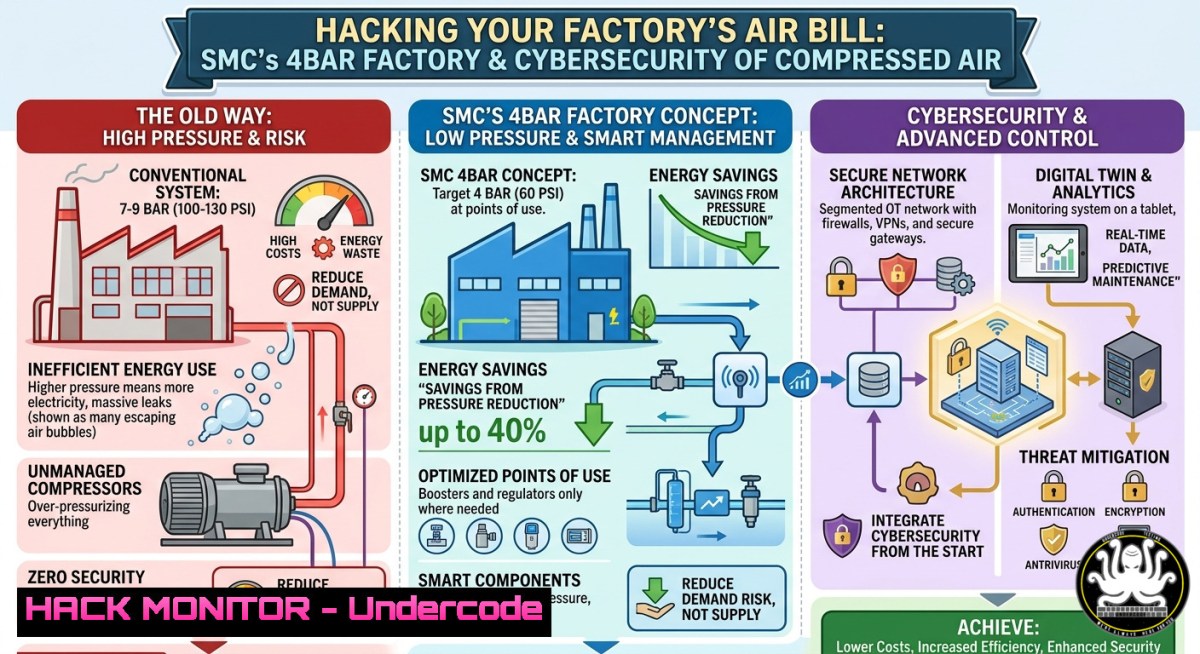
Introduction:
In modern smart manufacturing, compressed air is often the “hidden utility”—it powers actuators, conveyors, and blow-offs, yet it can account for up to 10–20% of a factory’s total electricity consumption. SMC’s 4BAR Factory initiative directly challenges industrial norms by advocating for a strategic reduction of system pressure from the typical 6–7 bar down to 4 bar, achieving 20–25% energy savings while reducing CO₂ emissions. However, in an era where every sensor, flow meter, and compressor is connected to the Industrial Internet of Things (IIoT), this optimization journey introduces a new set of cyber-physical risks that demand equal attention.
Learning Objectives:
- Understand the 4BAR Factory Methodology – Learn the proactive three-step approach of visualizing consumption, optimizing line pressure, and future-proofing new machinery.
- Apply AI-Driven Monitoring for Predictive Maintenance – Explore how AI-powered platforms detect leaks, anomalies, and inefficiencies in real-time for compressed air systems.
- Secure the Connected Factory – Identify cybersecurity risks associated with IIoT-enabled pneumatic systems and implement foundational OT hardening controls aligned with NIST and IEC 62443 standards.
You Should Know:
1. Air Visualization and Pressure Optimization (The “How-To”)
The core of the 4BAR Factory lies in shifting from a reactive “fix-the-leak” culture to a proactive, data-driven optimization strategy. The process unfolds in three structured phases:
- Step 1: Energy Use Analysis. Deploy digital flow sensors (e.g., SMC’s PF3A) and pressure sensors with IO-Link communication across critical equipment. These sensors continuously measure air consumption at each point of use, identifying inefficient machinery and pinpointing where the greatest savings potential lies.
- Step 2: Pressure & Flow Optimization. After baseline data collection, begin systematically lowering delivery pressures in zones where it is safe to do so—typically starting with horizontal motions and blow-off applications. For demanding stations that require higher force, use localized boosters (such as SMC’s VBA series) to create “islands” of higher pressure without raising the entire plant’s baseline.
- Step 3: Future-Proofing. Establish 4 bar as the new internal standard for all new machinery acquisitions and retrofits. Specify energy-efficient components—such as pulse blow valves, vacuum ejectors with intermittent operation, and correctly sized cylinders—that maintain performance at reduced pressures.
For IT and OT teams tasked with implementing this transition, here are practical commands and configurations to integrate pneumatic monitoring into existing industrial control systems.
Monitoring Air Consumption with Modbus and MQTT:
Many modern flow sensors (e.g., SMC PF3A or IFM SD series) support Modbus RTU/TCP. To query real-time flow data:
 Linux: Using modpoll (command-line Modbus master)
modpoll -m tcp -a 1 -r 40001 -c 1 -1 192.168.1.100
 -m tcp: Modbus TCP mode
 -a 1: Slave ID 1
 -r 40001: Starting register address (typically holds flow rate in L/min)
 -c 1: Read 1 register
For IIoT integration, a lightweight Python script can publish sensor data to an MQTT broker for centralized monitoring:
 Python 3 script to read Modbus data and publish to MQTT
from pymodbus.client import ModbusTcpClient
import paho.mqtt.client as mqtt
import json
import time

client = ModbusTcpClient('192.168.1.100')  Sensor IP
mqtt_broker = '192.168.1.200'  Internal MQTT broker

def read_and_publish():
client.connect()
rr = client.read_holding_registers(40001, 1, unit=1)
flow_rate = rr.registers[bash] / 10.0  Scale factor for L/min
payload = json.dumps({"flow_l_min": flow_rate, "timestamp": time.time()})
mqttc = mqtt.Client()
mqttc.connect(mqtt_broker, 1883, 60)
mqttc.publish("factory/air/flow/sensor_01", payload)
client.close()
Windows PowerShell for Sensor Data Logging:
 Windows: Continuously log flow data to CSV every 5 seconds
while ($true) {
 Modbus TCP query via external tool (e.g., ModbusPoll.exe command line)
$flow = & "C:\Tools\ModbusPoll.exe" /tcp /ip 192.168.1.100 /address 40001
$timestamp = Get-Date -Format "yyyy-MM-dd HH:mm:ss"
"$timestamp, $flow" | Out-File -Append -FilePath "C:\Logs\air_flow_log.csv"
Start-Sleep -Seconds 5
}
- AI and Machine Learning for Compressed Air Efficiency (Predictive Maintenance)
Beyond passive monitoring, AI-driven platforms are fundamentally reshaping how factories manage their compressed air systems. Traditional monitoring relies on simple threshold alerts, but modern solutions leverage machine learning to distinguish between loaded, unloaded, and idle compressor states—revealing hidden waste that conventional “running hours” metrics miss entirely.
What AI Actually Monitors:
- Energy Anomaly Detection: The AI learns each site’s normal energy rhythm. When actual kWh consumption deviates from the baseline, it flags blocked filters or developing leaks before they become crises.
- Thermal & Pressure Divergence: Temperature and pressure should track together. When temperature rises without a corresponding pressure increase, it signals a dirty cooler or restricted airflow—often weeks before failure.
- Off-Hours Leakage Detection: While the plant is idle, AI continuously monitors pressure decay rates. Accelerated pressure drop during off-hours is a reliable indicator of unreported leaks.
- Fleet-Wide Sequencing: For facilities with multiple compressors, AI identifies the optimal combination for each shift, balancing wear evenly across units and eliminating the inefficient habit of always running the same machine hardest.
Implementing AI Monitoring with Open-Source Tools:
For teams looking to build their own AI-driven monitoring stack, open-source SCADA platforms can serve as the foundation:
 Deploy SCADA-LTS (open-source SCADA) via Docker
docker run -d --name scada-lts -p 8080:8080 scadalts/scada-lts
 Access web interface at http://localhost:8080
 Supports Modbus TCP, OPC UA, MQTT, and 20+ industrial protocols
SCADA-LTS provides real-time trending, alarm management, and a web-based HMI accessible from any device—ideal for visualizing compressor load cycles and energy anomaly patterns.
For advanced predictive analytics, integrate Apache StreamPipes, an open-source IIoT toolbox:
 Apache StreamPipes deployment (no-code data pipeline builder)
docker run -p 8090:8090 apache/streampipes
 Build real-time ML pipelines to detect leaks and predict failures
Apache StreamPipes enables users to connect data sources, apply machine learning models, and visualize results in real-time using a no-code interface—making AI accessible to OT teams without extensive data science backgrounds.
- Cybersecurity for Connected Pneumatic Systems (The Overlooked Risk)
As factories deploy IIoT sensors, AI analytics platforms, and cloud-connected compressors, the attack surface expands dramatically. Manufacturing remains the most-targeted industry globally, with 56% of OT organizations experiencing ransomware intrusions in the past year. A compromised air management system could manipulate pressure levels, trigger false alarms, or cause production halts—all without directly breaching traditional IT perimeters.
Essential OT Hardening Controls:
- Network Segmentation (Zones and Conduits): Implement IEC 62443-style segmentation by creating separate OT zones for pneumatic monitoring cells, safety systems, and data historians. Use firewalls or managed switches to control traffic between zones and enforce “deny-by-default” rules between IT and OT networks.
- Identity and Access Management (Zero Trust for OT): For any remote maintenance or vendor access to compressed air monitoring dashboards, enforce multi-factor authentication (MFA) and ephemeral credentials. Route all external access through a jump server with session recording—never expose SCADA or sensor gateways directly to the internet.
- Hardening PLCs and Edge Gateways: Disable unnecessary services, change default credentials (a shockingly common vulnerability), maintain firmware version inventories, and use signed firmware where supported. Many incidents still begin with default passwords and outdated firmware.
- OT-Aware Detection: Deploy passive network monitoring that understands industrial protocols (Modbus, Profinet, EtherNet/IP). Baseline normal traffic patterns and alert on anomalies—such as unexpected Modbus function codes or new devices communicating on the network—without interfering with real-time deterministic operations.
Linux Hardening for SCADA and Monitoring Servers:
 Disable unnecessary services on the SCADA server
sudo systemctl disable bluetooth.service cups.service avahi-daemon.service

Configure firewall (UFW) to restrict access to industrial protocols only
sudo ufw default deny incoming
sudo ufw allow from 192.168.1.0/24 to any port 502 proto tcp  Modbus TCP
sudo ufw allow from 192.168.1.0/24 to any port 1883 proto tcp  MQTT
sudo ufw allow from 192.168.2.0/24 to any port 22 proto tcp  SSH from admin subnet
sudo ufw enable

Implement file integrity monitoring for critical binaries
sudo apt install aide
sudo aideinit
sudo aide --check
Windows Hardening for HMI and Engineering Workstations:
 Windows: Disable insecure protocols (SMBv1, LLMNR)
Disable-WindowsOptionalFeature -Online -FeatureName "SMB1Protocol"
Set-ItemProperty -Path "HKLM:\Software\Policies\Microsoft\Windows\LLMNR" -Name "EnableLLMNR" -Value 0

Restrict local admin rights and enforce application whitelisting via AppLocker
 (Detailed GPO configuration via secpol.msc)

Enable advanced audit logging for PLC/SCADA access attempts
auditpol /set /subcategory:"Logon" /success:enable /failure:enable
- Data-Driven Compliance and the New GB/T 46564—2025 Standard
The 4BAR Factory concept is not merely a vendor initiative—it has directly shaped national policy. In 2025, China released GB/T 46564—2025, the nation’s first integrated standard for compressed air system energy efficiency, explicitly recommending a target main-line pressure of 0.40 MPa (4 bar) and endorsing SMC’s “low pressure overall, high pressure locally” strategy. SMC served as a primary drafter of this standard, embedding proven technologies such as KN-series energy-saving nozzles (30–90% air reduction), ZK2 vacuum generators (93% air consumption reduction), and energy-saving cylinder circuits into the national framework.
For compliance officers and energy managers, this convergence of industrial best practices and regulatory requirements creates a clear pathway: organizations that adopt 4BAR principles not only reduce operating costs but also preemptively align with tightening emissions legislation. The standard’s release signals a broader global trend where energy efficiency moves from voluntary optimization to mandated practice.
5. Real-World Implementation Case Study: CMZ’s 4BAR Transformation
A compelling demonstration of the 4BAR Factory methodology comes from CMZ, a machine tool manufacturer that collaborated with SMC to retrofit a TTS series lathe. Initial baseline measurements showed the machine operating at 7 bar with an annual air consumption of 39.3 million liters. Through systematic air visualization using a PF3A flow meter, the team identified a pressure drop issue that frequently triggered alarms during cleaning blow-offs.
The remediation involved installing KN-series nozzles (2.5 mm orifice diameter), optimizing tube diameters to improve conductance, and reconfiguring the blow-off circuit. Results were dramatic: operating pressure dropped to 4.5 bar, annual air consumption fell to 23.7 million liters (a 40% reduction), blow-off consumption decreased by 36%, and CO₂ emissions from compressed air usage declined by 39% (539 kg CO₂ per year saved). This case illustrates that significant gains are achievable without scrapping existing equipment—only targeted retrofits and data-driven adjustments.
What Undercode Say:
- Energy waste in compressed air systems is not inevitable—it is structural. Most plants operate at pressure setpoints chosen decades ago, based on outdated assumptions. The 4BAR Factory’s core insight is that demand-side optimization (reducing pressure at the point of use) is more effective than supply-side fixes alone.
- Digitization without security is a liability. Deploying IIoT sensors and AI analytics unlocks massive efficiency gains, but every connected device expands the attack surface. OT security must be embedded from the first sensor installation, not added as an afterthought—especially as manufacturing becomes the primary target of ransomware groups worldwide.
Prediction:
-
- By 2027, AI-powered predictive maintenance for compressed air systems will become standard in over 40% of Fortune 500 manufacturing facilities, driven by 20–30% energy cost reductions and tightening emissions regulations.
- – Failure to implement basic OT segmentation and access controls will result in at least three major publicly disclosed cyber incidents targeting IIoT-enabled pneumatic control systems within the next 18 months.
-
- National standards like China’s GB/T 46564—2025 will proliferate globally, with the EU and US likely adopting similar 4 bar pressure targets as part of broader industrial decarbonization mandates.
▶️ Related Video (76% Match):
🎯Let’s Practice For Free:
IT/Security Reporter URL:
Reported By: What Would – Hackers Feeds
Extra Hub: Undercode MoN
Basic Verification: Pass ✅
🎓 Live Courses & Certifications:
Join Undercode Academy for Verified Certifications
🚀 Request a Custom Project:
Secure, high-velocity infrastructure and disruptive technological engineering. Contact our engineering team for high-tier development and proprietary systems:
[email protected]


