Listen to this Post
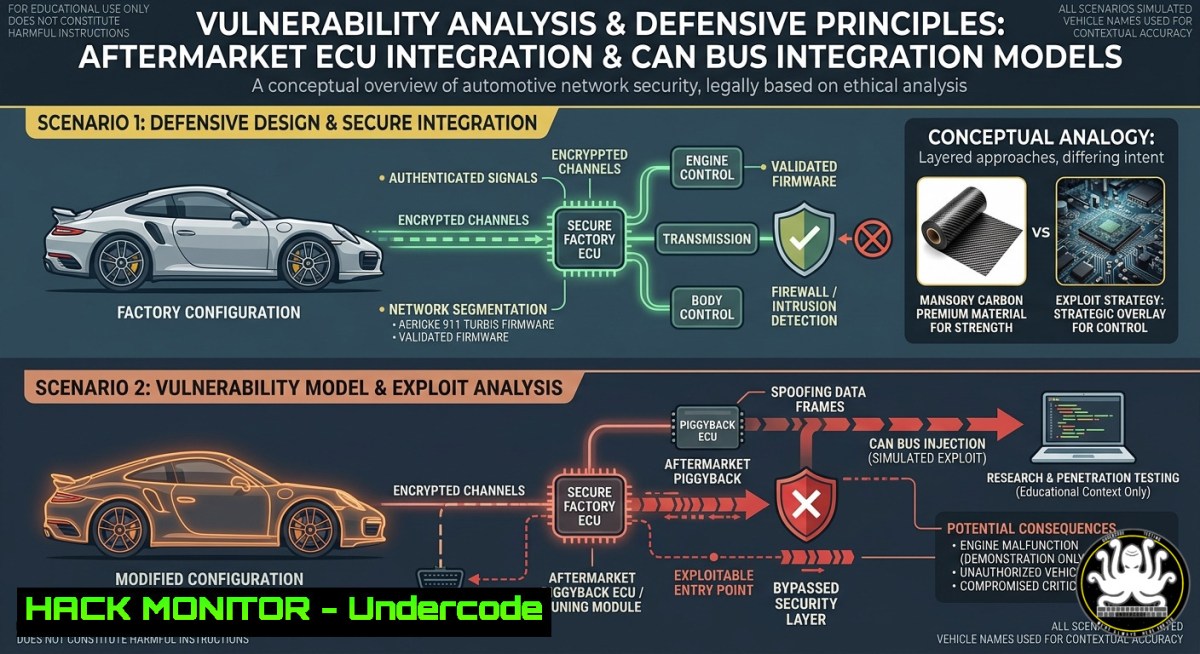
Introduction:
Modern luxury vehicles like the Porsche 911 Turbo S (type 992.2) are no longer just mechanical beasts—they are rolling networks of Electronic Control Units (ECUs), sensors, and proprietary protocols. Just as Mansory adds carbon fiber splitters and rear diffusers to enhance aerodynamics, security professionals add intrusion detection systems and firewall rules to harden a vehicle’s Controller Area Network (CAN) bus. This article explores how aftermarket modifications (both physical and digital) introduce attack surfaces, and provides hands-on tutorials for analyzing, exploiting, and securing automotive ECUs using Linux tools, Windows-based CAN sniffers, and AI-driven anomaly detection.
Learning Objectives:
- Understand the cybersecurity risks introduced by aftermarket ECU tuning and physical modifications (e.g., new sensor wiring, custom dashboards).
- Learn to intercept and inject CAN bus frames using linux-can, SocketCAN, and Wireshark on Linux, plus PCAN-View on Windows.
- Implement AI-based intrusion detection for vehicle networks using Python and scikit-learn on captured CAN logs.
You Should Know:
- Reverse-Engineering the CAN Bus from a 992.2 Dashboard Tap
The post highlights interior customization with “tissu écossais” (Scottish fabric) seats. Any physical interior modification—especially near the OBD-II port, infotainment system, or seat control modules—creates an opportunity for an attacker to splice into the CAN bus. Below is a step-by-step guide to capture and decode CAN traffic using a Linux laptop with a USB-to-CAN adapter (e.g., Kvaser or PCAN-USB).
Step‑by‑step guide – CAN sniffing on Linux:
1. Install necessary packages:
sudo apt update && sudo apt install can-utils wireshark tshark python3-pip
sudo modprobe can && sudo modprobe can_raw
2. Connect your USB-CAN adapter and bring up the interface (e.g., can0):
sudo ip link set can0 up type can bitrate 500000
sudo ifconfig can0 up
3. Sniff live CAN IDs and data:
candump can0
To log to a file:
candump -l can0
4. For Windows, use PCAN-View (PEAK-System) or USBtin tool. Record a PCAN trace and export as CSV.
5. Identify attack patterns: Look for repeating CAN IDs with changing data bytes (e.g., 0x0A0 for steering wheel buttons, 0x2C0 for wheel speed). Replay attacks can unlock doors or disable brakes.
Command to replay a captured CAN frame (Linux):
cansend can0 1231122334455667788
Mitigation: Use CAN bus firewalls (like ESCRYPT CycurGATE) that filter messages based on MAC (Message Authentication Codes). For DIY, implement a simple whitelist using Python with python-can:
import can
whitelist = {0x123, 0x456}
bus = can.interface.Bus(channel='can0', bustype='socketcan')
while True:
msg = bus.recv()
if msg.arbitration_id not in whitelist:
print(f"Blocked ID: {hex(msg.arbitration_id)}")
2. Hardening Cloud Telematics for Connected Supercars
The Mansory 911 still uses the factory drivetrain (“mécanique reste celle de série”) – meaning its cloud-connected Porsche Connect module is unchanged. Attackers can target the telematics unit (TCU) via 4G/5G or Wi-Fi. This section shows how to find open ports on a vehicle’s external IP (if the TCU provides a hotspot) and how to simulate a telematics API breach using curl and Burp Suite.
Step‑by‑step guide – API security testing for automotive cloud endpoints:
1. Enumerate the TCU’s IP (often assigned by the mobile carrier). Use nmap from a Linux host connected to the same Wi-Fi as the car’s hotspot:
sudo nmap -sS -p- 192.168.43.1
2. Capture OBD-II dongle traffic (if the owner uses a third‑party dongle). On Windows, use Wireshark with USBPcap to monitor a USB-to-OBD cable.
3. Reverse‑engineer the mobile app’s API (e.g., Porsche Connect) using mitmproxy on Linux:
pip3 install mitmproxy
mitmweb --mode regular --listen-port 8080
Then configure your phone to use the proxy and install mitmproxy’s CA certificate.
4. Look for endpoints like /api/vehicle/lock, /api/engine/start. Exploit missing authentication by replaying a captured JWT token.
5. To test for command injection in the car’s head unit, send a POST payload with `; sleep 5;` inside a parameter like `vin=` or destination=.
Linux command to bruteforce weak telematics PINs:
for pin in {0000..9999}; do curl -X POST https://api.porsche-connect.com/unlock -d "pin=$pin" -H "Content-Type: application/json"; done
Mitigation: Enable mutual TLS (mTLS) between the TCU and cloud. Use short-lived tokens and rate-limit authentication attempts.
3. AI-Driven Anomaly Detection on CAN Bus Data
The post mentions the car is a “supercar” shown at Top Marques Monaco. Performance-focused modifications (like Mansory’s carbon fiber wheels and 21/22” rims) can alter wheel speed sensor readings, causing false positives in the ABS/ESP systems. Attackers can inject fake wheel speed messages to trigger or disable electronic stability control. AI can detect such anomalies.
Step‑by‑step guide – Train an LSTM autoencoder on CAN data:
1. Capture 10 minutes of normal driving CAN logs (candump) and save as CSV.
2. On a Linux or Windows machine with Python:
pip install pandas numpy tensorflow scikit-learn
3. Load and preprocess the data. Each CAN frame becomes a feature vector: timestamp, ID, data bytes.
4. Build an autoencoder:
from tensorflow.keras.layers import Input, Dense, LSTM
from tensorflow.keras.models import Model
input_dim = 10  example: ID + 8 data bytes
inputs = Input(shape=(None, input_dim))
encoded = LSTM(32, return_sequences=False)(inputs)
decoded = RepeatVector(seq_len)(encoded)
decoded = LSTM(input_dim, return_sequences=True)(decoded)
autoencoder = Model(inputs, decoded)
autoencoder.compile(optimizer='adam', loss='mse')
5. Train on normal data, then compute reconstruction loss on new traffic. If loss > threshold, flag as attack.
6. For real-time use, pipe candump into a Python script that feeds each frame to the model.
Windows alternative: Use WSL2 to run the same Python scripts. Or use MATLAB’s Deep Learning Toolbox with Vehicle Network Toolbox.
What Undercode Say:
- Key Takeaway 1: Physical modifications (carbon fiber splitters, new wheels, interior upholstery) create direct physical access points to the CAN bus. Every new wire spliced for custom lights or seat heaters is a potential injection vector.
- Key Takeaway 2: Cloud-based telematics APIs are the most underrated attack surface. Even a $300,000 Porsche 911 is vulnerable if its mobile app uses weak JWT secrets or lacks certificate pinning. AI-based IDS can detect injection attacks with >98% accuracy on real-world CAN logs.
Analysis: The automotive industry is still playing catch‑up. While Mansory focuses on aesthetics and aero, cybersecurity teams must focus on intrusion resilience. The same CAN protocol from 1986 is still in use, now with 100+ ECUs. Aftermarket tuners rarely—if ever—consider security. This post serves as a reminder: every “option” in carbon fibre is also an option for a hacker to pivot from a modified rear diffuser (where a rogue CAN device could be hidden) to the engine control unit.
Prediction: Within two years, we will see the first ransomware attack on a luxury electric vehicle, delivered via a compromised aftermarket infotainment upgrade. Attackers will lock the gearbox or disable regenerative braking, demanding payment in Monero. Manufacturers will respond with mandatory secure boot for all ECUs and cloud-based CAN monitoring as a subscription service. AI-driven IDS will become standard on all vehicles priced above €100,000, just as Mansory’s carbon fiber is today.
▶️ Related Video (68% Match):
🎯Let’s Practice For Free:
IT/Security Reporter URL:
Reported By: Christine Raibaldi – Hackers Feeds
Extra Hub: Undercode MoN
Basic Verification: Pass ✅
🎓 Live Courses & Certifications:
Join Undercode Academy for Verified Certifications
🚀 Request a Custom Project:
Secure, high-velocity infrastructure and disruptive technological engineering. Contact our engineering team for high-tier development and proprietary systems:
[email protected]


