Listen to this Post
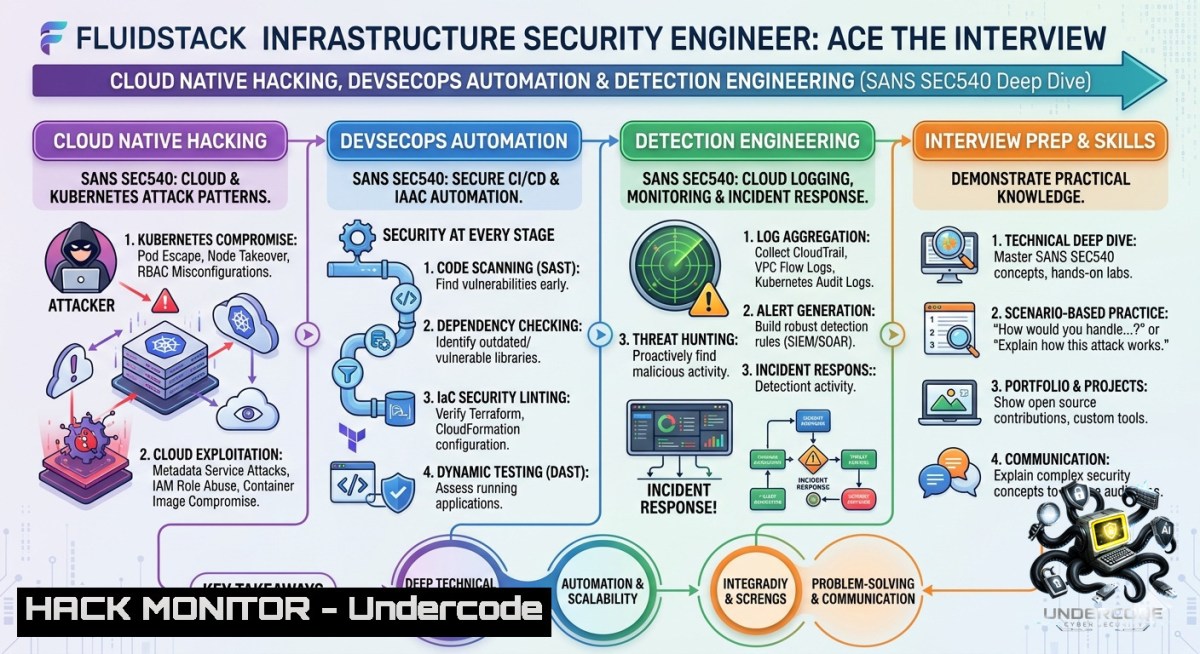
Introduction:
Modern cloud-1ative security demands more than just theoretical knowledge—it requires hands-on builders who can solve end-to-end problems across infrastructure, applications, and detection pipelines. Fluidstack, a rapidly growing cloud and AI infrastructure company, is actively hiring for an Infrastructure Security Engineer and multiple Detection & Response roles, emphasizing practical, deep-dive technical skills over mere compliance checklists. This article distills the core competencies from the job post, including insights from SANS SEC540 (Cloud Native Security and DevSecOps), and provides actionable step-by-step guides, commands, and hardening techniques to help you prepare for these demanding roles.
Learning Objectives:
– Implement cloud infrastructure hardening using AWS native controls and open-source tooling.
– Build automated detection rules for containerized workloads and serverless environments.
– Exploit and mitigate common misconfigurations in Kubernetes, CI/CD pipelines, and API gateways.
You Should Know:
1. Infrastructure as Code (IaC) Security Scanning & Hardening
Step‑by‑step guide explaining what this does and how to use it:
Infrastructure Security Engineers must validate Terraform or CloudFormation templates before deployment. The following process uses `checkov` and `tfsec` to identify misconfigurations (e.g., open S3 buckets, overprivileged IAM roles) and then applies remediation.
Linux/macOS commands:
 Install checkov and tfsec
pip install checkov
brew install tfsec  or download from GitHub releases

 Scan a Terraform directory
checkov -d /path/to/terraform/ --quiet
tfsec /path/to/terraform/

 Generate a remediation report
checkov -d /path/to/terraform/ --output cli --soft-fail
Windows (PowerShell):
 Using Chocolatey
choco install checkov tfsec

 Scan
checkov -d C:\infra\terraform\
tfsec C:\infra\terraform\
Remediation example: If `checkov` flags an S3 bucket with public read ACL, modify your Terraform:
resource "aws_s3_bucket_acl" "example" {
bucket = aws_s3_bucket.example.id
acl = "private"  instead of "public-read"
}
Integrate these scans into a CI pipeline (GitHub Actions, GitLab CI) to block insecure deployments. For AWS, combine with `aws-1uke` for cleanup of non-compliant resources.
2. Kubernetes Security Hardening & Runtime Threat Detection
Step‑by‑step guide explaining what this does and how to use it:
Fluidstack’s stack likely includes Kubernetes. Hardening involves RBAC, Pod Security Standards (PSS), and admission controllers. Use `kube-bench` to CIS-benchmark your cluster, `kube-hunter` for penetration testing, and Falco for runtime detection.
Linux commands:
 Run kube-bench against a control plane node (SSH into master)
kube-bench run --targets master

 Run kube-hunter remotely
kube-hunter --remote kube-api-server.example.com

 Install Falco with Helm
helm repo add falcosecurity https://falcosecurity.github.io/charts
helm install falco falcosecurity/falco --set falco.jsonOutput=true
Detection rule example (Falco) for container escape:
- rule: Container Escape via Mounted Docker Socket
desc: Detect mount of Docker socket inside container
condition: >
open_write and fd.directory in (/var/run/docker.sock)
output: "Docker socket mounted and accessed (user=%user.name container=%container.id)"
priority: CRITICAL
Mitigation: Enforce Pod Security `restricted` level, use OPA/Gatekeeper to block privileged containers, and run `kube-scanner` for vulnerability images:
kube-scanner --image nginx:latest --severity CRITICAL
3. Cloud Detection & Response: Building Custom Sigma Rules
Step‑by‑step guide explaining what this does and how to use it:
Detection engineers need to write rules for cloud logs (AWS CloudTrail, Azure Activity Logs). Convert Sigma rules to SIEM queries (e.g., Splunk, Sentinel). The job post mentions Arpan Abani Sarkar hiring for Detection & Response – focus on anomalous IAM behavior.
Sigma rule example (YAML) for detecting Console login without MFA:
title: AWS Console Login Without MFA
status: experimental
logsource:
product: aws
service: cloudtrail
detection:
selection:
eventName: "ConsoleLogin"
additionalEventData.MFAUsed: "No"
condition: selection
level: high
Convert to Splunk query:
index=aws_cloudtrail eventName=ConsoleLogin AdditionalEventData.MFAUsed=No
| stats count by userIdentity.userName, sourceIPAddress
Linux command to simulate an anomalous login (for testing detection):
aws sts assume-role --role-arn arn:aws:iam::123456789012:role/test-role --role-session-1ame test-session --1o-cli-pager
Windows (using AWS CLI PowerShell):
Get-STSRole -RoleArn "arn:aws:iam::123456789012:role/test-role" -RoleSessionName "test-session"
Mitigation: Enforce MFA with an IAM policy denying `”aws:MultiFactorAuthPresent”: “false”` for all console actions.
4. API Security & JWT Hardening for Microservices
Step‑by‑step guide explaining what this does and how to use it:
Cloud-1ative apps rely on APIs. Common vulnerabilities include JWT alg=none, excessive permissions, and lack of rate limiting. Use `jwt_tool` and `zap` to test, then harden with Kong or AWS WAF.
Linux commands:
 Install jwt_tool
git clone https://github.com/ticarpi/jwt_tool
cd jwt_tool
python3 jwt_tool.py <JWT_TOKEN>

 Test alg=none attack
python3 jwt_tool.py <JWT_TOKEN> -X a

 Rate limiting test with bombardier
bombardier -c 100 -1 10000 -d 30s https://api.fluidstack.com/v1/endpoint
Mitigation – Kong plugin configuration (YAML):
plugins:
- name: jwt
config:
secret_is_base64: false
run_on_preflight: true
- name: rate-limiting
config:
minute: 100
policy: local
AWS WAF rule for SQLi/XSS protection (JSON):
{
"Name": "SQLi-XSS-Rule",
"Priority": 1,
"Statement": {
"ByteMatchStatement": {
"SearchString": "<script",
"FieldToMatch": { "Body": {} },
"TextTransformations": [{"Priority": 0, "Type": "NONE"}]
}
},
"Action": { "Block": {} }
}
5. Continuous DevSecOps Pipeline: SAST, DAST, SCA, and Container Signing
Step‑by‑step guide explaining what this does and how to use it:
Integrate security into CI/CD – a core tenet of SANS SEC540. Use GitHub Actions with CodeQL (SAST), OWASP ZAP (DAST), Trivy (SCA), and cosign for image signing.
GitHub Actions workflow (.github/workflows/devsecops.yml) snippet:
jobs:
security:
runs-on: ubuntu-latest
steps:
- uses: actions/checkout@v3
- name: SAST - CodeQL
uses: github/codeql-action/init@v2
- name: SCA - Trivy
run: trivy fs --severity CRITICAL --exit-code 1 .
- name: Build image and sign
run: |
docker build -t fluidstack/app:latest .
cosign sign --key cosign.key fluidstack/app:latest
Linux command to verify signature:
cosign verify --key cosign.pub fluidstack/app:latest
Mitigation: Block unsigned images in Kubernetes using Kyverno policy:
apiVersion: kyverno.io/v1
kind: ClusterPolicy
metadata:
name: require-cosign
spec:
validationFailureAction: enforce
rules:
- name: check-signature
match:
resources:
kinds:
- Pod
verifyImages:
- image: "fluidstack/"
key: |-
--BEGIN PUBLIC KEY--
(your cosign public key)
What Undercode Say:
– Key Takeaway 1: Fluidstack’s “hands-on security builder” archetype demands proficiency in cloud-1ative exploit chaining, not just tool operation. Mastering Terraform misconfiguration detection (e.g., public RDS snapshots) combined with Falco runtime rules gives you a decisive edge.
– Key Takeaway 2: The dual hiring tracks (Infrastructure Security vs. Detection & Response) reflect the industry’s split between proactive hardening and reactive threat hunting. Successful candidates will demonstrate both via a lab – e.g., deploying a vulnerable EKS cluster, exploiting a privilege escalation, then writing a Sigma rule to detect it.
+ Analysis: The post’s casual tone (“endure my memes and jokes”) masks high expectations: you must be a builder who automates security as code. SANS SEC540’s curriculum (cloud native security, DevSecOps pipelines, and Kubernetes attack/defense) directly maps to these roles. The lack of explicit URLs in the post suggests that networking and community referrals matter more than formal applications – hence the call “reach out to me directly.” Additionally, the mention of Arpan’s team indicates a separate detection-focused track, likely requiring skills in AWS GuardDuty customization, Python automation for incident response, and maybe even machine learning for anomaly detection. For hands-on practice, set up a mini-fluidstack-like environment: AWS EKS, API Gateway, and S3, then simulate a real breach (e.g., exposed IAM keys) and trace it through CloudTrail.
Prediction:
– +1 The demand for hybrid Infrastructure Security/Detection Engineers will drive creation of integrated certifications combining SANS SEC540 with GIAC GDSA (cloud automation) within 18 months.
– -1 Fluidstack’s rapid growth may lead to security debt; the first major breach could occur from an overlooked misconfiguration in their AI data pipeline, similar to the 2023 MOVEit fallout.
– +1 Hiring “builders” over auditors will accelerate adoption of shift-left security, reducing mean time to remediation (MTTR) by 40% in cloud-1ative orgs.
– -1 Over-reliance on community referrals risks homogenous security teams missing diverse threat perspectives, potentially creating blind spots in detection logic.
▶️ Related Video (64% Match):
🎯Let’s Practice For Free:
🎓 Live Courses & Certifications:
[Join Undercode Academy for Verified Certifications](https://undercode.co.uk/certifications/)
🚀 Request a Custom Project:
Secure, high-velocity infrastructure and disruptive technological engineering. Contact our engineering team for high-tier development and proprietary systems:
[[email protected]](mailto:[email protected])
💎 Smart Architecture | 🛡️ Secure by Design | ⭐ Trusted by Thousands
IT/Security Reporter URL:
Reported By: [Dakota Riley](https://www.linkedin.com/posts/dakota-riley-b48401b7_are-you-a-hands-on-security-builder-who-enjoys-share-7467962543358066688-aTaz/) – Hackers Feeds
Extra Hub: Undercode MoN
Basic Verification: Pass ✅
🔐JOIN OUR CYBER WORLD [ CVE News • HackMonitor • UndercodeNews ]
[💬 Whatsapp](https://undercode.help/whatsapp) | [💬 Telegram](https://t.me/UndercodeCommunity)
📢 Follow UndercodeTesting & Stay Tuned:
[𝕏 formerly Twitter 🐦](https://x.com/undercodeupdate) | [@ Threads](https://www.threads.net/@undercodetesting) | [🔗 Linkedin](https://www.linkedin.com/company/undercodetesting/) | [🦋BlueSky](https://bsky.app/profile/undercode.bsky.social)


