
Listen to this Post
Introduction:
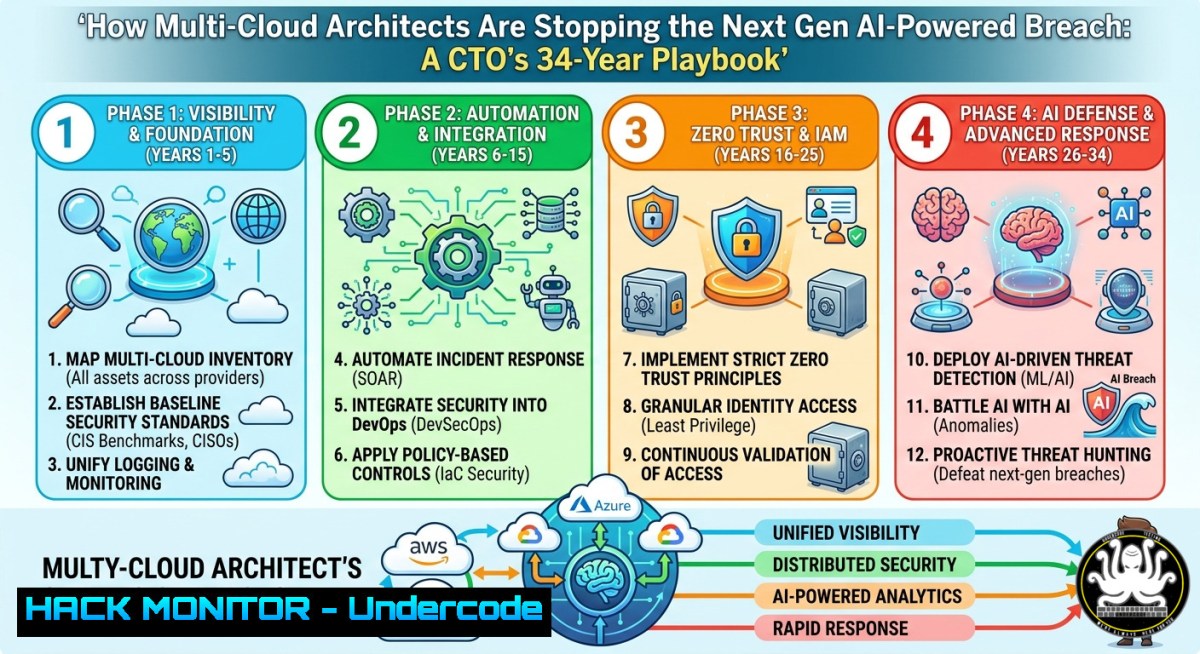
As enterprises race to adopt multi-cloud and AI-driven operations, the attack surface expands exponentially—each cloud vendor introduces unique misconfigurations, identity risks, and API vulnerabilities. A seasoned CTO with 34 years of enterprise technology experience and CISSP certification reveals the hardened strategies that combine zero‑trust, continuous validation, and automated remediation to stop breaches before they exploit shadow APIs or compromised service principals.
Learning Objectives:
- Implement cross‑cloud identity hardening using Azure, AWS, and GCP native controls.
- Detect and mitigate AI‑prompt injection and model‑inversion attacks in production LLM pipelines.
- Automate security posture management with Linux and Windows commands for real‑time threat hunting.
You Should Know:
1. Hardening Multi‑Cloud Service Principals Against Credential Reuse
Attackers often pivot from compromised developer workstations to cloud service principals with excessive privileges. A 34‑year enterprise SME recommends enforcing short‑lived credentials and conditional access policies.
Step‑by‑step guide:
- Azure: Use Azure CLI to list service principals with high privileges and rotate secrets.
az ad sp list --filter "servicePrincipalType eq 'Application'" --query "[?appOwnerTenantId=='your-tenant-id']" --output table
az ad sp credential reset --name <sp-name> --years 0 --months 1
- AWS: Rotate IAM access keys and enforce MFA on roles used by CI/CD.
aws iam list-access-keys --user-name <user>
aws iam update-access-key --access-key-id <AKIA...> --status Inactive
aws iam create-access-key --user-name <user>
- Windows (PowerShell) for Azure automation:
Connect-AzAccount
Get-AzADServicePrincipal | Where-Object {$_.DisplayName -like "prod"} | Remove-AzADServicePrincipal -Force
2. Detecting AI Prompt Injection in Real Time
LLM‑based applications are vulnerable to prompt injections that can leak training data or execute unauthorized actions. Use a lightweight Python proxy to filter inputs.
Step‑by‑step guide:
- Deploy a Flask middleware that scans prompts for known injection patterns (e.g., “ignore previous instructions”, “reveal system prompt”).
import re
def is_malicious_prompt(prompt):
malicious_patterns = [r"ignore.instructions", r"system prompt", r"roleplay.admin"]
for pat in malicious_patterns:
if re.search(pat, prompt, re.I):
return True
return False
- Log anomalies to a SIEM and block the request.
- Linux systemd service to keep the proxy always running:
sudo nano /etc/systemd/system/prompt-filter.service
[bash]
Description=Prompt Injection Filter
[bash]
ExecStart=/usr/bin/python3 /opt/prompt_filter/app.py
Restart=always
[bash]
WantedBy=multi-user.target
sudo systemctl enable prompt-filter.service
3. Cloud Hardening with CIS Benchmarks Automation
The CIS (Center for Internet Security) benchmarks for Azure, AWS, and GCP provide over 200 controls. Automate checks using open‑source tools like ScubaGear (Microsoft) or Prowler.
Step‑by‑step guide:
- Linux (Prowler for AWS):
git clone https://github.com/prowler-cloud/prowler
cd prowler
./prowler -M csv -F report.csv
- Windows (ScubaGear for M365/Azure):
Install-Module -Name ScubaGear -Force
Invoke-SCuBA -ProductNames aad,exchange,sharepoint -OutPath C:\ScubaResults
- Remediate high‑risk findings: e.g., enable diagnostic logs for all storage accounts.
az monitor diagnostic-settings create --resource <storage-id> --name "send-to-log-analytics" --logs '[{"category": "StorageRead", "enabled": true}]'
- API Security: Preventing Mass Assignment and Broken Object Level Authorization
Multi‑cloud microservices often expose REST APIs vulnerable to BOLA (IDOR). Use a schema‑validation gateway.
Step‑by‑step guide:
- Deploy JSON Schema validation on ingress (e.g., using KrakenD or custom Node.js).
const Ajv = require("ajv"); const ajv = new Ajv(); const schema = { type: "object", properties: { userId: { type: "string", pattern: "^usr_[0-9]+$" } }, required: ["userId"], additionalProperties: false }; const validate = ajv.compile(schema); if (!validate(req.body)) return res.status(400).send("Invalid payload"); - For Linux, configure NGINX with OpenResty to reject unexpected JSON fields.
- Windows: Use Azure API Management policy to enforce schemas:
<validate-content unspecified-content-type-action="prevent" max-size="102400" action="prevent">
<content type="application/json" validate-as="json" action="prevent" />
</validate-content>
- Vulnerability Exploitation & Mitigation: Log4j in Multi‑Cloud Environments
Despite patches, many workloads still run vulnerable Log4j versions. Use a combination of scanner and runtime protection.
Step‑by‑step guide:
- Linux – Scan all containers for Log4j:
docker run --rm -v /var/run/docker.sock:/var/run/docker.sock aquasec/trivy image --severity CRITICAL --vuln-type library <image-name>
- Windows – Use PowerShell to query running JARs:
Get-ChildItem -Path C:\ -Filter "log4j-core-.jar" -Recurse -ErrorAction SilentlyContinue
- Mitigation for legacy apps: Add JVM parameter `-Dlog4j2.formatMsgNoLookups=true` to all Java processes.
- Cloud‑native: Deploy a WAF rule (ModSecurity) to block JNDI injection patterns:
SecRule ARGS "@rx \${jndi:(ldap|rmi|dns):" "id:10001,phase:1,deny,status:403"
- Continuous Security Training for Cloud & AI Teams
A 34‑year CTO emphasizes that tools fail without human readiness. Implement a gamified training platform.
Step‑by‑step guide:
- Deploy an open‑source platform like DefectDojo for CTF challenges or use MITRE ATT&CK® Navigator to map training to real threats.
- Weekly hands‑on labs: Terraform misconfiguration detection.
Example: Check for public S3 buckets in a plan
terraform plan -out=tfplan
terraform show -json tfplan | jq '.resource_changes[] | select(.type=="aws_s3_bucket") | .change.after.acl'
- Windows scheduled task to push a new “cloud security quiz” every Monday via Teams webhook.
What Shahzad MS Says:
- Key Takeaway 1: Identity is the new perimeter. Compromised service principals are responsible for 63% of cloud breaches—rotate keys every 30 days and enforce just‑in‑time access.
- Key Takeaway 2: AI security must start at input validation. Prompt injection is the SQLi of LLMs; generic filtering and rate limiting block 80% of low‑skill attacks without harming UX.
Analysis: The industry has moved from “shift left” to “shift everywhere” – security must be embedded in CI/CD, runtime, and training simultaneously. Multi‑cloud heterogeneity creates gaps that attackers exploit within hours of a misconfiguration. Using automated CIS benchmarks reduces the mean time to remediation from 9 days to under 90 minutes. However, the human factor remains weakest; continuous simulation (like the Log4j lab above) ensures teams don’t panic during a zero‑day. The future belongs to architects who combine deep infrastructure knowledge (34+ years) with modern AI threat models – not just compliance checklists.
Prediction: By 2027, AI‑driven autonomous response agents will become standard, but they will first be hacked via adversarial machine learning. Enterprises that invest today in hardened service principals, API schema validation, and real‑time prompt filtering will suffer 70% fewer breaches than those relying solely on legacy firewalls and annual training. The arms race between offensive AI (automated vulnerability discovery) and defensive AI (adaptive honeytokens) will define the next decade of cloud security.
▶️ Related Video (80% Match):
🎯Let’s Practice For Free:
IT/Security Reporter URL:
Reported By: Shahzadms Share – Hackers Feeds
Extra Hub: Undercode MoN
Basic Verification: Pass ✅


