
Listen to this Post
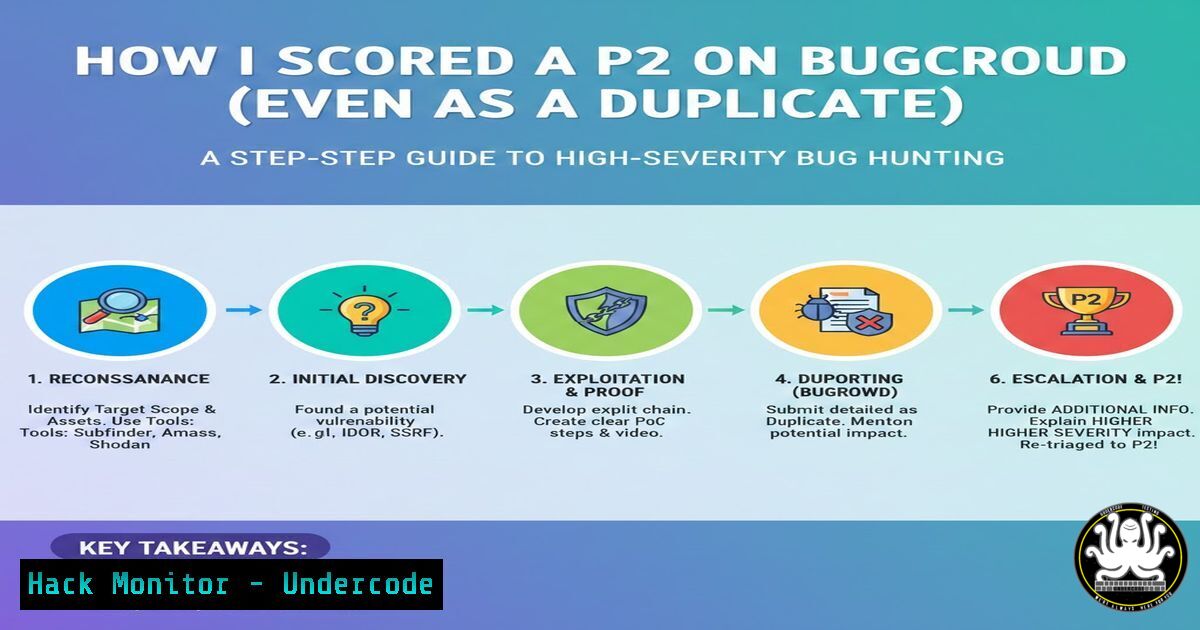
Introduction:
Bug bounty platforms like Bugcrowd connect ethical hackers with organizations seeking to secure their applications. A P2 (Priority 2) finding indicates a high‑severity vulnerability that demands immediate attention—often involving sensitive data exposure, privilege escalation, or critical misconfigurations. While duplicates can be disheartening, they validate your methodology and sharpen your skills. This article dissects the process behind discovering such flaws, from reconnaissance to reporting, and provides actionable commands and techniques used by top researchers.
Learning Objectives:
- Understand the bug bounty ecosystem and vulnerability severity ratings.
- Learn reconnaissance techniques to uncover high‑impact vulnerabilities.
- Master the art of documenting and reporting findings effectively.
You Should Know
1. Reconnaissance: The Foundation of Every P2
Before hunting, you must map the target’s digital footprint. Passive and active reconnaissance reveal subdomains, open ports, and hidden services that often host vulnerable applications.
Step‑by‑step guide:
- Subdomain enumeration – Use tools like `subfinder` and `amass` to collect subdomains.
subfinder -d example.com -o subdomains.txt
amass enum -d example.com -o amass_results.txt
- Port scanning – Identify live hosts and open ports with
nmap.nmap -sS -sV -p- -T4 -iL subdomains.txt -oN nmap_scan.txt
- Technology fingerprinting – Determine what runs on each service using `whatweb` or
wappalyzer.whatweb https://subdomain.example.com
- Gather HTTP titles and status codes – Quickly assess interesting endpoints with
httpx.httpx -l subdomains.txt -title -status-code -o httpx_results.txt
Windows equivalent: Use PowerShell with `Invoke-WebRequest` for basic checks, or run the above tools via WSL.
2. Mapping the Attack Surface: Identifying Hidden Endpoints
Once you have live hosts, brute‑force directories and parameters to uncover hidden functionality.
Step‑by‑step guide:
- Directory fuzzing – Use `ffuf` or `dirb` with common wordlists.
ffuf -u https://target.com/FUZZ -w /usr/share/wordlists/dirb/common.txt -o ffuf_results.json
- Parameter discovery – Find GET/POST parameters with
arjun.arjun -u https://target.com/endpoint.php
- Spidering with Burp Suite – Configure Burp’s spider to crawl the application and map its structure.
– Set scope to target domain.
– Run active crawl and review sitemap for interesting endpoints (e.g., /api, /admin, /debug).
4. JavaScript analysis – Extract endpoints from JS files using LinkFinder.
python3 linkfinder.py -i https://target.com/app.js -o cli
3. Finding Classic Web Vulnerabilities: IDOR, SQLi, XSS
Armed with endpoints, test for common flaws that frequently yield P2/P1 bugs.
Step‑by‑step guide:
- IDOR (Insecure Direct Object References) – Modify object identifiers in requests.
– Capture a request to `/user/profile?id=123` in Burp.
– Change `id` to another user’s ID (e.g., 124) and forward. If you see their data, you’ve found an IDOR.
– Automate with Burp Intruder using a payload list of numeric IDs.
2. SQL Injection – Test input fields and parameters.
– Manual test: append `’` or `”` to parameter values and observe error messages.
– Automated: Use `sqlmap` with a captured request.
sqlmap -r request.txt --dbs --batch
3. Cross‑Site Scripting (XSS) – Inject script payloads into input fields.
– Basic test: `` in form fields.
– For reflected XSS, use `ffuf` with XSS payload lists.
– Use browser developer tools to check if input is reflected unsanitized.
- Exploiting API Endpoints: A Goldmine for Bug Hunters
Modern applications expose REST or GraphQL APIs that often lack proper security controls.
Step‑by‑step guide:
- Discover API endpoints – Look for patterns like
/api/v1/,/graphql, or Swagger docs (/swagger,/api-docs). - Test for excessive data exposure – Use `curl` to fetch API responses and inspect for sensitive fields.
curl -X GET https://target.com/api/users/123 -H "Authorization: Bearer <token>"
- GraphQL introspection – If GraphQL is present, run an introspection query to reveal the schema.
curl -X POST https://target.com/graphql -H "Content-Type: application/json" -d '{"query":"{__schema{types{name,fields{name}}}}"}' - Check for broken object level authorization – Similar to IDOR, but on API endpoints. Change IDs in API requests and see if you can access other users’ data.
5. From Discovery to Validation: Confirming the Impact
Finding a potential bug is not enough—you must prove its business impact and reliability.
Step‑by‑step guide:
- Create a minimal PoC – For an IDOR, capture a request that leaks another user’s private data. Anonymize any real data but show the structure.
- Document the attack chain – Write down each step clearly:
– How you found the endpoint.
– The exact request/response pair.
– What data was exposed and why it matters (e.g., PII, financial info).
3. Reproduce on different accounts – If possible, create two test accounts to confirm the issue is not account‑specific.
4. Escalate impact – Show how the bug could lead to further compromise (e.g., IDOR to account takeover).
5. Screenshot and video – Record a short video demonstrating the vulnerability for the report.
6. Handling Duplicates: Why Points Still Matter
Submitting a finding only to see “Duplicate” is frustrating, but it’s a learning opportunity.
Step‑by‑step guide:
- Review the original report – Once the program resolves the duplicate, study the disclosed report (if public) to understand what the other hunter did differently.
- Analyze your methodology – Were you using the same tools? Did you miss an earlier disclosure?
- Focus on points and reputation – Even duplicates on Bugcrowd earn reputation points and sometimes a small bounty, acknowledging your effort.
- Iterate and improve – Use the duplicate as motivation to dig deeper; often duplicates mean you’re on the right track. Try variations or adjacent endpoints that might still be vulnerable.
7. Continuous Learning: Tools and Resources
Staying ahead in bug bounty requires constant skill development.
Step‑by‑step guide:
- Follow training platforms – PortSwigger Web Security Academy, PentesterLab, and HackTheBox offer hands‑on labs.
- Earn certifications – CEH v13, OSCP, or eWPTX validate your knowledge.
- Join communities – Engage in Bugcrowd’s forums, Reddit’s r/bugbounty, and Discord servers.
- Automate your workflow – Create custom scripts or use tools like `nuclei` for template‑based scanning.
nuclei -l live_hosts.txt -t cves/ -o nuclei_results.txt
What Undercode Say
- Methodology beats luck – A P2 finding, even if a duplicate, proves that your structured approach (recon → mapping → exploitation) is effective.
- Duplicates are data points – They teach you what others are finding and help refine your hunting strategy.
- Persistence pays – High‑severity bugs are rarely one‑offs; once you uncover a pattern, check every similar endpoint across the target.
- Points build momentum – On Bugcrowd, every validated report, duplicate or not, contributes to your reputation and unlocks higher‑priority targets.
- Community feedback – Engage with other hunters; they often share insights that can turn a near‑miss into a first‑of‑its‑kind discovery.
In an era where web applications grow increasingly complex, bug bounty programs are the frontline defense. The researcher who systematically maps attack surfaces and tests every parameter will inevitably find critical flaws. Duplicates are not dead ends—they are signposts pointing toward deeper, unexplored vulnerabilities. By documenting your process, sharing knowledge, and continuously learning, you turn every submission into a stepping stone toward becoming a top‑tier security researcher.
Prediction
As AI‑powered tools automate low‑hanging fruit, bug bounty hunters will shift focus to business logic flaws and chained exploits. Programs will increasingly reward methodologies that combine manual creativity with automated reconnaissance. The value of duplicate findings will rise as platforms use aggregated data to train AI models for proactive defense. Hunters who master both technical depth and clear communication will remain indispensable in the ever‑evolving cybersecurity landscape.
▶️ Related Video (70% Match):
🎯Let’s Practice For Free:
IT/Security Reporter URL:
Reported By: A R – Hackers Feeds
Extra Hub: Undercode MoN
Basic Verification: Pass ✅


