Listen to this Post
Introduction:
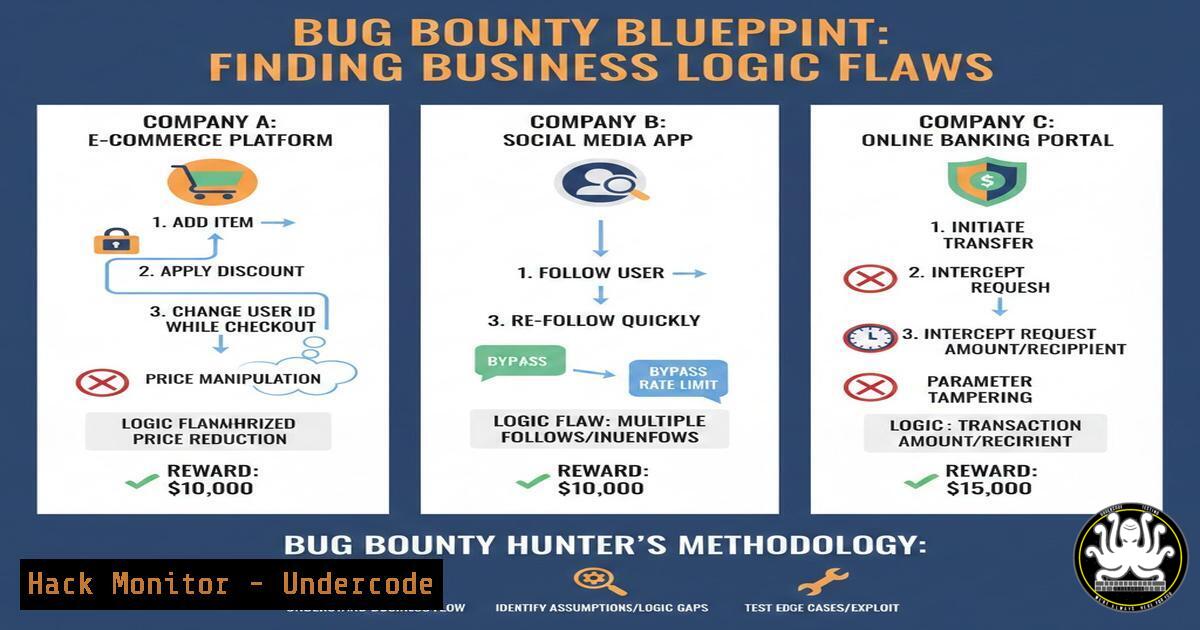
Logic bugs are subtle flaws in an application’s business logic that allow attackers to abuse legitimate functions—bypassing payments, escalating privileges, or manipulating workflows—without triggering traditional security alarms. Unlike SQL injection or XSS, these vulnerabilities stem from how the application is supposed to behave, making them harder to detect with automated scanners. In a recent bug bounty streak, a hunter uncovered three distinct logic bugs across three different companies, all affecting the same victim, demonstrating the power of creative manual testing and deep business-process understanding.
Learning Objectives:
- Objective 1: Define logic bugs and differentiate them from technical vulnerabilities.
- Objective 2: Learn systematic approaches to discover logic flaws in web applications.
- Objective 3: Master manual testing techniques and tooling to validate and exploit logic bugs.
You Should Know:
- What Are Logic Bugs and Why Do They Matter?
Logic bugs (or business logic errors) occur when an application’s intended workflow can be subverted to achieve an unintended outcome. Common examples include:
– Adding a negative quantity to a shopping cart to receive a credit.
– Changing a hidden parameter like `role=user` to role=admin.
– Completing a multi-step process out of order (e.g., skipping payment).
These bugs often lead to direct financial loss, unauthorized access, or data leaks. Because they rely on application-specific logic, automated vulnerability scanners rarely catch them. The recent findings by Zyad Abdelftah—three distinct logic bugs across three different companies—highlight how attackers can chain creative ideas to compromise multiple targets using similar flawed patterns.
2. Reconnaissance: Mapping the Application’s Business Flow
Before hunting logic bugs, you must understand the application’s intended behavior.
– Manual exploration: Use Burp Suite’s browser or a proxy to navigate every feature while recording the traffic. Pay special attention to checkout, account settings, password reset, and multi-step wizards.
– Flowchart creation: Draw the expected sequence of events for critical functions. For example, an e‑commerce purchase flow:
`Add to Cart → View Cart → Apply Coupon → Enter Shipping → Make Payment → Confirm Order`
– Identify trust boundaries: Note where the application makes decisions based on user‑supplied data (e.g., coupon codes, item quantities, user roles).
Linux command to monitor requests:
sudo tcpdump -i eth0 -A -s 0 'tcp port 80 or 443' | grep -E "POST|GET|Cookie"
Windows (PowerShell) alternative:
Get-NetTCPConnection -LocalPort 80,443 | Select-Object -ExpandProperty OwningProcess
3. Manual Testing Techniques for Logic Flaws
Once the flow is mapped, test each step for logic gaps.
- Parameter tampering: Modify hidden fields, price parameters, or role IDs in requests. Use Burp Repeater to resend altered requests.
Example: Change `{“product”:”A”,”price”:100}` to `{“product”:”A”,”price”:0}` and see if the backend accepts it. - Forced browsing: Attempt to access restricted URLs directly (e.g.,
/admin/dashboard) without proper authentication. Tools like Dirbuster or gobuster can help enumerate endpoints. - Race conditions: Send multiple simultaneous requests for a limited-time offer or one‑time coupon. Use Burp Intruder with a null payload and many threads.
- Workflow bypass: Complete a multi-step process out of order. For instance, if password reset has steps:
1. Request reset → receive token via email
2. Submit token + new password
Try skipping step 1 and directly POST to step 2 with a guessed token.
Example curl command for parameter tampering:
curl -X POST https://target.com/api/checkout -H "Content-Type: application/json" -d '{"items":[{"id":123,"quantity":-5}]}'
4. Automating Logic Bug Detection with Custom Scripts
While manual testing is essential, automation can speed up repetitive checks.
- Authorization tests: Use the Burp extension Autorize to replay authenticated requests with a lower-privilege session cookie and detect broken access controls.
- Python scripts: Write a script to simulate a multi-step workflow and fuzz inputs. Below is a skeleton for testing coupon abuse:
import requests
import threading

url = "https://target.com/apply-coupon"
cookies = {"session": "your_session"}
data = {"coupon": "SAVE20", "order_total": 100}

def apply_coupon():
r = requests.post(url, cookies=cookies, json=data)
print(r.status_code, r.text)

for i in range(10):  simulate 10 concurrent requests
threading.Thread(target=apply_coupon).start()
- Case Study: Simulating a Logic Bug in a Coupon System
Imagine an e‑commerce site that applies a 20% discount when a coupon is used. A logic bug could allow the coupon to be applied multiple times or on already discounted items.
Step‑by‑step test:
- Add an item to cart and intercept the request. Note the `cart_id` and
item_price. - Apply the coupon
SAVE20. The server responds with the new total. - Replay the coupon application request without first removing the coupon. If the server does not check whether the coupon was already used, the discount may stack.
- Repeat step 3 multiple times. If the total becomes negative, you’ve found a logic bug that could lead to free items or store credit.
Mitigation command for developers: Ensure coupon usage is tracked server‑side with a unique identifier per transaction. Use idempotency keys to prevent replay.
6. Mitigation and Hardening Against Logic Bugs
Developers can reduce logic bugs by:
- Threat modeling during design: Identify abuse cases for each feature.
- State management: Never trust client-side data for business decisions. Always validate on the server.
- Rate limiting and monotonic counters: Prevent race conditions by locking resources during critical operations.
- Comprehensive logging: Monitor for unusual sequences (e.g., coupon applied 10 times in 1 second).
Example Nginx rate‑limit configuration:
limit_req_zone $binary_remote_addr zone=checkout:10m rate=1r/s;
location /checkout {
limit_req zone=checkout burst=5;
proxy_pass http://backend;
}
7. Reporting Logic Bugs in Bug Bounty Programs
A clear, actionable report increases your chance of a bounty. Include:
– Summary: Explain the business impact (e.g., “attackers can get items for free”).
– Steps to reproduce: Provide a numbered list with exact requests/curl commands and screenshots.
– Proof of concept (PoC): Use a short video or a script demonstrating the bug.
– Suggested fix: Offer a concise remediation idea (e.g., “validate coupon usage per session”).
Platforms like Hackenproof and Zerocopter (mentioned in the original post) have templates that guide you. Remember to keep disclosures private until resolved.
What Undercode Say:
- Logic bugs are the low‑hanging fruit of business logic—they often go unnoticed by automated scans but can be extremely valuable.
- Creativity and deep application understanding are your greatest assets; the same idea can be adapted across multiple targets, as shown by the three‑company streak.
- Persistence pays off: testing every workflow edge case and chaining small flaws can lead to critical vulnerabilities.
- As applications grow more complex, logic flaws will become more common; companies must invest in manual security reviews and developer training.
- The bug bounty community thrives on shared knowledge—what worked for one hunter can inspire discoveries elsewhere.
Prediction:
With the rise of AI‑generated code and increasingly intricate business processes, logic bugs will likely become the next frontier in web security. Automated tools may soon leverage machine learning to model application flows and predict where logic breaks, but human intuition will remain essential for now. Expect bug bounty programs to place greater emphasis on business logic testing, and rewards for these flaws to climb as their impact becomes better understood.
▶️ Related Video (70% Match):
🎯Let’s Practice For Free:
IT/Security Reporter URL:
Reported By: Zyad Abdelftah – Hackers Feeds
Extra Hub: Undercode MoN
Basic Verification: Pass ✅


