
Listen to this Post
Introduction:
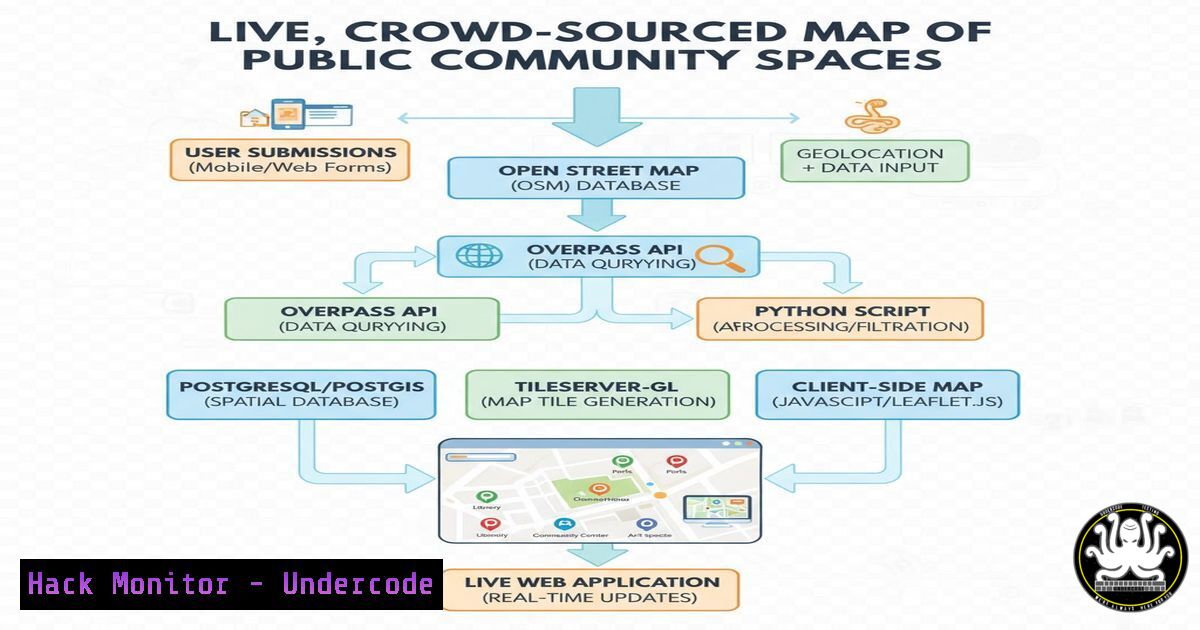
In an era where digital maps are dominated by corporate entities and often overlook hyper-local, community-driven spaces, the need for open, accessible data has never been greater. The recent launch of “Ooru.space” by Kailash Nadh, CTO of Zerodha, highlights a powerful intersection of civic tech, open data, and practical IT engineering. This project scrapes and visualizes public community spaces across India, relying on a stack of open-source tools. For cybersecurity and IT professionals, this initiative is a case study in secure API development, data scraping ethics, and cloud infrastructure hardening.
Learning Objectives:
- Understand how to ethically scrape geographic and public data while respecting `robots.txt` and rate limiting.
- Learn to configure a secure, open-source mapping stack (e.g., Leaflet, OpenStreetMap tiles).
- Implement basic cloud security measures to protect crowd-sourced directories from injection attacks and data poisoning.
You Should Know:
1. Data Scraping and Aggregation Methodology
The foundation of a project like Ooru.space is the initial data set. Nadh mentions scraping together a couple of hundred entries. This involves writing scripts to crawl existing directories, social media pages, or public PDFs for location data.
– Linux Command for Web Scraping (Ethical Check): Before scraping, always check the target’s permissions.
 Check robots.txt of a target domain (example only)
curl -I https://www.example.com/robots.txt
 Use wget to mirror a public directory responsibly (with delays)
wget --recursive --level=1 --wait=10 --random-wait https://public-resource-site.in/listings
– Python Script Logic: Most scrapers are built in Python using `BeautifulSoup` or Scrapy. A secure scraper must rotate User-Agents and IPs (via proxies) to avoid being blacklisted, which is also a common technique used in penetration testing for reconnaissance.
2. Building the Interactive Map (The Tech Stack)
Visualizing this data requires a lightweight, open-source mapping solution. Using OpenStreetMap (OSM) tiles with Leaflet.js is a standard approach.
– HTML/JavaScript Setup:
<!DOCTYPE html>
<html>
<head>
<title>Ooru: Community Spaces</title>
<link rel="stylesheet" href="https://unpkg.com/[email protected]/dist/leaflet.css" />
<script src="https://unpkg.com/[email protected]/dist/leaflet.js"></script>
<style> map { height: 600px; } </style>
</head>
<body>

<div id="map"></div>

<script>
var map = L.map('map').setView([20.5937, 78.9629], 5); // Centered on India
L.tileLayer('https://tile.openstreetmap.org/{z}/{x}/{y}.png', {
attribution: '© <a href="https://www.openstreetmap.org/copyright">OpenStreetMap</a>'
}).addTo(map);

// Load GeoJSON data securely (ensure JSON is validated)
fetch('data/communities.geojson')
.then(response => response.json())
.then(data => {
L.geoJSON(data).addTo(map);
});
</script>

</body>
</html>
3. Securing the Crowd-Sourcing Input
As the project expands via crowd-sourcing, the attack surface increases. Unvalidated user input can lead to data poisoning or Cross-Site Scripting (XSS) if the location names or descriptions are rendered unsafely.
– Backend Validation (Python/Flask Example): You must sanitize user submissions.
from flask import Flask, request, jsonify
import re

app = Flask(<strong>name</strong>)

@app.route('/submit-location', methods=['POST'])
def submit_location():
data = request.get_json()
name = data.get('name')
lat = data.get('latitude')
lon = data.get('longitude')

Validate Latitude/Longitude (Range Check)
if not (-90 <= float(lat) <= 90) or not (-180 <= float(lon) <= 180):
return jsonify({"error": "Invalid coordinates"}), 400

Sanitize Name (Prevent XSS)
clean_name = re.sub(r'[<>&;]', '', name)  Basic sanitization

TODO: Save to database after further validation (CSRF tokens)
return jsonify({"status": "success"}), 201
4. API Security and Rate Limiting
If Ooru.space exposes an API for developers to access the directory, it must be secured against abuse.
– NGINX Rate Limiting Configuration:
To prevent DDoS attacks or API scraping, configure your reverse proxy to limit requests.
 In nginx.conf or sites-available
limit_req_zone $binary_remote_addr zone=api_limit:10m rate=10r/m;

server {
location /api/ {
limit_req zone=api_limit burst=5 nodelay;
proxy_pass http://localhost:5000;
 Add API keys validation via headers
if ($http_api_key != "your_secure_key") {
return 401;
}
}
}
5. Hosting and Cloud Hardening
Hosting such a directory (even statically) requires hardening the server. Commands for a Linux (Ubuntu) server:
– Fail2Ban Installation: Protect SSH and web apps from brute force.
sudo apt update
sudo apt install fail2ban -y
sudo systemctl enable fail2ban
sudo cp /etc/fail2ban/jail.conf /etc/fail2ban/jail.local
sudo systemctl restart fail2ban
– Firewall Configuration:
sudo ufw allow 22/tcp  SSH
sudo ufw allow 80/tcp  HTTP
sudo ufw allow 443/tcp  HTTPS
sudo ufw enable
What Undercode Say:
- Open Data is a Cybersecurity Asset: Projects like Ooru.space demonstrate that public, open data repositories are not just social goods but also crucial for training AI models and security tools without relying on corporate walled gardens.
- Civic Tech Needs Hardening: The shift toward crowd-sourced public directories introduces unique risks, such as map poisoning (adding fake locations for malicious purposes) and XSS attacks. Input validation must be as rigorous as in financial applications.
- The Scraping Dilemma: From a red-team perspective, the techniques used to build this directory (data aggregation) mirror those used in OSINT (Open Source Intelligence) gathering. Understanding how to scrape ethically is the first step in learning how to defend against malicious scrapers.
Analysis:
The simplicity of Ooru.space belies the complex IT infrastructure required to keep it running. It relies on the stability of OpenStreetMap, the security of its own backend, and the integrity of its users. For a security professional, it highlights the “Security by Design” principle: security must be integrated from the moment you write the first scraper to the moment you deploy the map tiles. The use of open-source tools means the code is visible, which is a double-edged sword—it allows for community auditing but also exposes vulnerabilities if not managed properly. Ultimately, this project is a testament to how a minimal, secure, and open stack can create significant public value.
Prediction:
As projects like Ooru.space gain traction, they will become prime targets for “astroturfing” attacks, where bad actors attempt to inject fake communities to gather user data or spread misinformation. This will drive the development of lightweight, decentralized verification mechanisms (like OAuth-based community leader verification) rather than centralized moderation, pushing the boundaries of trust in open-data ecosystems.
▶️ Related Video (78% Match):
🎯Let’s Practice For Free:
IT/Security Reporter URL:
Reported By: Kailashnadh An – Hackers Feeds
Extra Hub: Undercode MoN
Basic Verification: Pass ✅


