Listen to this Post
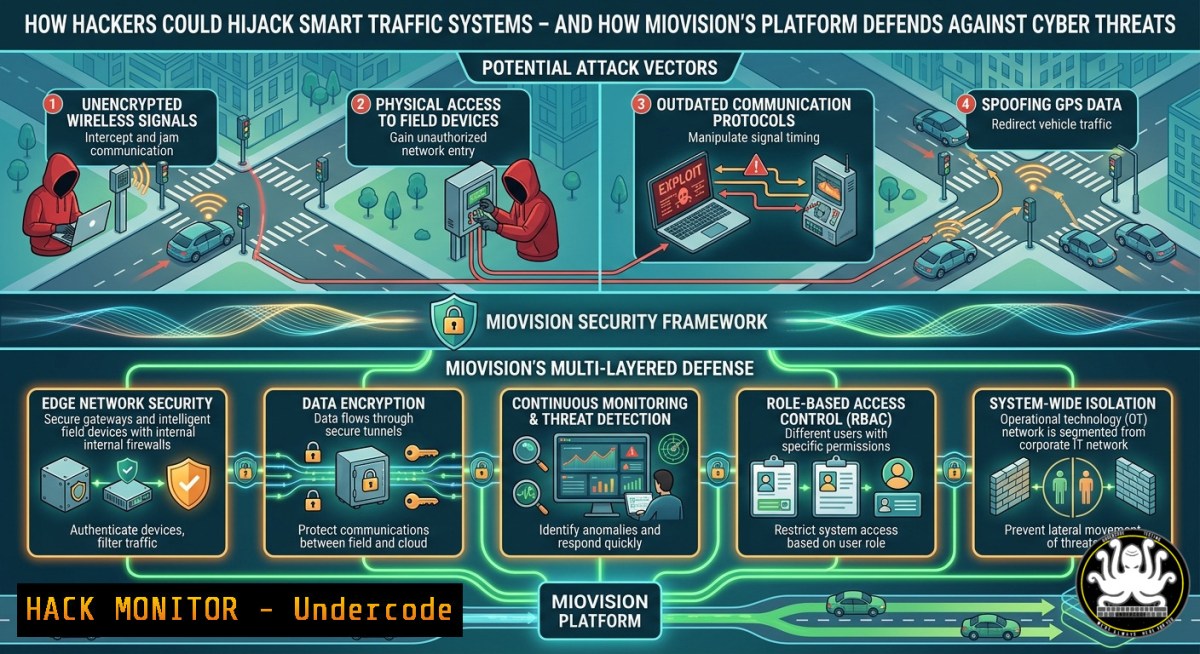
Introduction:
Modern traffic management platforms like Miovision’s Traffic Optimization Platform leverage real‑time network data, AI‑driven timing recommendations, and remote deployment to transform reactive traffic operations into proactive network optimization. However, this convergence of operational technology (OT) with cloud‑based analytics and IoT sensors introduces a critical attack surface: adversaries could manipulate traffic signals, cause gridlock, or even trigger accidents if security controls are bypassed.
Learning Objectives:
- Identify key cyber‑risks in intelligent traffic systems (ITS), including API abuse, device spoofing, and AI model poisoning.
- Apply Linux and Windows hardening commands to protect traffic controllers and management consoles.
- Implement a step‑by‑step vulnerability assessment and mitigation strategy for cloud‑connected traffic optimization platforms.
You Should Know:
- Mapping the Attack Surface of a Smart Traffic Platform
Miovision’s platform collects real‑time data from roadside sensors, cameras, and traffic controllers, then uses centralized analytics to generate timing updates that are deployed remotely. An attacker could target:
– Unencrypted communication between sensors and the cloud.
– Weak API authentication allowing unauthorized timing changes.
– Compromised edge devices (Linux‑based traffic controllers).
Step‑by‑step reconnaissance (authorized testing only):
- Use `nmap` to discover open ports on traffic controller subnets:
`nmap -sS -p 1-65535 –open 192.168.1.0/24`
- Check for default SSH or Telnet services:
`nc -zv 192.168.1.100 22` (Linux)
`Test-NetConnection -Port 23 192.168.1.100` (PowerShell)
- Enumerate API endpoints of the management dashboard:
`curl -k https://miovision-platform.example/api/v1/status`
Look for missing rate limiting or verbose error messages.
2. API Security Hardening for Remote Timing Deployment
The platform’s “remotely deploy updates” feature requires robust API security. Without proper controls, an attacker could replay captured requests or inject malicious signal timing parameters.
Step‑by‑step API security configuration (for platform administrators):
- Implement OAuth 2.0 with short‑lived JWTs. Verify token validation using:
`jwt_tool.py eyJhbGciOiJIUzI1NiIs…` (test for algorithm confusion)
- Enforce strict input validation for timing parameters (e.g., minimum/maximum green light duration). Example regex for green time:
`^[0-9]{1,3}$` (limit to 0–999 seconds)
- Use `mod_security` or AWS WAF to block SQLi/XXE on API gateways:
`SecRule ARGS “@inject sql” “id:100,deny,status:403″` (Linux)
3. Hardening Linux‑Based Traffic Controllers
Many traffic cabinets run embedded Linux (e.g., Ubuntu Core, Yocto). Default credentials or outdated kernels can lead to full device takeover.
Step‑by‑step Linux hardening commands:
- Disable unused services (e.g., telnet, FTP):
`systemctl disable –now telnet.socket`
`apt purge telnetd ftpd -y` (Debian/Ubuntu)
- Enforce SSH key‑only authentication:
`echo “PasswordAuthentication no” >> /etc/ssh/sshd_config`
`systemctl restart sshd`
- Set immutable system files to prevent rootkit modification:
`chattr +i /etc/passwd /etc/shadow`
- Monitor USB device insertion (for physical attacks):
`udevadm monitor –property` (then script alerts to SIEM)
4. Securing Windows‑Based Management Consoles
Traffic engineers often use Windows workstations with the platform’s GUI to visualize data and deploy changes. Compromised endpoints can pivot to the entire traffic network.
Step‑by‑step Windows security measures:
- Enforce AppLocker to allow only signed Miovision executables:
`New-AppLockerPolicy -RuleType Exe -User Everyone -Action Allow -Path “C:\Program Files\Miovision”` (PowerShell as Admin) - Disable LLMNR and NetBIOS to prevent responder attacks:
`Set-ItemProperty -Path “HKLM:\SYSTEM\CurrentControlSet\Services\LLMNR” -Name “Start” -Value 4`
- Use Windows Defender Firewall to block inbound traffic from untrusted subnets:
`New-NetFirewallRule -DisplayName “Block non‑ITS subnet” -Direction Inbound -RemoteAddress 192.168.2.0/24 -Action Block`
5. AI Model Poisoning Against Traffic Optimization
The platform’s “generate optimized timing recommendations in minutes” relies on machine learning models trained on historical traffic data. An adversary could inject malicious data points (e.g., fake congestion reports) to cause the AI to recommend dangerous patterns (e.g., all‑green intersections).
Step‑by‑step mitigation for AI pipelines:
- Implement data provenance using cryptographic hashes:
`sha256sum sensor_data.csv > sensor_data.sha256` (Linux)
Verify before training: `sha256sum -c sensor_data.sha256`
- Use adversarial training and outlier detection (e.g., Isolation Forest):
from sklearn.ensemble import IsolationForest
model = IsolationForest(contamination=0.05)
outliers = model.fit_predict(traffic_data)
- Enforce role‑based access control (RBAC) on the data ingestion API so only authenticated sensors can write.
6. Cloud Hardening for Real‑Time Data Workflows
Miovision’s centralized workflow processes live performance measures. Misconfigured S3 buckets or overly permissive IAM roles can expose sensitive traffic patterns.
Step‑by‑step cloud hardening (AWS example):
- Enable S3 bucket versioning and block public access:
`aws s3api put-public-access-block –bucket miovision-traffic-data –public-access-block-configuration BlockPublicAcls=true,IgnorePublicAcls=true`
- Enforce TLS 1.3 for data‑in‑transit:
`aws elbv2 set-security-policies –name prod-traffic-listener –policy-names ELBSecurityPolicy-TLS13-1-2-2021-06`
- Use AWS GuardDuty to detect anomalous API calls:
`aws guardduty create-detector –enable` then review findings via Security Hub.
7. Vulnerability Exploitation & Mitigation – Full Scenario
Scenario: An attacker discovers a vulnerable traffic controller with default credentials (admin:admin) on port 22.
Step‑by‑step exploitation (authorized red team):
- SSH into controller: `ssh [email protected]`
– Modify signal timing file (e.g.,/etc/traffic/timing.conf):
`echo “green_light_duration=300” >> timing.conf` (causes 5‑minute green)
- Reload service: `systemctl restart traffic-controller`
Mitigation commands (defender):
- Force password change and rotate SSH keys:
`passwd admin`
`rm -f /home/admin/.ssh/authorized_keys`
`ssh-keygen -t ed25519 -f /etc/ssh/ssh_host_ed25519_key`
- Deploy file integrity monitoring (AIDE):
`aide –init` then `aide –check` daily via cron.
- Network segmentation: block controller access except from dedicated jump host:
`iptables -A INPUT -s 10.10.10.0/24 -j ACCEPT`
`iptables -A INPUT -j DROP`
What Undercode Say:
- Key Takeaway 1: Smart traffic platforms like Miovision’s are not just IT systems – they are cyber‑physical systems where a compromised API or edge device can cause real‑world gridlock or accidents. Security must be built into the “proactive network optimization” workflow, not bolted on afterwards.
- Key Takeaway 2: Many traffic controllers still run outdated Linux kernels with default credentials. Hardening commands (disabling Telnet, enforcing SSH keys, enabling file immutability) are low‑hanging fruits that prevent 80% of opportunistic attacks.
Analysis (approx. 10 lines):
The convergence of AI, real‑time data, and remote deployment is revolutionary for traffic engineering, but it also creates an unprecedented attack surface. Most agencies focus on uptime and performance, neglecting security fundamentals like API rate limiting, encrypted sensor‑to‑cloud communication, and routine vulnerability scanning. Leonard Ang emphasizes that a single unpatched traffic controller can become a pivot point to manipulate timing recommendations across an entire city. The Miovision platform’s strength – centralized data‑driven workflow – also becomes its Achilles’ heel if access tokens are leaked. Proactive defense requires continuous monitoring of API calls, anomaly detection in AI training pipelines, and regular red‑team exercises against traffic cabinets. Without these measures, the same “optimized timing recommendations” that ease congestion could be weaponized to cause synchronized traffic jams or emergency vehicle delays. Agencies must adopt a zero‑trust model for every sensor and actuator.
Expected Output:
Introduction:
Smart traffic platforms transform reactive traffic management into proactive network optimization using real‑time data and AI – but without rigorous security, they become prime targets for adversaries who can remotely manipulate signal timing, cause gridlock, or even stage coordinated accidents. Miovision’s Traffic Optimization Platform exemplifies both the promise and the peril of connected ITS.
What Undercode Say:
- Attackers don’t need to hack every traffic light – compromising the centralized platform or a single edge device gives them city‑wide control.
- Defenders must treat traffic APIs like financial APIs: enforce OAuth, validate every input, and log every deployment change for audit.
Prediction:
Within the next two years, a major smart city will experience a ransomware attack that locks traffic controllers, demanding crypto payment to restore green lights. This incident will trigger federal regulations mandating OT‑specific security standards (e.g., NIST SP 800‑82 revision for traffic systems). Miovision and similar vendors will accelerate adding “security modules” – built‑in anomaly detection for timing patterns, automatic rollback of malicious updates, and hardware root‑of‑trust for each traffic cabinet. AI model hardening will become a standard feature, with continuous adversarial testing. Organizations that ignore these measures will face liability for “preventable cyber‑physical harm.”
▶️ Related Video (76% Match):
🎯Let’s Practice For Free:
IT/Security Reporter URL:
Reported By: Trafficengineering Its – Hackers Feeds
Extra Hub: Undercode MoN
Basic Verification: Pass ✅
🎓 Live Courses & Certifications:
Join Undercode Academy for Verified Certifications
🚀 Request a Custom Project:
Secure, high-velocity infrastructure and disruptive technological engineering. Contact our engineering team for high-tier development and proprietary systems:
[email protected]


