
Listen to this Post
Introduction:
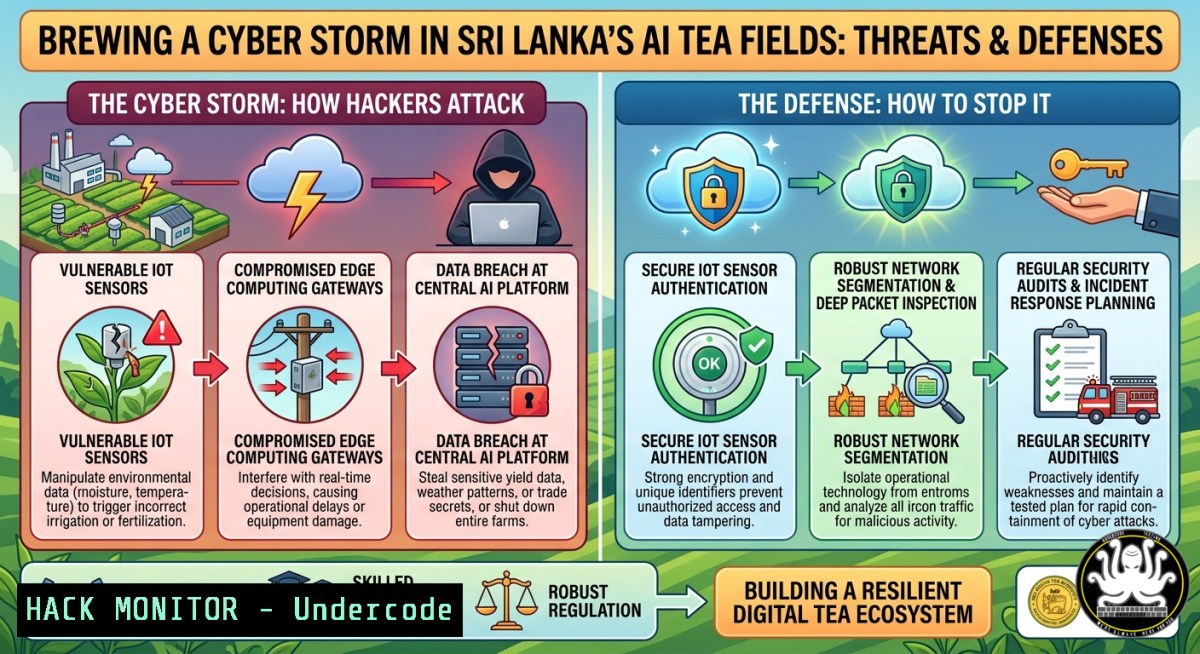
The recent launch of the Regen Tea Hub in Hanthana, Sri Lanka, marks a leap forward for AI-enabled regenerative agriculture – but smart soil probes, leaf readers, and weather stations also create a sprawling cyber-physical attack surface. Without robust security, adversaries could poison training data, intercept real-time field intelligence, or disrupt fertilizer recommendations, turning precision farming into a denial-of-harvest nightmare.
Learning Objectives:
- Identify IoT and API vulnerabilities in smart agriculture platforms like Regen Tea Hub.
- Apply Linux/Windows commands to harden edge devices and cloud backends.
- Build and test mitigation strategies for AI model poisoning and data interception.
You Should Know:
- Hardening SoilProbe Instant Soil Analyser – Locking Down IoT Field Devices
Field-deployed soil sensors often communicate via LoRaWAN, Zigbee, or cellular. Without device authentication, an attacker could inject false soil pH or moisture readings, leading to disastrous fertilizer misapplication.
Step‑by‑step guide (Linux – Raspberry Pi gateway):
- Disable unused network services: `sudo systemctl disable bluetooth hciuart`
- Set strict iptables rules to allow only the required MQTT/TCP port:
sudo iptables -A INPUT -p tcp --dport 8883 -m state --state NEW -j ACCEPT
sudo iptables -A INPUT -j DROP
sudo iptables-save > /etc/iptables/rules.v4
- Enable SPI firewall to block ARP spoofing: `sudo arptables -A INPUT –source-mac !
-j DROP`
Windows (if using an on-prem management PC):
- Block unauthorised USB‑to‑serial adapters via Group Policy:
`sc config USBSTOR start= disabled`
- Use `New-NetFirewallRule` to restrict inbound sensor data ports:
New-NetFirewallRule -DisplayName "Block Non-MQTT" -Direction Inbound -Protocol TCP -LocalPort 1883 -Action Block
2. Securing Ballotronix Tea Leaf Reader’s AI API
The leaf reader sends crop health images to a cloud AI endpoint. Without API security, attackers can scrape proprietary models, launch denial-of‑wallet attacks, or feed adversarial images.
Test API exposure with curl:
curl -X GET https://api.regen-tea.com/v1/leaf/analyze -H "Authorization: Bearer faketoken" -d '{"image":"base64..."}'
If you get a valid response without proper auth, implement:
– API keys + JWT with short expiration.
– Rate limiting using `nginx` or cloud WAF:
limit_req_zone $binary_remote_addr zone=leafapi:10m rate=5r/m;
– Input validation – reject malformed images: `file –mime-type image.jpg | grep -E ‘jpeg|png’`
Windows – monitor API abuse with PowerShell:
Get-WinEvent -LogName Microsoft-Windows-Sysmon/Operational | Where-Object {$_.Message -match "curl|wget"}
3. Cloud Hardening for AgriMet Weather Station Data
Weather stations stream temperature, humidity, and wind data to an AWS/Azure bucket. Misconfigured S3 buckets or IoT Core policies can leak sensitive crop microclimate data to competitors or ransomware gangs.
Linux (using AWS CLI):
- Enforce bucket encryption:
aws s3api put-bucket-encryption --bucket agrimet-data --server-side-encryption-configuration '{"Rules":[{"ApplyServerSideEncryptionByDefault":{"SSEAlgorithm":"AES256"}}]}' - Block public access: `aws s3api put-public-access-block –bucket agrimet-data –public-access-block-configuration BlockPublicAcls=true,IgnorePublicAcls=true`
Windows (Azure CLI – restrict IP to field gateway only):
az storage account network-rule add --account-name agrimetstorage --ip-address <gateway_public_ip>
az storage account update --name agrimetstorage --default-action Deny
- Man‑in‑the‑Middle on the Weather Station – Attack & Mitigation
An attacker on the same Wi‑Fi (e.g., at the Hanthana field office) can intercept unencrypted weather telemetry and inject false “drought” alerts.
Simulate sniffing (Linux – ethical lab only):
sudo tcpdump -i wlan0 -n 'udp port 14550' -A
Mitigation: Force TLS 1.2+ on all MQTT or CoAP traffic.
– On the station (ESP32 example): `mqtt_client->setCacert(root_ca);`
– Verify certificate pinning: `openssl s_client -connect agrimet.regen-tea.com:8883 -CAfile ca.pem`
Windows – detect unencrypted protocols:
Get-NetTCPConnection -State Established | Where-Object {$_.LocalPort -eq 1883}
Then use `New-NetFirewallRule` to block port 1883 (non‑TLS MQTT).
5. Training Course: Cybersecurity for Regenerative AgriTech
To ensure adoption velocity (as Toby J Daniel noted), behaviour change requires hands‑on training. Design a 2‑day course:
- Day 1 – IoT Hardening (Linux commands, firewall rules, secure boot).
- Day 2 – AI Model Security (adversarial patch generation, federated learning with PyTorch).
Lab setup (using Docker and Vagrant):
 On instructor’s Linux VM
docker run -d -p 8000:8000 --name agri-lab vulnerables/web-dav
Students then exploit and patch. Provide cheat sheet: curl, nmap, fail2ban.
Windows evaluation – simulate phishing with open‑source tools:
Install-Module -Name PhishingKit
Send-PhishingEmail -To [email protected] -Template weather_alert
Track click rates via Get-ADUser -Filter -Properties LastLogon.
6. Anomaly Detection in Real‑Time Field Data
Use `journalctl` (Linux) to monitor SoilProbe logs for sudden spikes:
journalctl -u soilprobe-service -f | grep --line-buffered "pH outlier" | while read line; do echo "ALERT: $line" | mail -s "Anomaly" [email protected]; done
Windows Event Log monitoring:
$action = { New-EventLog -LogName Security -Source "AgriMon"; Write-EventLog -LogName Security -Source "AgriMon" -EventId 100 -Message "Unusual leaf reader activity" }
Register-WmiEvent -Query "SELECT  FROM Win32_ProcessStartTrace WHERE ProcessName='leafreader.exe'" -Action $action
What Undercode Say:
- Key Takeaway 1: AI‑enabled regenerative agriculture introduces non‑traditional attack vectors – soil data poisoning, weather station MITM, and adversarial leaf analysis. Fixing these requires equal investment in cybersecurity training for field officers.
- Key Takeaway 2: Smart hardware (SoilProbe, Ballotronix) is useless if the insights arrive compromised or too late. Real‑time TLS encryption and local anomaly detection must be part of the platform SLA, not an afterthought.
Analysis: The Regen Tea Hub is a blueprint for digital agri‑transformation, but its reliance on heterogeneous IoT and cloud APIs mirrors critical infrastructure weaknesses. Attackers could manipulate soil analytics to ruin entire harvests, not just steal data. Adoption velocity – as Toby J Daniel noted – will stall if farmers lose trust due to a single cyber incident. Therefore, Demetrix Infotech should embed purple‑team exercises and automated compliance scanning (e.g., OpenSCAP for Linux, Policy Analyzer for Windows) into their regular release cycle.
Prediction:
By 2027, agriculture‑focused ransomware will target AI farm management platforms like Regen Tea Hub, demanding crypto to unlock real‑time weather and soil recommendations. Future‑proof solutions will require zero‑trust edge computing, post‑quantum cryptography for long‑lived sensors, and mandatory cyber‑resilience training for smallholders – shifting from “smart farming” to “secure regenerative farming” as a competitive differentiator.
▶️ Related Video (70% Match):
🎯Let’s Practice For Free:
IT/Security Reporter URL:
Reported By: Demetrixinfotech Regenteahub – Hackers Feeds
Extra Hub: Undercode MoN
Basic Verification: Pass ✅


