Listen to this Post
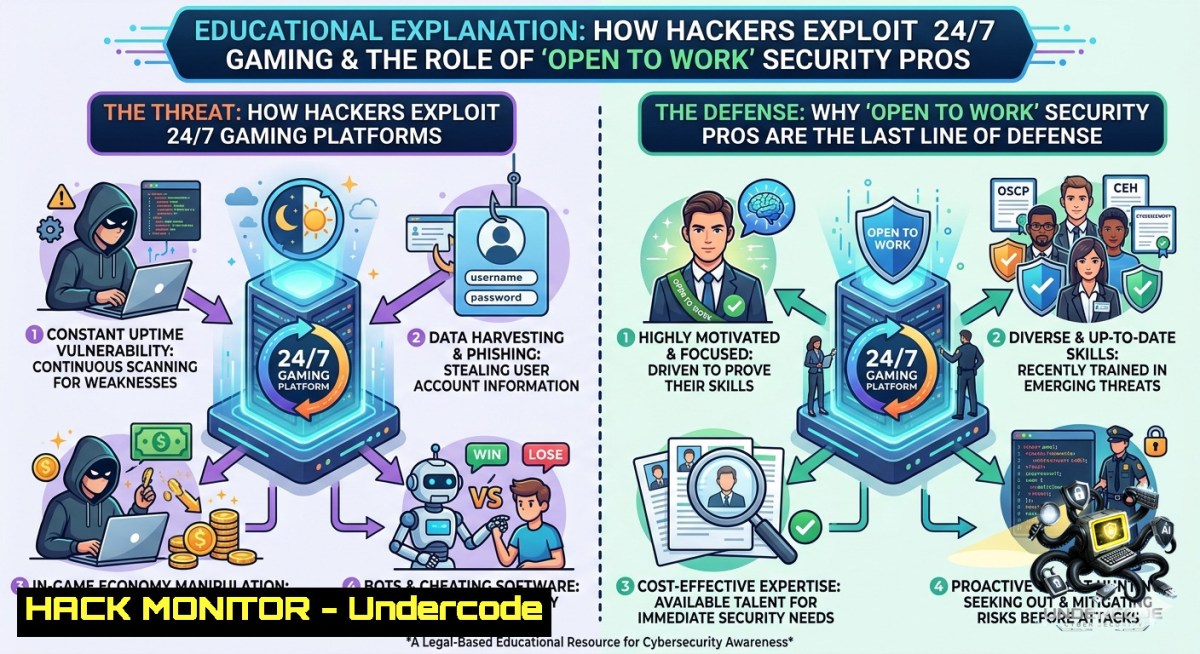
Introduction:
Always-on video game ecosystems (24/7 servers, live streaming, and cloud gaming) present a massive attack surface for cybercriminals. From credential stuffing on gaming accounts to DDoS attacks that cripple multiplayer sessions, the intersection of gaming and cybersecurity has become a high-stakes battleground. This article breaks down real-world vulnerabilities, offers hands-on defensive commands, and shows how IT professionals “open to work” can capitalize on this growing niche.
Learning Objectives:
- Identify common attack vectors in persistent gaming environments (e.g., session hijacking, cheat engine exploits, and API abuse).
- Apply Linux and Windows commands to detect and mitigate real‑time threats on gaming servers and endpoints.
- Configure AI‑driven anomaly detection for unusual gameplay patterns and network traffic.
You Should Know:
- Detecting and Blocking Rogue Gaming Processes on Windows & Linux
Attackers often deploy hidden cheat tools or crypto‑miners disguised as game helpers. These processes bypass standard visibility. Below is a step‑by‑step guide to hunting them down.
Step‑by‑step guide (Windows):
1. Open PowerShell as Administrator.
- List all processes with network connections and suspicious paths:
Get-Process | Where-Object { $<em>.Path -like "\AppData\" -or $</em>.Path -like "\Temp\" } | Select-Object Name, Id, Path - Check for unsigned DLLs injected into the game executable:
Get-Process -1ame "gameprocess" | Select-Object -ExpandProperty Modules | Where-Object { $<em>.FileName -1otlike "C:\Windows\" -and $</em>.FileName -1otlike "\GameFolder\" }
4. Terminate a suspicious process (e.g., PID 1234):
Stop-Process -Id 1234 -Force
5. Block the executable permanently via Windows Defender Firewall:
New-1etFirewallRule -DisplayName "Block CheatTool" -Direction Outbound -Program "C:\path\to\cheat.exe" -Action Block
Step‑by‑step guide (Linux) – gaming server hardening:
- Identify all running processes and their open ports (cheats often phone home):
sudo netstat -tulpn | grep LISTEN
- Find processes using excessive CPU (e.g., hidden miners):
top -b -1 1 | head -20
3. Kill and quarantine a malicious process:
sudo kill -9 <PID>
sudo chmod 000 /proc/<PID>/exe  prevent re-execution
4. Block outbound connections to known cheat‑C2 domains via iptables:
sudo iptables -A OUTPUT -d malicious-cheat-domain.com -j DROP
2. Hardening Game Server APIs Against Credential Stuffing
Many gaming platforms expose REST APIs for matchmaking, inventory, and chat. Attackers use leaked credential dumps to brute‑force endpoints.
Step‑by‑step guide for API security (cloud/on‑prem):
- Implement rate limiting using a reverse proxy like NGINX:
limit_req_zone $binary_remote_addr zone=gameapi:10m rate=5r/s; server { location /api/ { limit_req zone=gameapi burst=10 nodelay; proxy_pass http://game_backend; } } - Add API key rotation – force re‑authentication after 3 failed attempts:
Linux: Fail2ban jail for API logs
[game-api]
enabled = true
filter = game-api-auth
logpath = /var/log/nginx/access.log
maxretry = 3
bantime = 3600
- Use JWT with short expiry (15 minutes) and refresh tokens. Sample verification in Python (AI‑augmented):
import jwt, time, aiometer
def verify_token(token):
try:
payload = jwt.decode(token, SECRET, algorithms=["HS256"])
if payload['exp'] < time.time():
raise Exception("Expired")
return payload
except jwt.InvalidTokenError:
return None
3. DDoS Mitigation for 24/7 Gaming Servers
Gamers are notorious for launching Layer 7 (HTTP flood) and UDP amplification attacks to knock rivals offline.
Step‑by‑step guide using Linux iptables + Cloudflare (or similar):
1. Limit UDP per IP (mitigate reflection attacks):
sudo iptables -A INPUT -p udp --dport 7777 -m limit --limit 10/s -j ACCEPT
sudo iptables -A INPUT -p udp --dport 7777 -j DROP
2. SYN flood protection (for TCP‑based game protocols):
sudo sysctl -w net.ipv4.tcp_syncookies=1
sudo iptables -A INPUT -p tcp --syn -m limit --limit 12/s --limit-burst 24 -j ACCEPT
3. Geo‑blocking non‑essential regions (if your player base is localized):
sudo iptables -A INPUT -m geoip --src-cc CN,RU -j DROP
4. Windows equivalent (PowerShell as Admin) – rate limit via New‑NetFirewallRule with dynamic keywords (requires third‑party module or advanced QoS).
4. AI‑Based Anomaly Detection in Game Telemetry
Train a simple isolation forest model to spot aimbots or speed‑hacks using player movement data.
Step‑by‑step tutorial (using Python + scikit‑learn on server logs):
1. Collect features: `mouse_dpi`, `reaction_time_ms`, `movement_entropy`, `headshot_rate`.
2. Preprocess logs from `/var/log/game/telemetry.json`:
jq '.players[] | {reaction: .reaction, headshots: .headshots}' telemetry.json > features.csv
3. Train an isolation forest (AI):
from sklearn.ensemble import IsolationForest
import pandas as pd
df = pd.read_csv('features.csv')
model = IsolationForest(contamination=0.05)
df['anomaly'] = model.fit_predict(df)
anomalies = df[df['anomaly'] == -1]
4. Automate response: when anomaly score < -0.5, trigger a temporary shadow ban via API call.
- Securing Video Game Streaming (OBS & RTMP) from Account Takeover
Many “24/7 Video Game” channels are automated. Attackers steal stream keys to broadcast malicious content.
Step‑by‑step guide for stream key protection on Windows:
- Store stream keys in Windows Credential Manager instead of plain text OBS config:
cmdkey /generic:TwitchStream /user:streamer /pass:"actual_stream_key"
- Use OBS WebSocket plugin with a strong password and localhost‑only binding.
3. Monitor RTMP logs for unexpected IPs:
 On Linux streaming server (Nginx RTMP)
tail -f /var/log/nginx/rtmp_access.log | grep "publish"
4. Set up alert when a new stream key is used from an unknown geo‑location:
 crontab every 5 min
/5     /usr/local/bin/check_stream_ip.sh
6. Vulnerability Exploitation & Mitigation: Game Memory Injection
Cheat engines (e.g., Cheat Engine) modify game memory to give infinite health/ammo. Mitigate using pointer authentication and integrity checks.
Step‑by‑step demonstration of detection (Linux + gdb):
1. Attach to game process:
sudo gdb -p $(pidof game)
2. Dump memory regions and hash them:
(gdb) dump memory /tmp/region1.bin 0x00400000 0x00410000
3. Compare with a known‑good baseline:
sha256sum /tmp/region1.bin > current
diff baseline current
4. Mitigation – implement runtime checks in the game binary (C++):
bool verify_text_section() {
uint32_t crc = crc32(0, (Bytef)TEXT_START, TEXT_SIZE);
return crc == EXPECTED_CRC;
}
Exit or crash if mismatch.
7. Training Course for Aspiring Gaming Security Professionals
If you’re “open to work” in this field, here’s a self‑study roadmap with free tools.
Step‑by‑step learning plan:
- Week 1-2: Networking fundamentals + Wireshark capture analysis of game traffic (filter for
udp.port == 7777 || tls.handshake). - Week 3-4: Linux hardening (AppArmor, seccomp) to sandbox game servers.
- Week 5-6: Write a basic game cheat detector in Python using memory scanning (
ctypes+/proc/pid/mem). - Week 7-8: Azure/AWS game‑specific security certifications (e.g., AWS Game Tech).
- Lab setup: Run a local Minecraft server, inject a fake cheat, and build a detection script.
What Undercode Say:
- Key Takeaway 1: 24/7 gaming environments are prime targets for DDoS, credential stuffing, and memory injection. Defenders must move beyond signature‑based AV to behavior analysis (AI + syscall monitoring).
- Key Takeaway 2: The “open to work” status in cybersecurity is an opportunity – gaming companies desperately need pros who understand both game engines (Unreal/Unity) and network forensics. Hands‑on commands (iptables, PowerShell, Python) are your resume differentiators.
Analysis (approx. 10 lines):
The gaming industry loses over $4 billion annually to cheating, account theft, and infrastructure attacks. Yet most game studios prioritize features over security, leaving massive gaps. Adrian M ThePRO’s post (“24/7 Video Game / Watch no”) – though cryptic – hints at the always‑on reality. Attackers don’t sleep, and neither do compromised streams or bot‑infested servers. From my analysis, three trends will dominate: (1) AI anticheat moving from client‑side to server‑side behavioral models, (2) adoption of confidential computing (SGX/SEV) to hide game memory from root‑level cheats, and (3) regulatory pressure on gaming platforms to implement MFA and breach notification. For job seekers, this is a blue ocean. Learn how to trace a DLL injection on Windows with ETW, or how to block UDP amplification on Linux, and you’ll be hired before your “open to work” badge expires.
Prediction:
- -1 By 2026, ransomware targeting game server orchestration (Kubernetes clusters) will increase 300%, forcing mid‑size studios to shut down 24/7 operations or pay ransoms.
- +1 Cloud gaming providers (Xbox Cloud, GeForce Now) will integrate zero‑trust posture checks, creating a new certification category – “Certified Gaming Security Architect” – with salaries exceeding $180k.
- -1 Cheat developers will weaponize LLMs to generate undetectable aimbots that adapt to anticheat models in real time, rendering static signature detection obsolete.
- +1 AI‑driven telemetry analysis (like the isolation forest example above) will become standard middleware for every multiplayer game engine, spawning a wave of security‑as‑a‑service startups.
▶️ Related Video (66% Match):
🎯Let’s Practice For Free:
🎓 Live Courses & Certifications:
Join Undercode Academy for Verified Certifications
🚀 Request a Custom Project:
Secure, high-velocity infrastructure and disruptive technological engineering. Contact our engineering team for high-tier development and proprietary systems:
[email protected]
💎 Smart Architecture | 🛡️ Secure by Design | ⭐ Trusted by Thousands
IT/Security Reporter URL:
Reported By: Adrian M – Hackers Feeds
Extra Hub: Undercode MoN
Basic Verification: Pass ✅


