
Listen to this Post
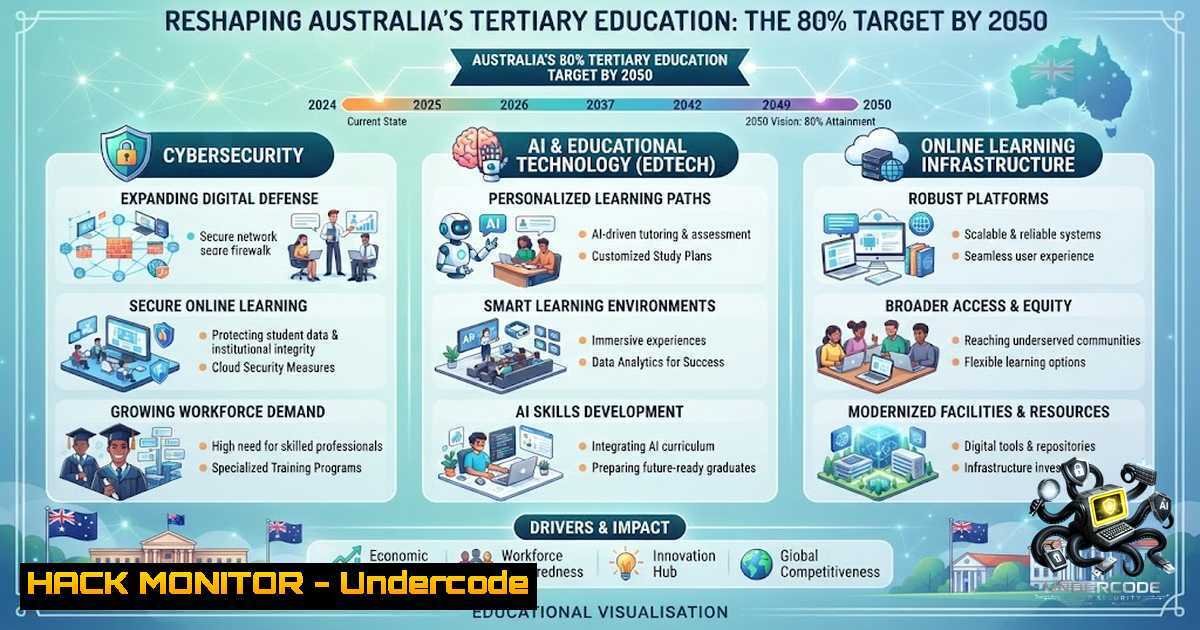
Introduction:
Australia has set an ambitious national target: 80% tertiary attainment by 2050. This goal, championed by the 2050 Alliance’s paper Growth through Equity: From the Universities Accord to Implementation, is driving a massive digital transformation across the higher education sector. Online Education Services (OES), a leading enabler of online education, has endorsed this vision, recognising that expanding access requires not just more places, but secure, scalable, and intelligent learning experiences. However, as digital learning ecosystems expand to accommodate millions of new students, they become prime targets for cyber threats. Recent data shows the education sector is the most exposed to cyber risk across all industries, with vulnerability rates of 31% for cloud assets and 38% for APIs. This article explores the intersection of Australia’s higher education equity agenda with the cybersecurity, AI, and IT infrastructure challenges that must be addressed to make the 2050 target a secure reality.
Learning Objectives:
- Understand the cybersecurity risks associated with scaling online learning platforms in Australian higher education
- Learn how AI is being deployed to enhance both educational delivery and threat detection in university environments
- Acquire practical Linux and Windows commands for hardening learning management systems and cloud infrastructure
- Explore configuration techniques for securing APIs, student data, and identity management systems
- Develop an awareness of ransomware mitigation strategies specific to the education sector
1. The Cybersecurity Landscape of Australian Higher Education
The expansion of online education in Australia has coincided with a dramatic rise in cyber threats targeting universities. In 2025, Australian higher education institutions experienced multiple serious data breaches, reflecting a global trend of educational institutions as high-value targets. The Australian Information Commissioner reported that information and cyber security controls accounted for 82% of all weaknesses identified in university audits.
One of the most significant incidents involved Western Sydney University, which suffered at least five major cybersecurity incidents since 2023, including breaches of its student management system, Microsoft Office 365 environment, and third-party storage platforms. Hackers gained access to sensitive information including Australian passport and visa numbers, bank account details, and driver’s licence numbers. The University of Sydney also experienced a breach where attackers accessed an online coding repository and stole personal information of staff and students.
Perhaps most concerning for the online learning ecosystem was the global hack of the Canvas learning management system in May 2026, which impacted Australian universities and schools. This cloud-based platform, developed by Instructure, experienced a security breach that forced institutions to reset all user credentials before regaining access.
Step‑by‑step guide: Hardening Linux-based Learning Management Systems
For universities running Linux-based LMS platforms (such as Moodle or custom solutions), implement these security measures:
1. Harden SSH access:
sudo nano /etc/ssh/sshd_config
 Set: PermitRootLogin no
 Set: PasswordAuthentication no
 Set: AllowUsers [bash]
sudo systemctl restart sshd
2. Implement fail2ban to prevent brute-force attacks:
sudo apt-get install fail2ban
sudo cp /etc/fail2ban/jail.conf /etc/fail2ban/jail.local
sudo nano /etc/fail2ban/jail.local
 Enable [bash] and [bash] or [bash] jails
sudo systemctl enable fail2ban && sudo systemctl start fail2ban
3. Configure automatic security updates:
sudo apt-get install unattended-upgrades
sudo dpkg-reconfigure --priority=low unattended-upgrades
 Select "Yes" to automatically download and install stable updates
4. Set up file integrity monitoring with AIDE:
sudo apt-get install aide
sudo aideinit
sudo mv /var/lib/aide/aide.db.new /var/lib/aide/aide.db
 Run daily: sudo aide --check
- API Security: The Weak Link in Educational Technology
CyCognito research has identified that 38% of APIs in the education sector contain vulnerabilities, making them a primary attack vector. As universities increasingly rely on API-driven integrations between learning management systems, student information systems, authentication services, and third-party tools, securing these interfaces becomes critical.
The 2050 Alliance’s emphasis on “availability of places” and “affordability” implies a proliferation of digital access points—each representing a potential entry for threat actors. Illegal academic cheating services have been identified as a continuing concern, with TEQSA warning that these services target students to share personal login details, using these credentials to access sensitive institutional information.
Step‑by‑step guide: Securing Educational APIs
1. Implement API gateway authentication (Kong or NGINX):
 NGINX configuration for API key validation
location /api/ {
if ($http_apikey !~ "^(valid_key_1|valid_key_2)$") {
return 403;
}
proxy_pass http://backend_api;
}
2. Enforce rate limiting to prevent abuse:
 In NGINX
limit_req_zone $binary_remote_addr zone=api_limit:10m rate=10r/s;
location /api/ {
limit_req zone=api_limit burst=20 nodelay;
proxy_pass http://backend_api;
}
- Windows Server: Configure IIS request filtering and IP restrictions:
PowerShell: Add IP restriction to IIS Add-WebConfigurationProperty -Filter "system.webServer/security/ipSecurity" ` -1ame "." -Value @{ipAddress="192.168.1.0"; subnetMask="255.255.255.0"; allowed="true"} Enable dynamic IP restrictions Install-WindowsFeature -1ame Web-DynIP -
Validate all API inputs using JSON schema validation:
import jsonschema
schema = {
"type": "object",
"properties": {
"student_id": {"type": "string", "pattern": "^[0-9]{8}$"},
"course_code": {"type": "string", "maxLength": 10}
},
"required": ["student_id", "course_code"]
}
jsonschema.validate(api_payload, schema)
3. AI-Powered Threats and Defences in Online Education
Generative AI has transformed Australian higher education, amplifying online harms such as misinformation, fraud, and image-based abuse. The same technology that enables personalised learning at scale also empowers threat actors to conduct sophisticated phishing campaigns, create synthetic media for social engineering, and automate credential harvesting.
The 2025 Western Sydney University phishing attack exemplifies this threat: fraudulent emails claimed that students’ academic degrees had been revoked and they were permanently excluded. Such psychologically manipulative messages, potentially AI-generated, exploit students’ fears and trust in their institutions.
Conversely, AI is being deployed defensively. OES has positioned itself at the forefront of this challenge, developing a positioning paper on how assurance of learning must evolve in response to AI-enabled assessment. The organisation argues that credible assurance in an AI-enabled environment depends on connected, program-level approaches rather than detection-led and modality-based controls.
Step‑by‑step guide: Deploying AI-Powered Threat Detection
- Implement machine learning-based anomaly detection using ELK Stack:
Install Elasticsearch, Logstash, Kibana wget -qO - https://artifacts.elastic.co/GPG-KEY-elasticsearch | sudo apt-key add - sudo apt-get install elasticsearch logstash kibana Configure Logstash to parse authentication logs input { file { path => "/var/log/auth.log" } } filter { grok { match => { "message" => "%{SYSLOGTIMESTAMP:timestamp} %{WORD:host} %{WORD:process}: %{GREEDYDATA:message}" } } } output { elasticsearch { hosts => ["localhost:9200"] } } -
Set up automated phishing detection with SpamAssassin and custom rules:
sudo apt-get install spamassassin spamc
sudo nano /etc/spamassassin/local.cf
Add custom rules for education-specific phishing
header EDUC_PHISHING Subject =~ /revoked|excluded|degree/i
score EDUC_PHISHING 5.0
-
Windows: Deploy Microsoft Defender for Endpoint with AI threat analytics:
Enable cloud-delivered protection
Set-MpPreference -CloudBlockLevel High
Set-MpPreference -CloudTimeout 50
Enable real-time protection
Set-MpPreference -DisableRealtimeMonitoring $false
Configure submission of samples
Set-MpPreference -SubmitSamplesConsent 1
4. Implement AI-based user behaviour analytics (UBA):
 Simplified anomaly detection using isolation forest
from sklearn.ensemble import IsolationForest
import numpy as np

X = login_time_features, access_patterns, location_data
model = IsolationForest(contamination=0.01, random_state=42)
model.fit(X)
predictions = model.predict(X)  -1 indicates anomaly
4. Ransomware Resilience for Educational Institutions
Ransomware attacks on Australian education institutions doubled in the first half of 2025 compared to the previous year, with 57 incidents recorded. The education sector is among the most frequently targeted, alongside healthcare, financial services, and critical infrastructure. Higher education institutions achieved only a 38% block rate against ransomware encryption attempts, leaving significant exposure.
The University of Western Australia fell victim to a ransomware variant in 2025, highlighting the vulnerability of even well-resourced institutions. On average, ransomware attacks result in the permanent loss of over 40% of affected data, making robust backup strategies essential.
Step‑by‑step guide: Ransomware Prevention and Response
- Linux: Implement immutable backups using rsync with read-only permissions:
Create backup user with minimal privileges
sudo useradd -r -s /bin/bash backupuser
Schedule immutable backups
rsync -avz --delete /var/www/html/ /backup/lms_daily/
sudo chattr +i /backup/lms_daily/  Make immutable
-
Windows: Configure Volume Shadow Copy for rapid recovery:
Enable VSS for system drive
vssadmin resize shadowstorage /for=C: /on=C: /maxsize=20%
Create a manual shadow copy
vssadmin create shadow /for=C:
Schedule regular snapshots via Task Scheduler
3. Implement network segmentation to contain ransomware spread:
 Linux iptables to isolate compromised segments
sudo iptables -A FORWARD -s 10.0.0.0/24 -d 10.0.1.0/24 -j DROP
sudo iptables -A FORWARD -s 10.0.1.0/24 -d 10.0.0.0/24 -j DROP
4. Deploy EDR solutions with ransomware behavioural detection:
 Deploy Wazuh (open-source SIEM) with ransomware detection rules
curl -s https://packages.wazuh.com/key/GPG-KEY-WAZUH | apt-key add -
echo "deb https://packages.wazuh.com/4.x/apt/ stable main" | tee /etc/apt/sources.list.d/wazuh.list
apt-get update && apt-get install wazuh-agent
systemctl start wazuh-agent
5. Cloud Infrastructure Hardening for Scalable Online Learning
The 2050 target of 80% tertiary attainment demands cloud-1ative scalability. However, the education sector has the highest exposure to cyber risk in cloud infrastructure, with 31% of cloud assets containing vulnerabilities. The Canvas breach demonstrated that even major cloud-based platforms are not immune.
OES, as a leading enabler of online education, partners with universities to create engaging online learning experiences. This partnership model extends to cloud infrastructure, where secure multi-tenancy and data isolation are paramount.
Step‑by‑step guide: Cloud Security Hardening
1. AWS: Implement S3 bucket security best practices:
 Block public access
aws s3api put-public-access-block --bucket your-bucket \
--public-access-block-configuration "BlockPublicAcls=true,IgnorePublicAcls=true,BlockPublicPolicy=true,RestrictPublicBuckets=true"

Enable default encryption
aws s3api put-bucket-encryption --bucket your-bucket \
--server-side-encryption-configuration '{"Rules":[{"ApplyServerSideEncryptionByDefault":{"SSEAlgorithm":"AES256"}}]}'
- Azure: Configure Conditional Access policies for student authentication:
PowerShell: Create conditional access policy
New-AzureADMSConditionalAccessPolicy -DisplayName "Block legacy authentication" \
-Conditions @{Applications=@{IncludeApplications="All"}; Users=@{IncludeUsers="All"}} \
-GrantControls @{Operator="OR"; BuiltInControls="MFA"} \
-SessionControls @{ApplicationEnforcedRestrictions=@{IsEnabled=$true}}
3. Implement Infrastructure as Code (IaC) security scanning:
 Using checkov for Terraform security scanning
pip install checkov
checkov -d /path/to/terraform/
 Scan for misconfigurations in AWS, Azure, GCP resources
4. Configure cloud-1ative WAF for API protection:
 AWS WAF rate-based rules
aws wafv2 create-rule-group --1ame RateLimitRule --scope REGIONAL \
--capacity 100 --visibility-config '{"SampledRequestsEnabled":true,"CloudWatchMetricsEnabled":true,"MetricName":"RateLimitRule"}' \
--rules '[{"Name":"RateLimit","Priority":0,"Statement":{"RateBasedStatement":{"Limit":1000,"AggregateKeyType":"IP"}},"Action":{"Block":{}},"VisibilityConfig":{"SampledRequestsEnabled":true,"CloudWatchMetricsEnabled":true,"MetricName":"RateLimit"}}]'
- Identity and Access Management (IAM) for Student Data Protection
With student data breaches becoming increasingly common—Western Sydney University alone exposed data affecting 10,000 students—robust IAM is non-1egotiable. The 2050 Alliance’s “five A’s” framework identifies “Aspiration, Academic achievement, Availability of places, and Affordability”, but a sixth “A”—Authentication—is equally critical for success.
Step‑by‑step guide: Implementing Zero Trust IAM
1. Linux: Deploy FreeIPA for centralised authentication:
sudo dnf install freeipa-server
sudo ipa-server-install --domain=uni.edu.au --realm=UNI.EDU.AU \
--setup-dns --auto-forwarders -U
 Configure HBAC rules for student vs staff access
- Windows Server: Implement Active Directory Federation Services (ADFS) with MFA:
Install ADFS role
Install-WindowsFeature -1ame ADFS-Federation -IncludeManagementTools
Configure MFA policies
Set-AdfsGlobalAuthenticationPolicy -AdditionalAuthenticationProvider "MicrosoftAuthenticator"
3. Implement Single Sign-On (SSO) with SAML 2.0:
<!-- Sample SAML assertion for student authentication -->
<saml:Assertion>
<saml:Subject>
<saml:NameID>[email protected]</saml:NameID>
<saml:SubjectConfirmation Method="urn:oasis:names:tc:SAML:2.0:cm:bearer"/>
</saml:Subject>
<saml:AttributeStatement>
<saml:Attribute Name="role"><saml:AttributeValue>student</saml:AttributeValue></saml:Attribute>
<saml:Attribute Name="department"><saml:AttributeValue>engineering</saml:AttributeValue></saml:Attribute>
</saml:AttributeStatement>
</saml:Assertion>
4. Monitor privileged access with audit logging:
 Linux: Configure auditd for sudo access monitoring
sudo auditctl -w /etc/sudoers -p wa -k sudoers_changes
sudo auditctl -w /usr/bin/sudo -p x -k sudo_execution
 Review logs: sudo ausearch -k sudo_execution
What Undercode Say:
- Equity and security are inseparable. Australia’s ambitious 80% tertiary attainment target cannot succeed without secure digital infrastructure. Every new student represents a new digital identity that must be protected.
- The education sector is a prime target. With vulnerability rates of 31% for cloud assets and 38% for APIs, universities must prioritise cybersecurity investment alongside expansion efforts.
The intersection of Australia’s higher education equity agenda with cybersecurity presents both challenges and opportunities. OES’s recognition of the need for “connected, program-level approaches” to assurance of learning mirrors what cybersecurity experts have long advocated: security must be embedded in the fabric of educational technology, not bolted on as an afterthought. The 2050 Alliance’s paper, while focused on equity and participation, implicitly acknowledges the digital infrastructure required to achieve these goals—infrastructure that must be resilient, intelligent, and secure.
As ransomware attacks double and AI-powered threats evolve, Australian universities must adopt a proactive security posture. This means investing in AI-driven threat detection, implementing zero-trust architectures, and ensuring that every student and staff member receives cybersecurity literacy training. The proposed mandatory annual CyberAI Literacy Module for all students and staff is a step in the right direction.
The lessons from 2025’s breaches—Western Sydney University’s repeated incidents, the University of Sydney’s repository compromise, and the global Canvas hack—demonstrate that no institution is immune. However, they also provide a roadmap for improvement: better API security, stronger identity management, immutable backups, and AI-powered anomaly detection.
Prediction:
- +1 Australia’s 2050 tertiary attainment target will accelerate the adoption of AI-driven cybersecurity solutions, creating a $2 billion+ edtech security market by 2030.
- -1 Without significant investment in cybersecurity workforce development, Australian universities will face increasingly sophisticated attacks, potentially undermining public trust in online education.
- +1 The integration of cybersecurity literacy into all tertiary curricula will produce a generation of graduates better equipped to navigate digital threats, strengthening Australia’s national cyber resilience.
- -1 Smaller regional institutions, which may lack the resources of major metropolitan universities, remain disproportionately vulnerable and could become the weakest link in the national education cybersecurity posture.
- +1 OES’s leadership in AI-enabled assessment and assurance of learning positions Australian online education as a global model for secure, equitable, and scalable digital learning.
▶️ Related Video (76% Match):
🎯Let’s Practice For Free:
🎓 Live Courses & Certifications:
Join Undercode Academy for Verified Certifications
🚀 Request a Custom Project:
Secure, high-velocity infrastructure and disruptive technological engineering. Contact our engineering team for high-tier development and proprietary systems:
[email protected]
💎 Smart Architecture | 🛡️ Secure by Design | ⭐ Trusted by Thousands
IT/Security Reporter URL:
Reported By: Highereducation Universitiesaccord – Hackers Feeds
Extra Hub: Undercode MoN
Basic Verification: Pass ✅


