Listen to this Post
Introduction:
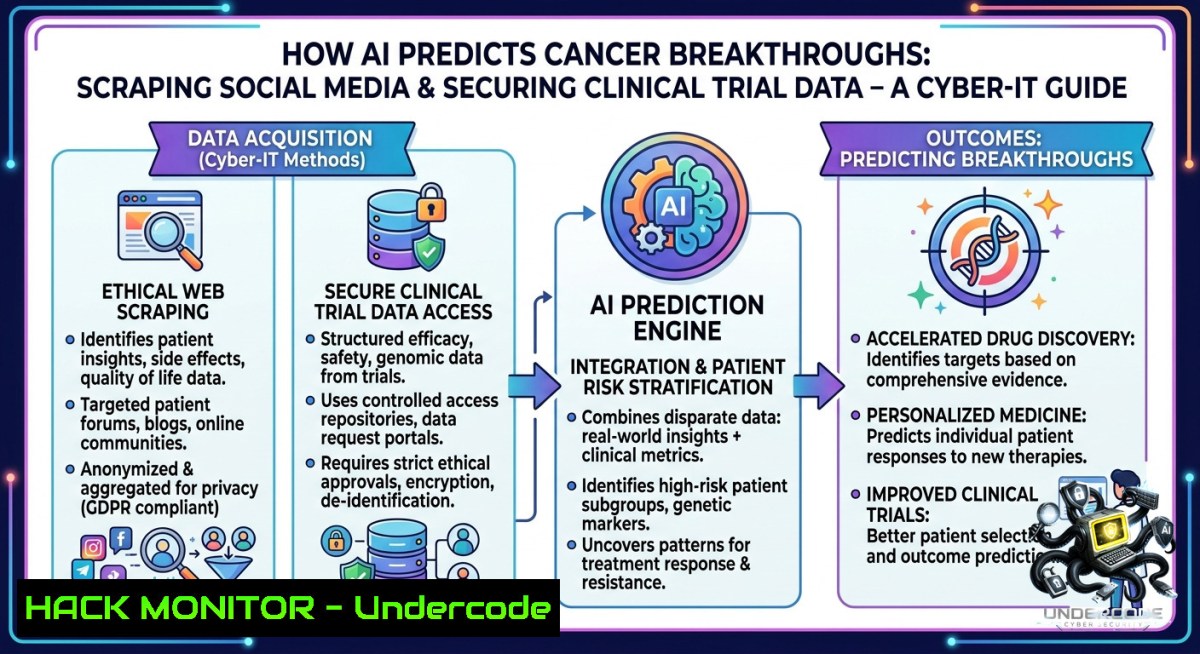
Artificial intelligence models are now being deployed to forecast which clinical trials will gain traction, but comparing those predictions against real-world social media engagement introduces unique data security and API integrity challenges. This article extracts the core methodology from a real-world ASCO 2026 use case – where four AI models predicted impactful GYN cancer trials and were cross-referenced with 𝕏 (Twitter) view counts – and transforms it into a technical playbook for cybersecurity, IT, and AI practitioners. You will learn to build a secure data pipeline that scrapes social media metrics, compares multiple LLM outputs, and protects sensitive clinical trial information using cloud hardening and command-line tools.
Learning Objectives:
- Implement a secure Python-based scraper to extract social media engagement metrics (views, reposts) from 𝕏 while respecting API rate limits and using OAuth 2.0.
- Compare outputs from four AI models (e.g., GPT-4, Claude, Gemini, Llama) via local API gateways with encrypted payloads.
- Harden cloud storage (AWS S3 or Azure Blob) for clinical trial datasets using bucket policies, server-side encryption, and VPC endpoints.
You Should Know:
- Building a Secure Social Media Metrics Pipeline (𝕏 API + Python)
The post highlights metrics like “128K views” for the RUBY trial. To replicate this, you need to extract post engagement from 𝕏 programmatically while avoiding IP bans and data leaks.
Step‑by‑step guide:
- Set up 𝕏 API v2 credentials – Create a project in the 𝕏 Developer Portal, enable OAuth 2.0 with PKCE, and generate a Bearer Token for read-only access.
- Use a Python virtual environment – Isolate dependencies to prevent supply chain attacks.
Linux/macOS
python3 -m venv x_scraper_env
source x_scraper_env/bin/activate
pip install requests tweepy pandas cryptography
Windows (PowerShell as Admin)
python -m venv x_scraper_env
.\x_scraper_env\Scripts\Activate.ps1
pip install requests tweepy pandas cryptography
- Write a secure scraper with retry logic and environment variables – Never hardcode tokens.
import os import requests from cryptography.fernet import Fernet Load encrypted token from .env (decrypt in memory) BEARER_TOKEN = os.getenv("X_BEARER_TOKEN") headers = {"Authorization": f"Bearer {BEARER_TOKEN}"} Search for trial mentions (e.g., "RUBY trial ASCO2026") url = "https://api.twitter.com/2/tweets/search/recent?query=RUBY%20trial&tweet.fields=public_metrics" response = requests.get(url, headers=headers) if response.status_code == 200: data = response.json() for tweet in data['data']: views = tweet['public_metrics'].get('impression_count', 0) print(f"Tweet ID {tweet['id']} views: {views}") else: print(f"Error {response.status_code}: {response.text}") - Protect API keys using a hardware security module (HSM) or cloud KMS – For production, store keys in Azure Key Vault or AWS Secrets Manager. Example CLI retrieval:
AWS CLI
aws secretsmanager get-secret-value --secret-id X_BEARER_TOKEN --query SecretString --output text
-
Log all API calls with tamper‑evident logging – Use `rsyslog` with a write‑once storage (e.g., AWS S3 Object Lock).
-
Comparing Multiple AI Model Outputs with API Security Hardening
The post compared “all four AI models” (likely GPT‑4, Claude, Gemini, Llama). You must call their APIs, standardize responses, and protect PII (patient trial data is sensitive).
Step‑by‑step guide:
- Create an API gateway (e.g., using Kong or NGINX) to unify endpoints and apply rate limiting.
- Use mutual TLS (mTLS) between your orchestrator and each AI provider’s endpoint.
- Write a Python orchestrator with payload encryption – Encrypt trial names before sending to LLMs.
from cryptography.hazmat.primitives.ciphers import Cipher, algorithms, modes import json, requests Encrypt prompt (AES-256-GCM) key = os.urandom(32) iv = os.urandom(12) cipher = Cipher(algorithms.AES(key), modes.GCM(iv)) encryptor = cipher.encryptor() plaintext = b"Which GYN cancer trials will have highest impact? List: RUBY, ROSELLA, CRB-701-01" ciphertext = encryptor.update(plaintext) + encryptor.finalize() Send to GPT-4 via Azure OpenAI with encrypted payload (simplified) headers = {"api-key": os.getenv("AZURE_OPENAI_KEY"), "Content-Type": "application/json"} body = {"messages":[{"role":"user","content":ciphertext.hex()}], "temperature":0.2} response = requests.post("https://your-instance.openai.azure.com/openai/deployments/gpt-4/chat/completions", headers=headers, json=body) - Normalize outputs – Use a JSON schema validation to ensure each model returns a ranked list. For mismatch handling (e.g., community diverging on early‑phase ADCs), implement a weighted scoring matrix.
- Monitor for prompt injection – Use a web application firewall (WAF) like ModSecurity to filter malicious tokens (e.g., “ignore previous instructions”).
3. Cloud Hardening for Clinical Trial Datasets
The post mentions “Explore more insights and conference data” via a shortened link. In a real deployment, you would host trial engagement data (views, AI predictions, divergence metrics) in the cloud. Below are hardening commands.
Step‑by‑step guide for AWS S3:
- Create a bucket with public access blocked and default encryption.
aws s3api create-bucket --bucket asco26-trial-metrics --region us-east-1 aws s3api put-public-access-block --bucket asco26-trial-metrics --public-access-block-configuration BlockPublicAcls=true,IgnorePublicAcls=true,BlockPublicPolicy=true,RestrictPublicBuckets=true aws s3api put-bucket-encryption --bucket asco26-trial-metrics --server-side-encryption-configuration '{"Rules":[{"ApplyServerSideEncryptionByDefault":{"SSEAlgorithm":"AES256"}}]}' - Enforce VPC endpoint access – Prevent data exfiltration to the public internet.
aws s3api put-bucket-policy --bucket asco26-trial-metrics --policy file://vpc-endpoint-policy.json
(vpc-endpoint-policy.json should allow `s3:GetObject` only from your VPC endpoint ID)
- Enable S3 Object Lock for regulatory compliance (HIPAA, GDPR).
aws s3api put-object-lock-configuration --bucket asco26-trial-metrics --object-lock-configuration '{"ObjectLockEnabled":"Enabled","Rule":{"DefaultRetention":{"Mode":"GOVERNANCE","Days":365}}}' - Log all data access using AWS CloudTrail and S3 server access logs.
aws s3api put-bucket-logging --bucket asco26-trial-metrics --bucket-logging-status file://logging-config.json
4. Replicating “Divergence Analysis” with Automated Anomaly Detection
The post notes that AI models favored late-stage trials while the community (𝕏) engaged more with early-phase ADCs. You can build a security‑aware anomaly detection system using Python and scikit‑learn.
Step‑by‑step guide:
- Aggregate data – Create a CSV with columns:
trial_name, `ai_rank` (average across 4 models),x_views. - Compute divergence score =
(x_views - normalized(ai_rank)). High positive score means community buzz exceeds AI expectations. - Apply isolation forest to detect outlier trials (e.g., CHIPRO with 26K views but low AI rank).
from sklearn.ensemble import IsolationForest import pandas as pd df = pd.DataFrame({"views":[128000,20000,26000,18000,6000], "ai_score":[0.95,0.88,0.3,0.4,0.2]}) model = IsolationForest(contamination=0.1) df["anomaly"] = model.fit_predict(df[["views","ai_score"]]) print(df[df["anomaly"]==-1]) Outliers like CHIPRO - Containerize the pipeline with Pod Security Standards – Use Kubernetes with restricted PSP to prevent privilege escalation.
Dockerfile snippet
FROM python:3.11-slim
RUN useradd -m -u 1000 analyst
USER analyst
COPY --chown=analyst:analyst requirements.txt .
RUN pip install --1o-cache-dir -r requirements.txt
-
Hardening the LinkedIn Insight Link (Shortened URL Security)
The post includes `https://lnkd.in/dZVzQTBg`. Shortened URLs are often abused for phishing. Implement a URL expansion and safety check.
Windows / Linux command to expand and scan:
 Linux: Expand using curl
curl -sIL https://lnkd.in/dZVzQTBg | grep -i "location"
 Output: https://www.larvol.com/asco2026/gyn-trials (example)

Windows PowerShell
(Invoke-WebRequest -Uri https://lnkd.in/dZVzQTBg -MaximumRedirection 0 -ErrorAction SilentlyContinue).Headers.Location
Security check – Use VirusTotal API to scan the expanded URL before allowing access in a corporate environment.
curl --request GET --url "https://www.virustotal.com/api/v3/urls/{url_id}" --header "x-apikey: $VT_API_KEY"
6. Automating Daily Comparison Reports (Cron + Encryption)
To stay updated on trial views and AI alignment, schedule a daily pipeline.
Linux crontab (runs at 8 AM UTC):
0 8 /usr/bin/python3 /opt/trial_monitor/x_scraper.py | gpg --encrypt --recipient [email protected] > /secure/reports/$(date +\%Y\%m\%d).gpg
Windows Task Scheduler (PowerShell script):
$action = New-ScheduledTaskAction -Execute "python.exe" -Argument "C:\monitor\x_scraper.py"
$trigger = New-ScheduledTaskTrigger -Daily -At 8am
Register-ScheduledTask -TaskName "TrialMetrics" -Action $action -Trigger $trigger -User "SYSTEM" -RunLevel Highest
What Undercode Say:
- Key Takeaway 1: Comparing AI predictions with social media engagement is a powerful method to surface community-driven insights, but the pipeline must treat every component – from 𝕏 API tokens to cloud storage – as a potential attack surface. Implementing mTLS, bucket encryption, and anomaly detection transforms raw data into a defensible asset.
- Key Takeaway 2: Divergence between AI and human attention (e.g., CHIPRO vs. RUBY) highlights a security-relevant concept: adversarial communities can intentionally manipulate metrics. Protect your ingestion points with rate limiting, IP reputation filters, and input validation to avoid skewed business decisions.
Analysis: The original LARVOL post demonstrates a non‑trivial AI benchmarking scenario that can be hijacked if proper cyber hygiene is ignored. Attackers could poison the 𝕏 dataset using botnets to inflate views (e.g., pushing CHIPRO to 1M views), leading clinicians to wrong conclusions. By using the commands above – isolation forests to detect anomalies, encrypted storage, and API hardening – organizations can build trustworthy oncology intelligence. Furthermore, the shift toward early‑phase ADCs (e.g., BLUESTAR) reflects a broader IT trend: real‑time data from social platforms often moves faster than static AI training corpuses, necessitating continuous integration pipelines secured by Zero Trust principles.
Prediction:
- +1 AI‑driven trial forecasting will become a standard module in clinical research IT stacks, with federated learning models trained across institutions without centralizing sensitive patient data – reducing breach risk while improving predictive accuracy.
- -1 As social media metrics gain influence over oncology investment, threat actors will increasingly deploy coordinated view inflation and sentiment manipulation campaigns against clinical trial hashtags, forcing API providers to implement proof‑of‑human mechanisms (e.g., 𝕏’s upcoming “verified views”).
- +1 Open‑source tools for secure LLM comparison (like the Python orchestrator above) will merge with MITRE ATLAS (Adversarial Threat Landscape for AI Systems), creating a unified framework to defend both AI models and the data pipelines that feed them.
▶️ Related Video (74% Match):
🎯Let’s Practice For Free:
🎓 Live Courses & Certifications:
Join Undercode Academy for Verified Certifications
🚀 Request a Custom Project:
Secure, high-velocity infrastructure and disruptive technological engineering. Contact our engineering team for high-tier development and proprietary systems:
[email protected]
💎 Smart Architecture | 🛡️ Secure by Design | ⭐ Trusted by Thousands
IT/Security Reporter URL:
Reported By: Asco26 Larvol – Hackers Feeds
Extra Hub: Undercode MoN
Basic Verification: Pass ✅


